Last visit was: 28 Apr 2026, 08:35 It is currently 28 Apr 2026, 08:35
Close
GMAT Club Daily Prep
Thank you for using the timer - this advanced tool can estimate your performance and suggest more practice questions. We have subscribed you to Daily Prep Questions via email.

Customized
for You

we will pick new questions that match your level based on your Timer History

Track
Your Progress

every week, we’ll send you an estimated GMAT score based on your performance

Practice
Pays

we will pick new questions that match your level based on your Timer History
Not interested in getting valuable practice questions and articles delivered to your email? No problem, unsubscribe here.
Close
Request Expert Reply
Confirm Cancel
User avatar
abhimahna
User avatar
Board of Directors
Joined: 18 Jul 2015
Last visit: 06 Jul 2024
Posts: 3,481
Own Kudos:
5,779
 [4]
Given Kudos: 346
Status:Emory Goizueta Alum
Products:
Expert
Expert reply
Posts: 3,481
Kudos: 5,779
 [4]
Kudos
Add Kudos
4
Bookmarks
Bookmark this Post
User avatar
abhimahna
User avatar
Board of Directors
Joined: 18 Jul 2015
Last visit: 06 Jul 2024
Posts: 3,481
Own Kudos:
Given Kudos: 346
Status:Emory Goizueta Alum
Products:
Expert
Expert reply
Posts: 3,481
Kudos: 5,779
Kudos
Add Kudos
Bookmarks
Bookmark this Post
User avatar
1219bob1219
Joined: 08 Nov 2021
Last visit: 19 Apr 2023
Posts: 9
Own Kudos:
5
 [2]
Given Kudos: 4
Location: India
GMAT 1: 580 Q47 V22
GMAT 1: 580 Q47 V22
Posts: 9
Kudos: 5
 [2]
2
Kudos
Add Kudos
Bookmarks
Bookmark this Post
User avatar
bb
User avatar
Founder
Joined: 04 Dec 2002
Last visit: 28 Apr 2026
Posts: 43,165
Own Kudos:
83,744
 [1]
Given Kudos: 24,683
Location: United States
GMAT 1: 750 Q49 V42
GPA: 3
Products:
Expert
Expert reply
Active GMAT Club Expert! Tag them with @ followed by their username for a faster response.
GMAT 1: 750 Q49 V42
Posts: 43,165
Kudos: 83,744
 [1]
1
Kudos
Add Kudos
Bookmarks
Bookmark this Post
1219bob1219
abhimahna explanation is not clear; Why did you chose 36.7% & 86% for the calculations ?


Thank you. I have updated the explanation and fixed the chart in the topic
Hope it is clearer.
User avatar
Keshav1404
Joined: 11 Jun 2022
Last visit: 27 Apr 2026
Posts: 65
Own Kudos:
Given Kudos: 48
GMAT 1: 660 Q48 V32
GMAT 1: 660 Q48 V32
Posts: 65
Kudos: 19
Kudos
Add Kudos
Bookmarks
Bookmark this Post
 
abhimahna

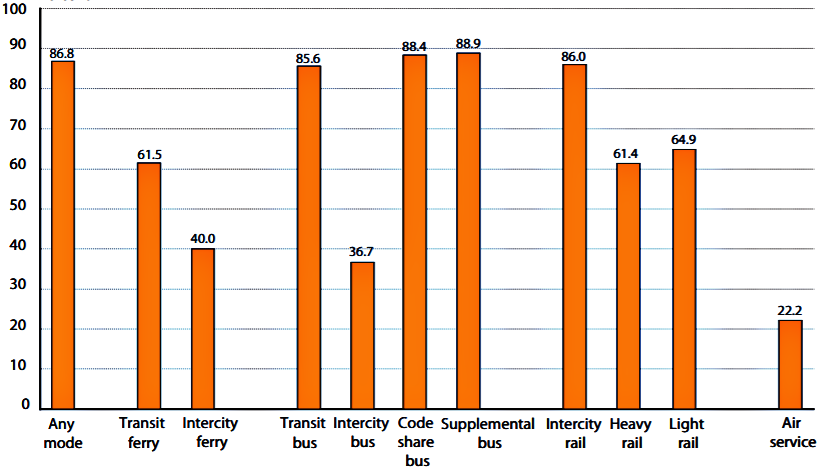
The graph shows the percentages for 9,000 commuter rail stations in Dalvarnie with connections to other modes in communities where both commuter rail and the other mode operate.


B. The maximum number of possible commuter rail stations with connections to both transit and intercity ferry service is

A. 0
B. 117
C. 130
D. 998
­I. If half of the commuter rail stations operate in areas with all four bus services and one fifth operate in areas with all three rail services, then a given commuter rail traveler is approximately________more    likely to be able to connect to travel to another city by rail than by bus.
           a. 30% Less
           b. 6% Less
           c. 12% More
           d. 142% More

II. The maximum number of possible commuter rail stations with connections to both transit and intercity ferry service is_________
            a. 0
            b. 117
            c. 130
            d. 998

Official Solution:
(I)
First, calculate the number of stations that have access to each of the other modes of transportation.
The problem states that 1/2 of the 9,000 stations operate in areas with all four bus services, or 4,500, and of these 36.7% have access to intercity bus service or approximately 1,651.5.
Then, the problem states that 1/5 of the 9,000 stations operate in areas with all three rail services, or 1,800, and of these 86% have access to intercity rail service or approximately 1,548.
Either estimate or use the calculator to determine that the percent difference will be 1,651.5 - 1,548 = 103.5 / 1,651.5 or approximately 6% less.

(II)
First, find the number of stations with access to any other mode of transit by taking 86.8% of the 9,000 stations to find that 7,812 stations have access to any other mode of transit. Then, assume that every such station with access also has access to both modes of ferry service, therefore 61.5% of the 7,812 or 4,804 (rounded) have transit ferry access and 40% of the 7,812 or 3,125 (rounded) have intercity ferry access.
Now, set up a group equation for overlapping sets to determine the maximum possible overlap as 7,812 = 4,804 + 3,125 - overlap + neither. Therefore, 7,812 = 7,929 - overlap + neither. Subtract 7,812 to find that the neither - overlap = 117, which is the maximum possible value for the overlapping set which will have both transit and intercity ferry access.

The correct answer is B


My Query:-
Firstly I was unable to understand the graph, I thought that out of 9000 the percentages of the rail station connected to several modes are given. But after evaluating the solution, I realized that thats not the case. Like in the first statement, First we find the out of 9,000 stations how many operate in areas with all four bus services, After calculating the same we then derive of these 36.7% have access to intercity bus service or approximately 1,651.5.

How do we interpret the question in the future, to avoid such confusion.

GMATNinja GMATNinjaTwo , Your Insights much needed.­­
User avatar
chetan2u
User avatar
GMAT Expert
Joined: 02 Aug 2009
Last visit: 28 Apr 2026
Posts: 11,231
Own Kudos:
Given Kudos: 335
Status:Math and DI Expert
Location: India
Concentration: Human Resources, General Management
GMAT Focus 1: 735 Q90 V89 DI81
Products:
Expert
Expert reply
GMAT Focus 1: 735 Q90 V89 DI81
Posts: 11,231
Kudos: 45,037
Kudos
Add Kudos
Bookmarks
Bookmark this Post
Keshav1404

abhimahna

The graph shows the percentages for 9,000 commuter rail stations in Dalvarnie with connections to other modes in communities where both commuter rail and the other mode operate.


B. The maximum number of possible commuter rail stations with connections to both transit and intercity ferry service is

A. 0
B. 117
C. 130
D. 998
­I. If half of the commuter rail stations operate in areas with all four bus services and one fifth operate in areas with all three rail services, then a given commuter rail traveler is approximately________more    likely to be able to connect to travel to another city by rail than by bus.
           a. 30% Less
           b. 6% Less
           c. 12% More
           d. 142% More

II. The maximum number of possible commuter rail stations with connections to both transit and intercity ferry service is_________
            a. 0
            b. 117
            c. 130
            d. 998

Official Solution:
(I)
First, calculate the number of stations that have access to each of the other modes of transportation.
The problem states that 1/2 of the 9,000 stations operate in areas with all four bus services, or 4,500, and of these 36.7% have access to intercity bus service or approximately 1,651.5.
Then, the problem states that 1/5 of the 9,000 stations operate in areas with all three rail services, or 1,800, and of these 86% have access to intercity rail service or approximately 1,548.
Either estimate or use the calculator to determine that the percent difference will be 1,651.5 - 1,548 = 103.5 / 1,651.5 or approximately 6% less.

(II)
First, find the number of stations with access to any other mode of transit by taking 86.8% of the 9,000 stations to find that 7,812 stations have access to any other mode of transit. Then, assume that every such station with access also has access to both modes of ferry service, therefore 61.5% of the 7,812 or 4,804 (rounded) have transit ferry access and 40% of the 7,812 or 3,125 (rounded) have intercity ferry access.
Now, set up a group equation for overlapping sets to determine the maximum possible overlap as 7,812 = 4,804 + 3,125 - overlap + neither. Therefore, 7,812 = 7,929 - overlap + neither. Subtract 7,812 to find that the neither - overlap = 117, which is the maximum possible value for the overlapping set which will have both transit and intercity ferry access.

The correct answer is B


My Query:-
Firstly I was unable to understand the graph, I thought that out of 9000 the percentages of the rail station connected to several modes are given. But after evaluating the solution, I realized that thats not the case. Like in the first statement, First we find the out of 9,000 stations how many operate in areas with all four bus services, After calculating the same we then derive of these 36.7% have access to intercity bus service or approximately 1,651.5.

How do we interpret the question in the future, to avoid such confusion.

GMATNinja GMATNinjaTwo , Your Insights much needed.­­
Yes, the language leaves a lot to imagination. 'Any mode' should be the maximum, as per my view, but ­there are two modes, code share bus and supplemental bus, higher than 86.8%.

The question would be edited accordingly.
User avatar
pearrrrrrr
Joined: 30 May 2023
Last visit: 26 May 2025
Posts: 52
Own Kudos:
17
 [1]
Given Kudos: 306
Posts: 52
Kudos: 17
 [1]
1
Kudos
Add Kudos
Bookmarks
Bookmark this Post
chetan2u

Keshav1404

abhimahna

The graph shows the percentages for 9,000 commuter rail stations in Dalvarnie with connections to other modes in communities where both commuter rail and the other mode operate.


B. The maximum number of possible commuter rail stations with connections to both transit and intercity ferry service is

A. 0
B. 117
C. 130
D. 998
­I. If half of the commuter rail stations operate in areas with all four bus services and one fifth operate in areas with all three rail services, then a given commuter rail traveler is approximately________more    likely to be able to connect to travel to another city by rail than by bus.
           a. 30% Less
           b. 6% Less
           c. 12% More
           d. 142% More

II. The maximum number of possible commuter rail stations with connections to both transit and intercity ferry service is_________
            a. 0
            b. 117
            c. 130
            d. 998

Official Solution:
(I)
First, calculate the number of stations that have access to each of the other modes of transportation.
The problem states that 1/2 of the 9,000 stations operate in areas with all four bus services, or 4,500, and of these 36.7% have access to intercity bus service or approximately 1,651.5.
Then, the problem states that 1/5 of the 9,000 stations operate in areas with all three rail services, or 1,800, and of these 86% have access to intercity rail service or approximately 1,548.
Either estimate or use the calculator to determine that the percent difference will be 1,651.5 - 1,548 = 103.5 / 1,651.5 or approximately 6% less.

(II)
First, find the number of stations with access to any other mode of transit by taking 86.8% of the 9,000 stations to find that 7,812 stations have access to any other mode of transit. Then, assume that every such station with access also has access to both modes of ferry service, therefore 61.5% of the 7,812 or 4,804 (rounded) have transit ferry access and 40% of the 7,812 or 3,125 (rounded) have intercity ferry access.
Now, set up a group equation for overlapping sets to determine the maximum possible overlap as 7,812 = 4,804 + 3,125 - overlap + neither. Therefore, 7,812 = 7,929 - overlap + neither. Subtract 7,812 to find that the neither - overlap = 117, which is the maximum possible value for the overlapping set which will have both transit and intercity ferry access.

The correct answer is B


My Query:-
Firstly I was unable to understand the graph, I thought that out of 9000 the percentages of the rail station connected to several modes are given. But after evaluating the solution, I realized that thats not the case. Like in the first statement, First we find the out of 9,000 stations how many operate in areas with all four bus services, After calculating the same we then derive of these 36.7% have access to intercity bus service or approximately 1,651.5.

How do we interpret the question in the future, to avoid such confusion.

GMATNinja GMATNinjaTwo , Your Insights much needed.­
Yes, the language leaves a lot to imagination. 'Any mode' should be the maximum, as per my view, but ­there are two modes, code share bus and supplemental bus, higher than 86.8%.

The question would be edited accordingly.
­I don't even know how to read the graph and interpret these 2 questions......
Moderators:
Math Expert
109949 posts
Founder
43165 posts