Events & Promotions
|
|

GMAT Club Daily Prep
Thank you for using the timer - this advanced tool can estimate your performance and suggest more practice questions. We have subscribed you to Daily Prep Questions via email.
Customized
for You
Track
Your Progress
Practice
Pays
Not interested in getting valuable practice questions and articles delivered to your email? No problem, unsubscribe here.
 Sep 26
01:00 PM EDT
-04:00 PM EDT
Top scores are possible when you enroll in a powerful GMAT course, taught live online + 6 months access to TTP OnDemand video courses included. Class starts Saturdays Sept. 26, 2026 - Dec. 19, 2026, 1:00pm-4:00pm ES Sep 26
06:00 PM PDT
-07:00 PM PDT
Free- full-length test + 15 concept videos + 150+ short videos + study plan! Sep 27
01:30 AM EDT
-02:30 AM EDT
At one point, she believed GMAT wasn’t for her. After scoring 595, self-doubt crept in and she questioned her potential. But instead of quitting, she made the right strategic changes. The result? A remarkable comeback to 695. Check out how Saakshi did it. Sep 26
12:30 AM EDT
-01:30 AM EDT
Struggling to find the right strategies to score a 99 %ile on GMAT Focus? Riya (GMAT 715) boosted her score by 100-points in just 15 days! Discover how the right mentorship, tailored strategies, and an unwavering mindset can transform your GMAT prep. Sep 28
07:00 PM EDT
-10:00 PM EDT
Boost your GMAT score in less than one month in a live online class + 6 months access to TTP OnDemand video courses included! Class starts Mon, Tues, Wed, Thur, Fri Sept. 28, 2026 - Oct. 16, 2027, 7:00pm-10:00pm EST Sep 29
11:00 AM EDT
-01:00 PM EDT
" Description: Top scores are possible when you enroll in a powerful GMAT course, taught live online + 6 months access to TTP OnDemand video courses included! Class starts Tues/Thur Sept. 29, 2026 - Dec. 3, 2026, 11:00am-1:00pm EST Oct 01
07:00 AM BST
-08:00 AM GMT
Welcome to the GMAT Club's Free Interview Prep Event for Top MBA Programs! Buy tickets - Virtual series that’s all set to equip you to -excel in your MBA interviews.


 Updated on: 21 Jun 2026, 07:13
Originally posted by AnkurGMAT20 on 07 Jan 2024, 10:24.
Last edited by Bunuel on 21 Jun 2026, 07:13, edited 4 times in total.
Last edited by Bunuel on 21 Jun 2026, 07:13, edited 4 times in total.
Kudos
Bookmarks


E
Be sure to select an answer first to save it in the Error Log before revealing the correct answer (OA)!
Difficulty:
 55%
(hard)
55%
(hard)
Question Stats:
69% (01:56) correct 31%
(02:15)
wrong
based on 1850
sessions
31%
(02:15)
wrong
based on 1850
sessions
History
Date
Time
Result
Not Attempted Yet
The Euphronios krater, a sixth-century-B.C.E ceramic vase, was named for its painter, Euphronios. One side depicts the death of the mythic hero Sarpedon; the other, several anonymous Athenian youths arming themselves for battle. The youths lack Sarpedon's anatomical detail; their limited musculature is portrayed using faint, almost invisible lines and seems unfinished. Scholars have, however, dismissed the idea that Euphronios failed to complete the side depicting the Athenian youths.
Which of the following, if true, provides the strongest reason for the scholars position regarding the krater?
A. No other examples of Euphronios work have survived, though descriptions of several work do exisit.
B Other existing krater from the time period depict one scene on one side and a related scene on the other side.
C The mythic hero Sarpedon was a stock figure used by sixth-century painters to comment on the concept of heroism.
D. Euphronios's work is among the first examples of the use of a new technique for depicting the body and its musculature.
E. Euphronios's cotemporaries generally included only minimal detail when painting unheralded characters.
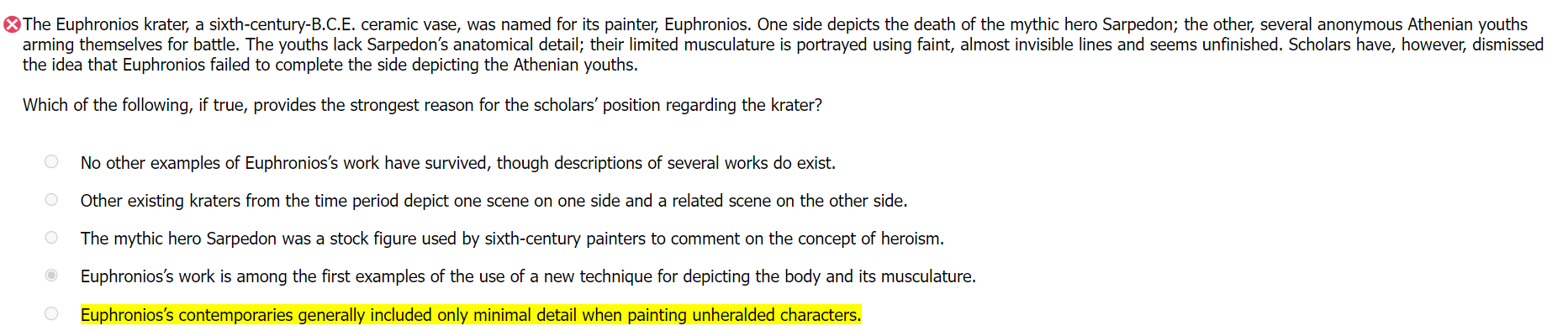

GMAT-Club-Forum-8u2yw3vp.png [ 102.65 KiB | Viewed 5228 times ]
Which of the following, if true, provides the strongest reason for the scholars position regarding the krater?
A. No other examples of Euphronios work have survived, though descriptions of several work do exisit.
B Other existing krater from the time period depict one scene on one side and a related scene on the other side.
C The mythic hero Sarpedon was a stock figure used by sixth-century painters to comment on the concept of heroism.
D. Euphronios's work is among the first examples of the use of a new technique for depicting the body and its musculature.
E. Euphronios's cotemporaries generally included only minimal detail when painting unheralded characters.
Attachment:
GMAT-Club-Forum-8u2yw3vp.png [ 102.65 KiB | Viewed 5228 times ]
Question exposed a gap?
Take sectional Adaptive Quant, Verbal, or DI tests on GMAT Club and review the detailed score report.
Get started →
 23 Jan 2024, 09:48
Kudos
Bookmarks
Explanation
The Euphronios krater, a sixth-century-B.C.E ceramic vase, was named for its painter, Euphronios. One side depicts the death of the mythic hero Sarpedon; the other, several anonymous Athenian youths arming themselves for battle. The youts lack Sarpedon's anatomical detail; their limited musculature is portrayed using faint, almost invisible lines and seems unfinished. Scholars have, however, dismissed the idea that Euphronios failed to complete the side depicting the Athenian youths.
The passage says that scholars have concluded basically the following:
It is not true that "that Euphronios failed to complete the side depicting the Athenian youths."
The passage provides no support for that conclusion. Rather, it provides a reason to believe otherwise:
The youths lack Sarpedon's anatomical detail; their limited musculature is portrayed using faint, almost invisible lines and seems unfinished.
Then, we are asked the following question:
Which of the following, if true, provides the strongest reason for the scholars position regarding the krater?
The correct answer will provide support for the scholars' conclusion.
a) No other examples of Euphronios's work have survived, though descriptions of several works do exist.
The fact that no other example of Euphronios's work have survived does not indicate anything about whether this particular work was completed.
Eliminate.
b) Other existing kraters from the time period depict one scene on one side and a related scene on the other side.
This choice's stating that other kraters depict one scene on one side and a related scene on the other side is meant to tempt us to choose this choice because it could be perceived as somehow confirming an aspect of what the passage says about the Euphronios krater, which has one scene on one side and another scene on the other side.
However, we need to confirm one specific idea, that it's not the case that Euphronios failed to complete the side depicting the Athenian youths.
So, since the information in this choice does not indicates anything about what constitutes a completed Krater, it does not do what we need.
Eliminate.
c) The mythic hero Sarpedon was a stock figure used by sixth-century painters to comment on the concept of heroism.
We have to be careful not to run with this choice and create an unsupported story. For example, it would be easy to decide that the fact that Sarpedon was a stock figure used by sixth-century painters somehow explains why Sarpedon has anatomical detail that the youths don't have even though the vase was completed.
The truth is that the fact that Sarpedon was a stock figure used by sixth-century painters doesn't mean anything about whether Euphronios completed the side depicting the Athenian youths. All that information means is that Sarpedon was commonly used for the purpose of commenting on the concept of heroism. The fact that Sarpedon was commonly used doesn't indicate whether Euphronios considered the side depicting the youths complete.
Eliminate.
d) Euphronios's work is among the first examples of the use of a new technique for depicting the body and its musculature.
This choice is tricky to eliminate since we might decide that it means that the portrayal of the youths' musculature using faint, almost invisible lines is complete because it's an example of "a new technique for depicting the body and its musculature."
However, there's a key thing we need to notice, which is that the passage indicates that the musculature of both Sarpedon and the youths was depicted by Euphronios.
So, this "new technique" doesn't refer to how one or the other was depicted. It refers to how Euphronios depicted musculature in general, whether with "Sarpedon's anatomical detail" or "using faint, almost invisible lines."
Thus, we have no reason to believe that this choice is about only the way the youths were depicted, and thus it doesn't indicate anything about whether the side with the depiction of the youths was completed.
If there were no better choice, we still might feel forced to decide that "using faint, almost invisible lines" is the "new technique." However, we aren't forced to do so since (E) is a better choice.
Keep just in case, but look for a better choice.
e) Euphronios's contemporaries generally included only minimal detail when painting unheralded characters.
This choice indicates that "minimal detail," such as "faint, almost invisible lines," was commonly used when painting unheralded characters.
"Anonymous Athenian youths" could be considered "unheralded," meaning "not previously known about or recognized." So, in "using faint, almost invisible lines" to depicts them, Euphronios would have been doing what many artists of the time did when they completed works.
Thus, what this choice says indicates that the work was completed, in a style common at the time.
The correct answer is (E).
The Euphronios krater, a sixth-century-B.C.E ceramic vase, was named for its painter, Euphronios. One side depicts the death of the mythic hero Sarpedon; the other, several anonymous Athenian youths arming themselves for battle. The youts lack Sarpedon's anatomical detail; their limited musculature is portrayed using faint, almost invisible lines and seems unfinished. Scholars have, however, dismissed the idea that Euphronios failed to complete the side depicting the Athenian youths.
The passage says that scholars have concluded basically the following:
It is not true that "that Euphronios failed to complete the side depicting the Athenian youths."
The passage provides no support for that conclusion. Rather, it provides a reason to believe otherwise:
The youths lack Sarpedon's anatomical detail; their limited musculature is portrayed using faint, almost invisible lines and seems unfinished.
Then, we are asked the following question:
Which of the following, if true, provides the strongest reason for the scholars position regarding the krater?
The correct answer will provide support for the scholars' conclusion.
a) No other examples of Euphronios's work have survived, though descriptions of several works do exist.
The fact that no other example of Euphronios's work have survived does not indicate anything about whether this particular work was completed.
Eliminate.
b) Other existing kraters from the time period depict one scene on one side and a related scene on the other side.
This choice's stating that other kraters depict one scene on one side and a related scene on the other side is meant to tempt us to choose this choice because it could be perceived as somehow confirming an aspect of what the passage says about the Euphronios krater, which has one scene on one side and another scene on the other side.
However, we need to confirm one specific idea, that it's not the case that Euphronios failed to complete the side depicting the Athenian youths.
So, since the information in this choice does not indicates anything about what constitutes a completed Krater, it does not do what we need.
Eliminate.
c) The mythic hero Sarpedon was a stock figure used by sixth-century painters to comment on the concept of heroism.
We have to be careful not to run with this choice and create an unsupported story. For example, it would be easy to decide that the fact that Sarpedon was a stock figure used by sixth-century painters somehow explains why Sarpedon has anatomical detail that the youths don't have even though the vase was completed.
The truth is that the fact that Sarpedon was a stock figure used by sixth-century painters doesn't mean anything about whether Euphronios completed the side depicting the Athenian youths. All that information means is that Sarpedon was commonly used for the purpose of commenting on the concept of heroism. The fact that Sarpedon was commonly used doesn't indicate whether Euphronios considered the side depicting the youths complete.
Eliminate.
d) Euphronios's work is among the first examples of the use of a new technique for depicting the body and its musculature.
This choice is tricky to eliminate since we might decide that it means that the portrayal of the youths' musculature using faint, almost invisible lines is complete because it's an example of "a new technique for depicting the body and its musculature."
However, there's a key thing we need to notice, which is that the passage indicates that the musculature of both Sarpedon and the youths was depicted by Euphronios.
So, this "new technique" doesn't refer to how one or the other was depicted. It refers to how Euphronios depicted musculature in general, whether with "Sarpedon's anatomical detail" or "using faint, almost invisible lines."
Thus, we have no reason to believe that this choice is about only the way the youths were depicted, and thus it doesn't indicate anything about whether the side with the depiction of the youths was completed.
If there were no better choice, we still might feel forced to decide that "using faint, almost invisible lines" is the "new technique." However, we aren't forced to do so since (E) is a better choice.
Keep just in case, but look for a better choice.
e) Euphronios's contemporaries generally included only minimal detail when painting unheralded characters.
This choice indicates that "minimal detail," such as "faint, almost invisible lines," was commonly used when painting unheralded characters.
"Anonymous Athenian youths" could be considered "unheralded," meaning "not previously known about or recognized." So, in "using faint, almost invisible lines" to depicts them, Euphronios would have been doing what many artists of the time did when they completed works.
Thus, what this choice says indicates that the work was completed, in a style common at the time.
The correct answer is (E).
General Discussion

Jayam12
Joined: 31 Oct 2023
Last visit: 19 Jun 2025
Posts: 53
Own Kudos:
Given Kudos: 200
Location: India
Schools: Fuqua '27 (WA)
12 Jan 2024, 07:47
Kudos
Bookmarks
Can someone help me understand why option D is not correct? What if it was a new technique of having "faint and almost invisible lines..." hence not considered incomplete






