Events & Promotions
|
|

GMAT Club Daily Prep
Thank you for using the timer - this advanced tool can estimate your performance and suggest more practice questions. We have subscribed you to Daily Prep Questions via email.
Customized
for You
Track
Your Progress
Practice
Pays
Not interested in getting valuable practice questions and articles delivered to your email? No problem, unsubscribe here.
 Sep 28
07:00 PM EDT
-10:00 PM EDT
Boost your GMAT score in less than one month in a live online class + 6 months access to TTP OnDemand video courses included! Class starts Mon, Tues, Wed, Thur, Fri Sept. 28, 2026 - Oct. 16, 2027, 7:00pm-10:00pm EST Sep 27
01:30 AM EDT
-02:30 AM EDT
At one point, she believed GMAT wasn’t for her. After scoring 595, self-doubt crept in and she questioned her potential. But instead of quitting, she made the right strategic changes. The result? A remarkable comeback to 695. Check out how Saakshi did it. Sep 29
11:00 AM EDT
-01:00 PM EDT
" Description: Top scores are possible when you enroll in a powerful GMAT course, taught live online + 6 months access to TTP OnDemand video courses included! Class starts Tues/Thur Sept. 29, 2026 - Dec. 3, 2026, 11:00am-1:00pm EST Oct 01
02:00 AM EDT
-03:00 AM EDT
Tejas studied hard but kept repeating the same mistakes. After 3 attempts at 645, a focused 4-week strategy helped him identify and fix what was holding him back—leading to a 695 with just 12–15 hours of study per week. Oct 01
07:00 AM BST
-08:00 AM GMT
Welcome to the GMAT Club's Free Interview Prep Event for Top MBA Programs! Buy tickets - Virtual series that’s all set to equip you to -excel in your MBA interviews. Oct 03
01:00 PM EDT
-04:00 PM EDT
Top scores are possible when you enroll in a powerful GMAT course, taught live online + 6 months access to TTP OnDemand video courses included! Class starts Saturdays Oct. 3, 2026 - Dec. 26, 2026, 1:00pm-4:00pm EST Oct 04
08:00 PM PDT
-09:00 PM PDT
15 Full-length GMAT FE mocks with insightful analytics, weakness diagnosis, and video explanations!

 11 Jun 2024, 03:26
Kudos
Bookmarks


Dropdown 1: greater than
Dropdown 2: 2011
Be sure to select an answer first to save it in the Error Log before revealing the correct answer (OA)!
Difficulty:
 45%
(medium)
45%
(medium)
Question Stats:
68% (02:47) correct 32%
(02:48)
wrong
based on 4128
sessions
32%
(02:48)
wrong
based on 4128
sessions
History
Date
Time
Result
Not Attempted Yet
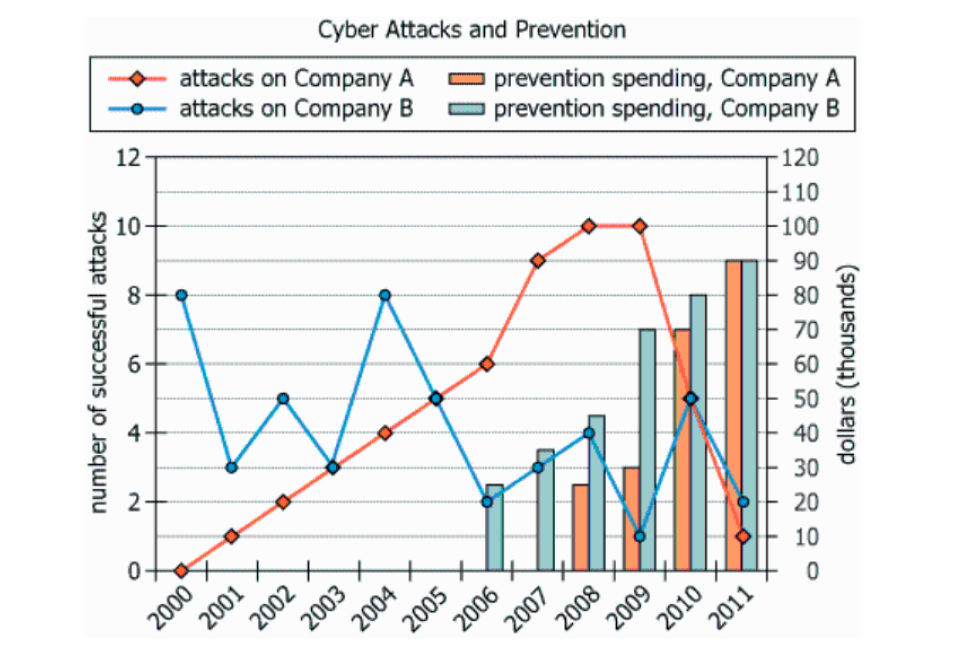
For the years 2000 to 2011, the graph shows for the number of successful cyber attacks that year on two companies, as well as the amount of money (in thousands of dollars) each company spent that year in prevention of cyber attacks. Neither company had experienced successful cyber attacks before the year 2000.
Use the drop-down menus to form the most accurate statements based on the given information.
From 2000 to 2011, the number of successful cyber attacks that Company A experienced was the number of successful cyber attacks that Company B experienced.
The only year where increased spending coincided with a decrease in successful cyber attacks (compared to the previous year) for both companies was .
For the years 2000 to 2011, the graph shows for the number of successful cyber attacks that year on two companies, as well as the amount of money (in thousands of dollars) each company spent that year in prevention of cyber attacks. Neither company had experienced successful cyber attacks before the year 2000.
Use the drop-down menus to form the most accurate statements based on the given information.
From 2000 to 2011, the number of successful cyber attacks that Company A experienced was the number of successful cyber attacks that Company B experienced.
The only year where increased spending coincided with a decrease in successful cyber attacks (compared to the previous year) for both companies was .
ID: 101119
ShowHide Answer
Official Answer
Dropdown 1: greater than
Dropdown 2: 2011
 20 Sep 2024, 08:21
Kudos
Bookmarks
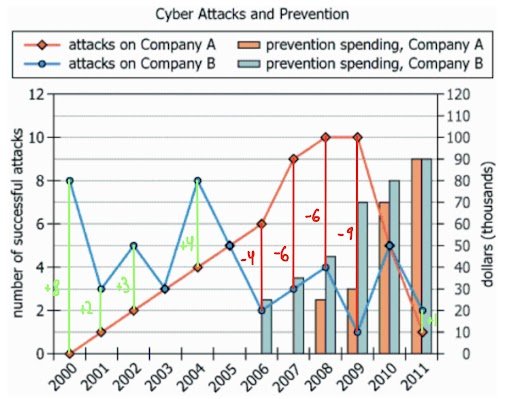
1. We are first asked to compare the number of successful attacks on company A vs B.
2. To do this, we don't have to sum up all the attacks, but rather calculate the delta between A and B.

3. The graph tells us that the number of attacks on B is (+8+2+3+4-4-6-6-9+1) = -7 larger than for A. In other words, company A had more successful cyberattacks than company B.
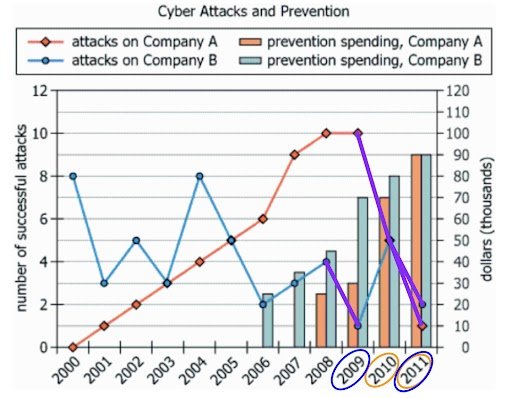
4. Next, we are asked to find the year when both companies increased funding and the number of cyberattacks decreased.
5. Notice that funding only increases for both companies throughout the years.

6. The number of cyberattacks on A decreases only in years 2010 and 2011. The number of cyberattacks on B decreases only in years 2009 and 2011 (earlier years aren't important since funding was 0). So, our answer is 2011.
GraphCyberattack1.jpg [ 52.55 KiB | Viewed 16502 times ]
GraphCyberattack2.jpg [ 52.9 KiB | Viewed 16231 times ]
2. To do this, we don't have to sum up all the attacks, but rather calculate the delta between A and B.
3. The graph tells us that the number of attacks on B is (+8+2+3+4-4-6-6-9+1) = -7 larger than for A. In other words, company A had more successful cyberattacks than company B.
4. Next, we are asked to find the year when both companies increased funding and the number of cyberattacks decreased.
5. Notice that funding only increases for both companies throughout the years.
6. The number of cyberattacks on A decreases only in years 2010 and 2011. The number of cyberattacks on B decreases only in years 2009 and 2011 (earlier years aren't important since funding was 0). So, our answer is 2011.
Attachment:
GraphCyberattack1.jpg [ 52.55 KiB | Viewed 16502 times ]
Attachment:
GraphCyberattack2.jpg [ 52.9 KiB | Viewed 16231 times ]
 24 Aug 2024, 08:00
Kudos
Bookmarks
Razara
Try adding the difference with -ve and +ve sign with reference to company A values; that way you have to add only once. If you get a +ve number means it is greater than the company B.
Hope it helps.





