Events & Promotions
|
|

GMAT Club Daily Prep
Thank you for using the timer - this advanced tool can estimate your performance and suggest more practice questions. We have subscribed you to Daily Prep Questions via email.
Customized
for You
Track
Your Progress
Practice
Pays
Not interested in getting valuable practice questions and articles delivered to your email? No problem, unsubscribe here.
 Sep 23
12:30 AM EDT
-01:30 AM EDT
Learn how Keshav, a Chartered Accountant, scored an impressive 705 on GMAT in just 30 days with GMATWhiz's expert guidance. In this video, he shares preparation tips and strategies that worked for him, including the mock, time management, and more Sep 24
01:30 AM EDT
-01:30 AM EDT
Tejas studied hard but kept repeating the same mistakes. After 3 attempts at 645, a focused 4-week strategy helped him identify and fix what was holding him back—leading to a 695 with just 12–15 hours of study per week. Sep 26
01:00 PM EDT
-04:00 PM EDT
Top scores are possible when you enroll in a powerful GMAT course, taught live online + 6 months access to TTP OnDemand video courses included. Class starts Saturdays Sept. 26, 2026 - Dec. 19, 2026, 1:00pm-4:00pm ES Sep 26
06:00 PM PDT
-07:00 PM PDT
Free- full-length test + 15 concept videos + 150+ short videos + study plan! Sep 29
11:00 AM EDT
-01:00 PM EDT
" Description: Top scores are possible when you enroll in a powerful GMAT course, taught live online + 6 months access to TTP OnDemand video courses included! Class starts Tues/Thur Sept. 29, 2026 - Dec. 3, 2026, 11:00am-1:00pm EST Oct 01
07:00 AM BST
-08:00 AM GMT
Welcome to the GMAT Club's Free Interview Prep Event for Top MBA Programs! Buy tickets - Virtual series that’s all set to equip you to -excel in your MBA interviews.

Swagatalaxmi

Joined: 05 Sep 2023
Last visit: 09 Jul 2026
Posts: 132
Given Kudos: 329
Location: India
Concentration: Healthcare, General Management
Schools: Wharton '27 (D) Columbia '27 (D) Booth '27 (WL) MIT '27 (D) Kellog '27 (D) Stern '27 (WL) Yale '27 (D) Fuqua '27 (D) Ross '27 (A$) Darden '26 (A$$$) Goizueta '26 (A$$$) Mashall '26 (A$) Tepper '26 (A$)
GMAT Focus 1: 695 Q85 V88 DI80 
GPA: 3.19
WE:Medicine and Health (Healthcare/Pharmaceuticals)
Products:
Schools: Wharton '27 (D) Columbia '27 (D) Booth '27 (WL) MIT '27 (D) Kellog '27 (D) Stern '27 (WL) Yale '27 (D) Fuqua '27 (D) Ross '27 (A$) Darden '26 (A$$$) Goizueta '26 (A$$$) Mashall '26 (A$) Tepper '26 (A$)
GMAT Focus 1: 695 Q85 V88 DI80
Posts: 132
 20 Jun 2024, 23:48
Kudos
Bookmarks
Recent research suggests that policy governing the retirement age in a given country affects not only the employment level of those who have reached the retirement age, but also the employment level of workers who are close to the retirement age. The distance effect describes a situation observed in many countries where people who are closest to the retirement age are least likely to be employed.
In Nation X, retirement policies, including retirement age and pension levels, are set on a national level. Each province, however, determines its own policy on unemployment benefits for those who have not yet retired. Recently, the provinces collected various forms of data concerning employment.
Nation X subsequently introduced an incentive scheme to encourage workers to delay retirement beyond the previously mandatory retirement age of 60, in exchange for higher retirement compensation beginning at a later age. This incentive has had two positive effects: it increased the money available in the pension funds due to delayed retirement of currently employed workers and it increased the likelihood that those near the retirement age who are not employed will search for employment.
In Nation X, retirement policies, including retirement age and pension levels, are set on a national level. Each province, however, determines its own policy on unemployment benefits for those who have not yet retired. Recently, the provinces collected various forms of data concerning employment.
Nation X subsequently introduced an incentive scheme to encourage workers to delay retirement beyond the previously mandatory retirement age of 60, in exchange for higher retirement compensation beginning at a later age. This incentive has had two positive effects: it increased the money available in the pension funds due to delayed retirement of currently employed workers and it increased the likelihood that those near the retirement age who are not employed will search for employment.


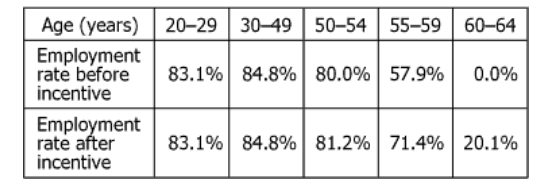
The table provides evidence of a positive effect discussed in the third paragraph of the introduction.
Be sure to select an answer first to save it in the Error Log before revealing the correct answer (OA)!
Difficulty:
 5%
(low)
5%
(low)
Question Stats:
83% (02:55) correct 17%
(02:45)
wrong
based on 937
sessions
17%
(02:45)
wrong
based on 937
sessions
History
Date
Time
Result
Not Attempted Yet
Which one of the following statements most accurately describes a relationship between the table and the introduction?
| The table suggests that a phenomenon discussed in the first paragraph of the introduction is not present in Nation X. | |
| The table provides evidence that contradicts research discussed in the first paragraph of the introduction. | |
| The table provides evidence of a positive effect discussed in the third paragraph of the introduction. | |
| The table presents data discussed in the second paragraph of the introduction. | |
| The table demonstrates that a phenomenon discussed in the introduction may be present in the nation as a whole but need not be present in all parts of that nation. |
ShowHide Answer
Official Answer
The table provides evidence of a positive effect discussed in the third paragraph of the introduction.
The employment rate for workers age 60-64 was higher after the incentive scheme was implemented.: Yes
The employment rate for workers age 50-54 was higher after the incentive scheme was implemented.: Yes
The distance effect was no longer evident.: No
Be sure to select an answer first to save it in the Error Log before revealing the correct answer (OA)!
Difficulty:
 25%
(medium)
25%
(medium)
Question Stats:
73% (01:21) correct
27%
(01:27)
wrong
based on 1061
sessions
History
Date
Time
Result
Not Attempted Yet
For each of the following statements about Nation X, select Yes if it describes a situation that the given information suggests may have resulted from the experimental incentive scheme. Otherwise, select No.
| Yes | No | |
| The employment rate for workers age 60-64 was higher after the incentive scheme was implemented. | ||
| The employment rate for workers age 50-54 was higher after the incentive scheme was implemented. | ||
| The distance effect was no longer evident. |
ShowHide Answer
Official Answer
The employment rate for workers age 60-64 was higher after the incentive scheme was implemented.: Yes
The employment rate for workers age 50-54 was higher after the incentive scheme was implemented.: Yes
The distance effect was no longer evident.: No
The incentive scheme has the greatest effect on the employment rates of those workers who are within 5 years of the retirement age.: Consistent
The level of unemployment benefits has a greater impact on the percentage of employed workers age 55-59 than on the percentage of employed workers age 30-49.: Consistent
The distance effect is greater when the level of unemployment benefits is low.: Inconsistent
Be sure to select an answer first to save it in the Error Log before revealing the correct answer (OA)!
Difficulty:
 95%
(hard)
95%
(hard)
Question Stats:
45% (02:03) correct
55%
(02:18)
wrong
based on 1190
sessions
History
Date
Time
Result
Not Attempted Yet
For each of the following statements about Nation X, select Consistent if the statement is consistent with the information provided. Otherwise, select Inconsistent.
| Consistent | Inconsistent | |
| The incentive scheme has the greatest effect on the employment rates of those workers who are within 5 years of the retirement age. | ||
| The level of unemployment benefits has a greater impact on the percentage of employed workers age 55-59 than on the percentage of employed workers age 30-49. | ||
| The distance effect is greater when the level of unemployment benefits is low. |
ShowHide Answer
Official Answer
The incentive scheme has the greatest effect on the employment rates of those workers who are within 5 years of the retirement age.: Consistent
The level of unemployment benefits has a greater impact on the percentage of employed workers age 55-59 than on the percentage of employed workers age 30-49.: Consistent
The distance effect is greater when the level of unemployment benefits is low.: Inconsistent
Tab 3.png [ 30.98 KiB | Viewed 12304 times ]
Tab 2.png [ 55.79 KiB | Viewed 12258 times ]
Attachment:
Tab 3.png [ 30.98 KiB | Viewed 12304 times ]
Attachment:
Tab 2.png [ 55.79 KiB | Viewed 12258 times ]
Trying to understand why the right answer is right?
GMAT Club Tests explanations walk through concepts, shortcuts, and common traps on many questions.
See how →
 01 Dec 2024, 06:31
Kudos
Bookmarks
Q1-
1-The employment rate for workers age 60–64 was higher after the incentive scheme was implemented. (Yes)
Explanation: From the table, the employment rate for the 60–64 age group increased from 0.0% to 20.1% after the incentive scheme was introduced. This clearly shows that the employment rate for this age group was higher post-implementation, so the answer is Yes.
2-The employment rate for workers age 50–54 was higher after the incentive scheme was implemented. (No)
Explanation: The table shows that the employment rate for the 50–54 age group increased slightly from 80.0% to 81.2% after the incentive scheme. While there was an increase, this may not be directly attributed to the scheme itself since the increase is minimal, and the graph and passage don’t indicate that the scheme primarily targeted this age group. Thus, the correct answer is No.
3-The distance effect was no longer evident. (No)
Explanation: The distance effect refers to the observation that workers closest to retirement age (55–59 and 60–64) are least likely to be employed. Even though the incentive scheme increased employment rates for older workers, the 55–59 group still had lower employment rates compared to younger groups (e.g., 50–54). Additionally, the 60–64 age group still had the lowest employment rate overall (20.1%). Hence, the distance effect remains evident, and the correct answer is No.
Q2-
1-The incentive scheme has the greatest effect on the employment rates of those workers who are within 5 years of the retirement age. (Consistent)
Explanation: According to the table, the employment rate for workers aged 55–59 increased significantly from 57.9% to 71.4%, and for workers aged 60–64, it rose from 0.0% to 20.1%. These age groups are within 5 years of the previous mandatory retirement age of 60, showing that the incentive scheme had its most significant effect on their employment rates. Thus, this statement is consistent with the information.
2-The level of unemployment benefits has a greater impact on the percentage of employed workers age 55–59 than on the percentage of employed workers age 30–49. (Consistent)
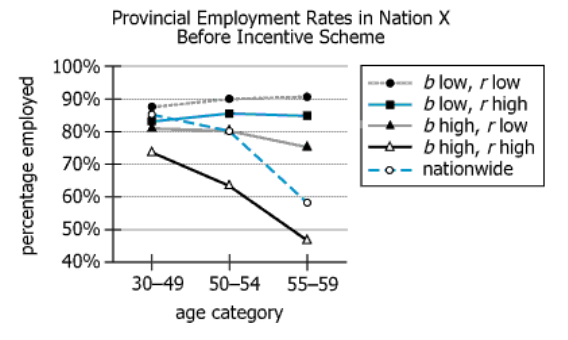
Explanation: From the graph, the employment rate for the 55–59 age group is much more sensitive to changes in unemployment benefits compared to the 30–49 age group. For the 55–59 group, provinces with low unemployment benefits and low separation rates show much higher employment levels compared to those with high unemployment benefits and high separation rates. In contrast, the 30–49 age group shows little variation across different benefit levels. This supports the statement as consistent.
3-The distance effect is greater when the level of unemployment benefits is low. (Inconsistent)
Explanation: The distance effect refers to lower employment rates for workers closer to retirement age. However, the graph shows that in provinces with low unemployment benefits, the employment rate for the 55–59 age group is relatively higher compared to provinces with high unemployment benefits. This indicates that the distance effect is less pronounced, not greater, when unemployment benefits are low. Hence, this statement is inconsistent with the information.
Q3-
Explanation: The third paragraph of the passage discusses the introduction of an incentive scheme in Nation X and its positive effects, including increased employment rates for older workers. The table clearly shows that after implementing the scheme, employment rates for the 55–59 and 60–64 age groups significantly increased. This confirms a positive effect directly related to the scheme, making this the correct answer.
1-The employment rate for workers age 60–64 was higher after the incentive scheme was implemented. (Yes)
Explanation: From the table, the employment rate for the 60–64 age group increased from 0.0% to 20.1% after the incentive scheme was introduced. This clearly shows that the employment rate for this age group was higher post-implementation, so the answer is Yes.
2-The employment rate for workers age 50–54 was higher after the incentive scheme was implemented. (No)
Explanation: The table shows that the employment rate for the 50–54 age group increased slightly from 80.0% to 81.2% after the incentive scheme. While there was an increase, this may not be directly attributed to the scheme itself since the increase is minimal, and the graph and passage don’t indicate that the scheme primarily targeted this age group. Thus, the correct answer is No.
3-The distance effect was no longer evident. (No)
Explanation: The distance effect refers to the observation that workers closest to retirement age (55–59 and 60–64) are least likely to be employed. Even though the incentive scheme increased employment rates for older workers, the 55–59 group still had lower employment rates compared to younger groups (e.g., 50–54). Additionally, the 60–64 age group still had the lowest employment rate overall (20.1%). Hence, the distance effect remains evident, and the correct answer is No.
Q2-
1-The incentive scheme has the greatest effect on the employment rates of those workers who are within 5 years of the retirement age. (Consistent)
Explanation: According to the table, the employment rate for workers aged 55–59 increased significantly from 57.9% to 71.4%, and for workers aged 60–64, it rose from 0.0% to 20.1%. These age groups are within 5 years of the previous mandatory retirement age of 60, showing that the incentive scheme had its most significant effect on their employment rates. Thus, this statement is consistent with the information.
2-The level of unemployment benefits has a greater impact on the percentage of employed workers age 55–59 than on the percentage of employed workers age 30–49. (Consistent)
Explanation: From the graph, the employment rate for the 55–59 age group is much more sensitive to changes in unemployment benefits compared to the 30–49 age group. For the 55–59 group, provinces with low unemployment benefits and low separation rates show much higher employment levels compared to those with high unemployment benefits and high separation rates. In contrast, the 30–49 age group shows little variation across different benefit levels. This supports the statement as consistent.
3-The distance effect is greater when the level of unemployment benefits is low. (Inconsistent)
Explanation: The distance effect refers to lower employment rates for workers closer to retirement age. However, the graph shows that in provinces with low unemployment benefits, the employment rate for the 55–59 age group is relatively higher compared to provinces with high unemployment benefits. This indicates that the distance effect is less pronounced, not greater, when unemployment benefits are low. Hence, this statement is inconsistent with the information.
Q3-
Explanation: The third paragraph of the passage discusses the introduction of an incentive scheme in Nation X and its positive effects, including increased employment rates for older workers. The table clearly shows that after implementing the scheme, employment rates for the 55–59 and 60–64 age groups significantly increased. This confirms a positive effect directly related to the scheme, making this the correct answer.
General Discussion
 10 Nov 2024, 06:34
Kudos
Bookmarks
Hope this helps.
Q3.1) within 5 years of the retirement age means age groups 55-59 and 60-64 and from table in tab3 we can see that all the other age groups barely had an effect. Consistent
Q3.2) The level of unemployment benefits is given in tab2, where we can see that when x axis is age 30-49, irrespective of b being high or low, the y axis i.e the percentage of employed workers is between 80-90% only but when x axis is age 55-59 then the value of b is significantly affecting the y axis i.e the percentage of employed workers. Consistent
Q3.3) level of unemployment benefits is given in tab2, where solid circle and solid square represent b low and with age(x axis) they are pretty consistent(if anything, slightly increasing) but the distance effect says people who are closest to the retirement age are least likely to be employed so it should have been decreasing. Inconsistent
Q3.1) within 5 years of the retirement age means age groups 55-59 and 60-64 and from table in tab3 we can see that all the other age groups barely had an effect. Consistent
Q3.2) The level of unemployment benefits is given in tab2, where we can see that when x axis is age 30-49, irrespective of b being high or low, the y axis i.e the percentage of employed workers is between 80-90% only but when x axis is age 55-59 then the value of b is significantly affecting the y axis i.e the percentage of employed workers. Consistent
Q3.3) level of unemployment benefits is given in tab2, where solid circle and solid square represent b low and with age(x axis) they are pretty consistent(if anything, slightly increasing) but the distance effect says people who are closest to the retirement age are least likely to be employed so it should have been decreasing. Inconsistent