Events & Promotions
|
|

GMAT Club Daily Prep
Thank you for using the timer - this advanced tool can estimate your performance and suggest more practice questions. We have subscribed you to Daily Prep Questions via email.
Customized
for You
Track
Your Progress
Practice
Pays
Not interested in getting valuable practice questions and articles delivered to your email? No problem, unsubscribe here.
 Sep 04
10:00 AM PDT
-11:00 AM PDT
What does test anxiety really look like on the GMAT? For many test takers, it does not look like a panic attack. Instead, it shows up as brain fog, rereading, negative comparisons, mental noise.... Sep 02
01:00 PM EDT
-11:59 PM EDT
Take 30% off all study plans with code COURSEWORK - Expires on Monday 9/7 Sep 04
01:30 AM EDT
-02:30 AM EDT
This Labor Day, turn your hard work into real score gains. From 615→715 in 15 days to 705 in 30 days, our students prove what's possible with personalized, expert guidance. Save up to 25% on 1-on-1 tutoring. Sep 06
09:30 AM EDT
-12:30 PM EST
Top scores are possible when you enroll in a powerful EA course, taught live online + 6 months access to TTP OnDemand video courses included! Perfect class schedule and easy course access for working professionals. Class starts Sundays Sept. 6, 2026.- Sep 07
12:01 AM PDT
-11:59 PM PDT
On the 7th, GMAT Club Tests will be Free! Including all the Quizzes, Questions, and Tests. 12 AM - 11:59 PM PDT  Sep 07
12:30 AM EDT
-01:30 AM EDT
Tejas studied hard but kept repeating the same mistakes. After 3 attempts at 645, a focused 4-week strategy helped him identify and fix what was holding him back—leading to a 695 with just 12–15 hours of study per week.- Sep 07
10:00 AM PDT
-11:00 AM PDT
A complete walkthrough of GMAT Club’s free 12-week GMAT study plan: what you study each week, how progress and goals are tracked, how the error log works, and how your practice unlocks paid tools at no cost. - Sep 09
07:00 AM PDT
-10:00 AM PDT
Meet AdComs and explore top Master’s programs - MiM, MiF, MSc, MSBA and more. - Application Fee Waivers - Free 1-Week of GMAT Club Tests: - Master's Application Toolkit - Grand Prize Giveaway - Sep 09
10:00 AM PDT
-11:00 AM PDT
Three MBA applications. Three rejections. No interview invites. A year later, Aman was admitted to Cambridge Judge, SMU, and IMD. In this episode of MBA Admit Stories, Aman shares how he rebuilt his MBA application...  Sep 10
08:00 PM PDT
-09:00 PM PDT
Free- full-length test + 15 concept videos + 150+ short videos + study plan! Sep 15
07:00 PM EDT
-09:00 PM EST
Elite scores are possible when you enroll in a powerful GMAT course, taught live online + 6 months access to TTP OnDemand video courses included! Class starts Tues/Thurs Sept. 15, 2026 - Nov. 15, 2027, 7:00pm-9:00pm EST Sep 21
08:00 PM EDT
-10:00 PM EDT
Boost your GMAT score in less than one month in a live online class + 6 months access to TTP OnDemand video courses included! Class starts Mon, Tues, Wed, Thur, Fri Sept. 21, 2026 - Oct. 9, 2027, 7:00pm-10:00pm EST


 Updated on: 21 Mar 2026, 10:45
Originally posted by bhavyatayal1833 on 24 Jun 2024, 21:57.
Last edited by Bunuel on 21 Mar 2026, 10:45, edited 1 time in total.
Last edited by Bunuel on 21 Mar 2026, 10:45, edited 1 time in total.
Kudos
Bookmarks
Question 1


B
Be sure to select an answer first to save it in the Error Log before revealing the correct answer (OA)!
Difficulty:
 95%
(hard)
95%
(hard)
Question Stats:
38% (03:27) correct 62%
(03:26) wrong
based on 768
sessions
62%
(03:26) wrong
based on 768
sessions
History
Date
Time
Result
Not Attempted Yet
Question 2
E
Be sure to select an answer first to save it in the Error Log before revealing the correct answer (OA)!
Difficulty:
 45%
(medium)
45%
(medium)
Question Stats:
53% (00:55) correct 47%
(01:01) wrong
based on 990
sessions
History
Date
Time
Result
Not Attempted Yet
Question 3
D
Be sure to select an answer first to save it in the Error Log before revealing the correct answer (OA)!
Difficulty:
 5%
(low)
5%
(low)
Question Stats:
80% (00:31) correct 20%
(00:50) wrong
based on 988
sessions
History
Date
Time
Result
Not Attempted Yet
Question 4
E
Be sure to select an answer first to save it in the Error Log before revealing the correct answer (OA)!
Difficulty:
5%
(low)
Question Stats:
87% (00:52) correct 13%
(01:10) wrong
based on 949
sessions
History
Date
Time
Result
Not Attempted Yet
GMAT-Club-Forum-jxn9gzhx.png [ 349.21 KiB | Viewed 5467 times ]
GMAT-Club-Forum-ppf0g620.png [ 127.93 KiB | Viewed 5462 times ]
GMAT-Club-Forum-014u6vpg.png [ 53.8 KiB | Viewed 5451 times ]
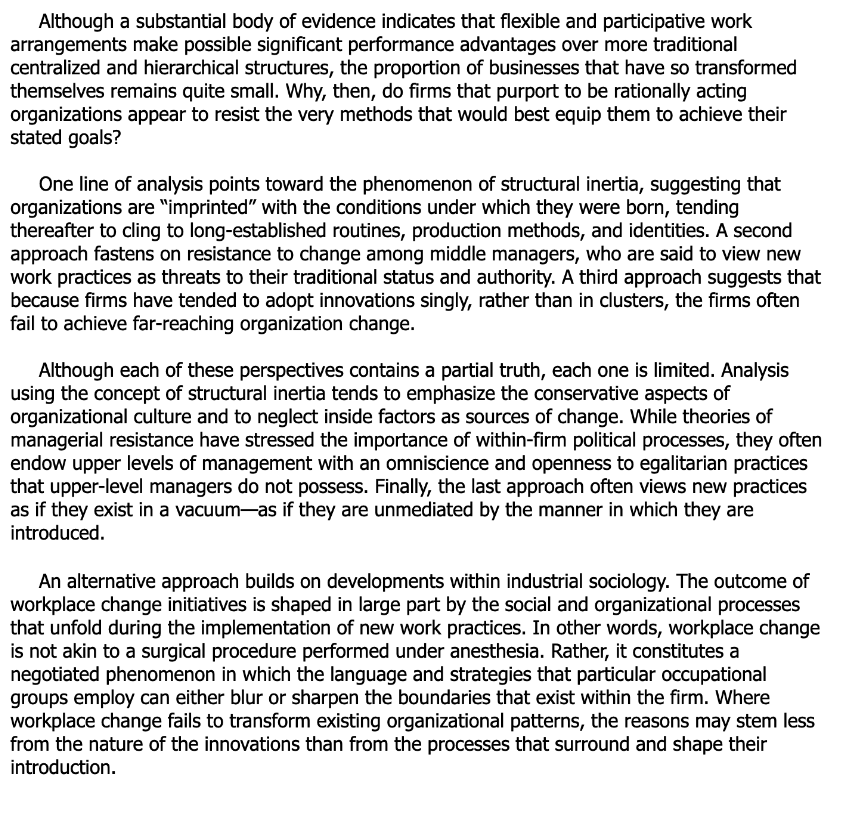
Although a substantial body of evidence indicates that flexible and participative work arrangements make possible significant performance advantages over more traditional centralized and hierarchical structures, the proportion of businesses that have so transformed themselves remains quite small. Why, then, do firms that purport to be rationally acting organizations appear to resist the very methods that would best equip them to achieve their stated goals?
One line of analysis points toward the phenomenon of structural inertia, suggesting that organizations are "imprinted" with the conditions under which they were born, tending thereafter to cling to long-established routines, production methods, and identities. A second approach fastens on resistance to change among middle managers, who are said to view new work practices as threats to their traditional status and authority. A third approach suggests that because firms have tended to adopt innovations singly, rather than in clusters, the firms often fail to achieve far-reaching organization change.
Although each of these perspectives contains a partial truth, each one is limited. Analysis using the concept of structural inertia tends to emphasize the conservative aspects of organizational culture and to neglect inside factors as sources of change. While theories of managerial resistance have stressed the importance of within-firm political processes, they often endow upper levels of management with an omniscience and openness to egalitarian practices that upper-level managers do not possess. Finally, the last approach often views new practices as if they exist in a vacuum—as if they are unmediated by the manner in which they are introduced.
An alternative approach builds on developments within industrial sociology. The outcome of workplace change initiatives is shaped in large part by the social and organizational processes that unfold during the implementation of new work practices. In other words, workplace change is not akin to a surgical procedure performed under anesthesia. Rather, it constitutes a negotiated phenomenon in which the language and strategies that particular occupational groups employ can either blur or sharpen the boundaries that exist within the firm. Where workplace change fails to transform existing organizational patterns, the reasons may stem less from the nature of the innovations than from the processes that surround and shape their introduction.
One line of analysis points toward the phenomenon of structural inertia, suggesting that organizations are "imprinted" with the conditions under which they were born, tending thereafter to cling to long-established routines, production methods, and identities. A second approach fastens on resistance to change among middle managers, who are said to view new work practices as threats to their traditional status and authority. A third approach suggests that because firms have tended to adopt innovations singly, rather than in clusters, the firms often fail to achieve far-reaching organization change.
Although each of these perspectives contains a partial truth, each one is limited. Analysis using the concept of structural inertia tends to emphasize the conservative aspects of organizational culture and to neglect inside factors as sources of change. While theories of managerial resistance have stressed the importance of within-firm political processes, they often endow upper levels of management with an omniscience and openness to egalitarian practices that upper-level managers do not possess. Finally, the last approach often views new practices as if they exist in a vacuum—as if they are unmediated by the manner in which they are introduced.
An alternative approach builds on developments within industrial sociology. The outcome of workplace change initiatives is shaped in large part by the social and organizational processes that unfold during the implementation of new work practices. In other words, workplace change is not akin to a surgical procedure performed under anesthesia. Rather, it constitutes a negotiated phenomenon in which the language and strategies that particular occupational groups employ can either blur or sharpen the boundaries that exist within the firm. Where workplace change fails to transform existing organizational patterns, the reasons may stem less from the nature of the innovations than from the processes that surround and shape their introduction.
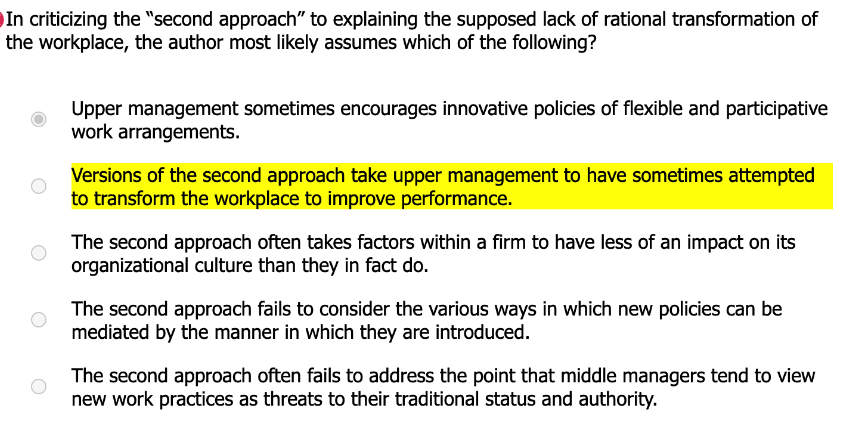
1. In criticizing the "second approach" to explaining the supposed lack of rational transformation of the workplace, the author most likely assumes which of the following?
A. Upper management sometimes encourages innovative policies of flexible and participative work arrangements.
B. Versions of the second approach take upper management to have sometimes attempted to transform the workplace to improve performance.
C. The second approach often takes factors within a firm to have less of an impact on its organizational culture than they in fact do.
D. The second approach fails to consider the various ways in which new policies can be mediated by the manner in which they are introduced.
E. The second approach often fails to address the point that middle managers tend to view new work practices as threats to their traditional status and authority.
A. Upper management sometimes encourages innovative policies of flexible and participative work arrangements.
B. Versions of the second approach take upper management to have sometimes attempted to transform the workplace to improve performance.
C. The second approach often takes factors within a firm to have less of an impact on its organizational culture than they in fact do.
D. The second approach fails to consider the various ways in which new policies can be mediated by the manner in which they are introduced.
E. The second approach often fails to address the point that middle managers tend to view new work practices as threats to their traditional status and authority.
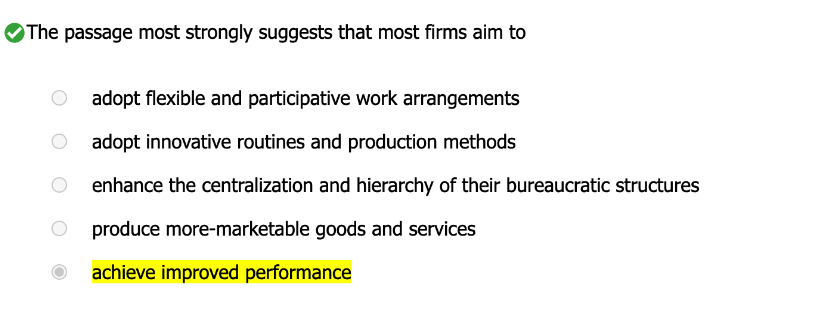
2. The passage most strongly suggests that most firms aim to
A. adopt flexible and participative work arrangements
B. adopt innovative routines and production methods
C. enhance the centralization and hierarchy of their bureaucratic structures
D. produce more-marketable goods and services
E. achieve improved performance
A. adopt flexible and participative work arrangements
B. adopt innovative routines and production methods
C. enhance the centralization and hierarchy of their bureaucratic structures
D. produce more-marketable goods and services
E. achieve improved performance
3. The passage is primarily concerned with discussing
A. how firms have attempted to introduce flexible and participative work arrangements
B. why some firms are attempting to become less centralized and hierarchical
C. why firms should adopt flexible and participative work arrangements
D. why relatively few firms have fully adopted flexible and participative work arrangements
E. the contributions of industrial sociology to understanding innovative work practices
A. how firms have attempted to introduce flexible and participative work arrangements
B. why some firms are attempting to become less centralized and hierarchical
C. why firms should adopt flexible and participative work arrangements
D. why relatively few firms have fully adopted flexible and participative work arrangements
E. the contributions of industrial sociology to understanding innovative work practices
4. The author most strongly suggests that the success of an innovation designed to achieve organizational change depends mostly on
A. whether the innovation is implemented by middle management or upper management
B. whether, in the implementation of the innovation, all employees are made aware of the change
C. whether the innovation is implemented alone or with other innovations
D. the overcoming of resistance of middle management to the innovation
E. the overall favorability of the processes that surround and shape the implementation of the innovation
A. whether the innovation is implemented by middle management or upper management
B. whether, in the implementation of the innovation, all employees are made aware of the change
C. whether the innovation is implemented alone or with other innovations
D. the overcoming of resistance of middle management to the innovation
E. the overall favorability of the processes that surround and shape the implementation of the innovation
Official Mock 6





Attachment:
GMAT-Club-Forum-jxn9gzhx.png [ 349.21 KiB | Viewed 5467 times ]
Attachment:
GMAT-Club-Forum-ppf0g620.png [ 127.93 KiB | Viewed 5462 times ]
Attachment:
GMAT-Club-Forum-014u6vpg.png [ 53.8 KiB | Viewed 5451 times ]
Using official mocks already?
Add GMAT Club Tests for harder practice, analytics, and explanations without overlapping Official Guide or official mock questions.
Try it now →
Try it now →
 10 Aug 2024, 02:29
Kudos
Bookmarks
For Q.1, it's important to understand that
Third paragraph is the literally direct explanation of second paragraph's 1st 2nd and 3rd approaches.
For Q.4, fourth paragraph didn't even mention the word "innovation" but the answer to Q.4 is in fourth paragraph.
It can be hard to interpret but these words "change initiatives" and "new work practices" are the representative of "innovation".
On top of it, this article has a handful of difficult vocabulary.
Third paragraph is the literally direct explanation of second paragraph's 1st 2nd and 3rd approaches.
For Q.4, fourth paragraph didn't even mention the word "innovation" but the answer to Q.4 is in fourth paragraph.
It can be hard to interpret but these words "change initiatives" and "new work practices" are the representative of "innovation".
On top of it, this article has a handful of difficult vocabulary.
 10 Aug 2024, 05:41
Kudos
Bookmarks
My attempt.
Honestly I selected wrong answer first for Q1.
1--> Even with evidence why are businesses resisting flexible/particpative(that would help their goal) for centralized/hierarchical ?
2-->Three explanations.
a--firms to stick to what they're born/know
b--middle managers consider the flexible/participative as threat to their authority
c--Innovation are singular rather than clusters. So they dont bring change in entire company
3--> above are partially true. Some drawbacks for each are as
a--they neglect inside as source of change. So even if they stick to what they know they can still do innovation
b--Upper level is put on a pedestal about being open and receptive while upper level managers really arent.
c--Even singular changes doesnt exist in vacuum and they are introduced after some mediation. So cause some change.
4-- > This has lot of confusing stuff imo.
But, I got the main point that the innovations are only as good as they environment that allows their development and existence.
Answers:
1: In criticizing the "second approach" to explaining the supposed lack of rational transformation of the workplace, the author most likely assumes which of the following?
2nd para b opinion: middle managers are not flex/receptive to new ideas
criticism by author: upper managers are thought to be open to innovative ideas while they arent.
imo most of us finalize A and B.
A. Upper management sometimes encourages innovative policies of flexible and participative work arrangements.
-> This is not an assumption that author has to assume to criticize. This is part of the point that author tries to criticize.
B. Versions of the second approach take upper management to have sometimes attempted to transform the workplace to improve performance.
-> So this may be pretty hard to understand in first attempt.
Authors criticism works if the b opinion people thinks upper managers do attempt for innovation and are hindered by middle managers.
B seems more apt in context.
2: There was talk of goal in Ist paragraph.
Two points from Ist para.
methods that would best equip them to achieve their stated goals
flexible and participative work arrangements make possible significant performance advantages
So answer must be significant performance advantage.
E. achieve improved performance
3.From paragraph1.
D. why relatively few firms have fully adopted flexible and participative work arrangements
4.From para4.
E. the overall favorability of the processes that surround and shape the implementation of the innovation
Honestly I selected wrong answer first for Q1.
1--> Even with evidence why are businesses resisting flexible/particpative(that would help their goal) for centralized/hierarchical ?
2-->Three explanations.
a--firms to stick to what they're born/know
b--middle managers consider the flexible/participative as threat to their authority
c--Innovation are singular rather than clusters. So they dont bring change in entire company
3--> above are partially true. Some drawbacks for each are as
a--they neglect inside as source of change. So even if they stick to what they know they can still do innovation
b--Upper level is put on a pedestal about being open and receptive while upper level managers really arent.
c--Even singular changes doesnt exist in vacuum and they are introduced after some mediation. So cause some change.
4-- > This has lot of confusing stuff imo.
But, I got the main point that the innovations are only as good as they environment that allows their development and existence.
Answers:
1: In criticizing the "second approach" to explaining the supposed lack of rational transformation of the workplace, the author most likely assumes which of the following?
2nd para b opinion: middle managers are not flex/receptive to new ideas
criticism by author: upper managers are thought to be open to innovative ideas while they arent.
imo most of us finalize A and B.
A. Upper management sometimes encourages innovative policies of flexible and participative work arrangements.
-> This is not an assumption that author has to assume to criticize. This is part of the point that author tries to criticize.
B. Versions of the second approach take upper management to have sometimes attempted to transform the workplace to improve performance.
-> So this may be pretty hard to understand in first attempt.
Authors criticism works if the b opinion people thinks upper managers do attempt for innovation and are hindered by middle managers.
B seems more apt in context.
2: There was talk of goal in Ist paragraph.
Two points from Ist para.
methods that would best equip them to achieve their stated goals
flexible and participative work arrangements make possible significant performance advantages
So answer must be significant performance advantage.
E. achieve improved performance
3.From paragraph1.
D. why relatively few firms have fully adopted flexible and participative work arrangements
4.From para4.
E. the overall favorability of the processes that surround and shape the implementation of the innovation


 changes. Now, the author points out that these three approaches are not completely true and goes on to emphasize the shortcomings of all three approaches. After this criticizm, the author talks about an approach that borrows from developments within industrial psych. Finally, the author's viewpoint is that the nature of innovations may be the secondary culprit, but the primary culprit are the processes that surround and influence the introduction of those innovations.