Events & Promotions
|
|

GMAT Club Daily Prep
Thank you for using the timer - this advanced tool can estimate your performance and suggest more practice questions. We have subscribed you to Daily Prep Questions via email.
Customized
for You
Track
Your Progress
Practice
Pays
Not interested in getting valuable practice questions and articles delivered to your email? No problem, unsubscribe here.
 Jun 10
06:00 AM PDT
-06:15 PM PDT
Register for the GMAT Club Virtual MBA Spotlight Fair – the world’s premier event for serious MBA candidates. This is your chance to hear directly from Admissions Directors at nearly every Top 30 MBA program..- Jun 10
10:00 AM PDT
-11:00 AM PDT
Scoring 715 on the GMAT Focus Edition requires more than just learning formulas, memorizing concepts, or solving hundreds of questions. In this episode, Nishant shares how he improved his GMAT preparation by focusing on application of concepts, and more.  Jun 11
11:00 AM EDT
-01:00 PM EDT
TTP GMAT OnDemand gives serious students 400+ hours of expert video instruction, the full TTP course, AI support, weekly office hours, and a 715+ score guarantee—all built for elite GMAT score improvement. Jun 22
07:30 PM EDT
-09:30 PM EDT
Master the GMAT with expert live instruction, a personalized study plan, and real-time support. Includes 40 hours of online classes plus 6 months of access to the TTP GMAT OnDemand video course. Class date: Mon/Wed June 22, 2026 →August 26, 2026

 19 Aug 2024, 02:56
Kudos
Bookmarks


Dropdown 1: 0.1875
Dropdown 2: 0.125
Be sure to select an answer first to save it in the Error Log before revealing the correct answer (OA)!
Difficulty:
 45%
(medium)
45%
(medium)
Question Stats:
71% (02:28) correct 29%
(02:26)
wrong
based on 2468
sessions
29%
(02:26)
wrong
based on 2468
sessions
History
Date
Time
Result
Not Attempted Yet
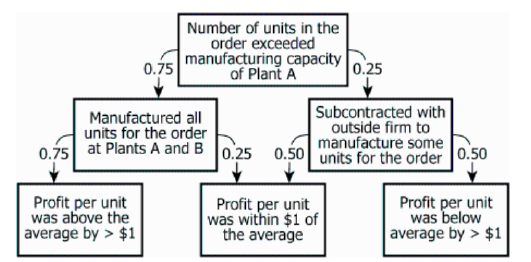
A particular manufacturing company has exactly two manufacturing plants–Plants A and B. A consultant, using data about the company's past performance and a particular model, calculated the probability of various outcomes when the company has promised to manufacture an order consisting of a greater number of units than could be produced only at the main plant, Plant A. Those probabilities are shown in the chart.
Select from each drop-down menu the opfon that creates the statement that most accurately reflects the information given.
The chart indicates that, for an order selected at random from those consisting of more units than could be produced by Plant A, the probability that the company's profit per unit on that order was within $1 of the average is equal to the sum of and .
A particular manufacturing company has exactly two manufacturing plants–Plants A and B. A consultant, using data about the company's past performance and a particular model, calculated the probability of various outcomes when the company has promised to manufacture an order consisting of a greater number of units than could be produced only at the main plant, Plant A. Those probabilities are shown in the chart.
Select from each drop-down menu the opfon that creates the statement that most accurately reflects the information given.
The chart indicates that, for an order selected at random from those consisting of more units than could be produced by Plant A, the probability that the company's profit per unit on that order was within $1 of the average is equal to the sum of and .
ID: 700357
ShowHide Answer
Official Answer
Dropdown 1: 0.1875
Dropdown 2: 0.125
If this question felt shaky,
try an adaptive mini quiz of similar problems in
GMAT Club Forum Quiz →. Free plan gives 5 questions per day.
 21 Aug 2024, 05:27
Kudos
Bookmarks
[Left hand side] 0.75 x 0.25 = 0.1875
[Right hand side] 0.25 x 0.50 = 0.125
Add LHS + RHS to get the probability that the company's profit per unit on that order was within $1 of the average
[Right hand side] 0.25 x 0.50 = 0.125
Add LHS + RHS to get the probability that the company's profit per unit on that order was within $1 of the average
 20 Sep 2024, 08:39
Kudos
Bookmarks
1. The problem asks us to find the probability (and represent it as a sum) that the company's profit per unit on that order was within $1 of the average based on an order consisting of more units than could be produced by Plant A.
2. We are given a graph and are asked the probability to get from the top point to the bottom point.
3. There are two paths to get there. Path 1 goes through "Manufactured all units for the order at Plants A and B" - this has a probability of \(0.75 * 0.25 = 0.1875\). Path 2 goes through "Subcontracted with outside firm to manufacture some units for the order" - this has a probability of \(0.25 * 0.25 = 0.125\).
4. The probability we need to find is equal to 0.1875 + 0.125. Since these two numbers can be both selected, our answer will be 0.1875 and 0.125.
2. We are given a graph and are asked the probability to get from the top point to the bottom point.
3. There are two paths to get there. Path 1 goes through "Manufactured all units for the order at Plants A and B" - this has a probability of \(0.75 * 0.25 = 0.1875\). Path 2 goes through "Subcontracted with outside firm to manufacture some units for the order" - this has a probability of \(0.25 * 0.25 = 0.125\).
4. The probability we need to find is equal to 0.1875 + 0.125. Since these two numbers can be both selected, our answer will be 0.1875 and 0.125.