Events & Promotions
| Last visit was: 06 Sep 2026, 10:38 |
It is currently 06 Sep 2026, 10:38 |
|
|

GMAT Club Daily Prep
Thank you for using the timer - this advanced tool can estimate your performance and suggest more practice questions. We have subscribed you to Daily Prep Questions via email.
Customized
for You
Track
Your Progress
Practice
Pays
Not interested in getting valuable practice questions and articles delivered to your email? No problem, unsubscribe here.
 Sep 07
12:01 AM PDT
-11:59 PM PDT
On the 7th, GMAT Club Tests will be Free! Including all the Quizzes, Questions, and Tests. 12 AM - 11:59 PM PDT- Sep 07
10:00 AM PDT
-11:00 AM PDT
A complete walkthrough of GMAT Club’s free 12-week GMAT study plan: what you study each week, how progress and goals are tracked, how the error log works, and how your practice unlocks paid tools at no cost.  Sep 02
01:00 PM EDT
-11:59 PM EDT
Take 30% off all study plans with code COURSEWORK - Expires on Monday 9/7 Sep 04
10:00 AM EDT
-11:59 PM EDT
We’ve worked incredibly hard to build TTP into the best test prep experience possible, and it would mean a lot to us to win Newsweek’s 2026 Readers’ Choice Award for Best Test Prep. If TTP has helped you, we’d be incredibly grateful for your vote. Sep 06
09:30 AM EDT
-12:30 PM EST
Top scores are possible when you enroll in a powerful EA course, taught live online + 6 months access to TTP OnDemand video courses included! Perfect class schedule and easy course access for working professionals. Class starts Sundays Sept. 6, 2026.- Sep 09
07:00 AM PDT
-10:00 AM PDT
Meet AdComs and explore top Master’s programs - MiM, MiF, MSc, MSBA and more. - Application Fee Waivers - Free 1-Week of GMAT Club Tests: - Master's Application Toolkit - Grand Prize Giveaway - Sep 09
10:00 AM PDT
-11:00 AM PDT
Three MBA applications. Three rejections. No interview invites. A year later, Aman was admitted to Cambridge Judge, SMU, and IMD. In this episode of MBA Admit Stories, Aman shares how he rebuilt his MBA application...  Sep 15
07:00 PM EDT
-09:00 PM EST
Elite scores are possible when you enroll in a powerful GMAT course, taught live online + 6 months access to TTP OnDemand video courses included! Class starts Tues/Thurs Sept. 15, 2026 - Nov. 15, 2027, 7:00pm-9:00pm EST Sep 21
08:00 PM EDT
-10:00 PM EDT
Boost your GMAT score in less than one month in a live online class + 6 months access to TTP OnDemand video courses included! Class starts Mon, Tues, Wed, Thur, Fri Sept. 21, 2026 - Oct. 9, 2027, 7:00pm-10:00pm EST

Question 1


D
Be sure to select an answer first to save it in the Error Log before revealing the correct answer (OA)!
Difficulty:
 85%
(hard)
85%
(hard)
Question Stats:
43% (03:00) correct 57%
(03:17) wrong
based on 1236
sessions
57%
(03:17) wrong
based on 1236
sessions
History
Date
Time
Result
Not Attempted Yet
Question 2
B
Be sure to select an answer first to save it in the Error Log before revealing the correct answer (OA)!
Difficulty:
 5%
(low)
5%
(low)
Question Stats:
90% (00:45) correct 10%
(00:59) wrong
based on 1147
sessions
History
Date
Time
Result
Not Attempted Yet
Question 3
D
Be sure to select an answer first to save it in the Error Log before revealing the correct answer (OA)!
Difficulty:
95%
(hard)
Question Stats:
39% (01:57) correct 61%
(01:50) wrong
based on 1128
sessions
History
Date
Time
Result
Not Attempted Yet


GMAT-Club-Forum-qjtp0dxf.png [ 129.52 KiB | Viewed 6157 times ]

GMAT-Club-Forum-twqazu4v.png [ 49.96 KiB | Viewed 6150 times ]

GMAT-Club-Forum-4kcfeang.png [ 73.93 KiB | Viewed 6161 times ]

GMAT-Club-Forum-tkylovec.png [ 71.14 KiB | Viewed 6143 times ]
Hurricane forecasters have difficulty determining maximum sustained surface-level winds. Reconnaissance aircraft usually obtain data from a flight level of 10,000 feet. However, in 1997, reconnaissance aircraft began deploying dropwindsondes in hurricanes. These weather instruments, carrying global positioning systems and affixed to parachutes, acquire detailed data from flight level down to surface level. Near the eyewall—the ring of towering thunderstorms surrounding a hurricane's eye—the strongest winds are usually found at around 1,600 feet, about 20 percent stronger than at flight level. In the hurricanes' outer reaches, however, wind maximums are typically found at higher elevations. The data also show that, near the eyewall, winds on top of a thirty-story building average about twenty miles per hour stronger than at ground level. Given the collective dropwindsonde data, forecasters typically estimate eyewall surface-level winds at about 90 percent of flight-level winds, with surface-level winds in the outer reaches at about 78 percent.
Hurricane Mitch in 1998, however, exhibited maximum flight-level winds no stronger than 150 miles per hour, yet dropwindsondes indicated much stronger surface-level winds. In this case, Mitch appeared to be weakening from the top down; the circulation at flight levels was decreasing but had yet to decrease at surface levels. This storm is a reminder that the typical estimates often need modification based on certain real-time factors, especially convective (warm-air updraft) intensity and sea-surface temperature.
Hurricane Mitch in 1998, however, exhibited maximum flight-level winds no stronger than 150 miles per hour, yet dropwindsondes indicated much stronger surface-level winds. In this case, Mitch appeared to be weakening from the top down; the circulation at flight levels was decreasing but had yet to decrease at surface levels. This storm is a reminder that the typical estimates often need modification based on certain real-time factors, especially convective (warm-air updraft) intensity and sea-surface temperature.
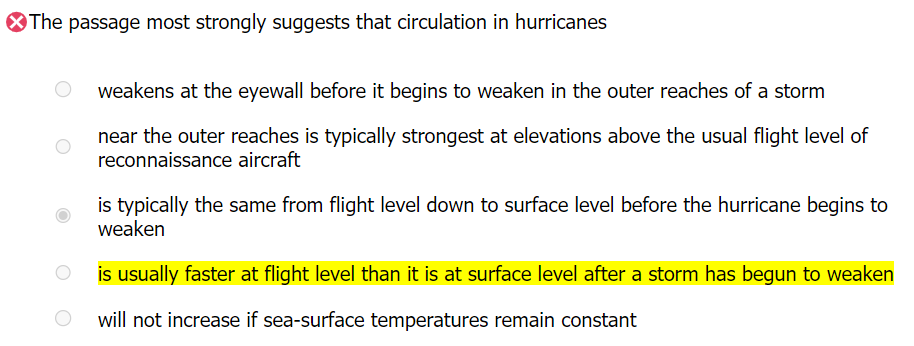
1. The passage most strongly suggests that circulation in hurricanes
A. weakens at the eyewall before it begins to weaken in the outer reaches of a storm
B. near the outer reaches is typically strongest at elevations above the usual flight level of reconnaissance aircraft
C. is typically the same from flight level down to surface level before the hurricane begins to weaken
D. is usually faster at flight level than it is at surface level after a storm has begun to weaken
E. will not increase if sea-surface temperatures remain constant
A. weakens at the eyewall before it begins to weaken in the outer reaches of a storm
B. near the outer reaches is typically strongest at elevations above the usual flight level of reconnaissance aircraft
C. is typically the same from flight level down to surface level before the hurricane begins to weaken
D. is usually faster at flight level than it is at surface level after a storm has begun to weaken
E. will not increase if sea-surface temperatures remain constant
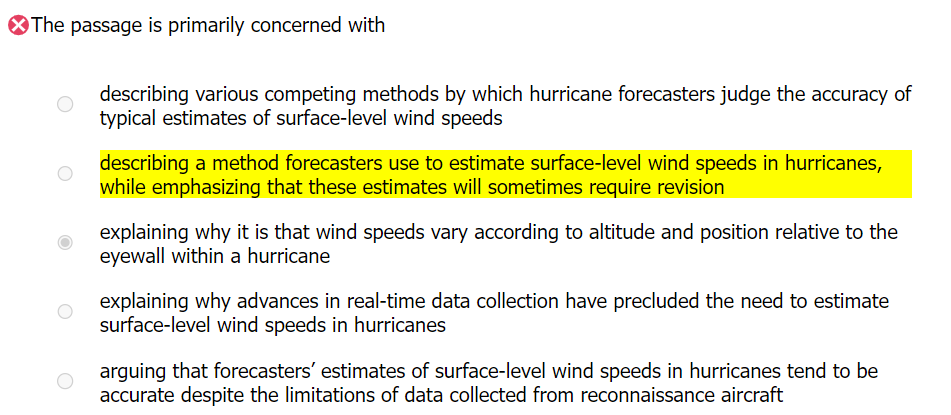
2. The passage is primarily concerned with
A. describing various competing methods by which hurricane forecasters judge the accuracy of typical estimates of surface-level wind speeds
B. describing a method forecasters use to estimate surface-level wind speeds in hurricanes, while emphasizing that these estimates will sometimes require revision
C. explaining why it is that wind speeds vary according to altitude and position relative to the eyewall within a hurricane
D. explaining why advances in real-time data collection have precluded the need to estimate surface-level wind speeds in hurricanes
E. arguing that forecasters' estimates of surface-level wind speeds in hurricanes tend to be accurate despite the limitations of data collected from reconnaissance aircraft
A. describing various competing methods by which hurricane forecasters judge the accuracy of typical estimates of surface-level wind speeds
B. describing a method forecasters use to estimate surface-level wind speeds in hurricanes, while emphasizing that these estimates will sometimes require revision
C. explaining why it is that wind speeds vary according to altitude and position relative to the eyewall within a hurricane
D. explaining why advances in real-time data collection have precluded the need to estimate surface-level wind speeds in hurricanes
E. arguing that forecasters' estimates of surface-level wind speeds in hurricanes tend to be accurate despite the limitations of data collected from reconnaissance aircraft
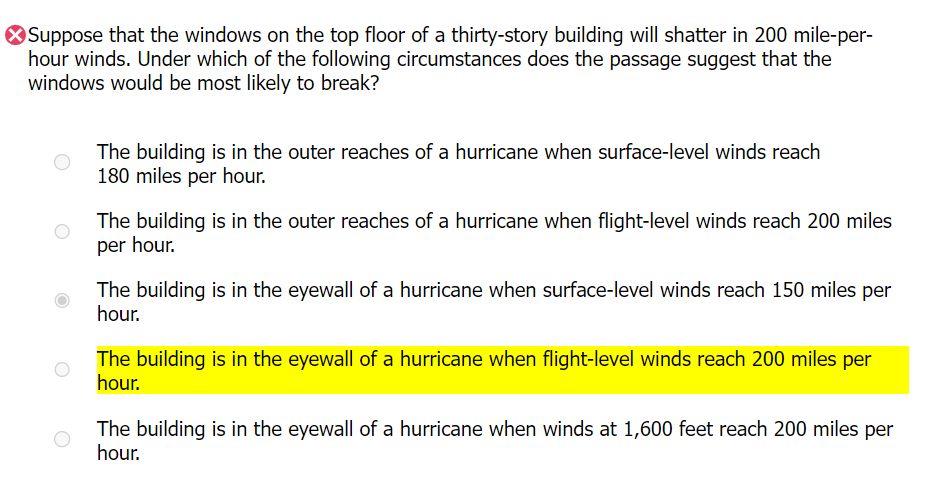
3. Suppose that the windows on the top floor of a thirty-story building will shatter in 200 mile-per- hour winds. Under which of the following circumstances does the passage suggest that the windows would be most likely to break?
A. The building is in the outer reaches of a hurricane when surface-level winds reach 180 miles per hour.
B. The building is in the outer reaches of a hurricane when flight-level winds reach 200 miles per hour.
C. The building is in the eyewall of a hurricane when surface-level winds reach 150 miles per hour.
D. The building is in the eyewall of a hurricane when flight-level winds reach 200 miles per hour.
E. The building is in the eyewall of a hurricane when winds at 1,600 feet reach 200 miles per hour.
A. The building is in the outer reaches of a hurricane when surface-level winds reach 180 miles per hour.
B. The building is in the outer reaches of a hurricane when flight-level winds reach 200 miles per hour.
C. The building is in the eyewall of a hurricane when surface-level winds reach 150 miles per hour.
D. The building is in the eyewall of a hurricane when flight-level winds reach 200 miles per hour.
E. The building is in the eyewall of a hurricane when winds at 1,600 feet reach 200 miles per hour.
Attachment:
GMAT-Club-Forum-qjtp0dxf.png [ 129.52 KiB | Viewed 6157 times ]
Attachment:
GMAT-Club-Forum-twqazu4v.png [ 49.96 KiB | Viewed 6150 times ]
Attachment:
GMAT-Club-Forum-4kcfeang.png [ 73.93 KiB | Viewed 6161 times ]
Attachment:
GMAT-Club-Forum-tkylovec.png [ 71.14 KiB | Viewed 6143 times ]
Using official mocks already?
Add GMAT Club Tests for harder practice, analytics, and explanations without overlapping Official Guide or official mock questions.
Try it now →
Try it now →

 22 Apr 2024, 11:54
Kudos
Bookmarks
Q3:
Answer D is correct because it describes a scenario where the building is in the eyewall of a hurricane when flight-level winds reach 200 miles per hour. According to the passage, near the eyewall, winds on top of a thirty-story building average about twenty miles per hour stronger than at ground level. This means that if flight-level winds reach 200 miles per hour, the winds on top of the thirty-story building would be even stronger, potentially exceeding the threshold of 200 miles per hour required to shatter the windows.
Answer A is not the best choice because it describes a scenario where the building is in the outer reaches of a hurricane when surface-level winds reach 180 miles per hour. However, the passage states that in the outer reaches, wind maximums are typically found at higher elevations, so the wind speed at the top of the thirty-story building may not necessarily reach 200 miles per hour, the threshold for window breakage.
In summary, answer D is more likely to result in window breakage because it describes a scenario where the building is in the eyewall of a hurricane with stronger flight-level winds, which would translate to even stronger winds at the top of the building.
Q1
Let's break down each option and why they are incorrect:
A. The passage does not explicitly state that circulation weakens at the eyewall before weakening in the outer reaches. In fact, it mentions that near the eyewall, the strongest winds are usually found at around 1,600 feet, which suggests that the circulation might weaken at different rates in different parts of the hurricane.
B. While the passage does mention that wind maximums are typically found at higher elevations in the outer reaches of a hurricane, it does not explicitly state that this is above the usual flight level of reconnaissance aircraft. Also, this option doesn't address the comparison between flight level and surface level winds, which is the main focus of the passage.
C. The passage states that near the eyewall, winds on top of a thirty-story building average about twenty miles per hour stronger than at ground level, suggesting that circulation is not typically the same from flight level down to surface level. Additionally, the passage mentions that the strongest winds near the eyewall are typically found at around 1,600 feet, not at surface level.
D. This is the correct answer because the passage mentions that in Hurricane Mitch, the circulation at flight levels was decreasing but had yet to decrease at surface levels. This indicates that circulation is usually faster at flight level than it is at surface level after a storm has begun to weaken.
E. The passage does not directly address whether circulation will increase or not based on sea-surface temperatures. It mainly focuses on the difference in wind speeds at different elevations within a hurricane and how that affects forecasting.
So, option D is correct because it directly addresses the situation described in the passage, where circulation at flight levels was decreasing but had yet to decrease at surface levels in Hurricane Mitch.
Note : credit to chat gpt
Answer D is correct because it describes a scenario where the building is in the eyewall of a hurricane when flight-level winds reach 200 miles per hour. According to the passage, near the eyewall, winds on top of a thirty-story building average about twenty miles per hour stronger than at ground level. This means that if flight-level winds reach 200 miles per hour, the winds on top of the thirty-story building would be even stronger, potentially exceeding the threshold of 200 miles per hour required to shatter the windows.
Answer A is not the best choice because it describes a scenario where the building is in the outer reaches of a hurricane when surface-level winds reach 180 miles per hour. However, the passage states that in the outer reaches, wind maximums are typically found at higher elevations, so the wind speed at the top of the thirty-story building may not necessarily reach 200 miles per hour, the threshold for window breakage.
In summary, answer D is more likely to result in window breakage because it describes a scenario where the building is in the eyewall of a hurricane with stronger flight-level winds, which would translate to even stronger winds at the top of the building.
Q1
Let's break down each option and why they are incorrect:
A. The passage does not explicitly state that circulation weakens at the eyewall before weakening in the outer reaches. In fact, it mentions that near the eyewall, the strongest winds are usually found at around 1,600 feet, which suggests that the circulation might weaken at different rates in different parts of the hurricane.
B. While the passage does mention that wind maximums are typically found at higher elevations in the outer reaches of a hurricane, it does not explicitly state that this is above the usual flight level of reconnaissance aircraft. Also, this option doesn't address the comparison between flight level and surface level winds, which is the main focus of the passage.
C. The passage states that near the eyewall, winds on top of a thirty-story building average about twenty miles per hour stronger than at ground level, suggesting that circulation is not typically the same from flight level down to surface level. Additionally, the passage mentions that the strongest winds near the eyewall are typically found at around 1,600 feet, not at surface level.
D. This is the correct answer because the passage mentions that in Hurricane Mitch, the circulation at flight levels was decreasing but had yet to decrease at surface levels. This indicates that circulation is usually faster at flight level than it is at surface level after a storm has begun to weaken.
E. The passage does not directly address whether circulation will increase or not based on sea-surface temperatures. It mainly focuses on the difference in wind speeds at different elevations within a hurricane and how that affects forecasting.
So, option D is correct because it directly addresses the situation described in the passage, where circulation at flight levels was decreasing but had yet to decrease at surface levels in Hurricane Mitch.
Note : credit to chat gpt


 11 May 2024, 07:23
Kudos
Bookmarks
Q3 can be answered by referring to the below lines in the passage:
The other choices lead to lesser speeds or there is not enough info in the choices to arrive at a conclusive speed value wrt to the problem.
Quote:
Quote:
Choice D: Flight level speed = 200 mph, thus surface level speed at eye wall = 90% of 200 = 180 mph. Finally, speed at top of the building = 180 + 20 = 200 mph. Thus windows will break.
The other choices lead to lesser speeds or there is not enough info in the choices to arrive at a conclusive speed value wrt to the problem.

SudsMeister
20 May 2025, 00:04
Kudos
Bookmarks
Quote:
A. Building is in outer reaches when surface level winds reach 180.
From the passage, let's find out about outer area speed and what's it relation at various heights.
Quote:
So, outer area speeds at surface level it is approximately 80% of speeds at flight level which is 10000 feet.
At 10000 feet outer area speeds would be around 180/0.8 = 225.
So, in the outer area, wind speeds vary from 225 at 10000 feet to 180 at surface level. So, outer speed should be 200 at around 5000 feet (midway between flight and surface level). Building with 30 floors (basic world knowledge can be used to estimate that per story height can be around 10-15 feet, so 30 story < 500 feet) is much closer to the surface than 10000 feet. So, building should not be hit with 200 speed outer winds. Most likely reject, but keep in mind in case we don't get a better answer, this might be the one we will pick as the building at least falls in the 180-225 speed range.
B. Outer area speed is 200 at flight level.
Using same information as above we can see that the wind speed is going to be lesser than 200 at the building and surface level. Not enough to break windows.
C. Eyewall speed at surface is 150.
Using same information as in option A, we can figure out that at flight level, eyewall speeds are approximately 150/0.9 = 167.
But the passage tells us another information about eyewall speeds:
Quote:
So, at 1600 feet, eyewall is strongest = 167 + 20% = 200.
But if it's maximum is 200 at 1600 feet (height of a 30-story building < 500 feet) and at surface it is 150, then at 30 story level it will be lesser than 200 - not enough to break windows.
D. Eyewall speed is 200 at flight level.
Max is at 1600 feet = 200 + 20% = 240, at surface it is 200 * 0.9 = 180.
If building is around 500 feet, then building's height is around 1/3rd of 1600 feet. Wind loses speed of 60 between 1600 to 0 feet, so at 1/3rd height, it will lose 2/3rd speed i.e. 40. So, at around 1/3rd height, speed of wind = 240 - 40 = 200. Enough to break windows - should be our answer.
E. Eyewall speed is 200 at 1600 feet. This is the max speed. At building level or surface level, the eyewall speed will be much lesser. Not enough.
Between A and D, D has a range of 240 to 180 at 1600 feet to surface respectively, while A has a range of 225 to 180 at 10000 feet to surface respectively.
D is more likely to have winds at around 200 or more at 500 feet height. Maybe drawing it out will help visualise it better - 4 height levels (10000, 1600, 500, and 0) and speeds marked for various scenarios.
Answer D.