Events & Promotions
|
|

GMAT Club Daily Prep
Thank you for using the timer - this advanced tool can estimate your performance and suggest more practice questions. We have subscribed you to Daily Prep Questions via email.
Customized
for You
Track
Your Progress
Practice
Pays
Not interested in getting valuable practice questions and articles delivered to your email? No problem, unsubscribe here.
 Apr 28
08:00 AM PDT
-11:00 AM PDT
Whether you are just beginning your MBA journey or fine-tuning your path to a 700+ score, GMAT Day is designed to give you a competitive edge. Apr 27
11:00 AM EDT
-12:00 PM EDT
Prefer video-based learning? The Target Test Prep OnDemand course is a one-of-a-kind video masterclass featuring 400 hours of lecture-style teaching by Scott Woodbury-Stewart, founder of Target Test Prep and one of the most accomplished GMAT instructors Apr 29
12:30 AM EDT
-01:30 AM EDT
Learn how Kamakshi achieved a GMAT 675 with an impressive 96th %ile in Data Insights. Discover the unique methods and exam strategies that helped her excel in DI along with other sections for a balanced and high score. Apr 30
01:30 AM EDT
-02:30 AM EDT
At one point, she believed GMAT wasn’t for her. After scoring 595, self-doubt crept in and she questioned her potential. But instead of quitting, she made the right strategic changes. The result? A remarkable comeback to 695. Check out how Saakshi did it. May 01
11:00 AM PDT
-12:00 PM PDT
Free- full-length test + 15 concept videos + 150+ short videos + study plan! May 03
06:30 AM PDT
-08:30 AM PDT
Verbal trouble on GMAT? Fix it NOW! Join Sunita Singhvi for a focused webinar on actionable strategies to boost your Verbal score and take your performance to the next level.

andrewjohn8
GMAT Focus 1: 645 Q80 V88 DI78 
Posts: 34
 13 Feb 2024, 08:33
Kudos
Bookmarks


B
Be sure to select an answer first to save it in the Error Log before revealing the correct answer (OA)!
Difficulty:
 45%
(medium)
45%
(medium)
Question Stats:
72% (02:10) correct 28%
(02:23)
wrong
based on 1044
sessions
28%
(02:23)
wrong
based on 1044
sessions
History
Date
Time
Result
Not Attempted Yet

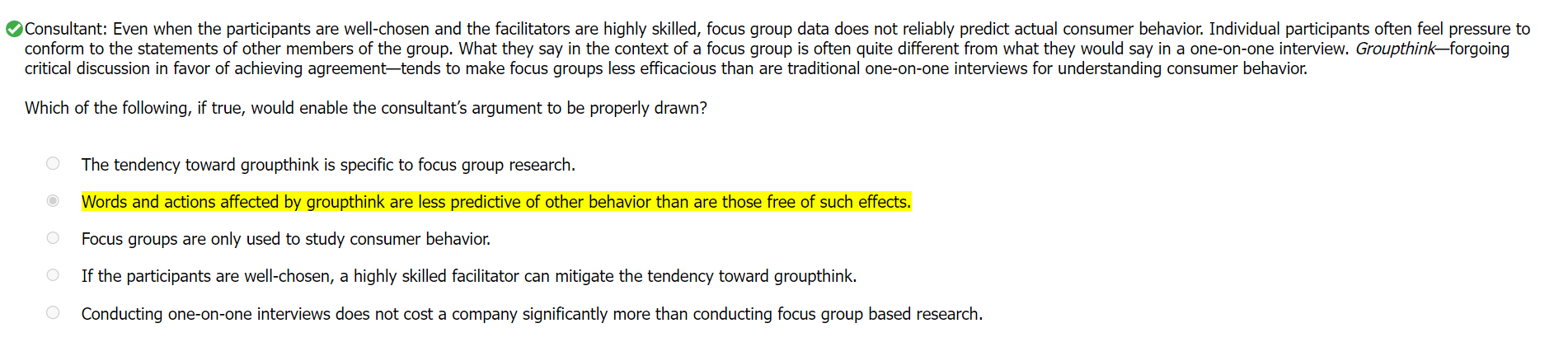
Consultant: Even when the participants are well-chosen and the facilitators are highly skilled, focus group data does not reliably predict actual consumer behavior. Individual participants often feel pressure to conform to the statements of other members of the group. What they say in the context of a focus group is often quite different from what they would say in a one-on-one interview. Groupthink--forgoing critical discussion in favor of achieving agreement--tends to make focus groups less efficacious than are traditional one-on-one interviews for understanding consumer behavior.
Which of the following, if true, would enable the consultant's argument to be properly drawn?
A. The tendency toward groupthink is specific to focus group research.
B. Words and actions affected by groupthink are less predictive of other behavior than are those free of such effects.
C. Focus groups are only used to study consumer behavior.
D. If the participants are well-chosen, a highly skilled facilitator can mitigate the tendency toward groupthink.
E. Conducting one-on-one interviews does not cost a company significantly more than conducting focus group based research.
GMAT-Club-Forum-95dbu2dk.png [ 104.67 KiB | Viewed 3292 times ]
Which of the following, if true, would enable the consultant's argument to be properly drawn?
A. The tendency toward groupthink is specific to focus group research.
B. Words and actions affected by groupthink are less predictive of other behavior than are those free of such effects.
C. Focus groups are only used to study consumer behavior.
D. If the participants are well-chosen, a highly skilled facilitator can mitigate the tendency toward groupthink.
E. Conducting one-on-one interviews does not cost a company significantly more than conducting focus group based research.
Attachment:
GMAT-Club-Forum-95dbu2dk.png [ 104.67 KiB | Viewed 3292 times ]
Need more Tests to Practice?
GMAT Club Tests give expert solutions for every question in full and sectional GMAT Focus mocks.
Learn more →

 13 Feb 2024, 13:51
Kudos
Bookmarks
Explanation
Consultant: Even when the participants are well-chosen and the facilitators are highly skilled, focus group data does not reliably predict actual consumer behavior. Individual participants often feel pressure to conform to the statements of other members of the group. What they say in the context of a focus group is often quite different from what they would say in a one-on-one interview. Groupthink--forgoing critical discussion in favor of achieving agreement--tends to make focus groups less efficacious than are traditional one-on-one interviews for understanding consumer behavior.
Analyzing the passage, we find statements that we could consider conclusions in the first and last line:
Even when the participants are well-chosen and the facilitators are highly skilled, focus group data does not reliably predict actual consumer behavior.
Groupthink--forgoing critical discussion in favor of achieving agreement--tends to make focus groups less efficacious than
are traditional one-on-one interviews for understanding consumer behavior.
Honestly, it's tough to find a conclusion in this passage. It states each of the above two possible conclusions more as facts than as opinions supported by other facts. At the same time, once we see that the question stem indicates that this question is an Assumption question, we know we have to find a conclusion and support for that conclusion. So, we have to go with our best call for what the writer of the question may have considered the conclusion and support.
My best call is that the writer considered the first statement in the passage the final conclusion and the last statement an intermediate conclusion.
Accordingly, we can say that the consultant has reasoned that, since groupthink causes people's "forgoing critical discussion in favor of achieving agreement," groupthink "tends to make focus groups less efficacious than are traditional one-on-one interviews for understanding consumer behavior," and therefore, "focus group data does not reliably predict actual consumer behavior."
Which of the following, if true, would enable the consultant's argument to be properly drawn?
This is another way of asking for an assumption on which the argument depends.
A. The tendency toward groupthink is specific to focus group research.
This statement doesn't have to be true for the argument to work.
After all, even if the tendency toward groupthink is not specific to focus group research and thus exists in other types of research, it can still be the case that "Groupthink ... tends to make focus groups less efficacious than are traditional one-on-one interviews" and that "focus group data does not reliably predict actual consumer behavior."
The consultant is not saying that all other types of research are better than focus group research or implying that all other types of research do not involve groupthink.
Eliminate.
B. Words and actions affected by groupthink are less predictive of other behavior than are those free of such effects.
In our above analysis of the passage, we saw that the consultant has reasoned that, since groupthink causes people's "forgoing critical discussion in favor of achieving agreement," groupthink "tends to make focus groups less efficacious than are traditional one-on-one interviews for understanding consumer behavior," and therefore focus group data "does not reliably predict consumer behavior."
So, the reasoning goes from "groupthink" to "less efficacious" to "does not reliably predict consumer behavior."
Looking at this choice, we see that it's basically stating the assumption that "groupthink" is connected to "less predictive."
Honestly, I don't think the argument really assumes what this choice says. After all, the argument goes from "groupthink" to "less effiicacious" and then to "does not reliably predict." So, it connects "groupthink" to "does not reliably predict" with "less efficicacious" and thus doesn't need the direct connection between "groupthink" and "less predictive" provided by this choice.
At the same time, none of the other choices work. So, we can roll with this choice given that it does at least connect an aspect of the support, "groupthink," to what appears to be the main conclusion, "less predictive."
Keep.
C. Focus groups are only used to study consumer behavior.
Regardless of whether focus groups are used to study only consumer behavior, the conclusion of this argument could be correct.
After, even if focus groups are use to study other forms of behavior, it could still be the case that "focus group data does not reliably predict actual consumer behavior."
Eliminate.
D. If the participants are well-chosen, a highly skilled facilitator can mitigate the tendency toward groupthink.
This choice clearly doesn't state an assumption on which the argument depends because it is contrary to the point of the argument.
In other words, "If the participants are well-chosen, a highly skilled facilitator can mitigate the tendency toward groupthink," goes in the opposite direction of the conclusion that, because of groupthink, "Even when the participants are well-chosen and the facilitators are highly skilled, focus group data does not reliably predict actual consumer behavior."
Eliminate.
E. Conducting one-on-one interviews does not cost a company significantly more than conducting focus group based research.
The key points of the argument are two specific ones: "Groupthink ... tends to make focus groups less efficacious than are traditional one-on-one interviews" and "focus group data does not reliably predict actual consumer behavior."
The points of the argument do not involve cost.
Also, the conclusion is not that one-on-one interviews are better overall for companies than focus groups.
So, the argument doesn't require any assumption about the relative costs of focus group-based research and one-on-one interviews.
Eliminate.
Correct answer: B
Consultant: Even when the participants are well-chosen and the facilitators are highly skilled, focus group data does not reliably predict actual consumer behavior. Individual participants often feel pressure to conform to the statements of other members of the group. What they say in the context of a focus group is often quite different from what they would say in a one-on-one interview. Groupthink--forgoing critical discussion in favor of achieving agreement--tends to make focus groups less efficacious than are traditional one-on-one interviews for understanding consumer behavior.
Analyzing the passage, we find statements that we could consider conclusions in the first and last line:
Even when the participants are well-chosen and the facilitators are highly skilled, focus group data does not reliably predict actual consumer behavior.
Groupthink--forgoing critical discussion in favor of achieving agreement--tends to make focus groups less efficacious than
are traditional one-on-one interviews for understanding consumer behavior.
Honestly, it's tough to find a conclusion in this passage. It states each of the above two possible conclusions more as facts than as opinions supported by other facts. At the same time, once we see that the question stem indicates that this question is an Assumption question, we know we have to find a conclusion and support for that conclusion. So, we have to go with our best call for what the writer of the question may have considered the conclusion and support.
My best call is that the writer considered the first statement in the passage the final conclusion and the last statement an intermediate conclusion.
Accordingly, we can say that the consultant has reasoned that, since groupthink causes people's "forgoing critical discussion in favor of achieving agreement," groupthink "tends to make focus groups less efficacious than are traditional one-on-one interviews for understanding consumer behavior," and therefore, "focus group data does not reliably predict actual consumer behavior."
Which of the following, if true, would enable the consultant's argument to be properly drawn?
This is another way of asking for an assumption on which the argument depends.
A. The tendency toward groupthink is specific to focus group research.
This statement doesn't have to be true for the argument to work.
After all, even if the tendency toward groupthink is not specific to focus group research and thus exists in other types of research, it can still be the case that "Groupthink ... tends to make focus groups less efficacious than are traditional one-on-one interviews" and that "focus group data does not reliably predict actual consumer behavior."
The consultant is not saying that all other types of research are better than focus group research or implying that all other types of research do not involve groupthink.
Eliminate.
B. Words and actions affected by groupthink are less predictive of other behavior than are those free of such effects.
In our above analysis of the passage, we saw that the consultant has reasoned that, since groupthink causes people's "forgoing critical discussion in favor of achieving agreement," groupthink "tends to make focus groups less efficacious than are traditional one-on-one interviews for understanding consumer behavior," and therefore focus group data "does not reliably predict consumer behavior."
So, the reasoning goes from "groupthink" to "less efficacious" to "does not reliably predict consumer behavior."
Looking at this choice, we see that it's basically stating the assumption that "groupthink" is connected to "less predictive."
Honestly, I don't think the argument really assumes what this choice says. After all, the argument goes from "groupthink" to "less effiicacious" and then to "does not reliably predict." So, it connects "groupthink" to "does not reliably predict" with "less efficicacious" and thus doesn't need the direct connection between "groupthink" and "less predictive" provided by this choice.
At the same time, none of the other choices work. So, we can roll with this choice given that it does at least connect an aspect of the support, "groupthink," to what appears to be the main conclusion, "less predictive."
Keep.
C. Focus groups are only used to study consumer behavior.
Regardless of whether focus groups are used to study only consumer behavior, the conclusion of this argument could be correct.
After, even if focus groups are use to study other forms of behavior, it could still be the case that "focus group data does not reliably predict actual consumer behavior."
Eliminate.
D. If the participants are well-chosen, a highly skilled facilitator can mitigate the tendency toward groupthink.
This choice clearly doesn't state an assumption on which the argument depends because it is contrary to the point of the argument.
In other words, "If the participants are well-chosen, a highly skilled facilitator can mitigate the tendency toward groupthink," goes in the opposite direction of the conclusion that, because of groupthink, "Even when the participants are well-chosen and the facilitators are highly skilled, focus group data does not reliably predict actual consumer behavior."
Eliminate.
E. Conducting one-on-one interviews does not cost a company significantly more than conducting focus group based research.
The key points of the argument are two specific ones: "Groupthink ... tends to make focus groups less efficacious than are traditional one-on-one interviews" and "focus group data does not reliably predict actual consumer behavior."
The points of the argument do not involve cost.
Also, the conclusion is not that one-on-one interviews are better overall for companies than focus groups.
So, the argument doesn't require any assumption about the relative costs of focus group-based research and one-on-one interviews.
Eliminate.
Correct answer: B
General Discussion
 14 Feb 2024, 06:38
Kudos
Bookmarks
Consultant: Even when the participants are well-chosen and the facilitators are highly skilled, focus group data does not reliably predict actual consumer behavior. Individual participants often feel pressure to conform to the statements of other members of the group. What they say in the context of a focus group is often quite different from what they would say in a one-on-one interview. Groupthink--forgoing critical discussion in favor of achieving agreement--tends to make focus groups less efficacious than are traditional one-on-one interviews for understanding consumer behavior.
Which of the following, if true, would enable the consultant's argument to be properly drawn?
A. The tendency toward groupthink is specific to focus group research.
B. Words and actions affected by groupthink are less predictive of other behavior than are those free of such effects.
C. Focus groups are only used to study consumer behavior.
D. If the participants are well-chosen, a highly skilled facilitator can mitigate the tendency toward groupthink.
E. Conducting one-on-one interviews does not cost a company significantly more than conducting focus group based research.
The passage basically says that no matter how good those involved are, focus group data isn't good when it comes to being able to PREDICT how consumers behave. The reason given is something akin to peer pressure. What happens is people will usually say something different compared to if they were interviewed solo. People in groups will basically stop thinking to get to an agreement and it makes focus groups not as good as solo interviews when it comes to understanding how consumers behave.
We're basically asked to look for a strengthener.
(B) is a bit weird to read but basically if you think what a "groupthink" affected person says is unreliable, then regardless of whether it's about X (i.e. CONSUMER BEHAVIOR) or Y (i.e. OTHER BEHAVIOR) you can't consider anything reliable. You can't pick and choose when what a groupthink affected person says and does is reliable. It wouldn't make sense to say: "Oh, these people in the group are talking about the best way to buy consumer products... we can't consider this reliable. But now they're talking about sports! We can definitely consider this reliable."
Which of the following, if true, would enable the consultant's argument to be properly drawn?
A. The tendency toward groupthink is specific to focus group research.
B. Words and actions affected by groupthink are less predictive of other behavior than are those free of such effects.
C. Focus groups are only used to study consumer behavior.
D. If the participants are well-chosen, a highly skilled facilitator can mitigate the tendency toward groupthink.
E. Conducting one-on-one interviews does not cost a company significantly more than conducting focus group based research.
The passage basically says that no matter how good those involved are, focus group data isn't good when it comes to being able to PREDICT how consumers behave. The reason given is something akin to peer pressure. What happens is people will usually say something different compared to if they were interviewed solo. People in groups will basically stop thinking to get to an agreement and it makes focus groups not as good as solo interviews when it comes to understanding how consumers behave.
We're basically asked to look for a strengthener.
(B) is a bit weird to read but basically if you think what a "groupthink" affected person says is unreliable, then regardless of whether it's about X (i.e. CONSUMER BEHAVIOR) or Y (i.e. OTHER BEHAVIOR) you can't consider anything reliable. You can't pick and choose when what a groupthink affected person says and does is reliable. It wouldn't make sense to say: "Oh, these people in the group are talking about the best way to buy consumer products... we can't consider this reliable. But now they're talking about sports! We can definitely consider this reliable."