Events & Promotions
|
|

GMAT Club Daily Prep
Thank you for using the timer - this advanced tool can estimate your performance and suggest more practice questions. We have subscribed you to Daily Prep Questions via email.
Customized
for You
Track
Your Progress
Practice
Pays
Not interested in getting valuable practice questions and articles delivered to your email? No problem, unsubscribe here.
 Sep 02
01:00 PM EDT
-11:59 PM EDT
Take 30% off all study plans with code COURSEWORK - Expires on Monday 9/7 Sep 04
10:00 AM EDT
-11:59 PM EDT
We’ve worked incredibly hard to build TTP into the best test prep experience possible, and it would mean a lot to us to win Newsweek’s 2026 Readers’ Choice Award for Best Test Prep. If TTP has helped you, we’d be incredibly grateful for your vote. Sep 06
09:30 AM EDT
-12:30 PM EST
Top scores are possible when you enroll in a powerful EA course, taught live online + 6 months access to TTP OnDemand video courses included! Perfect class schedule and easy course access for working professionals. Class starts Sundays Sept. 6, 2026. Sep 07
12:01 AM PDT
-11:59 PM PDT
On the 7th, GMAT Club Tests will be Free! Including all the Quizzes, Questions, and Tests. 12 AM - 11:59 PM PDT- Sep 07
10:00 AM PDT
-11:00 AM PDT
A complete walkthrough of GMAT Club’s free 12-week GMAT study plan: what you study each week, how progress and goals are tracked, how the error log works, and how your practice unlocks paid tools at no cost. - Sep 09
07:00 AM PDT
-10:00 AM PDT
Meet AdComs and explore top Master’s programs - MiM, MiF, MSc, MSBA and more. - Application Fee Waivers - Free 1-Week of GMAT Club Tests: - Master's Application Toolkit - Grand Prize Giveaway - Sep 09
10:00 AM PDT
-11:00 AM PDT
Three MBA applications. Three rejections. No interview invites. A year later, Aman was admitted to Cambridge Judge, SMU, and IMD. In this episode of MBA Admit Stories, Aman shares how he rebuilt his MBA application...  Sep 15
07:00 PM EDT
-09:00 PM EST
Elite scores are possible when you enroll in a powerful GMAT course, taught live online + 6 months access to TTP OnDemand video courses included! Class starts Tues/Thurs Sept. 15, 2026 - Nov. 15, 2027, 7:00pm-9:00pm EST Sep 21
08:00 PM EDT
-10:00 PM EDT
Boost your GMAT score in less than one month in a live online class + 6 months access to TTP OnDemand video courses included! Class starts Mon, Tues, Wed, Thur, Fri Sept. 21, 2026 - Oct. 9, 2027, 7:00pm-10:00pm EST

ChiranjeevSingh
Expert
Tutor

Expert reply
 09 Jun 2025, 20:30
Kudos
Bookmarks


N
Be sure to select an answer first to save it in the Error Log before revealing the correct answer (OA)!
Difficulty:
(N/A)
Question Stats:
0% (00:00) correct 0%
(00:00)
wrong
based on 1
sessions
0%
(00:00)
wrong
based on 1
sessions
History
Date
Time
Result
Not Attempted Yet
Introduction
Negation is a fundamental concept that can significantly impact your performance on the GMAT, particularly when tackling assumption questions. Many test-takers struggle with this concept despite its importance, leading to unnecessary errors and missed opportunities for points. This guide aims to clarify what negation truly means, dispel common misconceptions, and provide you with reliable techniques to apply negation correctly every time you encounter it on the exam.
Understanding Negation on the GMAT
When I ask students to define negation—a concept that's central to solving assumption questions on the GMAT—I get a wide variety of answers. And these aren't students who've just started preparing. Most of them have been studying for months, have gone through one or even two courses. Still, their answers reveal something quite surprising.
Common (and Confusing) Answers
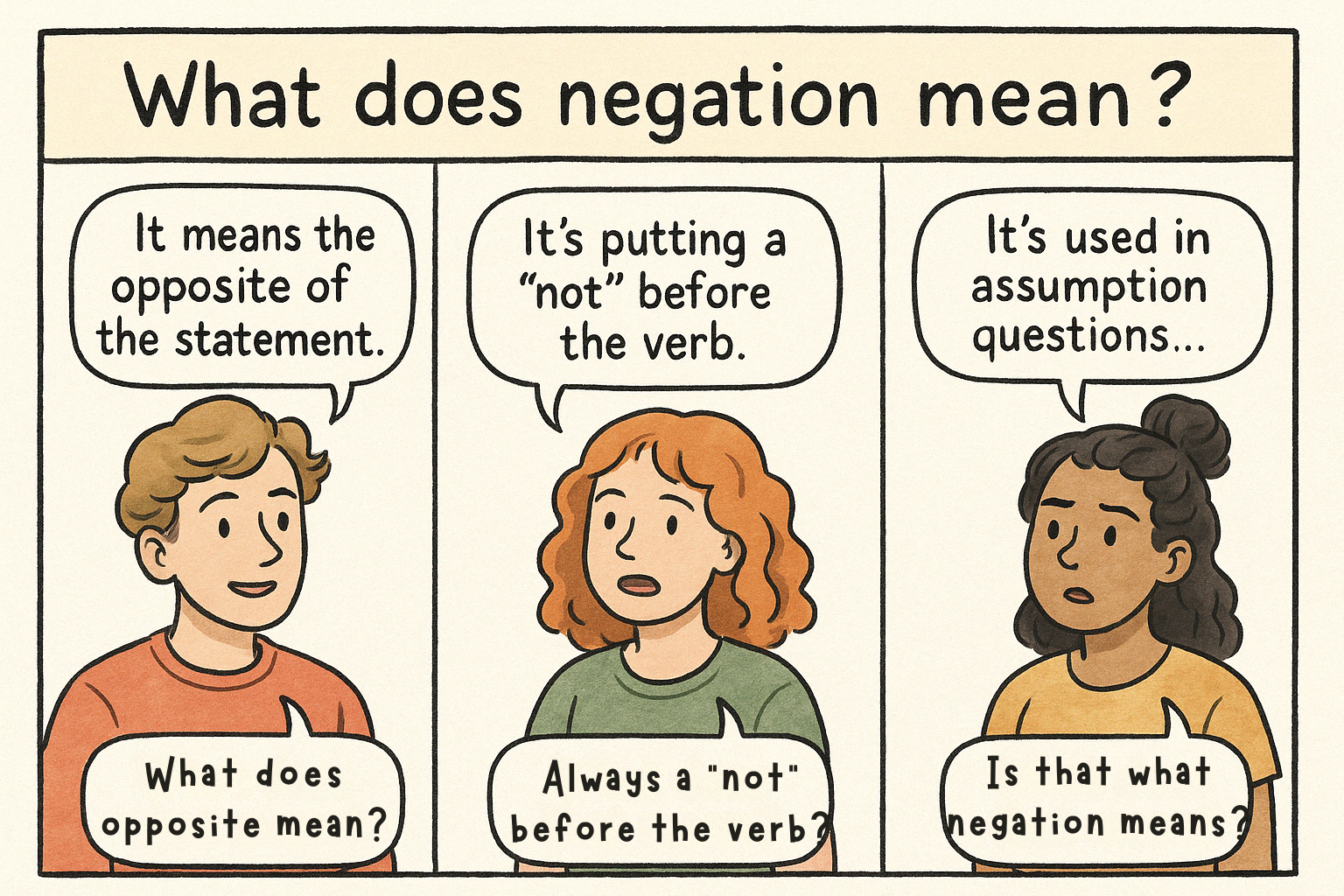
1. "Negation means the opposite of the statement."
So I ask, "What does opposite mean? Do you sort of flip the order of the words in the statement? What does opposite mean?"
They realize they don't actually know.
2. "Negation means putting a 'not' before the verb."
Then I ask, "Is that all? Just inserting a 'not'?" They pause and say, "Well, not always. Sometimes you have to change more than just the verb." So I ask again, "Okay, then what is the meaning of negation?"
No clear answer.
3. "Negation is what we use in assumption questions: negate an option and see if the argument falls apart."
I tell them, "Well, you are telling me how to use negation—you are not telling me the meaning of negation."
In all these cases, what stands out is this: students have been using the word negation for months, relying on it to solve assumption questions—and yet, they don't even know what it actually means.
How will they be able to get negation right consistently when they don't even know its exact meaning?
What does opposite mean.png [ 3.25 MiB | Viewed 1952 times ]
The Definition of Negation (Finally!)
It's actually extremely simple. Negation just means:
The statement is not true.
That's it.
Let's say we have a statement X. What is the negation of X?
It's just: "It is not true that X."
In Hindi, you might say: "Tu jhooth bol raha hai."
If someone says something, and you respond with "That's not true,"—you've just negated the statement.
This is all negation is. As simple as that.

ChatGPT Image Apr 20, 2025, 10_37_29 AM.png [ 1.9 MiB | Viewed 1809 times ]
Why the Definition Matters
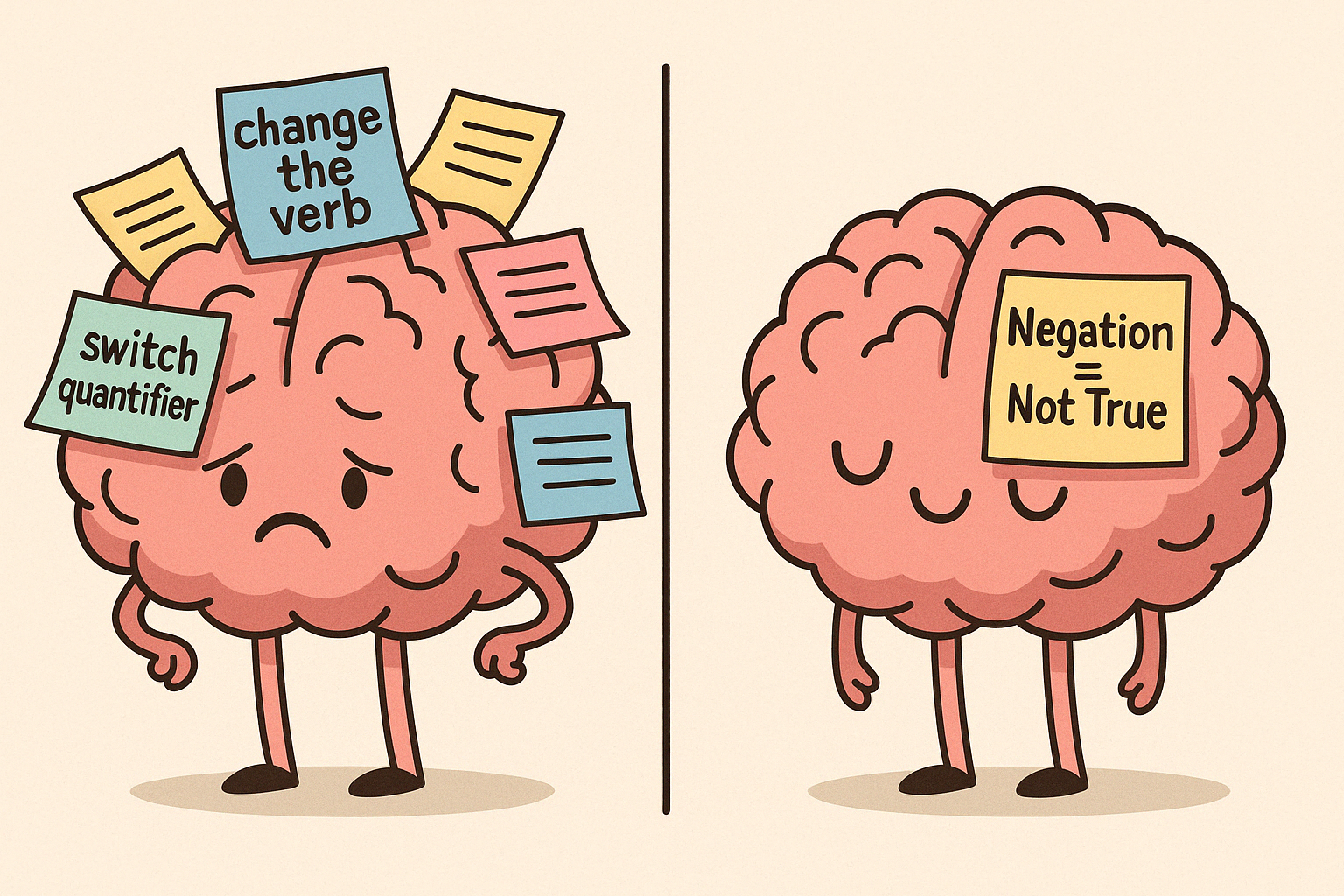
Now that we know the definition, it's important to keep it in mind always—because it's the definition that determines what part of the statement needs to be changed. Whether it's the quantifier, the verb, or both.
If you have been approaching negation in the way, "Oh, in this kind of statement I change the verb, in that kind I change the quantifier,"—you're just applying tricks. You don't understand the concept.
ChatGPT Image Apr 20, 2025, 10_40_11 AM.png [ 2.6 MiB | Viewed 1808 times ]
Misconception: "You only negate the verb or the quantifier—never both"
I've seen this on forums and in articles: "Negate either the verb or the quantifier—not both."
There are two problems here:
So clearly, both the quantifier and the verb changed.
Why? Because we followed the definition.
Let's again restate the definition of negation: Negation is simply that the statement is not true. Let's break it down.
I want you to understand that a very common mistake that people make is at the level of comprehension. That people don't even comprehend the statement while they are trying to negate the statement.
So you're trying to negate something that you don't really have a complete hold over. Naturally, there is a great chance that you will falter.
The same is the case here.
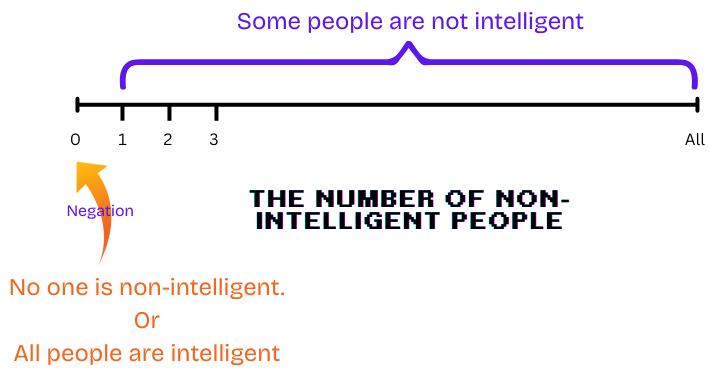
Some people are not intelligent.
What does that mean?
Some means at least one. And this is not a meaning of "some" specifically on the GMAT. This is the only meaning of "some".
So "Some people are not intelligent" means: There is at least one person who is not intelligent.
I want you to get a firm hold on the meaning of the statement before you try to negate it.
If you say, "This statement is not true," what do you mean? Think about it. That's what negation is—whatever you mean when you say that's not true.
0.png [ 23.97 KiB | Viewed 1731 times ]
For that statement to be not true, it must be the case that every person in the world is intelligent.
Only in that case, the statement "Some people are not intelligent" will be not true.
So that is why the negation is "All people are intelligent", or "Every person is intelligent."
That is the negation.
So, we arrive at the negation by using the meaning of negation.
Practical Negation Examples for GMAT Questions
Example 1: Joe is intelligent.
Negation: It is not true that Joe is intelligent.
What does that mean?
Does that mean that Joe is dumb? Not necessarily.
If somebody is saying, "Joe is intelligent," and you say, "No, that's not true," do you necessarily mean that he is dumb?
No.
It could be that he is dumb, or he is average, or somewhere in the middle.
We don't know that.
You are just refuting that he is intelligent.
So the negation is: Joe is not intelligent.
Example 2: Everyone is crazy.
Negation: It is not true that everyone is crazy.
What does that mean?
Let's say somebody is saying, "Everyone is crazy," and you say, "Well, that's not true."
What do you mean?
Do you mean that nobody is crazy?
While that's one possibility you might consider, simply saying "that's not true" doesn't necessarily imply nobody is crazy.
That person is saying everyone is crazy, and you are saying that's not true.
The only thing we can say for certain is that you don't agree that "everyone is crazy."
According to you, there must be at least one person who is not crazy.
So that is why the negation is: Some people are not crazy.
Again, you can see that we need to make two changes in the statement to get to the negation.
The quantifier everyone needs to be changed to some people, and the verb is needs to be changed to are not.
As I said earlier, it is the definition of negation that determines what needs to change in a statement to arrive at the negation.
Properties of a Statement and Its Negation
Let's say we have a statement X, and its negation ~X.
There are two key things that always hold:
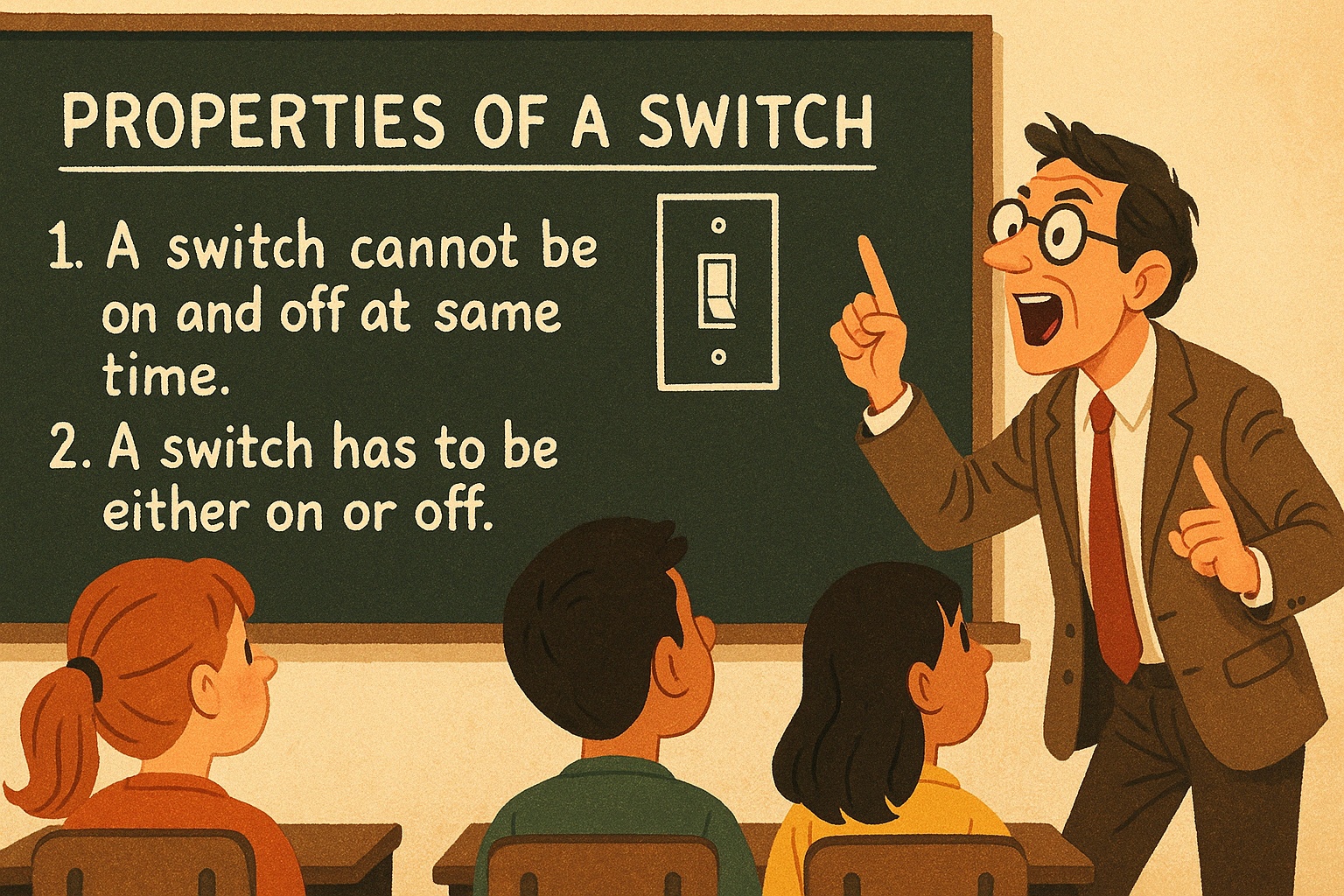
1. X and ~X can never be true at the same time.
Why is that the case?
Think about it—the negation is saying the statement X is not true. So, if X is true, the negation of X is not true.
And if the negation of X is true, then definitely X is not true.
2. X and ~X can never be false at the same time.
Why is it that they can never be false at the same time?
Let's say X is false. Then, by definition, negation of X will be true, because the negation was saying X is not true, which is the case here.
If the negation is false and the negation says X is not true, then X is true.
So we can see that they can never be false in any given situation.
If X is false, ~X must be true. And vice versa.
In short:
In any situation, one of the two must be true, the other must be false.
ChatGPT Image Apr 20, 2025, 11_30_51 AM.png [ 3.23 MiB | Viewed 1729 times ]
How This Helps
This understanding can be used to determine whether the two given statements are negation of each other or not.
Let's say you are considering statements X and Y, and you are thinking, "Well, statement Y seems to be a negation of statement X."
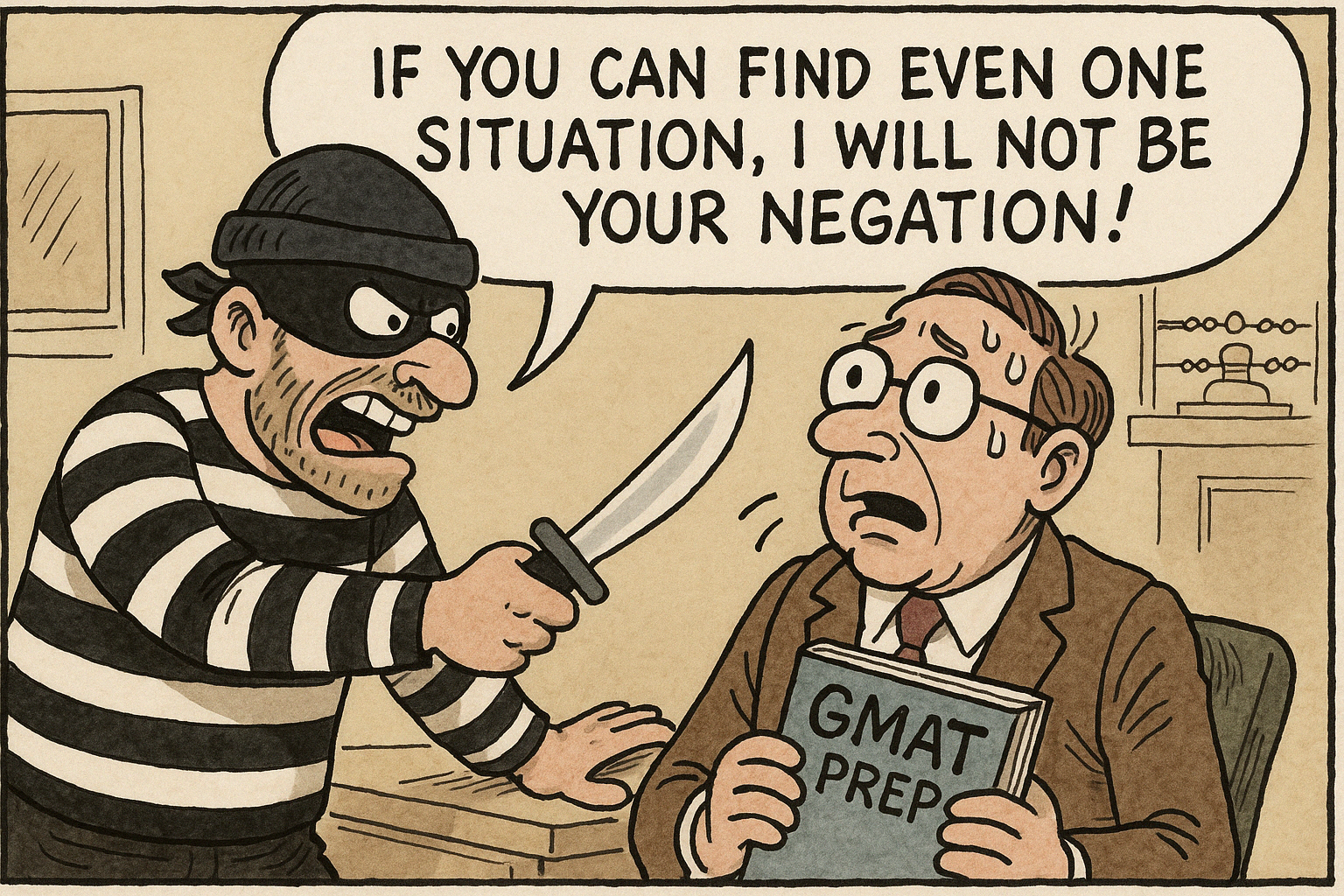
Now if you can come up with even one situation in which both statement X and statement Y can be true at the same time, then you can be absolutely sure that they are not negation of each other.
Or if you can come up with even one situation in which statement X and statement Y are false together, then you can also be absolutely sure that they are not negation of each other.
ChatGPT Image Apr 20, 2025, 11_41_15 AM.png [ 3.32 MiB | Viewed 1715 times ]
Essentially, we can use these points to verify whether a given pair of statements are negation of each other or not.
Let's say you come up with a negation statement, and you are wondering whether your statement is the correct negation—you can use this test:
If you can think of even one situation in which they (the original statement and your negation statement) can be true together or they can be false together, then you can be absolutely sure that you have not come up with the correct negation.
Negation Exists in Pairs
5-1=-5 Ox-1= O A negation of a negation is just the original..png [ 3 MiB | Viewed 1713 times ]
Another important thing that follows from the definition of negation is:
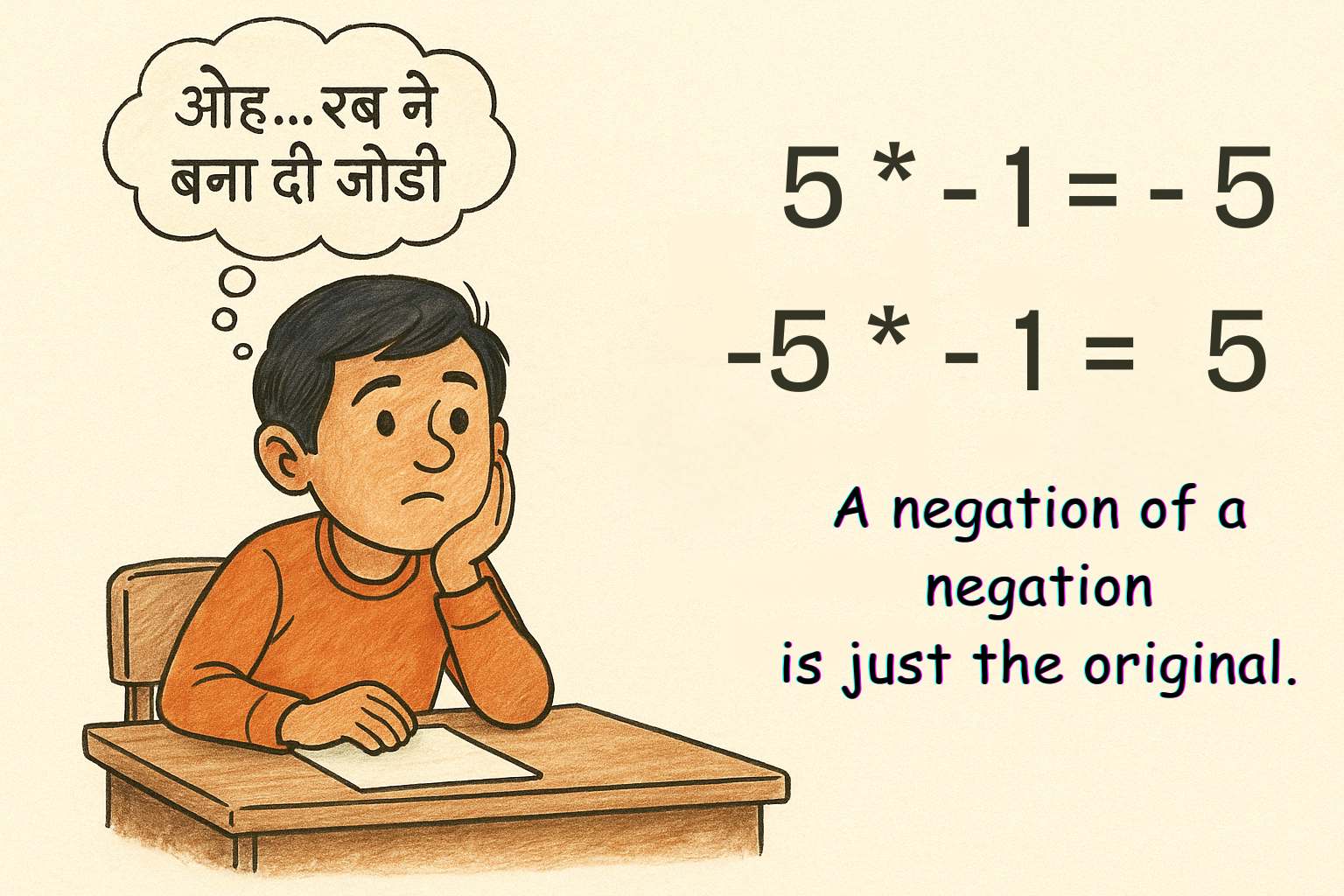
If Y is the negation of X, then X is the negation of Y.
Negation is always a two-way relationship. If one is the negation of the other, the other is the negation of the first.
Why is that the case?
The reason: think about the definition. The definition of negation is: X is not true.
And if I negate that also, what do I arrive at?
It is not true that X is not true.
This simply means that X is true, which is what the original statement was saying—X.
Let's go back to our earlier example:
Now negate the negation:
It is not true that Joe is not intelligent
What does that mean?
This means that Joe is intelligent, which brings us right back to the original statement.
It is always the case that negation exists in pairs, which means:
If X is a negation of Y, then automatically Y is the negation of X.
How to Use This
This gives you a way to cross-check. If you think you've found the negation of X (say, it's Y), try negating Y. Do you get back to X?
If yes, that supports the idea that Y is indeed the negation of X.
Now, of course, this isn't foolproof—you can make mistakes while applying it too—but it's still a helpful way to test your understanding.
Quick Reference Guide: Mastering Negation on the GMAT
Key Principles:
Negation is a fundamental concept that can significantly impact your performance on the GMAT, particularly when tackling assumption questions. Many test-takers struggle with this concept despite its importance, leading to unnecessary errors and missed opportunities for points. This guide aims to clarify what negation truly means, dispel common misconceptions, and provide you with reliable techniques to apply negation correctly every time you encounter it on the exam.
Understanding Negation on the GMAT
When I ask students to define negation—a concept that's central to solving assumption questions on the GMAT—I get a wide variety of answers. And these aren't students who've just started preparing. Most of them have been studying for months, have gone through one or even two courses. Still, their answers reveal something quite surprising.
Common (and Confusing) Answers
1. "Negation means the opposite of the statement."
So I ask, "What does opposite mean? Do you sort of flip the order of the words in the statement? What does opposite mean?"
They realize they don't actually know.
2. "Negation means putting a 'not' before the verb."
Then I ask, "Is that all? Just inserting a 'not'?" They pause and say, "Well, not always. Sometimes you have to change more than just the verb." So I ask again, "Okay, then what is the meaning of negation?"
No clear answer.
3. "Negation is what we use in assumption questions: negate an option and see if the argument falls apart."
I tell them, "Well, you are telling me how to use negation—you are not telling me the meaning of negation."
In all these cases, what stands out is this: students have been using the word negation for months, relying on it to solve assumption questions—and yet, they don't even know what it actually means.
How will they be able to get negation right consistently when they don't even know its exact meaning?
Attachment:
What does opposite mean.png [ 3.25 MiB | Viewed 1952 times ]
The Definition of Negation (Finally!)
It's actually extremely simple. Negation just means:
The statement is not true.
That's it.
Let's say we have a statement X. What is the negation of X?
It's just: "It is not true that X."
In Hindi, you might say: "Tu jhooth bol raha hai."
If someone says something, and you respond with "That's not true,"—you've just negated the statement.
This is all negation is. As simple as that.
Attachment:
ChatGPT Image Apr 20, 2025, 10_37_29 AM.png [ 1.9 MiB | Viewed 1809 times ]
Why the Definition Matters
Now that we know the definition, it's important to keep it in mind always—because it's the definition that determines what part of the statement needs to be changed. Whether it's the quantifier, the verb, or both.
If you have been approaching negation in the way, "Oh, in this kind of statement I change the verb, in that kind I change the quantifier,"—you're just applying tricks. You don't understand the concept.
Attachment:
ChatGPT Image Apr 20, 2025, 10_40_11 AM.png [ 2.6 MiB | Viewed 1808 times ]
Misconception: "You only negate the verb or the quantifier—never both"
I've seen this on forums and in articles: "Negate either the verb or the quantifier—not both."
There are two problems here:
- "Negating" parts of a sentence is flawed language. Negation is not applied to verbs or quantifiers; it's always applied to the idea. It doesn't make sense to say the verb is not true or the quantifier is not true. So if somebody is saying, "Okay, negate one of these two," the person doesn't even have a clear idea of what negation is.
Possibly, the person wants to say that you change either the verb or the quantifier, but not both. But that is also incorrect. There are situations when both the verb and the quantifier end up being changed in negation. - Sometimes both parts need to change.
Let's take the statement: "Some people are not intelligent."
- Its negation is: "All people are intelligent."Here, some changes to all, and are not changes to are.
So clearly, both the quantifier and the verb changed.
Why? Because we followed the definition.
Let's again restate the definition of negation: Negation is simply that the statement is not true. Let's break it down.
I want you to understand that a very common mistake that people make is at the level of comprehension. That people don't even comprehend the statement while they are trying to negate the statement.
So you're trying to negate something that you don't really have a complete hold over. Naturally, there is a great chance that you will falter.
The same is the case here.
Some people are not intelligent.
What does that mean?
Some means at least one. And this is not a meaning of "some" specifically on the GMAT. This is the only meaning of "some".
So "Some people are not intelligent" means: There is at least one person who is not intelligent.
I want you to get a firm hold on the meaning of the statement before you try to negate it.
If you say, "This statement is not true," what do you mean? Think about it. That's what negation is—whatever you mean when you say that's not true.
Attachment:
0.png [ 23.97 KiB | Viewed 1731 times ]
For that statement to be not true, it must be the case that every person in the world is intelligent.
Only in that case, the statement "Some people are not intelligent" will be not true.
So that is why the negation is "All people are intelligent", or "Every person is intelligent."
That is the negation.
So, we arrive at the negation by using the meaning of negation.
Practical Negation Examples for GMAT Questions
Example 1: Joe is intelligent.
Negation: It is not true that Joe is intelligent.
What does that mean?
Does that mean that Joe is dumb? Not necessarily.
If somebody is saying, "Joe is intelligent," and you say, "No, that's not true," do you necessarily mean that he is dumb?
No.
It could be that he is dumb, or he is average, or somewhere in the middle.
We don't know that.
You are just refuting that he is intelligent.
So the negation is: Joe is not intelligent.
Example 2: Everyone is crazy.
Negation: It is not true that everyone is crazy.
What does that mean?
Let's say somebody is saying, "Everyone is crazy," and you say, "Well, that's not true."
What do you mean?
Do you mean that nobody is crazy?
While that's one possibility you might consider, simply saying "that's not true" doesn't necessarily imply nobody is crazy.
That person is saying everyone is crazy, and you are saying that's not true.
The only thing we can say for certain is that you don't agree that "everyone is crazy."
According to you, there must be at least one person who is not crazy.
So that is why the negation is: Some people are not crazy.
Again, you can see that we need to make two changes in the statement to get to the negation.
The quantifier everyone needs to be changed to some people, and the verb is needs to be changed to are not.
As I said earlier, it is the definition of negation that determines what needs to change in a statement to arrive at the negation.
Properties of a Statement and Its Negation
Let's say we have a statement X, and its negation ~X.
There are two key things that always hold:
1. X and ~X can never be true at the same time.
Why is that the case?
Think about it—the negation is saying the statement X is not true. So, if X is true, the negation of X is not true.
And if the negation of X is true, then definitely X is not true.
2. X and ~X can never be false at the same time.
Why is it that they can never be false at the same time?
Let's say X is false. Then, by definition, negation of X will be true, because the negation was saying X is not true, which is the case here.
If the negation is false and the negation says X is not true, then X is true.
So we can see that they can never be false in any given situation.
If X is false, ~X must be true. And vice versa.
In short:
In any situation, one of the two must be true, the other must be false.
Attachment:
ChatGPT Image Apr 20, 2025, 11_30_51 AM.png [ 3.23 MiB | Viewed 1729 times ]
How This Helps
This understanding can be used to determine whether the two given statements are negation of each other or not.
Let's say you are considering statements X and Y, and you are thinking, "Well, statement Y seems to be a negation of statement X."
Now if you can come up with even one situation in which both statement X and statement Y can be true at the same time, then you can be absolutely sure that they are not negation of each other.
Or if you can come up with even one situation in which statement X and statement Y are false together, then you can also be absolutely sure that they are not negation of each other.
Attachment:
ChatGPT Image Apr 20, 2025, 11_41_15 AM.png [ 3.32 MiB | Viewed 1715 times ]
Essentially, we can use these points to verify whether a given pair of statements are negation of each other or not.
Let's say you come up with a negation statement, and you are wondering whether your statement is the correct negation—you can use this test:
If you can think of even one situation in which they (the original statement and your negation statement) can be true together or they can be false together, then you can be absolutely sure that you have not come up with the correct negation.
Negation Exists in Pairs
Attachment:
5-1=-5 Ox-1= O A negation of a negation is just the original..png [ 3 MiB | Viewed 1713 times ]
Another important thing that follows from the definition of negation is:
If Y is the negation of X, then X is the negation of Y.
Negation is always a two-way relationship. If one is the negation of the other, the other is the negation of the first.
Why is that the case?
The reason: think about the definition. The definition of negation is: X is not true.
And if I negate that also, what do I arrive at?
It is not true that X is not true.
This simply means that X is true, which is what the original statement was saying—X.
Let's go back to our earlier example:
- Statement: Joe is intelligent.
- Negation: Joe is not intelligent.
Now negate the negation:
It is not true that Joe is not intelligent
What does that mean?
This means that Joe is intelligent, which brings us right back to the original statement.
It is always the case that negation exists in pairs, which means:
If X is a negation of Y, then automatically Y is the negation of X.
How to Use This
This gives you a way to cross-check. If you think you've found the negation of X (say, it's Y), try negating Y. Do you get back to X?
If yes, that supports the idea that Y is indeed the negation of X.
Now, of course, this isn't foolproof—you can make mistakes while applying it too—but it's still a helpful way to test your understanding.
Quick Reference Guide: Mastering Negation on the GMAT
Key Principles:
- Negation means: "The statement is not true"
- Always understand the statement fully before attempting to negate it
- The negation of a negation returns to the original statement
- X and its negation (~X) can never both be true or both be false
ChiranjeevSingh
Expert
Tutor
Expert reply
09 Jun 2025, 20:30
Kudos
Bookmarks
A few exercises
How to Identify the Negation of a Statement
There are essentially two independent ways to figure out whether a given option is the negation of a given statement. You don’t have to use both methods every time — just use the one that feels more comfortable to you. However, for clarity, I’ll often use both methods in these exercises.
Method 1: Definition-Based Approach
Method 2: Two-Pointer Test (as discussed in the article)
A statement and its negation must satisfy both of the following conditions:
So:
You can use either method — or switch between them depending on the option — as they are completely independent ways of reasoning.
Now, let’s begin the drill.
Statement:
Some people are crazy.
Option A:
Some people are not crazy.
Question:
Is this a correct negation of the original statement?
Answer:
No, this is not a correct negation.
Explanation:
These two statements can be true at the same time.
It’s easy to imagine a scenario where both statements are true. For example, if there are 100 people in the world, and 50 of them are crazy while 50 are not, then both the original statement and the option are true simultaneously.
----------------------------------------
Statement:
Some people are crazy.
Option B:
None of the people are crazy.
Question:
Is this a correct negation of the original statement?
Answer:
Yes, this is a correct negation.
Explanation:
Let’s break it down in two ways:
1. By meaning:
So, whether you go by the definition of negation or the two-pointer test, Option B is the correct negation of the original statement.
----------------------------------------
Statement:
All citizens of India have a right to vote.
Option A:
None of the citizens of India have a right to vote.
Question:
Is this a correct negation of the original statement?
Answer:
No, this is not a correct negation.
Explanation:
Let’s examine this using two approaches:
1. Using the two-pointer test:
So they can both be false at the same time — which means this option fails the two-pointer test and is not a proper negation.
2. Using the definition of negation:
Therefore, Option A is not a correct negation of the original statement.
----------------------------------------
Statement:
All citizens of India have a right to vote.
Option B:
Some of the citizens of India do not have a right to vote.
Question:
Is this a correct negation of the original statement?
Answer:
Yes, this is a correct negation.
Explanation:
Let’s understand this through the meaning of negation:
You can also verify this using the two-pointer test:
Thus, Option B is the correct negation.
----------------------------------------
Statement:
People who live in America are rich.
Option A:
People who do not live in America are rich.
Question:
Is this a correct negation of the original statement?
Answer:
No, this is not a correct negation.
Explanation:
These two statements talk about two different sets of people:
Because they refer to different groups, the truth of one statement does not directly affect the truth of the other.
Since both statements can be true together or false together, they are not negation of each other.
Hence, Option A is not a correct negation of the original statement.
----------------------------------------
Statement:
People who live in America are rich.
Option B:
People who do not live in America are not rich.
Question:
Is this a correct negation of the original statement?
Answer:
No, this is not a correct negation.
Explanation:
Once again, the original statement and the option are referring to two different sets of people:
Since they focus on different groups, it’s possible for both statements to be true together or false together:
Because both statements can be true or false at the same time, this option does not qualify as a proper negation of the original statement.
----------------------------------------
Statement:
People who live in America are rich.
Option C:
People who live in America are not rich.
Question:
Is this a correct negation of the original statement?
Answer:
No, this is not a correct negation.
Explanation:
Let’s carefully examine what both the statement and the option are actually saying.
So:
Now, why is this not a valid negation?
1. Using the definition of negation:
If someone says everybody living in America is rich and you respond with that’s not true, it doesn’t mean you’re claiming nobody in America is rich. You might simply mean that some people are not rich. So the two aren’t necessarily opposed in meaning.
2. Using the two-pointer test:
Can both be false at the same time? Yes.
So both can be false together — which means Option C does not serve as a proper negation of the original statement.
----------------------------------------
Statement:
People who live in America are rich.
Option D:
Some people who live in America are not rich.
Question:
Is this a correct negation of the original statement?
Answer:
Yes, this is a correct negation.
Explanation:
That is exactly what Option D expresses:
Some people who live in America are not rich.
So Option D directly challenges the original statement in a way that aligns with the definition of negation. Therefore, Option D is the correct negation.
----------------------------------------
Statement:
Only people who live in America are rich.
Option A:
People who do not live in America are rich.
Question:
Is this a correct negation of the original statement?
Answer:
No, this is not a correct negation.
Explanation:
Let’s first understand what the option and the statement mean:
Now, let’s evaluate:
1. Using the definition of negation:
If someone says only people who live in America are rich, and you respond with that’s not true, you’re not necessarily claiming that everyone outside America is rich. You might simply mean that there are some people outside America who are rich. So Option A goes beyond the negation — it says more than is needed and thus does not qualify as a proper negation.
2. Using the two-pointer test:
Because both the statement and Option A can be false together, Option A does not qualify as a proper negation of the original statement.
----------------------------------------
Statement:
Only people who live in America are rich.
Option B:
Some people who do not live in America are rich.
Question:
Is this a correct negation of the original statement?
Answer:
Yes, this is a correct negation.
Explanation:
Let’s unpack the meaning:
Now, think about it from the lens of negation:
So, based on the meaning and the definition of negation, Option B is the correct negation of the original statement.
----------------------------------------
Statement:
Only people who live in America are rich.
Option C:
Some people who live in America are not rich.
Question:
Is this a correct negation of the original statement?
Answer:
No, this is not a correct negation.
Explanation:
Let’s carefully interpret both the statement and the option:
Now, ask: does Option C challenge the original statement?
No, it doesn’t.
Both the statement and Option C can be true at the same time. For example:
Then:
Since the statement and Option C can be true together, Option C is not a proper negation of the original statement.
---------------------
Part 2 of the negation series dives deeper into:
Part 3 of the series focuses on:
The final part, Part 4, includes a Comprehensive Practice Drill featuring a wide range of GMAT-style sentences for you to negate, along with detailed solutions.
Here's the link to Part 2 of the negation series. (At the end of part 2, you will find a link to part 3)
How to Identify the Negation of a Statement
There are essentially two independent ways to figure out whether a given option is the negation of a given statement. You don’t have to use both methods every time — just use the one that feels more comfortable to you. However, for clarity, I’ll often use both methods in these exercises.
Method 1: Definition-Based Approach
- The negation of a statement is simply: “The statement is not true.”
- So, take the original statement and imagine what it would mean to say: “That’s not true.”
- Now compare that meaning with the given option.
- If the option says exactly what you mean by rejecting the original statement, then the option is the correct negation.
Method 2: Two-Pointer Test (as discussed in the article)
A statement and its negation must satisfy both of the following conditions:
- They cannot be true together.
- They cannot be false together.
So:
- If you can find even one scenario where both the original statement and the option are true together or false together, then the option is not a negation.
- But if you can confidently say that there is no possible situation where they are true or false together, then the option is the correct negation.
You can use either method — or switch between them depending on the option — as they are completely independent ways of reasoning.
Now, let’s begin the drill.
Statement:
Some people are crazy.
Option A:
Some people are not crazy.
Question:
Is this a correct negation of the original statement?
Answer:
No, this is not a correct negation.
Explanation:
These two statements can be true at the same time.
- "Some people are crazy" means at least one person is crazy.
- "Some people are not crazy" means at least one person is not crazy.
It’s easy to imagine a scenario where both statements are true. For example, if there are 100 people in the world, and 50 of them are crazy while 50 are not, then both the original statement and the option are true simultaneously.
----------------------------------------
Statement:
Some people are crazy.
Option B:
None of the people are crazy.
Question:
Is this a correct negation of the original statement?
Answer:
Yes, this is a correct negation.
Explanation:
Let’s break it down in two ways:
1. By meaning:
- The original statement says at least one person is crazy.
- The negation should reject that idea.
- So, to say none of the people are crazy is to assert that even one person is not crazy — which directly contradicts the original.
- Can both statements be true together?
No. If nobody is crazy, then it's false to say some people are crazy.
- Can both statements be false together?
No. If it's false that none of the people are crazy, that means at least one person is crazy — which makes the original statement true.
So, whether you go by the definition of negation or the two-pointer test, Option B is the correct negation of the original statement.
----------------------------------------
Statement:
All citizens of India have a right to vote.
Option A:
None of the citizens of India have a right to vote.
Question:
Is this a correct negation of the original statement?
Answer:
No, this is not a correct negation.
Explanation:
Let’s examine this using two approaches:
1. Using the two-pointer test:
- Can both statements be true together?
No. If all citizens have the right to vote, then it’s impossible for none of them to have that right. So they can’t be true at the same time.
- Can both statements be false together?
Yes. Suppose 50% of the citizens have the right to vote, and 50% don’t. In this scenario:- The original statement ("all citizens...") is false.
- The option ("none of the citizens...") is also false.
So they can both be false at the same time — which means this option fails the two-pointer test and is not a proper negation.
2. Using the definition of negation:
- If someone says all citizens of India have a right to vote and you disagree, you're rejecting the idea that every single citizen has this right.
- But rejecting all doesn’t mean asserting none.
Therefore, Option A is not a correct negation of the original statement.
----------------------------------------
Statement:
All citizens of India have a right to vote.
Option B:
Some of the citizens of India do not have a right to vote.
Question:
Is this a correct negation of the original statement?
Answer:
Yes, this is a correct negation.
Explanation:
Let’s understand this through the meaning of negation:
- The original statement says every citizen of India has the right to vote.
- To negate that, you must deny that all citizens have that right — and that happens when at least one citizen does not have the right.
- That’s exactly what Option B says: Some of the citizens do not have a right to vote.
You can also verify this using the two-pointer test:
- They can’t be true at the same time.
- They can’t be false at the same time.
Thus, Option B is the correct negation.
----------------------------------------
Statement:
People who live in America are rich.
Option A:
People who do not live in America are rich.
Question:
Is this a correct negation of the original statement?
Answer:
No, this is not a correct negation.
Explanation:
These two statements talk about two different sets of people:
- The original statement is about people who live in America.
- The option is about people who do not live in America.
Because they refer to different groups, the truth of one statement does not directly affect the truth of the other.
- Both can be true: It’s possible that people in America are rich and people outside America are also rich.
- Both can be false: It’s also possible that neither group is rich.
Since both statements can be true together or false together, they are not negation of each other.
Hence, Option A is not a correct negation of the original statement.
----------------------------------------
Statement:
People who live in America are rich.
Option B:
People who do not live in America are not rich.
Question:
Is this a correct negation of the original statement?
Answer:
No, this is not a correct negation.
Explanation:
Once again, the original statement and the option are referring to two different sets of people:
- The original statement refers to people who live in America.
- The option refers to people who do not live in America.
Since they focus on different groups, it’s possible for both statements to be true together or false together:
- True together: People living in America are rich, and people outside America are not rich.
- False together: People living in America are not rich, and people outside America are rich.
Because both statements can be true or false at the same time, this option does not qualify as a proper negation of the original statement.
----------------------------------------
Statement:
People who live in America are rich.
Option C:
People who live in America are not rich.
Question:
Is this a correct negation of the original statement?
Answer:
No, this is not a correct negation.
Explanation:
Let’s carefully examine what both the statement and the option are actually saying.
- Both the statement and the option refer to the same group: people who live in America.
- Since there’s no qualifier like some or most, the default interpretation is that the statement is about all people who live in America.
So:
- The original statement means: All people who live in America are rich.
- Option C means: All people who live in America are not rich — or in other words, nobody who lives in America is rich.
Now, why is this not a valid negation?
1. Using the definition of negation:
If someone says everybody living in America is rich and you respond with that’s not true, it doesn’t mean you’re claiming nobody in America is rich. You might simply mean that some people are not rich. So the two aren’t necessarily opposed in meaning.
2. Using the two-pointer test:
Can both be false at the same time? Yes.
- Suppose 50% of the people living in America are rich and 50% are not.
- Then the statement (everyone is rich) is false.
- And the option (no one is rich) is also false.
So both can be false together — which means Option C does not serve as a proper negation of the original statement.
----------------------------------------
Statement:
People who live in America are rich.
Option D:
Some people who live in America are not rich.
Question:
Is this a correct negation of the original statement?
Answer:
Yes, this is a correct negation.
Explanation:
- The original statement, when read without any qualifiers, means: All people who live in America are rich.
- If you say that’s not true, what you’re really saying is that not everyone in America is rich — that at least one person living in America is not rich.
That is exactly what Option D expresses:
Some people who live in America are not rich.
So Option D directly challenges the original statement in a way that aligns with the definition of negation. Therefore, Option D is the correct negation.
----------------------------------------
Statement:
Only people who live in America are rich.
Option A:
People who do not live in America are rich.
Question:
Is this a correct negation of the original statement?
Answer:
No, this is not a correct negation.
Explanation:
Let’s first understand what the option and the statement mean:
- The original statement says: Only people who live in America are rich.
This means that no one outside America is rich — all rich people live in America.
- Option A says: People who do not live in America are rich.
Since there’s no qualifier, this is interpreted as: All people who do not live in America are rich — that is, everyone outside America is rich.
Now, let’s evaluate:
1. Using the definition of negation:
If someone says only people who live in America are rich, and you respond with that’s not true, you’re not necessarily claiming that everyone outside America is rich. You might simply mean that there are some people outside America who are rich. So Option A goes beyond the negation — it says more than is needed and thus does not qualify as a proper negation.
2. Using the two-pointer test:
- Can both statements be false together? Yes.
For example, suppose:
- A few people outside America are rich, and
- Many people outside America are not rich.
Then:
- The original statement is false (since people outside America are also rich).
- Option A is also false (because not all people outside America are rich).
So both can be false at the same time.
Because both the statement and Option A can be false together, Option A does not qualify as a proper negation of the original statement.
----------------------------------------
Statement:
Only people who live in America are rich.
Option B:
Some people who do not live in America are rich.
Question:
Is this a correct negation of the original statement?
Answer:
Yes, this is a correct negation.
Explanation:
Let’s unpack the meaning:
- The original statement says: Only people who live in America are rich.
This means that no one outside America is rich — all rich people are from America.
- Option B says: Some people who do not live in America are rich.
That is, at least one person outside America is rich.
Now, think about it from the lens of negation:
- If someone says only people living in America are rich and you say that’s not true, you’re rejecting the idea that all rich people are confined to America.
- You’re not saying that everyone outside America is rich — just that at least one rich person is not from America.
- That’s exactly what Option B expresses.
So, based on the meaning and the definition of negation, Option B is the correct negation of the original statement.
----------------------------------------
Statement:
Only people who live in America are rich.
Option C:
Some people who live in America are not rich.
Question:
Is this a correct negation of the original statement?
Answer:
No, this is not a correct negation.
Explanation:
Let’s carefully interpret both the statement and the option:
- The original statement says: Only people who live in America are rich.
This means that no one outside America is rich — but it says nothing about whether all people in America are rich.
In other words, it allows for the possibility that some people in America are not rich.
- Option C says: Some people who live in America are not rich.
That is, at least one person living in America is not rich.
Now, ask: does Option C challenge the original statement?
No, it doesn’t.
Both the statement and Option C can be true at the same time. For example:
- Suppose there are 5 rich people, all living in America, and
- There are many others in America who are not rich.
Then:
- The original statement is true (since all rich people are in America), and
- Option C is also true (since not everyone in America is rich).
Since the statement and Option C can be true together, Option C is not a proper negation of the original statement.
---------------------
Part 2 of the negation series dives deeper into:
- How to correctly negate various sentence structures and quantifiers you’ll encounter on the GMAT (like “All,” “Some,” “Only,” “If...then,” etc.).
- A common point of confusion: The vital difference between Negation and Contradiction.
Part 3 of the series focuses on:
- Another frequent error: Correctly interpreting and negating statements about Groups (Individuals vs. the Whole).
- The underlying issue of Comprehension – ensuring you understand the statement before you try to negate it.
The final part, Part 4, includes a Comprehensive Practice Drill featuring a wide range of GMAT-style sentences for you to negate, along with detailed solutions.
Here's the link to Part 2 of the negation series. (At the end of part 2, you will find a link to part 3)

MagicMeat
Joined: 10 Aug 2026
Last visit: 05 Sep 2026
Posts: 27
Own Kudos:
Given Kudos: 26
Location: India
Schools: Stern '27 ISB '27 MiM '27 HEC MiM '27 INSEAD MiM '27
GPA: 8.49
21 Aug 2026, 20:18
Kudos
Bookmarks
wouldnt the below fail the property test: cant both exist together:
some people who live in america are not rich;; and people who live in america are rich--
example: people in general in america are rich (99%)... only some people are not rich? (1%)? is this wrong because the 1st statement implies "All" and not "most"?
some people who live in america are not rich;; and people who live in america are rich--
example: people in general in america are rich (99%)... only some people are not rich? (1%)? is this wrong because the 1st statement implies "All" and not "most"?
Quote:





