Last visit was: 22 Apr 2026, 20:15 It is currently 22 Apr 2026, 20:15
Close
GMAT Club Daily Prep
Thank you for using the timer - this advanced tool can estimate your performance and suggest more practice questions. We have subscribed you to Daily Prep Questions via email.

Customized
for You

we will pick new questions that match your level based on your Timer History

Track
Your Progress

every week, we’ll send you an estimated GMAT score based on your performance

Practice
Pays

we will pick new questions that match your level based on your Timer History
Not interested in getting valuable practice questions and articles delivered to your email? No problem, unsubscribe here.
Close
Request Expert Reply
Confirm Cancel
User avatar
GMATD11
Joined: 10 Nov 2010
Last visit: 25 Sep 2012
Posts: 128
Own Kudos:
3,328
 [70]
Given Kudos: 22
Location: India
Concentration: Strategy, Operations
GMAT 1: 520 Q42 V19
GMAT 2: 540 Q44 V21
WE:Information Technology (Computer Software)
GMAT 2: 540 Q44 V21
Posts: 128
Kudos: 3,328
 [70]
3
Kudos
Add Kudos
67
Bookmarks
Bookmark this Post
Most Helpful Reply
User avatar
Bunuel
User avatar
Math Expert
Joined: 02 Sep 2009
Last visit: 22 Apr 2026
Posts: 109,754
Own Kudos:
Given Kudos: 105,823
Products:
Expert
Expert reply
Active GMAT Club Expert! Tag them with @ followed by their username for a faster response.
Posts: 109,754
Kudos: 810,679
 [39]
17
Kudos
Add Kudos
22
Bookmarks
Bookmark this Post
User avatar
KarishmaB
Joined: 16 Oct 2010
Last visit: 21 Apr 2026
Posts: 16,439
Own Kudos:
79,388
 [14]
Given Kudos: 484
Location: Pune, India
Expert
Expert reply
Active GMAT Club Expert! Tag them with @ followed by their username for a faster response.
Posts: 16,439
Kudos: 79,388
 [14]
9
Kudos
Add Kudos
5
Bookmarks
Bookmark this Post
General Discussion
User avatar
beyondgmatscore
Joined: 14 Feb 2011
Last visit: 10 Nov 2015
Posts: 101
Own Kudos:
Given Kudos: 3
Posts: 101
Kudos: 442
Kudos
Add Kudos
Bookmarks
Bookmark this Post
for 16, cube root is 2* cube root of 2 and positive square root is 4, so @n = 2*2^(1/3)*4 = 8 *2(1/3) so greater than 8 or greater than 0.5n

Similarly for 64, it is 4*8 = 32 = 0.5*64, so B is correct.

For E, the cube root is 9 and positive square root is 27, so 27*9 is not equal to 0.5*729, so incorrect
avatar
asdlkj
Joined: 28 Feb 2011
Last visit: 09 Mar 2011
Posts: 2
Posts: 2
Kudos: 0
Kudos
Add Kudos
Bookmarks
Bookmark this Post
n pow(1/3)* n pow(1/2)=0.5n

n pow (5/6)= 0.5n

n pow(1/6)=2

n= 64
avatar
sushantarora
Joined: 14 Apr 2011
Last visit: 21 Jan 2016
Posts: 6
Own Kudos:
Posts: 6
Kudos: 5
Kudos
Add Kudos
Bookmarks
Bookmark this Post
the cube root of what integer power of 2 is closest to 50?

1)16 2) 17 3)18 4 ) 19 5) 20

can u pls help me in this by a quicker solution???????
User avatar
Spidy001
Joined: 01 Feb 2011
Last visit: 16 Feb 2015
Posts: 298
Own Kudos:
Given Kudos: 42
Posts: 298
Kudos: 355
Kudos
Add Kudos
Bookmarks
Bookmark this Post
n^(5/6) = (1/2)n

=> n^6-2^6*n^5 = 0

=> n =0 or 64.

Answer is B.
User avatar
gladvijay
Joined: 27 Feb 2011
Last visit: 08 Sep 2011
Posts: 22
Own Kudos:
9
 [1]
Given Kudos: 9
Posts: 22
Kudos: 9
 [1]
1
Kudos
Add Kudos
Bookmarks
Bookmark this Post
GMATD11
From B and E whts wrong with E

50% of 729 is not an integer .. whereas @(729) is an integer
User avatar
KarishmaB
Joined: 16 Oct 2010
Last visit: 21 Apr 2026
Posts: 16,439
Own Kudos:
79,388
 [2]
Given Kudos: 484
Location: Pune, India
Expert
Expert reply
Active GMAT Club Expert! Tag them with @ followed by their username for a faster response.
Posts: 16,439
Kudos: 79,388
 [2]
2
Kudos
Add Kudos
Bookmarks
Bookmark this Post
sushantarora
the cube root of what integer power of 2 is closest to 50?

1)16 2) 17 3)18 4 ) 19 5) 20

can u pls help me in this by a quicker solution???????

Look at the powers of 2.

2^1 = 2
2^2 = 4
2^3 = 8
2^4 = 16
2^5 = 32
2^6 = 64
2^7 = 128
Since it is an exponential increase, the result increases much more as you go to higher and higher powers.
Which powers of 2 are around 50?
2^5 = 32
2^6 = 64
50 is almost in the middle of the two of them but closer to 64. Also, the result increases more with higher powers so I would expect 50 to be almost 2^(5.6) or a little higher.

If you find the cube root of 2^18, you will get (2^18)^(1/3) = 2^6
If you find the cube root of 2^17, you will get (2^17)^(1/3) = 2^(5.667)
This is the closest. Answer is 17.
avatar
sushantarora
Joined: 14 Apr 2011
Last visit: 21 Jan 2016
Posts: 6
Own Kudos:
Posts: 6
Kudos: 5
Kudos
Add Kudos
Bookmarks
Bookmark this Post
hi karishma,

seems like the best and easiest ans .. thank you so much .
User avatar
erikvm
Joined: 26 Feb 2015
Last visit: 19 Mar 2017
Posts: 92
Own Kudos:
Given Kudos: 43
Posts: 92
Kudos: 236
Kudos
Add Kudos
Bookmarks
Bookmark this Post
VeritasPrepKarishma
GMATD11
From B and E whts wrong with E

Just follow the rules of exponents. Answer will follow.
Cube root is the power of 1/3. Square root is the power of 1/2

\(n^{\frac{1}{3}}*n^{\frac{1}{2}} = \frac{n}{2}\)
You need to find n. So bring all n's together on one side of the equation and everything else on the other side.

Adding the exponents, \(n^{\frac{5}{6}} = \frac{n}{2}\)
Clubbing n's together, \(2 = n^{1-\frac{5}{6}}\)
\(n = 2^6 = 64\)

Hence it cannot be 729. If in the question, rather than half, we had a third, answer would have been 729.

I really need to study these formulas, where do I suggest I go?
User avatar
KarishmaB
Joined: 16 Oct 2010
Last visit: 21 Apr 2026
Posts: 16,439
Own Kudos:
Given Kudos: 484
Location: Pune, India
Expert
Expert reply
Active GMAT Club Expert! Tag them with @ followed by their username for a faster response.
Posts: 16,439
Kudos: 79,388
Kudos
Add Kudos
Bookmarks
Bookmark this Post
erikvm
VeritasPrepKarishma
GMATD11
From B and E whts wrong with E

Just follow the rules of exponents. Answer will follow.
Cube root is the power of 1/3. Square root is the power of 1/2

\(n^{\frac{1}{3}}*n^{\frac{1}{2}} = \frac{n}{2}\)
You need to find n. So bring all n's together on one side of the equation and everything else on the other side.

Adding the exponents, \(n^{\frac{5}{6}} = \frac{n}{2}\)
Clubbing n's together, \(2 = n^{1-\frac{5}{6}}\)
\(n = 2^6 = 64\)

Hence it cannot be 729. If in the question, rather than half, we had a third, answer would have been 729.

I really need to study these formulas, where do I suggest I go?

Check out the blog posts on the link given in my signature below.
User avatar
ScottTargetTestPrep
User avatar
Target Test Prep Representative
Joined: 14 Oct 2015
Last visit: 22 Apr 2026
Posts: 22,278
Own Kudos:
26,528
 [2]
Given Kudos: 302
Status:Founder & CEO
Affiliations: Target Test Prep
Location: United States (CA)
Expert
Expert reply
Active GMAT Club Expert! Tag them with @ followed by their username for a faster response.
Posts: 22,278
Kudos: 26,528
 [2]
1
Kudos
Add Kudos
1
Bookmarks
Bookmark this Post
GMATD11
If @(n) is defined as the product of the cube root of n and the positive square root of n, then for what number n does @(n)=50 percent of n?

A. 16
B. 64
C. 100
D. 144
E. 729
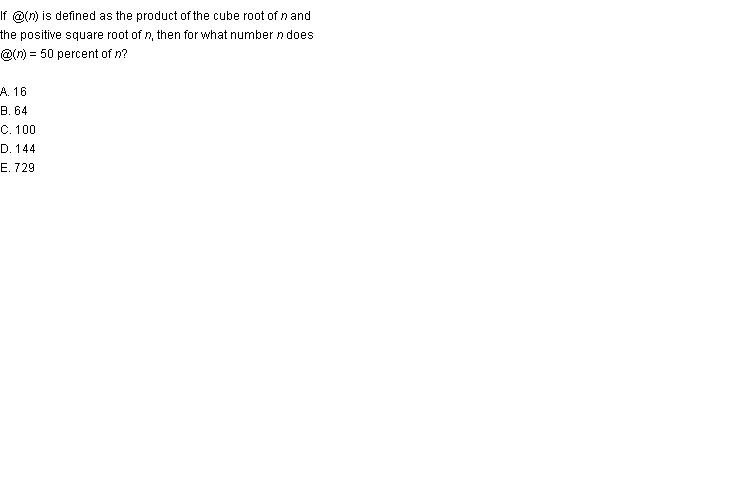
We are given that @(n) is defined as the product of the cube root of n and the positive square root of n.

We need to determine for what number n does @(n) = 50 percent of n.

We see that @n = (∛n)(√n) = (n^(⅓))(n^(½)) = n^(⅓ + ½) = n^(⅚)

We need to determine a value for n when:

n^(⅚) = 0.5n

2n^(⅚) = n

2 = n/n^(⅚)

2 = n^(⅙)

2^6 = n

n = 64

Answer: B
User avatar
TheGuyDangerous
User avatar
Current Student
Joined: 10 Sep 2019
Last visit: 11 Dec 2022
Posts: 137
Own Kudos:
Given Kudos: 59
Location: India
Concentration: Social Entrepreneurship, Healthcare
GMAT 1: 680 Q49 V33
GMAT 2: 720 Q50 V37
GRE 1: Q167 V159
GPA: 2.59
WE:Project Management (Non-Profit and Government)
Products:
Kudos
Add Kudos
Bookmarks
Bookmark this Post
This can be written as (n)^1/3 * (n)^1/2 = 0.5n

= (n)^5/6 = 0.5n

= (n)^1/6 = 2

=> n = 2^6

=> n = 64

Ans B
User avatar
QuantMadeEasy
Joined: 28 Feb 2014
Last visit: 01 Mar 2026
Posts: 502
Own Kudos:
Given Kudos: 78
Location: India
Concentration: General Management, International Business
GPA: 3.97
WE:Engineering (Education)
Posts: 502
Kudos: 801
Kudos
Add Kudos
Bookmarks
Bookmark this Post
GMATD11
If @(n) is defined as the product of the cube root of n and the positive square root of n, then for what number n does @(n)=50 percent of n?

A. 16
B. 64
C. 100
D. 144
E. 729
@(n) = n^1/3 x n^1/2 = n^5/6

According to the condition
n^5/6 = n/2
--> 2 = n^1/6
--> n =64

B is correct.
User avatar
bumpbot
User avatar
Non-Human User
Joined: 09 Sep 2013
Last visit: 04 Jan 2021
Posts: 38,965
Own Kudos:
Posts: 38,965
Kudos: 1,117
Kudos
Add Kudos
Bookmarks
Bookmark this Post
Automated notice from GMAT Club BumpBot:

A member just gave Kudos to this thread, showing it’s still useful. I’ve bumped it to the top so more people can benefit. Feel free to add your own questions or solutions.

This post was generated automatically.
Moderators:
Math Expert
109754 posts
Tuck School Moderator
853 posts


