Last visit was: 23 Apr 2026, 05:07 It is currently 23 Apr 2026, 05:07
Close
GMAT Club Daily Prep
Thank you for using the timer - this advanced tool can estimate your performance and suggest more practice questions. We have subscribed you to Daily Prep Questions via email.

Customized
for You

we will pick new questions that match your level based on your Timer History

Track
Your Progress

every week, we’ll send you an estimated GMAT score based on your performance

Practice
Pays

we will pick new questions that match your level based on your Timer History
Not interested in getting valuable practice questions and articles delivered to your email? No problem, unsubscribe here.
Close
Request Expert Reply
Confirm Cancel
User avatar
AnkitK
Joined: 11 Feb 2011
Last visit: 01 Dec 2012
Posts: 82
Own Kudos:
1,383
 [104]
Given Kudos: 21
Posts: 82
Kudos: 1,383
 [104]
2
Kudos
Add Kudos
102
Bookmarks
Bookmark this Post
Most Helpful Reply
User avatar
Bunuel
User avatar
Math Expert
Joined: 02 Sep 2009
Last visit: 23 Apr 2026
Posts: 109,776
Own Kudos:
Given Kudos: 105,853
Products:
Expert
Expert reply
Active GMAT Club Expert! Tag them with @ followed by their username for a faster response.
Posts: 109,776
Kudos: 810,757
 [34]
20
Kudos
Add Kudos
14
Bookmarks
Bookmark this Post
User avatar
mau5
User avatar
Verbal Forum Moderator
Joined: 10 Oct 2012
Last visit: 31 Dec 2024
Posts: 478
Own Kudos:
3,386
 [7]
Given Kudos: 141
Posts: 478
Kudos: 3,386
 [7]
5
Kudos
Add Kudos
2
Bookmarks
Bookmark this Post
General Discussion
User avatar
AnkitK
Joined: 11 Feb 2011
Last visit: 01 Dec 2012
Posts: 82
Own Kudos:
Given Kudos: 21
Posts: 82
Kudos: 1,383
Kudos
Add Kudos
Bookmarks
Bookmark this Post
Thnkx a ton bunuel for quick solution.Excellent!!
Cheers:P
User avatar
subhashghosh
User avatar
Retired Moderator
Joined: 16 Nov 2010
Last visit: 25 Jun 2024
Posts: 894
Own Kudos:
1,302
 [3]
Given Kudos: 43
Location: United States (IN)
Concentration: Strategy, Technology
Products:
Posts: 894
Kudos: 1,302
 [3]
2
Kudos
Add Kudos
Bookmarks
Bookmark this Post
(p-5)(p-8) = q

p = 6 or 7 for this to be true, so

2/10 = 1/5
avatar
jjack0310
Joined: 04 May 2013
Last visit: 06 Jan 2014
Posts: 32
Own Kudos:
25
 [2]
Given Kudos: 7
Posts: 32
Kudos: 25
 [2]
1
Kudos
Add Kudos
Bookmarks
Bookmark this Post
P is any integer between 1-10, inclusive.
Plug in the each values. It took me about 1:30 min to substitute all the values.

I did this because I can't visualize the graph of the equation other than I know it will be a parabola because of the X^2.

When p = 1, 2, 3, 4, 5, 8, 9, 10 the value of q is not negative.
Only time q is negative is when p = 6 or 7.
Probability 2/10 = 1/5 = B
User avatar
hfbamafan
Joined: 29 Mar 2010
Last visit: 27 Feb 2019
Posts: 90
Own Kudos:
591
 [2]
Given Kudos: 16
Location: United States
Concentration: Finance, International Business
GMAT 1: 590 Q28 V38
GPA: 2.54
WE:Accounting (Hospitality and Tourism)
GMAT 1: 590 Q28 V38
Posts: 90
Kudos: 591
 [2]
2
Kudos
Add Kudos
Bookmarks
Bookmark this Post
Is this question not just easy enough and factor and then plug in numbers??

if: \(p^2-13p+40\) Factors out to (p-8)(p-5)=q, which can easily be done in your head very quickly.

Then make a list of numbers that would give a negative result.

It can only be 2 numbers 6 and 7, since anything over 7 yields either 0 or a positive number, and anything less than 6 yields a positive number, there can only be two cases which would satisfy the solution. Is making a graph really necessary?
Making it 2/10 or 1/5
avatar
nishesh
Joined: 27 Mar 2014
Last visit: 03 Sep 2014
Posts: 3
Own Kudos:
Given Kudos: 14
Concentration: Accounting
GMAT Date: 09-04-2014
GPA: 4
Posts: 3
Kudos: 1
Kudos
Add Kudos
Bookmarks
Bookmark this Post
P(P-13) plus 40 = q

while testing the values q is negative only when p is 7 or 6

thus the answer is 2/10 or 1/5
User avatar
TeamGMATIFY
Joined: 20 Aug 2015
Last visit: 31 Oct 2016
Posts: 339
Own Kudos:
1,527
 [2]
Given Kudos: 10
Location: India
GMAT 1: 760 Q50 V44
Expert
Expert reply
GMAT 1: 760 Q50 V44
Posts: 339
Kudos: 1,527
 [2]
2
Kudos
Add Kudos
Bookmarks
Bookmark this Post
AnkitK
If p^2 – 13p + 40 = q, and p is a positive integer between 1 and 10, inclusive, what is the probability that q < 0?
A. 1/10
B. 1/5
C. 2/5
D. 3/5
E. 3/10

Given: \(p^2 – 13p + 40\) = q, 1< p < 10
Required: Probability of q < 0

\(p^2 – 13p + 40\) = (p -8)(p-5) = q

We need q < 0
Hence
(p -5)(p-8) < 0

Hence 5< p < 8.
Only two integral values lie in the range: 6 and 7

Probability = 2/10 = 1/5
Option B.

Solving an inequality with a less than sign:
The value of the variable will be greater than the smaller value and smaller than the greater value.
i.e. It will lie between the extremes.

Solving an inequality with a greater than sign:
The value of the variable will be smaller than the smaller value and greater than the greater value.
i.e. It can take all the values except the values in the range.
avatar
falewman
Joined: 08 Feb 2015
Last visit: 07 Mar 2017
Posts: 11
Own Kudos:
Given Kudos: 72
GMAT 1: 620 Q45 V30
GMAT 2: 700 Q45 V40
GMAT 3: 650 Q46 V34
GMAT 3: 650 Q46 V34
Posts: 11
Kudos: 3
Kudos
Add Kudos
Bookmarks
Bookmark this Post
The quadratic equation could be expanded to (p-5)(p-8)=q
If p is a member of the set [1,10], p could be one of the 10 choices.

The equation (p-5)(p-8) will work out to < 0 for the range (5,8). The integers between 5 and 8 exclusive are 6 and 7.

The probability that q <0 = probability(p = 5 or p = 8 is selected) = 2/10 = 1/5
User avatar
anairamitch1804
Joined: 26 Oct 2016
Last visit: 20 Apr 2019
Posts: 502
Own Kudos:
3,605
 [2]
Given Kudos: 877
Location: United States
Concentration: Marketing, International Business
Schools: HBS '19
GMAT 1: 770 Q51 V44
GPA: 4
WE:Education (Education)
Schools: HBS '19
GMAT 1: 770 Q51 V44
Posts: 502
Kudos: 3,605
 [2]
2
Kudos
Add Kudos
Bookmarks
Bookmark this Post
Factor the quadratic:
p^2 – 13p + 40 = q
(p – 8)(p – 5) = q
For p = 5 and p = 8, q = 0. Between p = 5 and p = 8, q has a negative sign, as (p – 8) is negative and (p – 5) is positive. With a total of 10 possible integer p values, only two (p = 6 and p = 7) fall in the range 5 < p < 8, so the probability is 2/10 or 1/5.
The correct answer is B.
User avatar
ScottTargetTestPrep
User avatar
Target Test Prep Representative
Joined: 14 Oct 2015
Last visit: 22 Apr 2026
Posts: 22,278
Own Kudos:
26,529
 [1]
Given Kudos: 302
Status:Founder & CEO
Affiliations: Target Test Prep
Location: United States (CA)
Expert
Expert reply
Active GMAT Club Expert! Tag them with @ followed by their username for a faster response.
Posts: 22,278
Kudos: 26,529
 [1]
1
Kudos
Add Kudos
Bookmarks
Bookmark this Post
AnkitK
If p^2 – 13p + 40 = q, and p is a positive integer between 1 and 10, inclusive, what is the probability that q < 0?
A. 1/10
B. 1/5
C. 2/5
D. 3/5
E. 3/10

We can factor the given equation:

p^2 – 13p + 40 = q

(p - 5)(p - 8) = q

We see that in order for q to be negative, either (p - 5) is negative and (p - 8) is positive OR (p - 5) is positive and (p - 8) is negative.

Analyzing our expression a bit further, we see that it only produces a negative product when p = 6 and p = 7.

Thus, the probability that q < 0 is 2/10 = 1/5.

Answer: B
avatar
Meetup
Joined: 23 Jul 2013
Last visit: 16 Jan 2023
Posts: 10
Own Kudos:
2
 [1]
Given Kudos: 29
Posts: 10
Kudos: 2
 [1]
1
Kudos
Add Kudos
Bookmarks
Bookmark this Post
Bunuel
Question moved to PS subfourm.

Question should read:

If p^2 – 13p + 40 = q, and p is a positive integer between 1 and 10, inclusive, what is the probability that q < 0?
A. 1/10
B. 1/5
C. 2/5
D. 3/5
E. 3/10

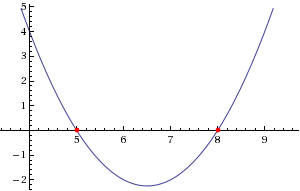
\(p^2-13p+40=(p-5)(p-8)\) --> \(p^2-13p+40<0\) for \(5<p<8\):
Attachment:
MSP51419ef17g8chg8g5ch00002g8ag3h1ba7ibee0.gif
Now, as \(p\) is an integer then \(p^2-13p+40=q<0\) for two values of \(p\) out of 10: 6 and 7, which means that: \(P=\frac{2}{10}=\frac{1}{5}\).

Answer: B.

Thanks for showing the explanation using the parabola Bunuel.

Was curious to understand how will it look like if for eg the question put the condition of q>0. In that case, the quadratic would turn out to be (p-8)(p-5) > 0. In such a case the parabola will open downward but then how do we make this out as the constant a (in a*p^2) is in any case +ve..
User avatar
GMATGuruNY
Joined: 04 Aug 2010
Last visit: 02 Apr 2026
Posts: 1,347
Own Kudos:
Given Kudos: 9
Schools:Dartmouth College
Expert
Expert reply
Posts: 1,347
Kudos: 3,905
Kudos
Add Kudos
Bookmarks
Bookmark this Post
AnkitK
If p^2 – 13p + 40 = q, and p is a positive integer between 1 and 10, inclusive, what is the probability that q < 0?
A. 1/10
B. 1/5
C. 2/5
D. 3/5
E. 3/10

p² - 13p + 40 = 0
(p-5)(p-8) = 0

The CRITICAL POINTS are p=5 and p=8.
Only at these two critical points does p² - 13p + 40 = 0.
To determine the ranges in which p² - 13p + 40 < 0, test one value to the left and right of each critical point.

There are three ranges to consider:
p < 5, 5 < p < 8, p > 8
If p=0 or p=100, then p² - 13p + 40 is clearly GREATER than 0, implying that p<5 and p>8 are not viable ranges.
Implication:
The only viable range is 5 < p < 8.
Thus, of the 10 integers between 1 and 10, inclusive, only two -- 6 and 7 -- will yield a negative for p² - 13p + 40:
\(\frac{2}{10} = \frac{1}{5}\)

avatar
hachtagburn
Joined: 26 Sep 2020
Last visit: 21 Dec 2020
Posts: 1
Given Kudos: 8
Posts: 1
Kudos: 0
Kudos
Add Kudos
Bookmarks
Bookmark this Post
AnkitK
If p^2 – 13p + 40 = q, and p is a positive integer between 1 and 10, inclusive, what is the probability that q < 0?
A. 1/10
B. 1/5
C. 2/5
D. 3/5
E. 3/10

If we factor the right side of the equation, we can come up with a more meaningful relationship between p and q: p2 – 13p + 40 = q so (p – 8)(p – 5) = q.
We know that p is an integer between 1 and 10, inclusive, so there are ten possible values for p. We see from the factored equation that the sign of q will depend on the value of p.
One way to solve this problem would be to check each possible value of p to see whether it yields a positive or negative q.
However, we can also use some logic here.
For q to be negative, the expressions (p – 8) and (p – 5) must have opposite signs.
Which integers on the number line will yield opposite signs for the expressions (p – 8) and (p – 5)?
Those integers in the range 5 < p < 8 (notice 5 and 8 are not included because they would both yield a value of zero and zero is a nonnegative integer).
That means that there are only two integer values for p, 6 and 7, which would yield a negative q. With a total of 10 possible p values, only 2 yield a negative q, so the probability is 2/10 or 1/5.
The correct answer is B.
User avatar
Basshead
Joined: 09 Jan 2020
Last visit: 07 Feb 2024
Posts: 907
Own Kudos:
323
 [1]
Given Kudos: 431
Location: United States
Posts: 907
Kudos: 323
 [1]
1
Kudos
Add Kudos
Bookmarks
Bookmark this Post
Factor the quadratic:

p^2 - 13p + 40 = q
(p - 5) (p - 8) = q

What is the probability that q < 0?

Since we know that p is a positive integer between 1 and 10, inclusive, then we can plug in numbers to check.

If q is negative, we know either (p - 5) or (p - 8) will be negative. We can quickly determine that if p is 6 or 7, q will be negative.

2 / 10 = 1/5

Answer is B.
User avatar
bumpbot
User avatar
Non-Human User
Joined: 09 Sep 2013
Last visit: 04 Jan 2021
Posts: 38,957
Own Kudos:
Posts: 38,957
Kudos: 1,117
Kudos
Add Kudos
Bookmarks
Bookmark this Post
Automated notice from GMAT Club BumpBot:

A member just gave Kudos to this thread, showing it’s still useful. I’ve bumped it to the top so more people can benefit. Feel free to add your own questions or solutions.

This post was generated automatically.
Moderators:
Math Expert
109776 posts
Tuck School Moderator
853 posts