Last visit was: 23 Apr 2026, 03:14 It is currently 23 Apr 2026, 03:14
Close
GMAT Club Daily Prep
Thank you for using the timer - this advanced tool can estimate your performance and suggest more practice questions. We have subscribed you to Daily Prep Questions via email.

Customized
for You

we will pick new questions that match your level based on your Timer History

Track
Your Progress

every week, we’ll send you an estimated GMAT score based on your performance

Practice
Pays

we will pick new questions that match your level based on your Timer History
Not interested in getting valuable practice questions and articles delivered to your email? No problem, unsubscribe here.
Close
Request Expert Reply
Confirm Cancel
User avatar
enigma123
Joined: 25 Jun 2011
Last visit: 16 Mar 2016
Posts: 392
Own Kudos:
19,854
 [65]
Given Kudos: 217
Status:Finally Done. Admitted in Kellogg for 2015 intake
Location: United Kingdom
Concentration: International Business, Strategy
GMAT 1: 730 Q49 V45
GPA: 2.9
WE:Information Technology (Consulting)
GMAT 1: 730 Q49 V45
Posts: 392
Kudos: 19,854
 [65]
3
Kudos
Add Kudos
61
Bookmarks
Bookmark this Post
Most Helpful Reply
User avatar
Bunuel
User avatar
Math Expert
Joined: 02 Sep 2009
Last visit: 23 Apr 2026
Posts: 109,773
Own Kudos:
Given Kudos: 105,853
Products:
Expert
Expert reply
Active GMAT Club Expert! Tag them with @ followed by their username for a faster response.
Posts: 109,773
Kudos: 810,733
 [16]
6
Kudos
Add Kudos
10
Bookmarks
Bookmark this Post
General Discussion
User avatar
mourinhogmat1
Joined: 08 Jun 2010
Last visit: 11 Aug 2015
Posts: 211
Own Kudos:
201
 [1]
Given Kudos: 13
Location: United States
Concentration: General Management, Finance
GMAT 1: 680 Q50 V32
GMAT 1: 680 Q50 V32
Posts: 211
Kudos: 201
 [1]
1
Kudos
Add Kudos
Bookmarks
Bookmark this Post
User avatar
Bunuel
User avatar
Math Expert
Joined: 02 Sep 2009
Last visit: 23 Apr 2026
Posts: 109,773
Own Kudos:
810,733
 [2]
Given Kudos: 105,853
Products:
Expert
Expert reply
Active GMAT Club Expert! Tag them with @ followed by their username for a faster response.
Posts: 109,773
Kudos: 810,733
 [2]
1
Kudos
Add Kudos
1
Bookmarks
Bookmark this Post
mourinhogmat1
A quick question: Nowhere in the question does it say that the two points are equidistant right? How can we say that the distance from origins are same? Please explain.

The formula to calculate the distance between two points \((x_1,y_1)\) and \((x_2,y_2)\) is \(d=\sqrt{(x_1-x_2)^2+(y_1-y_2)^2}\). Now, if one point is origin, coordinate (0, 0), then the formula can be simplified to: \(D=\sqrt{x^2+y^2}\).

Hence for our original question: a^2+b^2=c^2+d^2 means that points X and W are equidistant from the origin and e^2+f^2=g^2+h^2 means that points Y and Z are equidistant from the origin.

Next, since X and Z lie on the same line through the origin and W and Y lie on the same line through the origin then the distance of line segments XZ and WY is equal (for algebraic proof see above post).

Hope it's clear.
avatar
mal208213
Joined: 25 Mar 2013
Last visit: 05 Oct 2014
Posts: 13
Own Kudos:
18
 [1]
Given Kudos: 14
Status:Preparing...
Location: United States
Sat: V
Concentration: Strategy, Technology
GMAT Date: 07-22-2013
GPA: 3.7
WE:Information Technology (Computer Software)
Posts: 13
Kudos: 18
 [1]
1
Kudos
Add Kudos
Bookmarks
Bookmark this Post
enigma123
Attachment:
Distance.PNG
In the rectangular coordinate plane points X and Z lie on the same line through the origin and points W and Y lie on the same line through the origin. If a^2+b^2=c^2+d^2 and e^2+f^2=g^2+h^2, what is the value of length XZ – length WY?

A. -2
B. -1
C. 0
D. 1
E. 2

For me the answer should be C ZERO. This is how I arrived to D. Please let me know whether this is correct or not as I don't have an OA.

Distance from all the 4 points from origin can be written as

\(\sqrt{a^2 +b^2}\) + \(\sqrt{e^2 + j^2}\) = \(\sqrt{c^2 + d^2}\) + \(\sqrt{g^2 + h^2}\)

The above will give the answer of zero if we substitute the values from question stem.
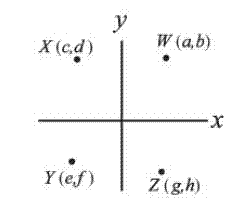

Another way to solve this is if I draw a line segment from origin to point W (say w) and origin to point X (say x) will be hypotenuse defined by \(\sqrt{a^2 +b^2}\)= \(\sqrt{w^2}\)
and \(\sqrt{c^2 +d^2}\)= \(\sqrt{x^2}\)

So you will end up with w=x and y=z --> (x+z) -(y+z) =0
User avatar
daboo343
Joined: 09 Nov 2012
Last visit: 20 Nov 2022
Posts: 219
Own Kudos:
Given Kudos: 162
Status:You have to have the darkness for the dawn to come
Daboo: Sonu
GMAT 1: 590 Q49 V20
GMAT 2: 730 Q50 V38
Products:
GMAT 2: 730 Q50 V38
Posts: 219
Kudos: 712
Kudos
Add Kudos
Bookmarks
Bookmark this Post
[quote="enigma123"]
Attachment:
Distance.PNG
In the rectangular coordinate plane points X and Z lie on the same line through the origin and points W and Y lie on the same line through the origin. If a^2+b^2=c^2+d^2 and e^2+f^2=g^2+h^2, what is the value of length XZ – length WY?

A. -2
B. -1
C. 0
D. 1
E. 2

Both the length will be same ( by applying Pythagoras theorem) hence length xz- length wy = 0
hence C
User avatar
Nunuboy1994
Joined: 12 Nov 2016
Last visit: 24 Apr 2019
Posts: 554
Own Kudos:
Given Kudos: 167
Location: United States
Schools: Yale '18
GMAT 1: 650 Q43 V37
GRE 1: Q157 V158
GPA: 2.66
Schools: Yale '18
GMAT 1: 650 Q43 V37
GRE 1: Q157 V158
Posts: 554
Kudos: 126
Kudos
Add Kudos
Bookmarks
Bookmark this Post
enigma123
Attachment:
The attachment Distance.PNG is no longer available
In the rectangular coordinate plane points X and Z lie on the same line through the origin and points W and Y lie on the same line through the origin. If a^2+b^2=c^2+d^2 and e^2+f^2=g^2+h^2, what is the value of length XZ – length WY?

A. -2
B. -1
C. 0
D. 1
E. 2

For me the answer should be C ZERO. This is how I arrived to D. Please let me know whether this is correct or not as I don't have an OA.

Distance from all the 4 points from origin can be written as

\(\sqrt{a^2 +b^2}\) + \(\sqrt{e^2 + j^2}\) = \(\sqrt{c^2 + d^2}\) + \(\sqrt{g^2 + h^2}\)

The above will give the answer of zero if we substitute the values from question stem.

Any set of values can be plugged into this question in order to calculate the result- what this question is basically saying is that absolute value of the x and y coordinates of a and b must be the same as absolute value of the x and y coordinates of c and d; the same holds true for coordinates (e,f) and (g,h).

( l a l , l b l ) = ( l c l , l d l ) ;
( l e l , l f l ) = ( l g l, l h l )

But lastly, this question asks us for the difference between the length of the two diagonals- the two diagonals have the same length so the answer is 0

Hence
"C"
Attachments

image1 (8).JPG
image1 (8).JPG [ 820.41 KiB | Viewed 18036 times ]

User avatar
dave13
Joined: 09 Mar 2016
Last visit: 15 Mar 2026
Posts: 1,086
Own Kudos:
Given Kudos: 3,851
Posts: 1,086
Kudos: 1,137
Kudos
Add Kudos
Bookmarks
Bookmark this Post
Bunuel
Attachment:
Distance.PNG
In the rectangular coordinate plane points X and Z lie on the same line through the origin and points W and Y lie on the same line through the origin. If a^2+b^2=c^2+d^2 and e^2+f^2=g^2+h^2, what is the value of length XZ – length WY?

A. -2
B. -1
C. 0
D. 1
E. 2

Since X and Z lie on the same line through the origin then the distance between X and Z will be equal to the sum of the individual distances of X and Z from the origin: \(\sqrt{c^2 + d^2}+\sqrt{g^2 + h^2}\);

The same way, the distance between W and Y will be equal to the sum of the individual distances of W and Y from the origin: \(\sqrt{a^2 + b^2}+\sqrt{e^2 + f^2}\);

\(XZ-WY=(\sqrt{c^2 + d^2}+\sqrt{g^2 + h^2})-(\sqrt{a^2 + b^2}+\sqrt{e^2 + f^2})=0\).

Answer: C.


Hello Bunuel :-)
if both lines lie through point of origin, that means their coordinates are (0;0) Right ? BUT we still dont know the LENGTHS of these two lines? How can you assume the lines are of the same lengths :? I would appreciate your explanation
Thanks ! :)
User avatar
Bunuel
User avatar
Math Expert
Joined: 02 Sep 2009
Last visit: 23 Apr 2026
Posts: 109,773
Own Kudos:
810,733
 [1]
Given Kudos: 105,853
Products:
Expert
Expert reply
Active GMAT Club Expert! Tag them with @ followed by their username for a faster response.
Posts: 109,773
Kudos: 810,733
 [1]
1
Kudos
Add Kudos
Bookmarks
Bookmark this Post
dave13
Bunuel
Attachment:
Distance.PNG
In the rectangular coordinate plane points X and Z lie on the same line through the origin and points W and Y lie on the same line through the origin. If a^2+b^2=c^2+d^2 and e^2+f^2=g^2+h^2, what is the value of length XZ – length WY?

A. -2
B. -1
C. 0
D. 1
E. 2

Since X and Z lie on the same line through the origin then the distance between X and Z will be equal to the sum of the individual distances of X and Z from the origin: \(\sqrt{c^2 + d^2}+\sqrt{g^2 + h^2}\);

The same way, the distance between W and Y will be equal to the sum of the individual distances of W and Y from the origin: \(\sqrt{a^2 + b^2}+\sqrt{e^2 + f^2}\);

\(XZ-WY=(\sqrt{c^2 + d^2}+\sqrt{g^2 + h^2})-(\sqrt{a^2 + b^2}+\sqrt{e^2 + f^2})=0\).

Answer: C.


Hello Bunuel :-)
if both lines lie through point of origin, that means their coordinates are (0;0) Right ? BUT we still dont know the LENGTHS of these two lines? How can you assume the lines are of the same lengths :? I would appreciate your explanation
Thanks ! :)

The coordinates of X and Z are not (0, 0). X is in the second quadrant and Y is in fourth quadrant.

Points X and Z lie on the same line through the origin means that X, Y and the origin lie on the same straight line.
User avatar
dave13
Joined: 09 Mar 2016
Last visit: 15 Mar 2026
Posts: 1,086
Own Kudos:
Given Kudos: 3,851
Posts: 1,086
Kudos: 1,137
Kudos
Add Kudos
Bookmarks
Bookmark this Post
Bunuel
dave13
Bunuel

In the rectangular coordinate plane points X and Z lie on the same line through the origin and points W and Y lie on the same line through the origin. If a^2+b^2=c^2+d^2 and e^2+f^2=g^2+h^2, what is the value of length XZ – length WY?

A. -2
B. -1
C. 0
D. 1
E. 2

Since X and Z lie on the same line through the origin then the distance between X and Z will be equal to the sum of the individual distances of X and Z from the origin: \(\sqrt{c^2 + d^2}+\sqrt{g^2 + h^2}\);

The same way, the distance between W and Y will be equal to the sum of the individual distances of W and Y from the origin: \(\sqrt{a^2 + b^2}+\sqrt{e^2 + f^2}\);

\(XZ-WY=(\sqrt{c^2 + d^2}+\sqrt{g^2 + h^2})-(\sqrt{a^2 + b^2}+\sqrt{e^2 + f^2})=0\).

Answer: C.


Hello Bunuel :-)
if both lines lie through point of origin, that means their coordinates are (0;0) Right ? BUT we still dont know the LENGTHS of these two lines? How can you assume the lines are of the same lengths :? I would appreciate your explanation
Thanks ! :)

The coordinates of X and Z are not (0, 0). X is in the second quadrant and Y is in fourth quadrant.

Points X and Z lie on the same line through the origin means that X, Y and the origin lie on the same straight line.


H Bunuel

say X(-3;4) ; W (3;4) and Y(-3;-4), Z(3;-4)

So as per formula of distance between two points i get

D = XW = \(\sqrt{(3-(-3))^2 + (4-4)^2}\) = 3
D = YZ = \(\sqrt{(3-(-3)^2+(-4-(-4))^2}\)= 3

XW -YZ = 3-3 =0
Is my understabding correct now ? :)

thanks!
avatar
DSBlender
Joined: 28 Jan 2020
Last visit: 14 Apr 2020
Posts: 13
Own Kudos:
Given Kudos: 36
Posts: 13
Kudos: 13
Kudos
Add Kudos
Bookmarks
Bookmark this Post
In the rectangular coordinate plane points X and Z lie on the same line through the origin and points W and Y lie on the same line through the origin. If a^2 + b^2 = c^2 + d^2 and e^2 + f^2 = g^2 + h^2, what is the value of length XZ – length WY?

A. -2
B. -1
C. 0
D. 1
E. 2


First off, if you are given a point (X,Y) on a coordinate plane, you can make a right triangle from the origin. In this problem, we are asked to find the difference of the length of two lines. We can use the Pythagorean Theorom to find the hypotenuse (distance from the origin) of each point on the coordinate plane. Since we know that a^2 + b^2 = c^ + d^2 and e^2 + f^2 = g^2 + h^2, we know that the distance from the origin is the same for the points in Q1 (W) and Q2 (X), and the distance from the origin is the same for the points in Q3 (Y) and Q4 (Z). This problem is essentially asking us the difference in lengths between XZ and WY. We don't need to know exact lengths, but for instance, if X and Z are 2 from the orign, and W and Y and 1 from the origin, the difference between XZ and WY is equal to 0. This is because no matter what the actual points on the coordinate plane are, we know that each line is the same length, because each line has the same distance from the origin. Answer C is correct.
User avatar
saby1410
Joined: 06 Feb 2017
Last visit: 10 Jun 2025
Posts: 167
Own Kudos:
Given Kudos: 93
Location: India
Posts: 167
Kudos: 23
Kudos
Add Kudos
Bookmarks
Bookmark this Post
Bunuel VeritasKarishma
why can't we find length using distance formula directly between points X and Z. why find distance form X to origin ?
User avatar
KarishmaB
Joined: 16 Oct 2010
Last visit: 22 Apr 2026
Posts: 16,441
Own Kudos:
Given Kudos: 484
Location: Pune, India
Expert
Expert reply
Active GMAT Club Expert! Tag them with @ followed by their username for a faster response.
Posts: 16,441
Kudos: 79,393
Kudos
Add Kudos
Bookmarks
Bookmark this Post
saby1410
Bunuel VeritasKarishma
why can't we find length using distance formula directly between points X and Z. why find distance form X to origin ?

We don't have any equations giving us relations with (c - g)^2, (d - h)^2 etc. Since all equations have distance from origin, those are what we need to consider.
avatar
NamaySharma
Joined: 21 Mar 2021
Last visit: 31 Dec 2021
Posts: 20
Own Kudos:
Given Kudos: 26
Posts: 20
Kudos: 21
Kudos
Add Kudos
Bookmarks
Bookmark this Post
mourinhogmat1
A quick question: All we know is that the line passes through X, origin, and Z vs. the second line passes through W, origin, and Y. There is no indication that the points are equidistant with respect to the origin. Can we assume this or is there a part of the wording from the original question missing?

The way I approached it:
sqrt ((g-c)^2+(h-d)^2) = sqrt ((a-e)^2+ (b-f)^2)
This simplifies to gc+hd = ae +bf.

Please explain.
This is my solution.
So a^2 + b^2 = c^2 + d^2 and e^2 + f^2 = g^2 + h^2
We square root on both sides for each equation and we get
Distance from origin for X = Distance from origin for W--------(1)
Distance from origin for Z = Distance from origin for Y---------(2)

Add One and Two and we get:
D of XZ = D of WY
Therefore when subtracted the answer = 0
avatar
NamaySharma
Joined: 21 Mar 2021
Last visit: 31 Dec 2021
Posts: 20
Own Kudos:
Given Kudos: 26
Posts: 20
Kudos: 21
Kudos
Add Kudos
Bookmarks
Bookmark this Post
saby1410
Bunuel VeritasKarishma
why can't we find length using distance formula directly between points X and Z. why find distance form X to origin ?
We don't hav the values. Thus this is the approach we use.
So a^2 + b^2 = c^2 + d^2 and e^2 + f^2 = g^2 + h^2
We square root on both sides for each equation and we get
Distance from origin for X = Distance from origin for W--------(1)
Distance from origin for Z = Distance from origin for Y---------(2)

Add One and Two and we get:
D of XZ = D of WY
Therefore when subtracted the answer = 0
User avatar
bumpbot
User avatar
Non-Human User
Joined: 09 Sep 2013
Last visit: 04 Jan 2021
Posts: 38,959
Own Kudos:
Posts: 38,959
Kudos: 1,117
Kudos
Add Kudos
Bookmarks
Bookmark this Post
Automated notice from GMAT Club BumpBot:

A member just gave Kudos to this thread, showing it’s still useful. I’ve bumped it to the top so more people can benefit. Feel free to add your own questions or solutions.

This post was generated automatically.
Moderators:
Math Expert
109773 posts
Tuck School Moderator
853 posts