Last visit was: 24 Apr 2026, 01:43 It is currently 24 Apr 2026, 01:43
Close
GMAT Club Daily Prep
Thank you for using the timer - this advanced tool can estimate your performance and suggest more practice questions. We have subscribed you to Daily Prep Questions via email.

Customized
for You

we will pick new questions that match your level based on your Timer History

Track
Your Progress

every week, we’ll send you an estimated GMAT score based on your performance

Practice
Pays

we will pick new questions that match your level based on your Timer History
Not interested in getting valuable practice questions and articles delivered to your email? No problem, unsubscribe here.
Close
Request Expert Reply
Confirm Cancel
User avatar
imhimanshu
Joined: 07 Sep 2010
Last visit: 08 Nov 2013
Posts: 216
Own Kudos:
6,365
 [203]
Given Kudos: 136
GMAT 1: 650 Q49 V30
Posts: 216
Kudos: 6,365
 [203]
13
Kudos
Add Kudos
190
Bookmarks
Bookmark this Post
Most Helpful Reply
User avatar
Bunuel
User avatar
Math Expert
Joined: 02 Sep 2009
Last visit: 23 Apr 2026
Posts: 109,802
Own Kudos:
Given Kudos: 105,868
Products:
Expert
Expert reply
Active GMAT Club Expert! Tag them with @ followed by their username for a faster response.
Posts: 109,802
Kudos: 810,913
 [105]
46
Kudos
Add Kudos
59
Bookmarks
Bookmark this Post
User avatar
LalaB
User avatar
Current Student
Joined: 23 Oct 2010
Last visit: 17 Jul 2016
Posts: 227
Own Kudos:
1,378
 [13]
Given Kudos: 73
Location: Azerbaijan
Concentration: Finance
Schools: HEC '15 (A)
GMAT 1: 690 Q47 V38
Schools: HEC '15 (A)
GMAT 1: 690 Q47 V38
Posts: 227
Kudos: 1,378
 [13]
11
Kudos
Add Kudos
2
Bookmarks
Bookmark this Post
General Discussion
User avatar
EvaJager
Joined: 22 Mar 2011
Last visit: 31 Aug 2016
Posts: 513
Own Kudos:
2,370
 [2]
Given Kudos: 43
WE:Science (Education)
Posts: 513
Kudos: 2,370
 [2]
1
Kudos
Add Kudos
1
Bookmarks
Bookmark this Post
imhimanshu
There are 10 solid colored balls in a box, including 1 Green and 1 Yellow. If 3 of the balls in the box are chosen at random, without replacement, what is the probability that the 3 balls chosen will include the Green ball but not the yellow ball.

A. 1/6
B. 7/30
C. 1/4
D. 3/10
E. 4/15

Experts, request you to please explain this using both Combiantion approach as well as probability approach.

Also, one more doubt, can we solve this question using 1- P(Green, Yellow and Other ball) approach
Thanks
H

Probability approach, direct not for the complementary event (it is more complicated, not worth trying in this case: it can be one G and also one Y or neither G nor Y, plus an additional different color):
P(G) * P(noG & noY) * P( another noG & noY) * 3 = 1/10 * 8/9 * 7/8 * 3 = 7/30.
We need the factor of 3 because the Green ball can be either the first, second or third.

Answer: B
User avatar
imhimanshu
Joined: 07 Sep 2010
Last visit: 08 Nov 2013
Posts: 216
Own Kudos:
6,365
 [1]
Given Kudos: 136
GMAT 1: 650 Q49 V30
Posts: 216
Kudos: 6,365
 [1]
1
Kudos
Add Kudos
Bookmarks
Bookmark this Post
Hi Bunuel,

Thanks for the reply. I was able to solve it using Approach # 2. But I have doubt in Approach # 1 . Request you to please provide your comments.

Isn't it an assumption that remaining 8 balls are of same color. If the remaining 8 balls each of them are of different color, then the number of arrangements will get changed and hence probability.

Please tell me what I am missing
Thanks.
H

Bunuel


We have that there are 1 Green (G), 1 Yellow (Y) and 8 some other colors (X) balls in the box.

User avatar
Bunuel
User avatar
Math Expert
Joined: 02 Sep 2009
Last visit: 23 Apr 2026
Posts: 109,802
Own Kudos:
810,913
 [1]
Given Kudos: 105,868
Products:
Expert
Expert reply
Active GMAT Club Expert! Tag them with @ followed by their username for a faster response.
Posts: 109,802
Kudos: 810,913
 [1]
1
Kudos
Add Kudos
Bookmarks
Bookmark this Post
imhimanshu
Hi Bunuel,

Thanks for the reply. I was able to solve it using Approach # 2. But I have doubt in Approach # 1 . Request you to please provide your comments.

Isn't it an assumption that remaining 8 balls are of same color. If the remaining 8 balls each of them are of different color, then the number of arrangements will get changed and hence probability.

Please tell me what I am missing
Thanks.
H

Bunuel


We have that there are 1 Green (G), 1 Yellow (Y) and 8 some other colors (X) balls in the box.


We are not assuming that 8 other balls are necessarily of some one particular color: they can be of one color or 8 different colors, but for us the only thing which is important that they are of different color than green and yellow.

Consider this: if the first ball selected is green then we are left with 9 balls out of which 1 is yellow and 8 other balls are not yellow (that's the only thing we care), so the probability of selecting non-yellow ball is 8/9.

Hope it's clear.
avatar
canada07
Joined: 20 Sep 2011
Last visit: 09 Mar 2015
Posts: 22
Own Kudos:
Kudos
Add Kudos
Bookmarks
Bookmark this Post
Bunuel question for you--and it may be dumb. When I tried the problem I knew that there were three possibilities for getting the green ball. However, I ended up calculating the probabilities for each scenario. Do we know that the probably is the same for each scenario or could it be different?
User avatar
Bunuel
User avatar
Math Expert
Joined: 02 Sep 2009
Last visit: 23 Apr 2026
Posts: 109,802
Own Kudos:
810,913
 [6]
Given Kudos: 105,868
Products:
Expert
Expert reply
Active GMAT Club Expert! Tag them with @ followed by their username for a faster response.
Posts: 109,802
Kudos: 810,913
 [6]
3
Kudos
Add Kudos
3
Bookmarks
Bookmark this Post
plock3vr
Bunuel question for you--and it may be dumb. When I tried the problem I knew that there were three possibilities for getting the green ball. However, I ended up calculating the probabilities for each scenario. Do we know that the probably is the same for each scenario or could it be different?

The probability of each case will be the same:
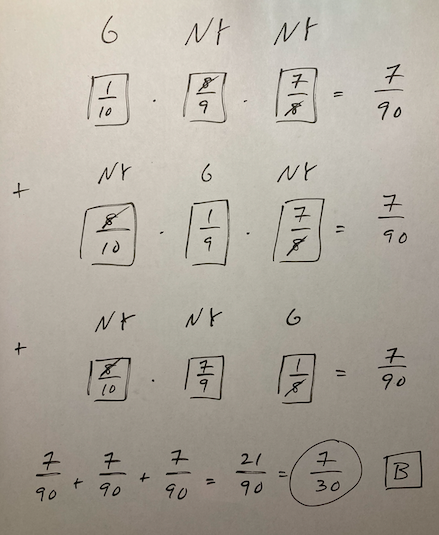
{GXX} - \(P=\frac{1}{10}*\frac{8}{9}*\frac{7}{8}=\frac{7}{90}\);

{XGX} - \(P=\frac{8}{10}*\frac{1}{9}*\frac{7}{8}=\frac{7}{90}\);

{XXG} - \(P=\frac{8}{10}*\frac{7}{9}*\frac{1}{8}=\frac{7}{90}\);

The sum: \(\frac{7}{90}+\frac{7}{90}+\frac{7}{90}=\frac{7}{30}\).

Hope it helps.
User avatar
ScottTargetTestPrep
User avatar
Target Test Prep Representative
Joined: 14 Oct 2015
Last visit: 23 Apr 2026
Posts: 22,283
Own Kudos:
26,532
 [1]
Given Kudos: 302
Status:Founder & CEO
Affiliations: Target Test Prep
Location: United States (CA)
Expert
Expert reply
Active GMAT Club Expert! Tag them with @ followed by their username for a faster response.
Posts: 22,283
Kudos: 26,532
 [1]
Kudos
Add Kudos
1
Bookmarks
Bookmark this Post
imhimanshu
There are 10 solid colored balls in a box, including 1 Green and 1 Yellow. If 3 of the balls in the box are chosen at random, without replacement, what is the probability that the 3 balls chosen will include the Green ball but not the yellow ball.

A. 1/6
B. 7/30
C. 1/4
D. 3/10
E. 4/15

The number of ways to select 3 balls that include the green ball but not the yellow ball is:

1C1 x 1C0 x 8C2 = 1 x 1 x (8 x 7)/2! = 28 ways

(Note: 1C1 is the number of ways to select 1 green ball from the 1 green ball, 1C0 is the number of ways to select 0 yellow ball from the 1 yellow ball, and 8C2 is the number of ways to select 2 balls from the 8 remaining balls.)

The number of ways to select 3 balls from 10 is:

10C3 = (10 x 9 x 8)/3! = (10 x 9 x 8)/(3 x 2) = 120

Thus, the probability that the 3 balls chosen will include the Green ball but not the yellow ball is 28/120 = 7/30.

Alternate Solution:

Let’s first determine the probability of selecting the one green ball on the first draw and any of the remaining balls (except the yellow ball) on the succeeding two draws: 1/10 x 8/9 x 7/8 = 56/720.

Now, we see that we could also pick the green ball on the second draw, with any ball (except the yellow one) on the first and third draws, with probability: 8/10 x 1/9 x ⅞ = 56/720.

Similarly, we could instead pick the green ball on the third draw, with any ball (except the yellow one) on the first and second draws, with probability: 8/10 x 7/9 x 1/8 = 56/720.

Thus the total probability for the event where the green ball is drawn but the yellow one is not is:
56/720 + 56/720 + 56/720 = 168/720 = 21/90 = 7/30.

Answer: B
User avatar
adityaganjoo
Joined: 10 Jan 2021
Last visit: 04 Oct 2022
Posts: 138
Own Kudos:
Given Kudos: 154
Posts: 138
Kudos: 32
Kudos
Add Kudos
Bookmarks
Bookmark this Post
imhimanshu
There are 10 solid colored balls in a box, including 1 Green and 1 Yellow. If 3 of the balls in the box are chosen at random, without replacement, what is the probability that the 3 balls chosen will include the Green ball but not the yellow ball.

A. 1/6
B. 7/30
C. 1/4
D. 3/10
E. 4/15

Experts, request you to please explain this using both Combiantion approach as well as probability approach.

Also, one more doubt, can we solve this question using 1- P(Green, Yellow and Other ball) approach
Thanks
H

Bunuel Need your help once more!

If we are choosing the balls without replacement, help me understand what is wrong with my approach:

3 possibilities: GXX, XGX, XXG

Probability = (1/10)(8/9)(7/8) + (9/10)(1/9)(7/8) + (9/10)(8/9)(1/8)
= (1/720)[ (56) + (63) + (72)]
= (1/720)[191]
= 191/720
User avatar
Bunuel
User avatar
Math Expert
Joined: 02 Sep 2009
Last visit: 23 Apr 2026
Posts: 109,802
Own Kudos:
810,913
 [1]
Given Kudos: 105,868
Products:
Expert
Expert reply
Active GMAT Club Expert! Tag them with @ followed by their username for a faster response.
Posts: 109,802
Kudos: 810,913
 [1]
1
Kudos
Add Kudos
Bookmarks
Bookmark this Post
adityaganjoo
imhimanshu
There are 10 solid colored balls in a box, including 1 Green and 1 Yellow. If 3 of the balls in the box are chosen at random, without replacement, what is the probability that the 3 balls chosen will include the Green ball but not the yellow ball.

A. 1/6
B. 7/30
C. 1/4
D. 3/10
E. 4/15

Experts, request you to please explain this using both Combiantion approach as well as probability approach.

Also, one more doubt, can we solve this question using 1- P(Green, Yellow and Other ball) approach
Thanks
H

Bunuel Need your help once more!

If we are choosing the balls without replacement, help me understand what is wrong with my approach:

3 possibilities: GXX, XGX, XXG

Probability = (1/10)(8/9)(7/8) + (9/10)(1/9)(7/8) + (9/10)(8/9)(1/8)
= (1/720)[ (56) + (63) + (72)]
= (1/720)[191]
= 191/720

Red figures are not correct.

Should be:
{GXX} - \(P=\frac{1}{10}*\frac{8}{9}*\frac{7}{8}=\frac{7}{90}\);

{XGX} - \(P=\frac{8}{10}*\frac{1}{9}*\frac{7}{8}=\frac{7}{90}\);

{XXG} - \(P=\frac{8}{10}*\frac{7}{9}*\frac{1}{8}=\frac{7}{90}\);

The sum: \(\frac{7}{90}+\frac{7}{90}+\frac{7}{90}=\frac{7}{30}\).
User avatar
Thib33600
Joined: 08 Feb 2023
Last visit: 02 Mar 2024
Posts: 28
Own Kudos:
Given Kudos: 22
Posts: 28
Kudos: 1
Kudos
Add Kudos
Bookmarks
Bookmark this Post
Bunuel
imhimanshu
There are 10 solid colored balls in a box,including 1 Green and 1 Yellow. If 3 of the balls in the box are chosen at random, without replacement, what is the probability that the 3 balls chosen will include the Green ball but not the yellow ball.

A. 1/6
B. 7/30
C. 1/4
D. 3/10
E. 4/15

Experts, request you to please explain this using both Combiantion approach as well as probability approach.

Also, one more doubt, can we solve this question using 1- P(Green, Yellow and Other ball) approach
Thanks
H


We have that there are 1 Green (G), 1 Yellow (Y) and 8 some other colors (X) balls in the box.

Approach #1:

We need to find the probability of GXX. \(P(GXX)=\frac{1}{10}*\frac{8}{9}*\frac{7}{8}*\frac{3!}{2!}=\frac{7}{30}\), we are multiplying by \(\frac{3!}{2!}\) since GXX scenario could occur in 3 ways: GXX, XGX, or XXG (the number of permutations of 3 letters GXX out of which 2 X's are identical).

Answer: B.

Approach #2:

\(P=\frac{C^2_8*C^1_1}{C^3_{10}}=\frac{7}{30}\), where \(C^2_8\) is ways to select 2 other color balls out of 8, \(C^1_1\) is ways to select 1 green ball, and \(C^3_{10}\) is total ways to select 3 balls out of 10.

Answer: B.

Hope it's clear.

How are you able to do the frst approach calculation without calculator?
User avatar
Bunuel
User avatar
Math Expert
Joined: 02 Sep 2009
Last visit: 23 Apr 2026
Posts: 109,802
Own Kudos:
Given Kudos: 105,868
Products:
Expert
Expert reply
Active GMAT Club Expert! Tag them with @ followed by their username for a faster response.
Posts: 109,802
Kudos: 810,913
Kudos
Add Kudos
Bookmarks
Bookmark this Post
Thib33600
Bunuel
imhimanshu
There are 10 solid colored balls in a box,including 1 Green and 1 Yellow. If 3 of the balls in the box are chosen at random, without replacement, what is the probability that the 3 balls chosen will include the Green ball but not the yellow ball.

A. 1/6
B. 7/30
C. 1/4
D. 3/10
E. 4/15

Experts, request you to please explain this using both Combiantion approach as well as probability approach.

Also, one more doubt, can we solve this question using 1- P(Green, Yellow and Other ball) approach
Thanks
H


We have that there are 1 Green (G), 1 Yellow (Y) and 8 some other colors (X) balls in the box.

Approach #1:

We need to find the probability of GXX. \(P(GXX)=\frac{1}{10}*\frac{8}{9}*\frac{7}{8}*\frac{3!}{2!}=\frac{7}{30}\), we are multiplying by \(\frac{3!}{2!}\) since GXX scenario could occur in 3 ways: GXX, XGX, or XXG (the number of permutations of 3 letters GXX out of which 2 X's are identical).

Answer: B.

Approach #2:

\(P=\frac{C^2_8*C^1_1}{C^3_{10}}=\frac{7}{30}\), where \(C^2_8\) is ways to select 2 other color balls out of 8, \(C^1_1\) is ways to select 1 green ball, and \(C^3_{10}\) is total ways to select 3 balls out of 10.

Answer: B.

Hope it's clear.

How are you able to do the frst approach calculation without calculator?

\(\frac{1}{10}*\frac{8}{9}*\frac{7}{8}*\frac{3!}{2!}=\frac{7}{30}\)

You don't need a calculator to get the value of the above. The key is to reduce.

8 gets reduced and we get:

    \(\frac{1}{10}*\frac{1}{9}*7*\frac{3!}{2!}\)

\(\frac{3!}{2!}\) is just 3, so we get:

    \(\frac{1}{10}*\frac{1}{9}*7*3\)

That 3 also gets reduced to give:

    \(\frac{1}{10}*\frac{1}{3}*7\)

And finally, we arrive at:

    \(\frac{7}{30}\)

Hope it helps.
User avatar
mcelroytutoring
Joined: 10 Jul 2015
Last visit: 19 Mar 2026
Posts: 1,206
Own Kudos:
2,675
 [1]
Given Kudos: 282
Status:Expert GMAT, GRE, and LSAT Tutor / Coach
Affiliations: Harvard University, A.B. with honors in Government, 2002
Location: United States (CO)
Age: 45 (10 years and counting on GMAT Club!)
GMAT 1: 770 Q47 V48
GMAT 2: 730 Q44 V47
GMAT 3: 750 Q50 V42
GMAT 4: 730 Q48 V42 (Online)
GRE 1: Q168 V169
GRE 2: Q170 V170
Expert
Expert reply
GMAT 4: 730 Q48 V42 (Online)
GRE 1: Q168 V169
GRE 2: Q170 V170
Posts: 1,206
Kudos: 2,675
 [1]
1
Kudos
Add Kudos
Bookmarks
Bookmark this Post
Another tricky one!

We have three possible orders: 1) G/NY/NY 2) NY/G/NY, and 3) NY/NY/G. If we pick the "not yellow" balls before the green ball, then "not yellow" really means "not yellow OR green," because we have to save the green ball for later.

For example, in the order NY/NY/G, the first NY cannot be 9/10, because that includes the green ball, which we have to save for later. Thus, it must be 8/10 instead.

The same goes for the second NY, which must be 7/9.

User avatar
gmathero911
Joined: 19 Mar 2023
Last visit: 27 Apr 2024
Posts: 15
Own Kudos:
Posts: 15
Kudos: 280
Kudos
Add Kudos
Bookmarks
Bookmark this Post
Hi Bunuel

Could you explain why it's (1/10)*(8/9)*(7/8)*(3!/2!) and not (1/10)*(8/9)*(7/8)*(10!/7!3!) ? Thank you!
User avatar
Bunuel
User avatar
Math Expert
Joined: 02 Sep 2009
Last visit: 23 Apr 2026
Posts: 109,802
Own Kudos:
Given Kudos: 105,868
Products:
Expert
Expert reply
Active GMAT Club Expert! Tag them with @ followed by their username for a faster response.
Posts: 109,802
Kudos: 810,913
Kudos
Add Kudos
Bookmarks
Bookmark this Post
 
iishim
Hi Bunuel

Could you explain why it's (1/10)*(8/9)*(7/8)*(3!/2!) and not (1/10)*(8/9)*(7/8)*(10!/7!3!) ? Thank you!
­3!/2! = 3 there represents the number of ways scenario (Green, Not Yellow, Not Yellow) can occur:

{Green, Not Yellow, Not Yellow}
{Not Yellow, Green, Not Yellow}
{Not Yellow, Not Yellow, Green}­

Thus, 3!/2! is essentially the number of permutations of GXX.
User avatar
DanTheGMATMan
Joined: 02 Oct 2015
Last visit: 23 Apr 2026
Posts: 380
Own Kudos:
Given Kudos: 9
Expert
Expert reply
Posts: 380
Kudos: 267
Kudos
Add Kudos
Bookmarks
Bookmark this Post
­Classic probability. We love it:

­
User avatar
egmat
User avatar
e-GMAT Representative
Joined: 02 Nov 2011
Last visit: 22 Apr 2026
Posts: 5,632
Own Kudos:
Given Kudos: 707
GMAT Date: 08-19-2020
Expert
Expert reply
Active GMAT Club Expert! Tag them with @ followed by their username for a faster response.
Posts: 5,632
Kudos: 33,433
Kudos
Add Kudos
Bookmarks
Bookmark this Post
This is a classic probability problem with constraints, and the key is understanding exactly what needs to happen. Let me walk you through this step-by-step.

Here's the core challenge you're facing: You need to find the probability that when you randomly select 3 balls from 10, you MUST get the green ball and you MUST NOT get the yellow ball.

Let's break this down systematically:

Step 1: Calculate total possible outcomes

First, how many ways can you choose 3 balls from 10 total balls? This is a combinations problem since order doesn't matter.

Total outcomes = \(C(10,3) = \frac{10 \times 9 \times 8}{3 \times 2 \times 1} = \frac{720}{6} = 120\)

So there are 120 different ways to select 3 balls from the box.

Step 2: Identify what makes an outcome "favorable"

Here's where you need to be really careful. For our selection to meet the requirements:
  • The green ball MUST be included (so that's already 1 of our 3 balls)
  • The yellow ball MUST NOT be included (so we can't pick from this one)
  • We need 2 more balls to complete our set of 3

Notice what this means: We've used up the green ball and excluded the yellow ball. That leaves us with \(10 - 1 - 1 = 8\) remaining balls to choose from.

Step 3: Calculate favorable outcomes

Now you need to count how many ways you can pick 2 balls from these 8 remaining balls (the ones that are neither green nor yellow).

Favorable outcomes = \(C(8,2) = \frac{8 \times 7}{2 \times 1} = \frac{56}{2} = 28\)

Step 4: Apply the probability formula

Probability = \(\frac{\text{Favorable outcomes}}{\text{Total outcomes}} = \frac{28}{120}\)

Simplify by dividing both numerator and denominator by 4:

\(\frac{28}{120} = \frac{7}{30}\)

Answer: B (\(\frac{7}{30}\))

The key insight: Once you lock in the green ball (must include) and exclude the yellow ball (must not include), you're really just choosing 2 balls from the 8 that remain. This transforms a seemingly complex constraint problem into a straightforward combinations calculation.

---

You can check out the step-by-step solution on Neuron by e-GMAT to master the systematic approach for probability problems with constraints. The complete solution also covers the common mistakes students make (like miscounting the remaining balls as 9 instead of 8) and shows you the pattern recognition framework that applies to all constraint-based probability questions. You can also explore other GMAT official questions with detailed solutions on Neuron for structured practice here.

Hope this helps!
Moderators:
Math Expert
109802 posts
Tuck School Moderator
853 posts