Last visit was: 26 Apr 2026, 00:28 It is currently 26 Apr 2026, 00:28
Close
GMAT Club Daily Prep
Thank you for using the timer - this advanced tool can estimate your performance and suggest more practice questions. We have subscribed you to Daily Prep Questions via email.

Customized
for You

we will pick new questions that match your level based on your Timer History

Track
Your Progress

every week, we’ll send you an estimated GMAT score based on your performance

Practice
Pays

we will pick new questions that match your level based on your Timer History
Not interested in getting valuable practice questions and articles delivered to your email? No problem, unsubscribe here.
Close
Request Expert Reply
Confirm Cancel
User avatar
ConnectTheDots
Joined: 28 Apr 2012
Last visit: 06 May 2020
Posts: 239
Own Kudos:
1,030
 [51]
Given Kudos: 142
Location: India
Concentration: Finance, Technology
GMAT 1: 650 Q48 V31
GMAT 2: 770 Q50 V47
WE:Information Technology (Computer Software)
4
Kudos
Add Kudos
47
Bookmarks
Bookmark this Post
Most Helpful Reply
User avatar
ConnectTheDots
Joined: 28 Apr 2012
Last visit: 06 May 2020
Posts: 239
Own Kudos:
1,030
 [9]
Given Kudos: 142
Location: India
Concentration: Finance, Technology
GMAT 1: 650 Q48 V31
GMAT 2: 770 Q50 V47
WE:Information Technology (Computer Software)
6
Kudos
Add Kudos
3
Bookmarks
Bookmark this Post
User avatar
mikemcgarry
User avatar
Magoosh GMAT Instructor
Joined: 28 Dec 2011
Last visit: 06 Aug 2018
Posts: 4,474
Own Kudos:
30,885
 [7]
Given Kudos: 130
Expert
Expert reply
Posts: 4,474
Kudos: 30,885
 [7]
4
Kudos
Add Kudos
3
Bookmarks
Bookmark this Post
General Discussion
User avatar
samirchaudhary
Joined: 07 Sep 2012
Last visit: 01 Feb 2019
Posts: 12
Own Kudos:
27
 [3]
Given Kudos: 7
Affiliations: ScoreBoost
Location: India
Posts: 12
Kudos: 27
 [3]
1
Kudos
Add Kudos
2
Bookmarks
Bookmark this Post
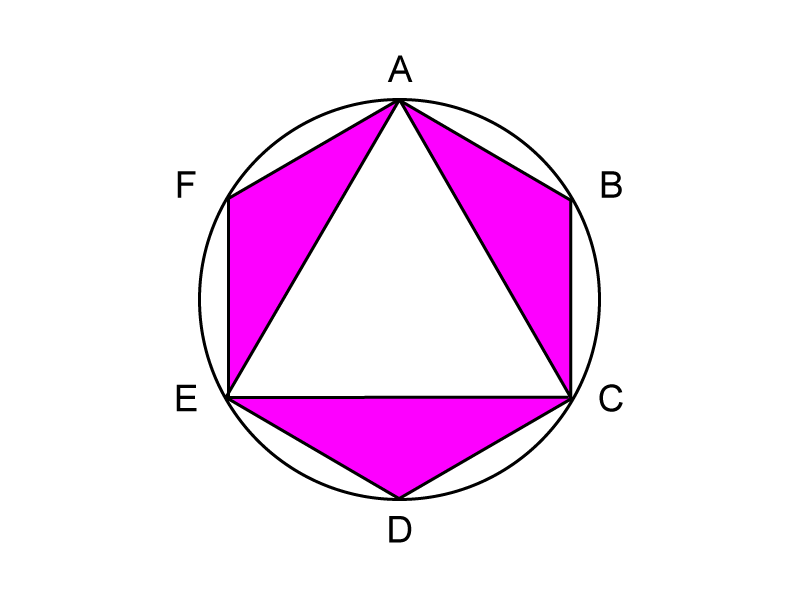
Hopefully a shorter approach .

Draw all the three diagonals of the hexagon, The diagonals intersect at 'O' , the center of the circle. And this divides hexagon into six equilateral triangles each with side = radius of the circle.

Now the triangle AEF and AEO are congruent (using SSS) <one side is common and other two sides of both the triangles are equal to the radius of the circle>. Similarly the other two pairs of triangles are congruent.

Sum of the area of all the shaded triangles is now equal to area of the triangle AEC, which is an equilateral triangle <easy to deduce>.

Now all we need is the ratio of the area of AEC to the area of circle.

Now, we need the length of side of the triangle AEC. Here we can use the property of centroid (point of intersection of the medians of a triangle) of a triangle to calculate the 'height' of the triangle AEC. Property : The centroid of a triangle divides the median in the ratio 2:1. <distance of centroid from the vertex is twice the distance of centroid from side>.

Using this property, height of the triangle = 1.5 r , where r is the radius of the circle.

We can use the formula : height of an equilateral triangle = \(\frac{sqrt3*a}{2}\) to calculate the side(a) of the equilateral triangle.

\(\frac{sqrt3*a}{2} = 1.5 r\)

\(a = sqrt3 * r\)

We now use formula for area of equilateral triangle : \(Area = \frac{sqrt3*a^2}{4}\)

Required ratio = \(\frac{sqrt3 * a^2}{4} / \pi * r^2\)

Substitute \(a = sqrt3 * r\), the ratio reduces to \(\frac{sqrt3 * 3 * r^2}{4} / \pi * r^2\)

Cancel \(r^2\) from numerator as well as denominator and approximate \(\pi\) as 3

Hence the required ratio now becomes \(\frac{sqrt3}{4}\).

We know the value of \(sqrt3=1.71\)(approx). At this point , we can safely mark 42% as answer.

Please excuse for formatting errors , I am correcting it.
Attachments

polygon.png
polygon.png [ 24.93 KiB | Viewed 19128 times ]

User avatar
PathFinder007
Joined: 10 Mar 2014
Last visit: 21 Oct 2018
Posts: 127
Own Kudos:
Given Kudos: 13
Posts: 127
Kudos: 745
Kudos
Add Kudos
Bookmarks
Bookmark this Post
ConnectTheDots
I checked this with my brother, who is a high school student. He did it in 1 min - :(
Here is his solution- (though his method relies on memorising formulae, still i think thats the basic necessity)

Circle radius = R
So, Area of circle\(A_1 = \pi R^2\)

Radius of circumcircle = Length of Sides (for a regular hexagon)
So, Area of regular hexagon \(A_2 = \frac{3 \sqrt{3} R^2}{2}\) (6 times area of a equilateral triangle with side= R)

ACE is an equilateral triangle (you are supposed to know that too)
and Circumradius of equilateral triangle with side 'a' , \(R = \frac{a}{sqrt{3}}\)

Hence, \(a = \sqrt{3}R\)
Area of equilateral triangle ACE \(A_3 = \frac{sqrt{3} ( sqrt{3} R )^2}{4} = \frac{3 \sqrt{3} R^2}{4}\)

Now % of shaded region = \(\frac{A_2 - A_3}{A_1}\)
in two steps, the fraction will reduce to :\(\frac{3sqrt{3}}{4 \pi}\), then you can approximate as posted by mike or samir.

HI

I have one query here.

How we can say Triangle ACE is an equilateral triangle. Could you please clarify this.

Thanks.
User avatar
mikemcgarry
User avatar
Magoosh GMAT Instructor
Joined: 28 Dec 2011
Last visit: 06 Aug 2018
Posts: 4,474
Own Kudos:
30,885
 [2]
Given Kudos: 130
Expert
Expert reply
Posts: 4,474
Kudos: 30,885
 [2]
2
Kudos
Add Kudos
Bookmarks
Bookmark this Post
PathFinder007
HI

I have one query here.

How we can say Triangle ACE is an equilateral triangle. Could you please clarify this.

Thanks.
Dear PathFinder007,
I'm happy to help. :-)

One absolutely crucial piece of information in the prompt is the following: polygon ABCDEF is a regular hexagon.

This word, "regular," is a funny word. In colloquial speech, it means "ordinary, commonplace." In geometry, it means exactly the opposite --- it means the most elite, most symmetrical possible shape if its kind.

You see, anything with six sides is a hexagon. A hexagon can be completely misshapen and asymmetrical, as long as it has six sides. A regular hexagon has six equal sides, and six equal angles. When we inscribe it into a circle, we know that the six points are equally spaced around the circumference and divide the circumference in to six equal arcs. That means that arc ABC, arc DCE, and arc EFA are also equal, which makes points A & C & E equally spaced around the circle, which means the three sides of triangle ACE are congruent, which makes it, by definition, an equilateral triangle.

For more on the geometry of regular shapes, see:
https://magoosh.com/gmat/2012/polygons-a ... -the-gmat/

Does all this make sense?
Mike :-)
User avatar
Princ
Joined: 22 Feb 2018
Last visit: 04 May 2025
Posts: 351
Own Kudos:
Given Kudos: 34
Posts: 351
Kudos: 925
Kudos
Add Kudos
Bookmarks
Bookmark this Post
mikemcgarry
ConnectTheDots
Approximately what percent of the area of the circle shown is shaded, if polygon ABCDEF is a regular hexagon?

(A) 24%

(B) 30%

(C) 36%

(D) 42%

(E) 48%


Let's look for a shortcut way.
Dear ConnectTheDots,
I'm happy to help. :-)

The sides of the regular hexagon inscribed in a circle are equal to the radius of the circle. You can easily see this if you divide the hexagon into six congruent equilateral triangles --- then each triangle length equals a hexagon side, and two of those triangle lengths are the diameter of the circle.

Look at triangle ABC. Sides AB = BC = r. The angle at B is 120 degrees, so the smaller angles are 30 degrees. Consider the midpoint of AC --- call that point P. Then segment BP divides triangle ABC into two congruent 30-60-90 triangles, each with hypotenuse = r. In one of those 30-60-90 triangles:
hypotenuse = r
short leg = r/2
long leg = (r*sqrt(3))/2
We could put two of those triangles together to make a rectangle with sides of (short leg) and (long leg), so the area of this rectangle would equal the area of triangle ABC. That area is
A = [(r^2)*sqrt(3)]/4
The entire diagram has three triangles that side in the shaded region, so the area of the shaded region is:
A = [(r^2)*3sqrt(3)]/4

That's the easy part. Now, we divide this by Archimedes' magic formula, A = (pi)(r^2), and we get a ratio of [3sqrt(3)]/4 to (pi), and we want to approximate that as a percent without a calculator. Now, MGMAT approximates (pi) as 3, in which case this ratio becomes sqrt(3)/4. It helps to know that sqrt(3) is approx. 1.73, so sqrt(3)/4 is approx 43%. I think this is at the far end of the kind of estimating that the GMAT would expect you to do.

I hope this helps.
Mike :-)

OA : D

I will try to do it in sligthly different way than mikemcgarry.
Quote:
The sides of the regular hexagon inscribed in a circle are equal to the radius of the circle. You can easily see this if you divide the hexagon into six congruent equilateral triangles --- then each triangle length equals a hexagon side, and two of those triangle lengths are the diameter of the circle.
Look at triangle ABC. Sides AB = BC = r. The angle at B is 120 degrees,

We can find area of triangle ABC by using = \(\frac{1}{2}*AB*BC* sin(Angle at B)\)
=\(\frac{{1*r^2*sin120^{\circ}}}{2}\)
=\(\frac{{1*r^2*cos30^{\circ}}}{2}\) ( As \(sin(90^{\circ}+A)= cosA\))
=\(\frac{r^2}{2}*\frac{\sqrt{3}}{2}\) (As \(cos30^{\circ}=\frac{\sqrt{3}}{2}\))
Total shaded area =\(3 *\frac{r^2}{2}*\frac{\sqrt{3}}{2}\)(As there are 3 shaded triangle)
Area of circle= \(\pi*r^2\)
Ratio of total shaded area to circle: \(3*\frac{\sqrt{3}}{4\pi}\)
taking \(\pi≈3\), ratio will come out to be \(.433\)(Approx)
Ratio multiplied by 100 would be about \(43\)%(Approx)
Option D is closest to \(43\)%, Hence OA=D
User avatar
Kalpit1212
Joined: 25 Sep 2019
Last visit: 23 Aug 2024
Posts: 56
Own Kudos:
Given Kudos: 103
Posts: 56
Kudos: 39
Kudos
Add Kudos
Bookmarks
Bookmark this Post
I did it through following method. Can someone please confirm if its correct? I dont know how to upload a pic.. but you can use above pictures..

Way i see is that the hexagon is divided into 12 congruent right angle triangles with H = r, S = r/2, sqrt3/2 r.
This implies area of shaded region = 6 x 1/2 x r/2 x sqrt3/2r = 3sqrt3/4 r^2
Hence % area = (3sqrt3/4)/22/7 ~ 3.8/88 which should be around 40% as 88*40% = 3.42. Closest to 40% is option D, hence the correct answer
User avatar
Kalpit1212
Joined: 25 Sep 2019
Last visit: 23 Aug 2024
Posts: 56
Own Kudos:
39
 [1]
Given Kudos: 103
Posts: 56
Kudos: 39
 [1]
1
Kudos
Add Kudos
Bookmarks
Bookmark this Post
I did it through following method. Can someone please confirm if its correct? I dont know how to upload a pic.. but you can use above pictures..

Way i see is that the hexagon is divided into 12 congruent right angle triangles with H = r, S = r/2, \sqrt{3}/2 r.
This implies area of shaded region = \(6 x \frac{1}{2} x r x \frac{r}{2} x \frac{\sqrt{3}}{2} = 3 x \frac{\sqrt{3}}{4}\)
Hence % area = \((3\frac{\sqrt{3}}{4})/22/7\) ~ 3.8/88 which should be around 40% as 88*40% = 3.42. Closest to 40% is option D, hence the correct answer
avatar
ouslam
Joined: 04 Apr 2020
Last visit: 25 Mar 2021
Posts: 20
Own Kudos:
Given Kudos: 72
Posts: 20
Kudos: 20
Kudos
Add Kudos
Bookmarks
Bookmark this Post
ok to keep my answer short and easy to explain.

I realized that the area of the equilateral triangle is actually half the area in purple (aka half the area in the hexagon)


*************************************** Rule *************************************************

the length of a side 'a' of an equilateral triangle inscribed in a circle is \(a= \sqrt{3} * R\)

*********************************************************************************************


so now i know the side of my triangle ,the area of the triangle= the area in purple.

area of the triangle is (equilateral ) : \(S=\sqrt{3}/2 * 1/2 * a^2 = \sqrt{3}*3*R^2/4\)

so to answer the question of the percentage divide the area of the triangle by the area of the circle ( PI * R^2)


cheers and kudos if you like
Attachments

20091123-hexy-hexagon-diag-1.gif
20091123-hexy-hexagon-diag-1.gif [ 29.97 KiB | Viewed 9522 times ]

User avatar
BrentGMATPrepNow
User avatar
Major Poster
Joined: 12 Sep 2015
Last visit: 31 Oct 2025
Posts: 6,733
Own Kudos:
36,466
 [2]
Given Kudos: 799
Location: Canada
Expert
Expert reply
Posts: 6,733
Kudos: 36,466
 [2]
1
Kudos
Add Kudos
1
Bookmarks
Bookmark this Post
ConnectTheDots
Attachment:
polygon.png
Approximately what percent of the area of the circle shown is shaded, if polygon ABCDEF is a regular hexagon?

(A) 24%
(B) 30%
(C) 36%
(D) 42%
(E) 48%

the sum of the angles in an n-sided polygon = (n - 2)(180°)
A hexagon has six sides.
So the sum of its angles = (6 - 2)(180°) = (4)(180°) = 720°
Since the hexagon is "regular," all 6 angles are equal
720°/6 = 120°, so each angle in the hexagon = 120°

Let's focus on one of the three shaded triangles.
If we add the altitude of this triangle, we got the following 30-60-90 triangle


Let's make things super convenient, and assign the following lengths to the 30-60-90 triangle:


This means the base of triangle EDC has length 2√3 (below)


So, the area of triangle EDC = (base)(height)/2 = (2√3)(1)/2 = √3
This means the area of ALL 3 shaded triangles = 3√3

ASIDE: By test day, all students should have the following approximations memorized:
√2 ≈ 1.4
√3 ≈ 1.7
√5 ≈ 2.2

So, 3√33(1.7)5.1

At this point, all we need to do is find the radius of the circle, and we're pretty much done.

Let's add the following lines to create another 30-60-90 triangle (below)


If we focus on the red 30-60-90 triangle (above), we see that the side opposite the 60° has length √3
This means the triangle has the following side lengths:


Great! We now know that the radius of the circle = 2
So the area of the circle = (pi)r² = (pi)(2²) ≈ (3.14)(4) ≈ 12.56

Approximately what percent of the area of the circle shown is shaded, if polygon ABCDEF is a regular hexagon?
5.1/12.56 ≈ 10/25 ≈ 40/100 ≈ 40%

Best answer: D
User avatar
vatsal323
User avatar
Current Student
Joined: 09 Oct 2020
Last visit: 08 Jun 2022
Posts: 42
Own Kudos:
Given Kudos: 43
Location: India
GMAT 1: 710 Q49 V38
GPA: 4
Kudos
Add Kudos
Bookmarks
Bookmark this Post
Princ
mikemcgarry
ConnectTheDots
Approximately what percent of the area of the circle shown is shaded, if polygon ABCDEF is a regular hexagon?

(A) 24%

(B) 30%

(C) 36%

(D) 42%

(E) 48%


Let's look for a shortcut way.
Dear ConnectTheDots,
I'm happy to help. :-)

The sides of the regular hexagon inscribed in a circle are equal to the radius of the circle. You can easily see this if you divide the hexagon into six congruent equilateral triangles --- then each triangle length equals a hexagon side, and two of those triangle lengths are the diameter of the circle.

Look at triangle ABC. Sides AB = BC = r. The angle at B is 120 degrees, so the smaller angles are 30 degrees. Consider the midpoint of AC --- call that point P. Then segment BP divides triangle ABC into two congruent 30-60-90 triangles, each with hypotenuse = r. In one of those 30-60-90 triangles:
hypotenuse = r
short leg = r/2
long leg = (r*sqrt(3))/2
We could put two of those triangles together to make a rectangle with sides of (short leg) and (long leg), so the area of this rectangle would equal the area of triangle ABC. That area is
A = [(r^2)*sqrt(3)]/4
The entire diagram has three triangles that side in the shaded region, so the area of the shaded region is:
A = [(r^2)*3sqrt(3)]/4

That's the easy part. Now, we divide this by Archimedes' magic formula, A = (pi)(r^2), and we get a ratio of [3sqrt(3)]/4 to (pi), and we want to approximate that as a percent without a calculator. Now, MGMAT approximates (pi) as 3, in which case this ratio becomes sqrt(3)/4. It helps to know that sqrt(3) is approx. 1.73, so sqrt(3)/4 is approx 43%. I think this is at the far end of the kind of estimating that the GMAT would expect you to do.

I hope this helps.
Mike :-)

OA : D

I will try to do it in sligthly different way than mikemcgarry.
Quote:
The sides of the regular hexagon inscribed in a circle are equal to the radius of the circle. You can easily see this if you divide the hexagon into six congruent equilateral triangles --- then each triangle length equals a hexagon side, and two of those triangle lengths are the diameter of the circle.
Look at triangle ABC. Sides AB = BC = r. The angle at B is 120 degrees,

We can find area of triangle ABC by using = \(\frac{1}{2}*AB*BC* sin(Angle at B)\)
=\(\frac{{1*r^2*sin120^{\circ}}}{2}\)
=\(\frac{{1*r^2*cos30^{\circ}}}{2}\) ( As \(sin(90^{\circ}+A)= cosA\))
=\(\frac{r^2}{2}*\frac{\sqrt{3}}{2}\) (As \(cos30^{\circ}=\frac{\sqrt{3}}{2}\))
Total shaded area =\(3 *\frac{r^2}{2}*\frac{\sqrt{3}}{2}\)(As there are 3 shaded triangle)
Area of circle= \(\pi*r^2\)
Ratio of total shaded area to circle: \(3*\frac{\sqrt{3}}{4\pi}\)
taking \(\pi≈3\), ratio will come out to be \(.433\)(Approx)
Ratio multiplied by 100 would be about \(43\)%(Approx)
Option D is closest to \(43\)%, Hence OA=D

This is a nice method. But how do you know that sides AB and BC are equal to r?
Moderators:
Math Expert
109831 posts
Tuck School Moderator
852 posts