Last visit was: 28 Apr 2026, 23:11 It is currently 28 Apr 2026, 23:11
Close
GMAT Club Daily Prep
Thank you for using the timer - this advanced tool can estimate your performance and suggest more practice questions. We have subscribed you to Daily Prep Questions via email.

Customized
for You

we will pick new questions that match your level based on your Timer History

Track
Your Progress

every week, we’ll send you an estimated GMAT score based on your performance

Practice
Pays

we will pick new questions that match your level based on your Timer History
Not interested in getting valuable practice questions and articles delivered to your email? No problem, unsubscribe here.
Close
Request Expert Reply
Confirm Cancel
User avatar
Bunuel
User avatar
Math Expert
Joined: 02 Sep 2009
Last visit: 28 Apr 2026
Posts: 109,963
Own Kudos:
811,845
 [6]
Given Kudos: 105,936
Products:
Expert
Expert reply
Active GMAT Club Expert! Tag them with @ followed by their username for a faster response.
Posts: 109,963
Kudos: 811,845
 [6]
1
Kudos
Add Kudos
5
Bookmarks
Bookmark this Post
User avatar
imeanup
Joined: 15 Jun 2017
Last visit: 24 Mar 2026
Posts: 452
Own Kudos:
Given Kudos: 8
Location: India
Posts: 452
Kudos: 636
Kudos
Add Kudos
Bookmarks
Bookmark this Post
avatar
TarunKumar1234
Joined: 14 Jul 2020
Last visit: 28 Feb 2024
Posts: 1,102
Own Kudos:
Given Kudos: 351
Location: India
Posts: 1,102
Kudos: 1,358
Kudos
Add Kudos
Bookmarks
Bookmark this Post
User avatar
ShankSouljaBoi
Joined: 21 Jun 2017
Last visit: 28 Mar 2026
Posts: 599
Own Kudos:
Given Kudos: 4,090
Location: India
Concentration: Finance, Economics
GMAT 1: 660 Q49 V31
GMAT 2: 620 Q47 V30
GMAT 3: 650 Q48 V31
GPA: 3.1
WE:Corporate Finance (Non-Profit and Government)
Products:
Kudos
Add Kudos
Bookmarks
Bookmark this Post
meanup
Consider \(\triangle ABC\), \(AB^2=AC^2-BC^2=8^2-4^2=48\)

\(AB=4\sqrt{3}\)

Area of \(\triangle ABC =\frac{1}{2}*BC*AB=\frac{1}{2}*4\sqrt{3}*4=8\sqrt{3}\)

We can find the \(\angle BCA = 30^{\circ}\) and \(\angle ACB=60^{\circ}\) using \(\frac{PPB}{HHB}\). Therefore, \(\angle CAD=60^{\circ}\) and \(\angle DCA=30^{\circ}\) which makes both \(\triangle ABC \approx \triangle ADC\) (similar).

Area of \(\triangle ADC =8\sqrt{3}\)

But we don't have any such option \(16\sqrt{3}\).

So, the \(\triangle ADC\) is an isoceles \(\triangle\), therefore, \(AD=DC\)

\(AC^2=AD^2+DC^2=2AD^2=>AD=4\sqrt{2}\)

Area of \(\triangle ADC = \frac{1}{2}*4\sqrt{2}*4\sqrt{2}=16\)

\(Total-Area = 16+8\sqrt{3}\)

IMO Ans E
Please explain the highlighted. Flipping a triangle over the other just for juxtaposition does not prove similarity. Further, I think u have used RHS to prove similarity, which is not the case here either.
User avatar
ShankSouljaBoi
Joined: 21 Jun 2017
Last visit: 28 Mar 2026
Posts: 599
Own Kudos:
Given Kudos: 4,090
Location: India
Concentration: Finance, Economics
GMAT 1: 660 Q49 V31
GMAT 2: 620 Q47 V30
GMAT 3: 650 Q48 V31
GPA: 3.1
WE:Corporate Finance (Non-Profit and Government)
Products:
Kudos
Add Kudos
Bookmarks
Bookmark this Post
Bunuel
In the figure below, what is the area of the region shown?
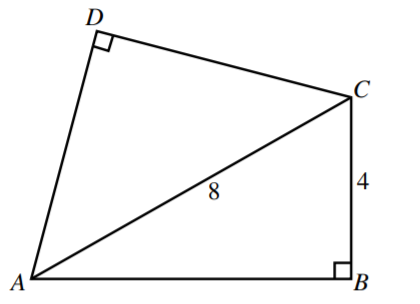

(A) \(8 \sqrt{3}\)

(B) 16

(C) \(12 + 4 \sqrt{3}\)

(D) \(8 + 8 \sqrt{3}\)

(E) \(16 + 8 \sqrt{3}\)

Attachment:
The attachment 2020-12-22_15-58-07.png is no longer available

Property used: Perpendicular from right angle divides the hypotenuse equally. Check the image. Its E

Bunuel, I think this is a 700+ question
Attachments

gmc.jpg
gmc.jpg [ 24.52 KiB | Viewed 1908 times ]

User avatar
ShankSouljaBoi
Joined: 21 Jun 2017
Last visit: 28 Mar 2026
Posts: 599
Own Kudos:
Given Kudos: 4,090
Location: India
Concentration: Finance, Economics
GMAT 1: 660 Q49 V31
GMAT 2: 620 Q47 V30
GMAT 3: 650 Q48 V31
GPA: 3.1
WE:Corporate Finance (Non-Profit and Government)
Products:
Kudos
Add Kudos
Bookmarks
Bookmark this Post
TarunKumar1234
Area of Triangle ABC = 1/2 *BC*AB = 1/2*4*4Sqt3= 8*Sqrt(3)

Now, we have Option D and E to pickup.

AC=8 so, AD+DC >AC=8, So, both sides AD and DC will be greater than 4.

Hence, Total Area = 8*Sqrt(3) + 1/2 * (>4)*(>4)

so, Option E. :)

to add to ur solution for clarity , lets try to decipher how did you get to AD and DC each has to be greater than 4.

Let AD be a and DC be b
Then, for the triangle ADC to exist

a-b < AC < a+b
a-b < 8 < a+b .... condition 1
::::::::> a+b/2 > 4
Now using AM >= GM

(Something greater than 4) >= GM. The maximum GM can be when a = b

So, (Something greater than 4) >= sqrt (a^2)
::::::::> (Something greater than 4) >= a .... condition 2
We will have to drop = in condition 2 because if a = b = 4 ... condition 1 is violated as 8 < a+b
====> 8 < 8
Therefore we can conclude that both a and b are greater than 4 .
User avatar
imeanup
Joined: 15 Jun 2017
Last visit: 24 Mar 2026
Posts: 452
Own Kudos:
Given Kudos: 8
Location: India
Posts: 452
Kudos: 636
Kudos
Add Kudos
Bookmarks
Bookmark this Post
ShankSouljaBoi

You haven't read the complete explanation. There are two possibilities here. Both are being mentioned in the explanation. Moreover, the triangles are "similar" based on AAA triangle similarity properties. However, that is not the case here based on the answer choices the triangle is isosceles.
User avatar
ShankSouljaBoi
Joined: 21 Jun 2017
Last visit: 28 Mar 2026
Posts: 599
Own Kudos:
Given Kudos: 4,090
Location: India
Concentration: Finance, Economics
GMAT 1: 660 Q49 V31
GMAT 2: 620 Q47 V30
GMAT 3: 650 Q48 V31
GPA: 3.1
WE:Corporate Finance (Non-Profit and Government)
Products:
Kudos
Add Kudos
Bookmarks
Bookmark this Post
meanup
ShankSouljaBoi

You haven't read the complete explanation. There are two possibilities here. Both are being mentioned in the explanation. Moreover, the triangles are "similar" based on AAA triangle similarity properties. However, that is not the case here based on the answer choices the triangle is isosceles.
The figure is not drawn to scale. I did read your explanation completely, and your contention that only two possibilities exist is false. What if I have 29 degrees and 61 degrees and 90 degrees. It's not mentioned that scaling has been considered. Further, how did you get to AAA, please show via image?
User avatar
imeanup
Joined: 15 Jun 2017
Last visit: 24 Mar 2026
Posts: 452
Own Kudos:
Given Kudos: 8
Location: India
Posts: 452
Kudos: 636
Kudos
Add Kudos
Bookmarks
Bookmark this Post
Yes, you are correct. It is not similar; ShankSouljaBoi

\(\triangle ABC\),
\(BC=4\)
\(AB=4\sqrt{3}\)

Using \(AB^2+BC^2=AC^2\) Pyth Theorem since the \(\angle B =90^{\circ}\) we can find the length of \(AB\)

As the triangle is a right triangle, we can do the following trigonometry;
\(\frac{BC}{AB}=tan θ^{\circ}\)

Still, we don't know the \(θ^{\circ}\). So, we can find that now:
\(\frac{4}{4\sqrt{3} }= \frac{1}{\sqrt{3}}=tan 30^{\circ}\)

Therefore, \(\angle CAB=30^{\circ}\) and \(\angle ACB=60^{\circ}\)

\(\triangle ADC\). \(A+D=90^{\circ}\) but it is not \(30,60\) or \(60,30\)
User avatar
ShankSouljaBoi
Joined: 21 Jun 2017
Last visit: 28 Mar 2026
Posts: 599
Own Kudos:
Given Kudos: 4,090
Location: India
Concentration: Finance, Economics
GMAT 1: 660 Q49 V31
GMAT 2: 620 Q47 V30
GMAT 3: 650 Q48 V31
GPA: 3.1
WE:Corporate Finance (Non-Profit and Government)
Products:
Kudos
Add Kudos
Bookmarks
Bookmark this Post
meanup
Yes, you are correct. It is not similar; ShankSouljaBoi

\(\triangle ABC\),
\(BC=4\)
\(AB=4\sqrt{3}\)

Using \(AB^2+BC^2=AC^2\) Pyth Theorem since the \(\angle B =90^{\circ}\) we can find the length of \(AB\)

As the triangle is a right triangle, we can do the following trigonometry;
\(\frac{BC}{AB}=tan θ^{\circ}\)

Still, we don't know the \(θ^{\circ}\). So, we can find that now:
\(\frac{4}{4\sqrt{3} }= \frac{1}{\sqrt{3}}=tan 30^{\circ}\)

Therefore, \(\angle CAB=30^{\circ}\) and \(\angle ACB=60^{\circ}\)

\(\triangle ADC\). \(A+D=90^{\circ}\) but it is not \(30,60\) or \(60,30\)
takeaway is two dimensions don't give u similarity 3 do. SSS AAA SAS RHS ASA are ok. ASS IS NOT

Posted from my mobile device
User avatar
Fdambro294
Joined: 10 Jul 2019
Last visit: 20 Aug 2025
Posts: 1,331
Own Kudos:
772
 [1]
Given Kudos: 1,656
Posts: 1,331
Kudos: 772
 [1]
1
Kudos
Add Kudos
Bookmarks
Bookmark this Post
Just because the 2 triangles share a hypotenuse does not necessarily mean that these 2 triangles are similar.

The perpendicular height drawn to the hypotenuse does not bisect the triangle. It does so when the right triangle is Isoscles.

The height drawn from the 90 degree vertex to the hypotenuse will create 3 similar triangles within that same triangle.

But we do not have any other lengths besides the hypotenuse = 8

Anyone find a way to solve this problem?

ShankSouljaBoi
meanup
Yes, you are correct. It is not similar; ShankSouljaBoi

\(\triangle ABC\),
\(BC=4\)
\(AB=4\sqrt{3}\)

Using \(AB^2+BC^2=AC^2\) Pyth Theorem since the \(\angle B =90^{\circ}\) we can find the length of \(AB\)

As the triangle is a right triangle, we can do the following trigonometry;
\(\frac{BC}{AB}=tan θ^{\circ}\)

Still, we don't know the \(θ^{\circ}\). So, we can find that now:
\(\frac{4}{4\sqrt{3} }= \frac{1}{\sqrt{3}}=tan 30^{\circ}\)

Therefore, \(\angle CAB=30^{\circ}\) and \(\angle ACB=60^{\circ}\)

\(\triangle ADC\). \(A+D=90^{\circ}\) but it is not \(30,60\) or \(60,30\)
takeaway is two dimensions don't give u similarity 3 do. SSS AAA SAS RHS ASA are ok. ASS IS NOT

Posted from my mobile device
Moderators:
Math Expert
109963 posts
Tuck School Moderator
852 posts