Last visit was: 09 Jun 2026, 10:53 It is currently 09 Jun 2026, 10:53
Close
GMAT Club Daily Prep
Thank you for using the timer - this advanced tool can estimate your performance and suggest more practice questions. We have subscribed you to Daily Prep Questions via email.

Customized
for You

we will pick new questions that match your level based on your Timer History

Track
Your Progress

every week, we’ll send you an estimated GMAT score based on your performance

Practice
Pays

we will pick new questions that match your level based on your Timer History
Not interested in getting valuable practice questions and articles delivered to your email? No problem, unsubscribe here.
Close
Request Expert Reply
Confirm Cancel
User avatar
callumdye
Joined: 07 Oct 2023
Last visit: 21 May 2024
Posts: 1
Own Kudos:
59
 [59]
Given Kudos: 1
Posts: 1
Kudos: 59
 [59]
7
Kudos
Add Kudos
52
Bookmarks
Bookmark this Post
Most Helpful Reply
User avatar
Bunuel
User avatar
Math Expert
Joined: 02 Sep 2009
Last visit: 09 Jun 2026
Posts: 111,155
Own Kudos:
Given Kudos: 106,725
Products:
Expert
Expert reply
Active GMAT Club Expert! Tag them with @ followed by their username for a faster response.
Posts: 111,155
Kudos: 819,758
 [14]
5
Kudos
Add Kudos
9
Bookmarks
Bookmark this Post
User avatar
kpop1234567890
Joined: 04 Sep 2023
Last visit: 17 May 2025
Posts: 70
Own Kudos:
25
 [6]
Given Kudos: 51
Status:Ongoing
Location: United States (CA)
Concentration: General Management, Marketing
GPA: 3.99
WE:Operations (Computer Software)
Posts: 70
Kudos: 25
 [6]
2
Kudos
Add Kudos
4
Bookmarks
Bookmark this Post
General Discussion
User avatar
Kinshook
User avatar
Major Poster
Joined: 03 Jun 2019
Last visit: 09 Jun 2026
Posts: 6,021
Own Kudos:
Given Kudos: 163
Location: India
GMAT 1: 690 Q50 V34
WE:Engineering (Transportation)
Products:
GMAT 1: 690 Q50 V34
Posts: 6,021
Kudos: 5,886
Kudos
Add Kudos
Bookmarks
Bookmark this Post
callumdye

Asked: If f(x) = g(x-1), where g(x) = |x| + 1, which of the following must be true?

f(x) = |x-1| + 1 > 0 Since |x-1|>=0

IMO C
User avatar
BrushMyQuant
Joined: 05 Apr 2011
Last visit: 08 Jun 2026
Posts: 2,287
Own Kudos:
2,717
 [2]
Given Kudos: 100
Status:Tutor - BrushMyQuant
Location: India
Concentration: Finance, Marketing
Schools: XLRI (A)
GMAT 1: 700 Q51 V31
GPA: 3
WE:Information Technology (Computer Software)
Expert
Expert reply
Schools: XLRI (A)
GMAT 1: 700 Q51 V31
Posts: 2,287
Kudos: 2,717
 [2]
2
Kudos
Add Kudos
Bookmarks
Bookmark this Post
↧↧↧ Detailed Video Solution to the Problem ↧↧↧


Given that f(x) = g(x - 1) and g(x) = |x| + 1 and we need to find which of the following must be true?

To find g(x-1) we need to compare what is inside ( ) in g(x) = |x| + 1 and g(x-1)

=> We need to substitute x with x-1 in g(x) = |x| + 1 to get the value of g(x-1)

=> g(x-1) = |x-1| + 1
=> f(x) = g(x-1) = |x-1| + 1

Now, f(x) = Modulus of some number + 1, and we know that modulus of any number is non-negative
=> f(x) > 0 + 1
=> f(x) > 1
=> f(x) > 0

So, Answer will be C
Hope it helps!

Watch the following video to MASTER Functions and Custom Characters

­
User avatar
KarishmaB
Joined: 16 Oct 2010
Last visit: 09 Jun 2026
Posts: 16,491
Own Kudos:
79,869
 [1]
Given Kudos: 485
Location: Pune, India
Expert
Expert reply
Active GMAT Club Expert! Tag them with @ followed by their username for a faster response.
Posts: 16,491
Kudos: 79,869
 [1]
Kudos
Add Kudos
1
Bookmarks
Bookmark this Post
callumdye
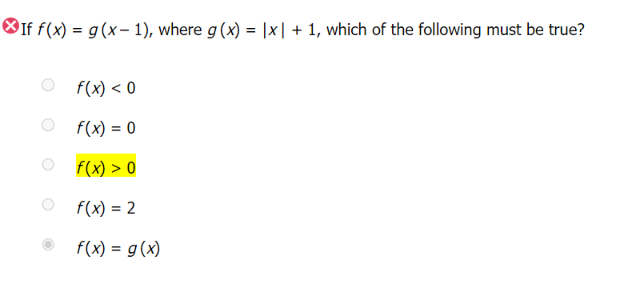
If f(x) = g(x - 1), where g(x) = |x| + 1, which of the following must be true?

(A) f(x) < 0

(B) f(x) = 0

(C) f(x) > 0

(D) f(x) = 2

(E) f(x) = g(x)
Attachment:
Functions.png


Functions may look hard but there are just a few things you need to keep in mind while working with them.
Check this post for those: https://anaprep.com/algebra-functions/

Given: g(x) = |x| + 1
Then g(x-1) = |x-1| + 1 (wherever there is x, simply put x-1)

Given: f(x) = g(x - 1) = |x-1| + 1
Now there is no one value that f(x) will take. It can take infinite values for different values of x. It can be 0, it can be 2 and it can be many other values.
But note that for no value of x will f(x) be negative. It is a sum of two non-negative quantities.

Answer (C)
User avatar
DanTheGMATMan
Joined: 02 Oct 2015
Last visit: 07 Jun 2026
Posts: 380
Own Kudos:
270
 [1]
Given Kudos: 10
Expert
Expert reply
Posts: 380
Kudos: 270
 [1]
1
Kudos
Add Kudos
Bookmarks
Bookmark this Post
Very common motif on the GMAT focus: just extract some logical conclusion from an algebraic setup. The absolute value has to be nonnegative, so f(x) will be greater than or equal to 1:
User avatar
NEYR0N
Joined: 12 Feb 2025
Last visit: 27 Jan 2026
Posts: 90
Own Kudos:
Given Kudos: 66
Posts: 90
Kudos: 14
Kudos
Add Kudos
Bookmarks
Bookmark this Post
why are we not taking scenarios where (x-1)>=0 , (x-1) < 0 ?
Kinshook
callumdye

Asked: If f(x) = g(x-1), where g(x) = |x| + 1, which of the following must be true?

f(x) = |x-1| + 1 > 0 Since |x-1|>=0

IMO C
User avatar
Bunuel
User avatar
Math Expert
Joined: 02 Sep 2009
Last visit: 09 Jun 2026
Posts: 111,155
Own Kudos:
Given Kudos: 106,725
Products:
Expert
Expert reply
Active GMAT Club Expert! Tag them with @ followed by their username for a faster response.
Posts: 111,155
Kudos: 819,758
Kudos
Add Kudos
Bookmarks
Bookmark this Post
INprimesItrust
why are we not taking scenarios where (x-1)>=0 , (x-1) < 0 ?
Kinshook
callumdye

Asked: If f(x) = g(x-1), where g(x) = |x| + 1, which of the following must be true?

f(x) = |x-1| + 1 > 0 Since |x-1|>=0

IMO C

There's no need to split into cases like (x-1) ≥ 0 or (x-1) < 0 because:

|x-1| is always ≥ 0 - that's the definition of absolute value.

So, |x-1| + 1 is always ≥ 1.

Thus, f(x) = |x-1| + 1 is always > 0 - no matter what x is.

That’s why option (C) is correct without needing to check cases.
User avatar
NEYR0N
Joined: 12 Feb 2025
Last visit: 27 Jan 2026
Posts: 90
Own Kudos:
Given Kudos: 66
Posts: 90
Kudos: 14
Kudos
Add Kudos
Bookmarks
Bookmark this Post
I'm surely not understanding something. What is the crux here ?

https://gmatclub.com/forum/on-the-numbe ... 16667.html

How are we assessing critical values 3 and 4 here, but not in this question?

Thanks,
Bunuel
INprimesItrust
why are we not taking scenarios where (x-1)>=0 , (x-1) < 0 ?
Kinshook
callumdye

Asked: If f(x) = g(x-1), where g(x) = |x| + 1, which of the following must be true?

f(x) = |x-1| + 1 > 0 Since |x-1|>=0

IMO C

There's no need to split into cases like (x-1) ≥ 0 or (x-1) < 0 because:

|x-1| is always ≥ 0 - that's the definition of absolute value.

So, |x-1| + 1 is always ≥ 1.

Thus, f(x) = |x-1| + 1 is always > 0 - no matter what x is.

That’s why option (C) is correct without needing to check cases.
User avatar
Bunuel
User avatar
Math Expert
Joined: 02 Sep 2009
Last visit: 09 Jun 2026
Posts: 111,155
Own Kudos:
819,758
 [1]
Given Kudos: 106,725
Products:
Expert
Expert reply
Active GMAT Club Expert! Tag them with @ followed by their username for a faster response.
Posts: 111,155
Kudos: 819,758
 [1]
1
Kudos
Add Kudos
Bookmarks
Bookmark this Post
INprimesItrust
I'm surely not understanding something. What is the crux here ?

https://gmatclub.com/forum/on-the-numbe ... 16667.html

How are we assessing critical values 3 and 4 here, but not in this question?

Thanks,
Bunuel
INprimesItrust
why are we not taking scenarios where (x-1)>=0 , (x-1) < 0 ?


There's no need to split into cases like (x-1) ≥ 0 or (x-1) < 0 because:

|x-1| is always ≥ 0 - that's the definition of absolute value.

So, |x-1| + 1 is always ≥ 1.

Thus, f(x) = |x-1| + 1 is always > 0 - no matter what x is.

That’s why option (C) is correct without needing to check cases.

Two questions are totally different.

In the question at hand, we are assessing |x - 1| + 1. How does it matter what x is or what x - 1 is? Who cares? The point the absolute value of x - 1, so |x - 1|, is ALWAYS non-negative. So |x - 1| + 1 will ALWAYS be positive - irrespective of x!
User avatar
ManishaPrepMinds
Joined: 14 Apr 2020
Last visit: 30 May 2026
Posts: 140
Own Kudos:
Given Kudos: 13
Location: India
Expert
Expert reply
Posts: 140
Kudos: 163
Kudos
Add Kudos
Bookmarks
Bookmark this Post
callumdye
If f(x) = g(x - 1), where g(x) = |x| + 1, which of the following must be true?

(A) f(x) < 0

(B) f(x) = 0

(C) f(x) > 0

(D) f(x) = 2

(E) f(x) = g(x)

Attachment:
Functions.png

Rewrite f(x) using g’s definition
f(x) = g(x − 1) = |x − 1| + 1
Use the property of absolute value
For any real x, |x − 1| ≥ 0 (absolute value is a distance, never negative)
f(x) = |x − 1| + 1 ≥ 0 + 1, so f(x) is always strictly positive
-> f(x) > 0
User avatar
GSV
Joined: 04 May 2024
Last visit: 06 Jun 2026
Posts: 277
Own Kudos:
Given Kudos: 95
Posts: 277
Kudos: 12
Kudos
Add Kudos
Bookmarks
Bookmark this Post
f(x) = g(x - 1) = |x - 1| + 1 = (positive value or 0) + 1 = positive. Thus, f(x) > 0.

Hence answer is C.

callumdye
If f(x) = g(x - 1), where g(x) = |x| + 1, which of the following must be true?

(A) f(x) < 0

(B) f(x) = 0

(C) f(x) > 0

(D) f(x) = 2

(E) f(x) = g(x)

Attachment:
Functions.png
User avatar
Usernamevisible
Joined: 09 Jun 2022
Last visit: 09 Jun 2026
Posts: 293
Own Kudos:
Given Kudos: 878
Products:
Posts: 293
Kudos: 23
Kudos
Add Kudos
Bookmarks
Bookmark this Post
Bunuel is this right approach -

Since g(x) = |x| + 1,
and |x| ≥ 0 for all x,
g(x) ≥ 1.
Therefore, g(x) is always positive.
-----------------------------------

Since f(x) = g(x - 1),
and x - 1 can be any real number,
f(x) is also always positive.
-----------------------------

Therefore,
f(x) > 0.
Answer: (C)
-----------

Key idea:
x - 1 is just another input. If g is positive for every possible input, then g(x - 1) must also be positive for every possible x. This is sufficient justification for the answer.
User avatar
egmat
User avatar
e-GMAT Representative
Joined: 02 Nov 2011
Last visit: 09 Jun 2026
Posts: 5,671
Own Kudos:
Given Kudos: 707
GMAT Date: 08-19-2020
Expert
Expert reply
Active GMAT Club Expert! Tag them with @ followed by their username for a faster response.
Posts: 5,671
Kudos: 33,509
Kudos
Add Kudos
Bookmarks
Bookmark this Post
Hi Usernamevisible,

Your conclusion is right, and your core insight (g is never less than 1, for any input) is exactly the property that settles this question. The answer is C.

There's just one link worth tightening so the justification is airtight rather than intuitive.

Your sentence "x - 1 is just another input, so g(x - 1) must also be positive" is true - but it's leaning on intuition. The clean way to make it rigorous is to actually form f(x) by substitution, the same move you'd make for any function:

- g(x) = |x| + 1
- To get g(x - 1), replace every x with x - 1: g(x - 1) = |x - 1| + 1
- So f(x) = |x - 1| + 1

Now the positivity isn't an appeal to "g is always positive" in the abstract - you can see it directly: |x - 1| >= 0 for every real x, so f(x) = |x - 1| + 1 >= 1. That's strictly greater than 0, no matter what x is. So f(x) > 0 must be true.

Why this matters

"The input doesn't change the output's sign" is the right instinct, but on the GMAT you want to land it on the actual expression. Once you write f(x) = |x - 1| + 1, every other option falls away cleanly: it's never 0 (min is 1), never a fixed 2 (that needs |x - 1| = 1), and not equal to g(x) in general.


So your answer is correct, and with the substitution written out, your justification is fully sufficient too.

Answer: C

Usernamevisible
Bunuel is this right approach -

Since g(x) = |x| + 1,
and |x| ≥ 0 for all x,
g(x) ≥ 1.
Therefore, g(x) is always positive.
-----------------------------------

Since f(x) = g(x - 1),
and x - 1 can be any real number,
f(x) is also always positive.
-----------------------------

Therefore,
f(x) > 0.
Answer: (C)
-----------

Key idea:
x - 1 is just another input. If g is positive for every possible input, then g(x - 1) must also be positive for every possible x. This is sufficient justification for the answer.
Moderator:
Math Expert
111155 posts