Last visit was: 27 Apr 2026, 10:16 It is currently 27 Apr 2026, 10:16
Close
GMAT Club Daily Prep
Thank you for using the timer - this advanced tool can estimate your performance and suggest more practice questions. We have subscribed you to Daily Prep Questions via email.

Customized
for You

we will pick new questions that match your level based on your Timer History

Track
Your Progress

every week, we’ll send you an estimated GMAT score based on your performance

Practice
Pays

we will pick new questions that match your level based on your Timer History
Not interested in getting valuable practice questions and articles delivered to your email? No problem, unsubscribe here.
Close
Request Expert Reply
Confirm Cancel
User avatar
Bunuel
User avatar
Math Expert
Joined: 02 Sep 2009
Last visit: 27 Apr 2026
Posts: 109,928
Own Kudos:
Given Kudos: 105,914
Products:
Expert
Expert reply
Active GMAT Club Expert! Tag them with @ followed by their username for a faster response.
Posts: 109,928
Kudos: 811,580
 [11]
1
Kudos
Add Kudos
10
Bookmarks
Bookmark this Post
User avatar
jedit
Joined: 14 Oct 2015
Last visit: 07 Sep 2021
Posts: 201
Own Kudos:
Given Kudos: 854
GPA: 3.57
Products:
Posts: 201
Kudos: 387
Kudos
Add Kudos
Bookmarks
Bookmark this Post
User avatar
mohshu
Joined: 21 Mar 2016
Last visit: 26 Dec 2019
Posts: 410
Own Kudos:
Given Kudos: 103
Products:
Posts: 410
Kudos: 143
Kudos
Add Kudos
Bookmarks
Bookmark this Post
User avatar
Alexey1989x
Joined: 05 Dec 2016
Last visit: 20 May 2023
Posts: 187
Own Kudos:
Given Kudos: 49
Concentration: Strategy, Finance
GMAT 1: 620 Q46 V29
GMAT 1: 620 Q46 V29
Posts: 187
Kudos: 98
Kudos
Add Kudos
Bookmarks
Bookmark this Post
I presume that it's E, because from (1) + (2) we cannot deduce whether RS is the mid-section of triangles or not.
PQ/TU=4/3 hence we have 1 and 2 for RS, and it is still possible for RS to be 7 or 14.
It also can be visualized if we make it wider ot thinner the overlapping of 2 triangles PQU & TQU.
User avatar
sonikavadhera
Joined: 06 Nov 2016
Last visit: 28 May 2019
Posts: 92
Own Kudos:
Given Kudos: 15
Location: India
GMAT 1: 710 Q50 V36
GPA: 2.8
Products:
GMAT 1: 710 Q50 V36
Posts: 92
Kudos: 63
Kudos
Add Kudos
Bookmarks
Bookmark this Post
jedit
Bunuel
In the diagram below, what is the length of RS?
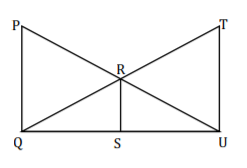

(1) PQ = 28 and TU = 21.
(2) PQ, RS and TU are parallel lines.


Attachment:
2017-07-18_1022.png

It appears to be C.

Statement 1: Insufficient.

We do not know the actual height from the base.

Statement 2: Insufficient.

We do not know lengths.

Combining, if the lines are parallel, their intersection should be the half of the average of the two lengths.

please explain how you came to the conclusion.
User avatar
RK007
Joined: 09 Nov 2018
Last visit: 27 Feb 2020
Posts: 64
Own Kudos:
Given Kudos: 222
Schools: ISB '21 (A)
Posts: 64
Kudos: 49
Kudos
Add Kudos
Bookmarks
Bookmark this Post
jedit
Bunuel
In the diagram below, what is the length of RS?


(1) PQ = 28 and TU = 21.
(2) PQ, RS and TU are parallel lines.


Attachment:
2017-07-18_1022.png

It appears to be C.

Statement 1: Insufficient.

We do not know the actual height from the base.

Statement 2: Insufficient.

We do not know lengths.

Combining, if the lines are parallel, their intersection should be the half of the average of the two lengths.

Is this a theorem? Do u have any explaination?
User avatar
RK007
Joined: 09 Nov 2018
Last visit: 27 Feb 2020
Posts: 64
Own Kudos:
Given Kudos: 222
Schools: ISB '21 (A)
Posts: 64
Kudos: 49
Kudos
Add Kudos
Bookmarks
Bookmark this Post
sonikavadhera
jedit
Bunuel
In the diagram below, what is the length of RS?


(1) PQ = 28 and TU = 21.
(2) PQ, RS and TU are parallel lines.


Attachment:
2017-07-18_1022.png

It appears to be C.

Statement 1: Insufficient.

We do not know the actual height from the base.

Statement 2: Insufficient.

We do not know lengths.

Combining, if the lines are parallel, their intersection should be the half of the average of the two lengths.

please explain how you came to the conclusion.

Were you able to find an answer to this?
User avatar
NCRanjan
Joined: 10 Sep 2018
Last visit: 05 Mar 2019
Posts: 41
Own Kudos:
Given Kudos: 72
Posts: 41
Kudos: 58
Kudos
Add Kudos
Bookmarks
Bookmark this Post
Hmm well its a nice question,

I chose E thinking on the lines that the only way C can be the answer would be if the bigger triangles are also similar ie if PQU is similar to TQU

Stmt 1 - only gives the value of PQ and TU and tells that they are not congruent. Fair enough
Stmt 2 says - RUS is similar to PUQ and that RQS is similar to TQU . no dimensions no answer

so if statement two also means PUQ and TUQ similar then we have our answer
RS/21= RS/28

RS=1/7
i want to believe it but since i am not sure i wont advocate it and wait for some expert to comment on it
User avatar
JeffYin
User avatar
Tutor
Joined: 28 Apr 2016
Last visit: 16 Jul 2020
Posts: 40
Own Kudos:
159
 [2]
Given Kudos: 9
Location: United States
GMAT 1: 780 Q51 V47
GPA: 3.9
Expert
Expert reply
GMAT 1: 780 Q51 V47
Posts: 40
Kudos: 159
 [2]
2
Kudos
Add Kudos
Bookmarks
Bookmark this Post
RK007
jedit
Bunuel
In the diagram below, what is the length of RS?


(1) PQ = 28 and TU = 21.
(2) PQ, RS and TU are parallel lines.


Attachment:
2017-07-18_1022.png

It appears to be C.

Statement 1: Insufficient.

We do not know the actual height from the base.

Statement 2: Insufficient.

We do not know lengths.

Combining, if the lines are parallel, their intersection should be the half of the average of the two lengths.

Is this a theorem? Do u have any explaination?

I'm not going to worry about whether this is a theorem or not, since approaching this problem from basic principles will be more relevant for the GMAT anyway.

I would start by re-drawing the diagram, and labeling the lengths of segments with variables as I have done below:


Note that we are solving for c in the above diagram. Now, based on statement 2, if we see that triangle RSU is similar to triangle PQR, and triangle RSQ is similar to triangle TUQ, we can write the ratios of sides as the following equations:

\(\frac{c}{e} = \frac{a}{d+e}\) and \(\frac{c}{d} = \frac{b}{d+e}\)

If we cross-multiply these equation we get:

\(c(d+e) = ae\) and \(c(d+e) = bd\)

This tells us that:

\(ae=bd\)

Now, statement 1 tells us that a = 28 and b = 21, which turns the equation above into:

\(28e = 21d\)

Thus, we have the ratio of e to d, which means that we also can calculate the ratio of e to d+e. We can rearrange the equation \(c(d+e) = ae\) to be:

\(c = a*\frac{e}{d+e}\)

Finally, since we know a = 28 and we can calculate the ratio \(\frac{e}{d+e}\), this is sufficient to calculate c, and thus answer the question.

Please let me know if you have any questions!
User avatar
bumpbot
User avatar
Non-Human User
Joined: 09 Sep 2013
Last visit: 04 Jan 2021
Posts: 38,987
Own Kudos:
Posts: 38,987
Kudos: 1,119
Kudos
Add Kudos
Bookmarks
Bookmark this Post
Automated notice from GMAT Club BumpBot:

A member just gave Kudos to this thread, showing it’s still useful. I’ve bumped it to the top so more people can benefit. Feel free to add your own questions or solutions.

This post was generated automatically.
Moderators:
Math Expert
109928 posts
498 posts
212 posts