Events & Promotions
|
|

GMAT Club Daily Prep
Thank you for using the timer - this advanced tool can estimate your performance and suggest more practice questions. We have subscribed you to Daily Prep Questions via email.
Customized
for You
Track
Your Progress
Practice
Pays
Not interested in getting valuable practice questions and articles delivered to your email? No problem, unsubscribe here.
 Apr 25
12:30 AM EDT
-01:30 AM EDT
At one point, she believed GMAT wasn’t for her. After scoring 595, self-doubt crept in and she questioned her potential. But instead of quitting, she made the right strategic changes. The result? A remarkable comeback to 695. Check out how Saakshi did it. Apr 26
01:30 AM EDT
-02:30 AM EDT
Learn how Keshav, a Chartered Accountant, scored an impressive 705 on GMAT in just 30 days with GMATWhiz's expert guidance. In this video, he shares preparation tips and strategies that worked for him, including the mock, time management, and more. Apr 26
10:00 AM EDT
-11:00 AM EDT
The Target Test Prep course represents a quantum leap forward in GMAT preparation, a radical reinterpretation of the way that students should study. Try before you buy with a 5-day, full-access trial of the course for FREE! Apr 27
11:00 AM EDT
-12:00 PM EDT
Prefer video-based learning? The Target Test Prep OnDemand course is a one-of-a-kind video masterclass featuring 400 hours of lecture-style teaching by Scott Woodbury-Stewart, founder of Target Test Prep and one of the most accomplished GMAT instructors Apr 28
08:00 AM PDT
-11:00 AM PDT
Whether you are just beginning your MBA journey or fine-tuning your path to a 700+ score, GMAT Day is designed to give you a competitive edge. May 01
11:00 AM PDT
-12:00 PM PDT
Free- full-length test + 15 concept videos + 150+ short videos + study plan!

 22 Feb 2021, 14:00
Kudos
Bookmarks


D
Be sure to select an answer first to save it in the Error Log before revealing the correct answer (OA)!
Difficulty:
 35%
(medium)
35%
(medium)
Question Stats:
64% (01:20) correct 36%
(01:42)
wrong
based on 144
sessions
36%
(01:42)
wrong
based on 144
sessions
History
Date
Time
Result
Not Attempted Yet

Attachment:
Screen Shot 2021-02-22 at 15.53.19.png [ 14.63 KiB | Viewed 3056 times ]
(1) The area of the square is 196 square units.
(2) The height of the hexagon is 14√3 units.
Show SpoilerSource
Source: Self-made question


 22 Feb 2021, 21:49
Kudos
Bookmarks
AndrewN
CONCEPT:
- Regular Hexagon is equivalent to 6 Equilateral Triangles put together
- The longest Diagonal of Regular Hexagon = 2*Length of side of Equilateral triangle/hexagon
- Height of Hexagon = 2*Height of equilateral ∆ \(= 2*(\frac{√3}{2})Side\)
Question: AB = 2n = ?
Statement 1: The area of the square is 196 square units.
i.e \(n^2 = 196\)
i.w. \(n = 15\)
SUFFICIENT
Statement 2: The height of the hexagon is 14√3 units
\(Height = √3*Side = 14√3\)
i.e. Side, \(n =14\)
SUFFICIENT
Answer: Option D
23 Feb 2021, 10:48
Kudos
Bookmarks
Hello, everyone. I agree with the excellent approach outlined by GMATinsight above. (I think there was simply a typo in the analysis to Statement 1, in which n should equal 14.) For those who may be less mathematically inclined but still have the basics down, I wanted to walk through another approach that could help in a pinch. The most legwork comes upfront, making sense of the figure itself, after which the rest is a breeze. If you do not know the properties of a regular hexagon, you can still figure out the internal angles and work from there. How? You can either invoke the formula for the number of degrees of each angle in a regular polygon, or you can reason your way to the same.
Step 1: Draw a circle around the hexagon so that it circumscribes the six-sided polygon. (See figure below.)
Step 2: Since a circle consists of 360 degrees, the sum of the external angles of the polygon must also equal 360 degrees.
Step 3: Since there are six vertices that touch the circle, divide the 360 degrees by 6.
\(360/6=60\)
Step 4: If each external angle of the polygon is 60 degrees, then each internal angle must be its supplement, since the two angles would form a straight angle, one that consists of 180 degrees. To solve for that internal angle measurement, then, we just need to subtract 60 from 180.
\(180-60=120\)
Of course, if you knew the formula to derive the same, you could save yourself some time:
\(\frac{180(n-2)}{n}\)
in which this n is the number of sides of the polygon.
Step 5: Now comes the hard part. If you draw the two diagonals within the hexagon that would be parallel to two of the sides, you can see that these diagonals would bisect not only the hexagon, but also each 120 degree internal angle. The result will be a hexagon that contains six equilateral triangles. I will add a diagram for clarity that summarizes what we have done up to this point, as well as where we are about to go in the next step.
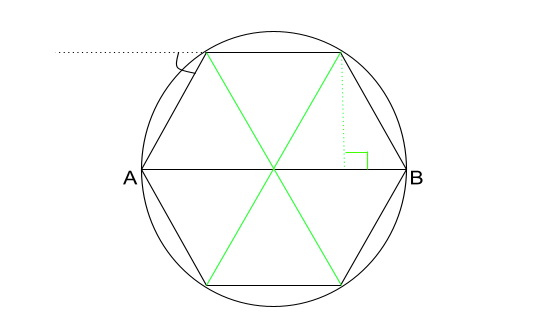
Screen Shot 2021-02-23 at 11.58.29.png [ 27.59 KiB | Viewed 2815 times ]
Step 6: Drop an altitude from the tip of one of the triangles to segment AB. This forms a right angle and, by extension, a right triangle within the equilateral triangle. We now have a 30-60-90 right triangle, and the sides opposite those angles must fit into the ratio x:x√3:2x, respectively. Hence, the n given as the side length in the problem must be equivalent to 2x in the ratio, since it would be the hypotenuse of the right triangle. All we need to know is the length of that hypotenuse. Now we are ready to assess the statements.
\(n^2=196\)
\(n=14\)
If n = 14, then the side length of each equilateral triangle must also be 14. Segment AB is the measure across one side of two separate equilateral triangles.
\(14*2=28\) units
Statement (1) is SUFFICIENT. What about Statement (2)?
\(2*7*2=28\) units
Statement (2) is SUFFICIENT.
Since each statement ALONE was sufficient to answer the question, the answer must be (D). I hope you had fun with this one, even if you took the long way. (Reinforcing fundamentals is a key to success on Quant, so there is no shame in it.)
Good luck with your studies.
- Andrew
Step 1: Draw a circle around the hexagon so that it circumscribes the six-sided polygon. (See figure below.)
Step 2: Since a circle consists of 360 degrees, the sum of the external angles of the polygon must also equal 360 degrees.
Step 3: Since there are six vertices that touch the circle, divide the 360 degrees by 6.
\(360/6=60\)
Step 4: If each external angle of the polygon is 60 degrees, then each internal angle must be its supplement, since the two angles would form a straight angle, one that consists of 180 degrees. To solve for that internal angle measurement, then, we just need to subtract 60 from 180.
\(180-60=120\)
Of course, if you knew the formula to derive the same, you could save yourself some time:
\(\frac{180(n-2)}{n}\)
in which this n is the number of sides of the polygon.
Step 5: Now comes the hard part. If you draw the two diagonals within the hexagon that would be parallel to two of the sides, you can see that these diagonals would bisect not only the hexagon, but also each 120 degree internal angle. The result will be a hexagon that contains six equilateral triangles. I will add a diagram for clarity that summarizes what we have done up to this point, as well as where we are about to go in the next step.
Attachment:
Screen Shot 2021-02-23 at 11.58.29.png [ 27.59 KiB | Viewed 2815 times ]
Quote:
We can derive the measure of n almost instantly.
\(n^2=196\)
\(n=14\)
If n = 14, then the side length of each equilateral triangle must also be 14. Segment AB is the measure across one side of two separate equilateral triangles.
\(14*2=28\) units
Statement (1) is SUFFICIENT. What about Statement (2)?
Quote:
With the diagram above, this should prove a no-brainer. Since segment AB bisects the hexagon, we know that the altitude of the equilateral triangle is 7√3 units. Moreover, since 7√3 corresponds to x√3 from the ratio, the side opposite the 60 degree angle, x must equal 7. Since the base of the equilateral triangle is 2x, we are off to the races, as before.
\(2*7*2=28\) units
Statement (2) is SUFFICIENT.
Since each statement ALONE was sufficient to answer the question, the answer must be (D). I hope you had fun with this one, even if you took the long way. (Reinforcing fundamentals is a key to success on Quant, so there is no shame in it.)
Good luck with your studies.
- Andrew