Last visit was: 23 Apr 2026, 07:23 It is currently 23 Apr 2026, 07:23
Close
GMAT Club Daily Prep
Thank you for using the timer - this advanced tool can estimate your performance and suggest more practice questions. We have subscribed you to Daily Prep Questions via email.

Customized
for You

we will pick new questions that match your level based on your Timer History

Track
Your Progress

every week, we’ll send you an estimated GMAT score based on your performance

Practice
Pays

we will pick new questions that match your level based on your Timer History
Not interested in getting valuable practice questions and articles delivered to your email? No problem, unsubscribe here.
Close
Request Expert Reply
Confirm Cancel
User avatar
I3igDmsu
Joined: 25 May 2009
Last visit: 26 Jan 2015
Posts: 104
Own Kudos:
690
 [65]
Given Kudos: 2
Concentration: Finance
GMAT Date: 12-16-2011
6
Kudos
Add Kudos
59
Bookmarks
Bookmark this Post
Most Helpful Reply
User avatar
robinmrtha
Joined: 30 Jun 2009
Last visit: 02 Sep 2009
Posts: 2
Own Kudos:
17
 [16]
Given Kudos: 5
Posts: 2
Kudos: 17
 [16]
15
Kudos
Add Kudos
1
Bookmarks
Bookmark this Post
User avatar
Bunuel
User avatar
Math Expert
Joined: 02 Sep 2009
Last visit: 23 Apr 2026
Posts: 109,778
Own Kudos:
Given Kudos: 105,853
Products:
Expert
Expert reply
Active GMAT Club Expert! Tag them with @ followed by their username for a faster response.
Posts: 109,778
Kudos: 810,784
 [15]
10
Kudos
Add Kudos
5
Bookmarks
Bookmark this Post
General Discussion
User avatar
gmatjon
Joined: 18 Aug 2009
Last visit: 21 Jul 2013
Posts: 212
Own Kudos:
Given Kudos: 16
Concentration: Accounting
Schools:UT at Austin, Indiana State University, UC at Berkeley
GPA: 3.8
WE 1: 5.5
WE 2: 5.5
WE 3: 6.0
GMAT 1: 700 Q49 V36
Posts: 212
Kudos: 364
Kudos
Add Kudos
Bookmarks
Bookmark this Post
I do not get this problem
Ok, let's imagine that the height of the parallelogram is 10 and it's base is 10 as well.
One of the angles of parallelogram is 45 degrees. That would mean, that one of the angles of the parallelogram height of the parallelogram and one of the sides of parallelogram will form right triangle. One leg of this triangle is 10, the other leg, which is part of the base of the parallelogram need to be 10 as well (Why?)
Because the right triangle is an isosceles triangle with angles 45, 45 and 90 degrees respectively.

BUT, that triangle would not make sense, since the total length of the base of the parallelogram is 10, how part of the length of the parallelogram could be 10 also.

Can somebody explain the problem to me.
Thank you
User avatar
Bunuel
User avatar
Math Expert
Joined: 02 Sep 2009
Last visit: 23 Apr 2026
Posts: 109,778
Own Kudos:
810,784
 [6]
Given Kudos: 105,853
Products:
Expert
Expert reply
Active GMAT Club Expert! Tag them with @ followed by their username for a faster response.
Posts: 109,778
Kudos: 810,784
 [6]
4
Kudos
Add Kudos
2
Bookmarks
Bookmark this Post
mirzohidjon
I do not get this problem
Ok, let's imagine that the height of the parallelogram is 10 and it's base is 10 as well.
One of the angles of parallelogram is 45 degrees. That would mean, that one of the angles of the parallelogram height of the parallelogram and one of the sides of parallelogram will form right triangle. One leg of this triangle is 10, the other leg, which is part of the base of the parallelogram need to be 10 as well (Why?)
Because the right triangle is an isosceles triangle with angles 45, 45 and 90 degrees respectively.

BUT, that triangle would not make sense, since the total length of the base of the parallelogram is 10, how part of the length of the parallelogram could be 10 also.

Can somebody explain the problem to me.
Thank you

Let parallelogram be ABCD. Base AD = 10, height BX = 10 and the angle BAD = 45 degrees. This would mean that when you draw the hight from B it will meat the base at point D (D and X will coincide). So the height will be the diagonal too. AB and CD will become hypotenuses and will be equal to \(10\sqrt{2}\).

\(P=20+20\sqrt{2}\).

Hope it's clear.
User avatar
gmatjon
Joined: 18 Aug 2009
Last visit: 21 Jul 2013
Posts: 212
Own Kudos:
Given Kudos: 16
Concentration: Accounting
Schools:UT at Austin, Indiana State University, UC at Berkeley
GPA: 3.8
WE 1: 5.5
WE 2: 5.5
WE 3: 6.0
GMAT 1: 700 Q49 V36
Posts: 212
Kudos: 364
Kudos
Add Kudos
Bookmarks
Bookmark this Post
Thank you, it was great help!
User avatar
amitjash
Joined: 17 Mar 2010
Last visit: 22 Feb 2017
Posts: 86
Own Kudos:
687
 [1]
Given Kudos: 9
Posts: 86
Kudos: 687
 [1]
1
Kudos
Add Kudos
Bookmarks
Bookmark this Post
Hi every body,
I think statement-2 alone will be suffice if we want to find the Perimeter. If one angle is 45, another angle has to be 45. In addition other two angles will be 270/2 each. Now, if you consider area of 100, you can find only one parallelogram matching these qualities. Please mind that here I dont care how i will find out the perimeter. But I do know that it can be found out.

Bunuel,
Can you please throw some light on this issue? I am not sure if I am making some mistake here. But i strongly believe that statement-2 alone must be suffice.
User avatar
Bunuel
User avatar
Math Expert
Joined: 02 Sep 2009
Last visit: 23 Apr 2026
Posts: 109,778
Own Kudos:
810,784
 [2]
Given Kudos: 105,853
Products:
Expert
Expert reply
Active GMAT Club Expert! Tag them with @ followed by their username for a faster response.
Posts: 109,778
Kudos: 810,784
 [2]
2
Kudos
Add Kudos
Bookmarks
Bookmark this Post
amitjash
Hi every body,
I think statement-2 alone will be suffice if we want to find the Perimeter. If one angle is 45, another angle has to be 45. In addition other two angles will be 270/2 each. Now, if you consider area of 100, you can find only one parallelogram matching these qualities. Please mind that here I dont care how i will find out the perimeter. But I do know that it can be found out.

Bunuel,
Can you please throw some light on this issue? I am not sure if I am making some mistake here. But i strongly believe that statement-2 alone must be suffice.

You are right about the angles, but there are many parallelograms possible with such angles and area 100:
\(h=10\), \(b=10\) --> \(area=100\);
\(h=5\), \(b=20\) --> \(area=100\);
\(h=1\), \(b=100\) --> \(area=100\);
...
--> different perimeter.

If refer to my previous post then we would have that \(height=BX=AX\) (as angle BAD is 45 degrees) and \(base=AX+XD\) --> \(Area=BX*(AX+XD)=AX*(AX+XD)=100\). You can plug different values for AX and XD to get are 100, thus the perimeter would be different for each case.
User avatar
shrouded1
User avatar
Retired Moderator
Joined: 02 Sep 2010
Last visit: 29 Apr 2018
Posts: 608
Own Kudos:
3,230
 [1]
Given Kudos: 25
Location: London
Products:
Posts: 608
Kudos: 3,230
 [1]
1
Kudos
Add Kudos
Bookmarks
Bookmark this Post
Orange08
If the area of a parallelogram is 100, what is the perimeter of the parallelogram?

1.The base of the parallelogram is 10.
2.One of the angles of the parallelogram is 45 degrees.

(1) Insufficient. Base=10. Area=100. So height is 10, but we don't know the angle inside the paralellogram, so we don't actually know length of the sides. (Imagine extreme case angle=90, makes it a square. Angle=10, makes its perimeter approach a very large number)

(2) Insufficent. Angle=45. Again, we dont know the base and the height, all we know their product is 100. hxb=100. Perimeter is 2(h(sqrt(2)) + b) which can take a range of different values for different choices of h.

(1+2) In this case, base=10. Height =10. Angle=45. So the other side will be 10(sqrt(2)). Hence perimeter = 20+20sqrt(2). Sufficient

Answer is (c)
User avatar
vitamingmat
Joined: 25 Aug 2010
Last visit: 28 Nov 2011
Posts: 39
Own Kudos:
Given Kudos: 1
Posts: 39
Kudos: 18
Kudos
Add Kudos
Bookmarks
Bookmark this Post
Bunuel
mirzohidjon
Hi, Bunuel,
I really appreciate your effort to help us. Finally after your explanation, I got the answer (since I imagined what kind of parallelogram the problem was talking about.
But, based on what assumptions, you deduce that parallelogram needs to be the way you described (diagonal equal to height)?
Attachment:
PointLatticeParallelograms_1000.gif
If the area of a parallelogram is 100, what is the perimeter of the parallelogram?

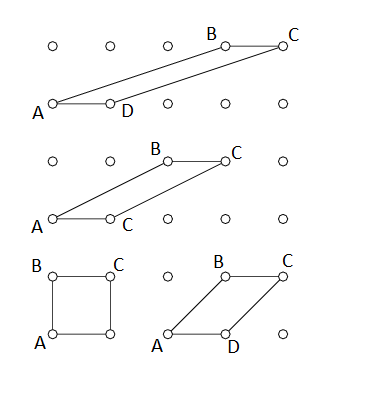
Given: \(Area=base*height=100\). Q: \(P=2b+2l=?\) (b - base, l - leg )

(1) The base of the parallelogram is 10 --> \(base=height=10\). Infinite variations are possible. Look at the diagram (let the distance between two horizontal and vertical points be 10): all 4 parallelograms have \(base=height=10\) but they have different perimeter. Not sufficient. Side notes: \(l\geq{10}\), when \(l=10=h\) we would have the square (case #3 on the diagram) and \(P=40\) (smallest possible perimeter), maximum value of perimeter is not limited.

(2) One of the angles of the parallelogram is 45 degrees. Clearly insufficient. But from this statement height BX and AX will make isosceles right triangle: \(height=BX=AX\).

(1)+(2) As from 2 we have that \(height=BX=AX\) and from (1) we have that \(base=height=10\) --> \(AX=base=AD=10\) --> X and D coincide (case #4 on the diagram) --> leg (AB) becomes hypotenuse of the isosceles right triangle with sides equal to 10 --> \(AB=10\sqrt{2}\) --> \(P=20+20\sqrt{2}\). Sufficient.

Answer: C.
Attachment:
m10-31.png

Hope it's clear.


HI Bunuel,

I got convienced bt small doubt grilling me ... if i draw a line from B to a base not diagnolly, can n't i consider as a height... ?? Is so then equation changes??
User avatar
Bunuel
User avatar
Math Expert
Joined: 02 Sep 2009
Last visit: 23 Apr 2026
Posts: 109,778
Own Kudos:
Given Kudos: 105,853
Products:
Expert
Expert reply
Active GMAT Club Expert! Tag them with @ followed by their username for a faster response.
Posts: 109,778
Kudos: 810,784
Kudos
Add Kudos
Bookmarks
Bookmark this Post
vitamingmat
Bunuel
mirzohidjon
Hi, Bunuel,
I really appreciate your effort to help us. Finally after your explanation, I got the answer (since I imagined what kind of parallelogram the problem was talking about.
But, based on what assumptions, you deduce that parallelogram needs to be the way you described (diagonal equal to height)?
Attachment:
PointLatticeParallelograms_1000.gif
If the area of a parallelogram is 100, what is the perimeter of the parallelogram?

Given: \(Area=base*height=100\). Q: \(P=2b+2l=?\) (b - base, l - leg )

(1) The base of the parallelogram is 10 --> \(base=height=10\). Infinite variations are possible. Look at the diagram (let the distance between two horizontal and vertical points be 10): all 4 parallelograms have \(base=height=10\) but they have different perimeter. Not sufficient. Side notes: \(l\geq{10}\), when \(l=10=h\) we would have the square (case #3 on the diagram) and \(P=40\) (smallest possible perimeter), maximum value of perimeter is not limited.

(2) One of the angles of the parallelogram is 45 degrees. Clearly insufficient. But from this statement height BX and AX will make isosceles right triangle: \(height=BX=AX\).

(1)+(2) As from 2 we have that \(height=BX=AX\) and from (1) we have that \(base=height=10\) --> \(AX=base=AD=10\) --> X and D coincide (case #4 on the diagram) --> leg (AB) becomes hypotenuse of the isosceles right triangle with sides equal to 10 --> \(AB=10\sqrt{2}\) --> \(P=20+20\sqrt{2}\). Sufficient.

Answer: C.
Attachment:
m10-31.png

Hope it's clear.


HI Bunuel,

I got convienced bt small doubt grilling me ... if i draw a line from B to a base not diagnolly, can n't i consider as a height... ?? Is so then equation changes??

A height is a perpendicular from a vertex to a side. When we consider two statements together we get that height from B coincide with diagonal BD.

Hope it's clear.
User avatar
tinki
Joined: 18 Aug 2010
Last visit: 03 Feb 2012
Posts: 51
Own Kudos:
Given Kudos: 22
Posts: 51
Kudos: 128
Kudos
Add Kudos
Bookmarks
Bookmark this Post
regarding the problem got question:

cant parallelogram be trapezoid with equal sides ? (in that case the area of trapezoid will be totally different and the answer will be E )
User avatar
Bunuel
User avatar
Math Expert
Joined: 02 Sep 2009
Last visit: 23 Apr 2026
Posts: 109,778
Own Kudos:
Given Kudos: 105,853
Products:
Expert
Expert reply
Active GMAT Club Expert! Tag them with @ followed by their username for a faster response.
Posts: 109,778
Kudos: 810,784
Kudos
Add Kudos
Bookmarks
Bookmark this Post
tinki
regarding the problem got question:

cant parallelogram be trapezoid with equal sides ? (in that case the area of trapezoid will be totally different and the answer will be E )

What do you mean by "cant parallelogram be trapezoid with equal sides"?

Next, given parallelogram (with one of the angles 45 degrees and base=height) can not have all 4 sides equal because it'll mean that height is equal to both base and leg which is impossible as the angle is 45 degrees (try to draw it).
User avatar
tinki
Joined: 18 Aug 2010
Last visit: 03 Feb 2012
Posts: 51
Own Kudos:
Given Kudos: 22
Posts: 51
Kudos: 128
Kudos
Add Kudos
Bookmarks
Bookmark this Post
Sorry , my question was not correclty formulated.

i somewhere read that trapezoid is a special type of parallelogram with one pare of parallel sides. Could that be right?
User avatar
Bunuel
User avatar
Math Expert
Joined: 02 Sep 2009
Last visit: 23 Apr 2026
Posts: 109,778
Own Kudos:
Given Kudos: 105,853
Products:
Expert
Expert reply
Active GMAT Club Expert! Tag them with @ followed by their username for a faster response.
Posts: 109,778
Kudos: 810,784
Kudos
Add Kudos
Bookmarks
Bookmark this Post
tinki
Sorry , my question was not correclty formulated.

i somewhere read that trapezoid is a special type of parallelogram with one pare of parallel sides. Could that be right?

Common definition of a trapezoid: a quadrilateral which has at least one pair of parallel sides.

Common definition of a parallelogram: a quadrilateral with two pairs of parallel sides.

According to these definitions all parallelograms are trapezoids but not all trapezoids are parallelograms.

Other definition of a trapezoid is: a quadrilateral which has only one pair of parallel sides. So according to this definition a parallelogram can not be a trapezoid at all.

But the above has nothing to do with the original question because we are told that the figure is a prallelogram: "If the area of a parallelogram is...".
User avatar
fluke
User avatar
Retired Moderator
Joined: 20 Dec 2010
Last visit: 24 Oct 2013
Posts: 1,095
Own Kudos:
Given Kudos: 376
Posts: 1,095
Kudos: 5,167
Kudos
Add Kudos
Bookmarks
Bookmark this Post
tinki
regarding the problem got question:

cant parallelogram be trapezoid with equal sides ? (in that case the area of trapezoid will be totally different and the answer will be E )

Trapezoid is not a parallelogram.

Parallelogram has four sides where opposite sides are always equal and parallel, whereas in a trapezoid, only one pair opposite sides is parallel.

Parallelograms: Rectangle, Square, Rhombus.

Area of parallelogram = base * height = 100

1. base = 10;

base * height = 10 * height = 100
height = 10
But, we can't find the other side of the parallelogram in order to find the perimeter. Not sufficient.

2. One of the angles is 45. Say parallelogram PQRS, where PR is parallel to QS. \(\angle{Q}\) is \(45{\circ}\)
If a line is drawn perpendicular from point P to QS and it meets at point X.
We know that the altitude, distance between PR and QS, is same as the distance between Q and X.
We don't know the side. Not sufficient.

Using both, as earlier explained, X is nothing but R. So, the side becomes the hypotenuse of the right triangle with base 10 and altitude 10, \(10\sqrt{2}\)

Perimeter: \(10+10\sqrt{2}\)

Answer: "C"
User avatar
bschooladmit
Joined: 11 May 2012
Last visit: 30 Mar 2014
Posts: 158
Own Kudos:
Given Kudos: 239
Status:Juggg..Jugggg Go!
Location: India
GC Meter: A.W.E.S.O.M.E
Concentration: Entrepreneurship, General Management
GMAT 1: 620 Q46 V30
GMAT 2: 720 Q50 V38
Products:
GMAT 2: 720 Q50 V38
Posts: 158
Kudos: 107
Kudos
Add Kudos
Bookmarks
Bookmark this Post
Bunuel! thanks for such good explanations, really appreciate that!! +1 to you!
User avatar
rohit8865
Joined: 05 Mar 2015
Last visit: 19 Apr 2026
Posts: 815
Own Kudos:
1,008
 [1]
Given Kudos: 45
Products:
Posts: 815
Kudos: 1,008
 [1]
1
Kudos
Add Kudos
Bookmarks
Bookmark this Post
Bunuel
mirzohidjon
Hi, Bunuel,
I really appreciate your effort to help us. Finally after your explanation, I got the answer (since I imagined what kind of parallelogram the problem was talking about.
But, based on what assumptions, you deduce that parallelogram needs to be the way you described (diagonal equal to height)?
Attachment:
The attachment PointLatticeParallelograms_1000.gif is no longer available
If the area of a parallelogram is 100, what is the perimeter of the parallelogram?

Given: \(Area=base*height=100\). Q: \(P=2b+2l=?\) (b - base, l - leg )

(1) The base of the parallelogram is 10 --> \(base=height=10\). Infinite variations are possible. Look at the diagram (let the distance between two horizontal and vertical points be 10): all 4 parallelograms have \(base=height=10\) but they have different perimeter. Not sufficient. Side notes: \(l\geq{10}\), when \(l=10=h\) we would have the square (case #3 on the diagram) and \(P=40\) (smallest possible perimeter), maximum value of perimeter is not limited.

(2) One of the angles of the parallelogram is 45 degrees. Clearly insufficient. But from this statement height BX and AX will make isosceles right triangle: \(height=BX=AX\).

(1)+(2) As from 2 we have that \(height=BX=AX\) and from (1) we have that \(base=height=10\) --> \(AX=base=AD=10\) --> X and D coincide (case #4 on the diagram) --> leg (AB) becomes hypotenuse of the isosceles right triangle with sides equal to 10 --> \(AB=10\sqrt{2}\) --> \(P=20+20\sqrt{2}\). Sufficient.

Answer: C.
Attachment:
The attachment m10-31.png is no longer available

Hope it's clear.
Bunuel/Anyone
Why not A alone is sufficient
being known 2 sides are 10 it means angles are also same .also as height BD is making 90 deg. means the other 2 angles are 45 deg each
fig. attached)
Thus making A as ans choice

Thanks
Attachments

m10-31.png
m10-31.png [ 5.08 KiB | Viewed 11016 times ]

User avatar
chetan2u
User avatar
GMAT Expert
Joined: 02 Aug 2009
Last visit: 22 Apr 2026
Posts: 11,229
Own Kudos:
Given Kudos: 335
Status:Math and DI Expert
Location: India
Concentration: Human Resources, General Management
GMAT Focus 1: 735 Q90 V89 DI81
Products:
Expert
Expert reply
GMAT Focus 1: 735 Q90 V89 DI81
Posts: 11,229
Kudos: 45,000
Kudos
Add Kudos
Bookmarks
Bookmark this Post
rohit8865
Bunuel
mirzohidjon
Hi, Bunuel,
I really appreciate your effort to help us. Finally after your explanation, I got the answer (since I imagined what kind of parallelogram the problem was talking about.
But, based on what assumptions, you deduce that parallelogram needs to be the way you described (diagonal equal to height)?
Attachment:
The attachment PointLatticeParallelograms_1000.gif is no longer available
If the area of a parallelogram is 100, what is the perimeter of the parallelogram?

Given: \(Area=base*height=100\). Q: \(P=2b+2l=?\) (b - base, l - leg )

(1) The base of the parallelogram is 10 --> \(base=height=10\). Infinite variations are possible. Look at the diagram (let the distance between two horizontal and vertical points be 10): all 4 parallelograms have \(base=height=10\) but they have different perimeter. Not sufficient. Side notes: \(l\geq{10}\), when \(l=10=h\) we would have the square (case #3 on the diagram) and \(P=40\) (smallest possible perimeter), maximum value of perimeter is not limited.

(2) One of the angles of the parallelogram is 45 degrees. Clearly insufficient. But from this statement height BX and AX will make isosceles right triangle: \(height=BX=AX\).

(1)+(2) As from 2 we have that \(height=BX=AX\) and from (1) we have that \(base=height=10\) --> \(AX=base=AD=10\) --> X and D coincide (case #4 on the diagram) --> leg (AB) becomes hypotenuse of the isosceles right triangle with sides equal to 10 --> \(AB=10\sqrt{2}\) --> \(P=20+20\sqrt{2}\). Sufficient.

Answer: C.
Attachment:
The attachment m10-31.png is no longer available

Hope it's clear.
Bunuel/Anyone
Why not A alone is sufficient
being known 2 sides are 10 it means angles are also same .also as height BD is making 90 deg. means the other 2 angles are 45 deg each
fig. attached)
Thus making A as ans choice

Thanks


Hi Rohit,
Refer your PM..
Area of llgm is dependent on base and height..
Base is one of the side but height will be other side only if angle is 90°...
With height 10, various combinations can be made...
Attachments

IMG_20160922_103428_HDR.jpg
IMG_20160922_103428_HDR.jpg [ 1.83 MiB | Viewed 11009 times ]

User avatar
KarishmaB
Joined: 16 Oct 2010
Last visit: 23 Apr 2026
Posts: 16,441
Own Kudos:
79,393
 [2]
Given Kudos: 484
Location: Pune, India
Expert
Expert reply
Active GMAT Club Expert! Tag them with @ followed by their username for a faster response.
Posts: 16,441
Kudos: 79,393
 [2]
1
Kudos
Add Kudos
Bookmarks
Bookmark this Post
rohit8865
Bunuel
mirzohidjon
Hi, Bunuel,
I really appreciate your effort to help us. Finally after your explanation, I got the answer (since I imagined what kind of parallelogram the problem was talking about.
But, based on what assumptions, you deduce that parallelogram needs to be the way you described (diagonal equal to height)?
Attachment:
The attachment PointLatticeParallelograms_1000.gif is no longer available
If the area of a parallelogram is 100, what is the perimeter of the parallelogram?

Given: \(Area=base*height=100\). Q: \(P=2b+2l=?\) (b - base, l - leg )

(1) The base of the parallelogram is 10 --> \(base=height=10\). Infinite variations are possible. Look at the diagram (let the distance between two horizontal and vertical points be 10): all 4 parallelograms have \(base=height=10\) but they have different perimeter. Not sufficient. Side notes: \(l\geq{10}\), when \(l=10=h\) we would have the square (case #3 on the diagram) and \(P=40\) (smallest possible perimeter), maximum value of perimeter is not limited.

(2) One of the angles of the parallelogram is 45 degrees. Clearly insufficient. But from this statement height BX and AX will make isosceles right triangle: \(height=BX=AX\).

(1)+(2) As from 2 we have that \(height=BX=AX\) and from (1) we have that \(base=height=10\) --> \(AX=base=AD=10\) --> X and D coincide (case #4 on the diagram) --> leg (AB) becomes hypotenuse of the isosceles right triangle with sides equal to 10 --> \(AB=10\sqrt{2}\) --> \(P=20+20\sqrt{2}\). Sufficient.

Answer: C.
Attachment:
The attachment m10-31.png is no longer available

Hope it's clear.
Bunuel/Anyone
Why not A alone is sufficient
being known 2 sides are 10 it means angles are also same .also as height BD is making 90 deg. means the other 2 angles are 45 deg each
fig. attached)
Thus making A as ans choice

Thanks

Responding to a pm:

Height is the length of the altitude from a vertex to the opposite side. It will be 10 in this case. But why is it necessary that it will fall on D? Look at these two figures. The perimeter in each case will be different.

Attachment:
ParallelogramJPEG.jpg
ParallelogramJPEG.jpg [ 23.09 KiB | Viewed 6204 times ]
 1   2   
Moderators:
Math Expert
109778 posts
498 posts
212 posts