Last visit was: 10 Sep 2026, 08:45 It is currently 10 Sep 2026, 08:45
Close
GMAT Club Daily Prep
Thank you for using the timer - this advanced tool can estimate your performance and suggest more practice questions. We have subscribed you to Daily Prep Questions via email.

Customized
for You

we will pick new questions that match your level based on your Timer History

Track
Your Progress

every week, we’ll send you an estimated GMAT score based on your performance

Practice
Pays

we will pick new questions that match your level based on your Timer History
Not interested in getting valuable practice questions and articles delivered to your email? No problem, unsubscribe here.
Close
Request Expert Reply
Confirm Cancel
User avatar
study
Joined: 05 Oct 2008
Last visit: 22 Mar 2022
Posts: 159
Own Kudos:
4,096
 [762]
Given Kudos: 22
Posts: 159
Kudos: 4,096
 [762]
55
Kudos
Add Kudos
703
Bookmarks
Bookmark this Post
User avatar
Bunuel
User avatar
Math Expert
Joined: 02 Sep 2009
Last visit: 10 Sep 2026
Posts: 113,386
Own Kudos:
Given Kudos: 111,450
Products:
Expert
Expert reply
Active GMAT Club Expert! Tag them with @ followed by their username for a faster response.
Posts: 113,386
Kudos: 840,479
 [139]
61
Kudos
Add Kudos
78
Bookmarks
Bookmark this Post
User avatar
PhunsukWangdu
Joined: 14 Jan 2010
Last visit: 03 Jun 2010
Posts: 12
Own Kudos:
32
 [19]
Posts: 12
Kudos: 32
 [19]
12
Kudos
Add Kudos
6
Bookmarks
Bookmark this Post
User avatar
Bunuel
User avatar
Math Expert
Joined: 02 Sep 2009
Last visit: 10 Sep 2026
Posts: 113,386
Own Kudos:
Given Kudos: 111,450
Products:
Expert
Expert reply
Active GMAT Club Expert! Tag them with @ followed by their username for a faster response.
Posts: 113,386
Kudos: 840,479
 [65]
33
Kudos
Add Kudos
32
Bookmarks
Bookmark this Post
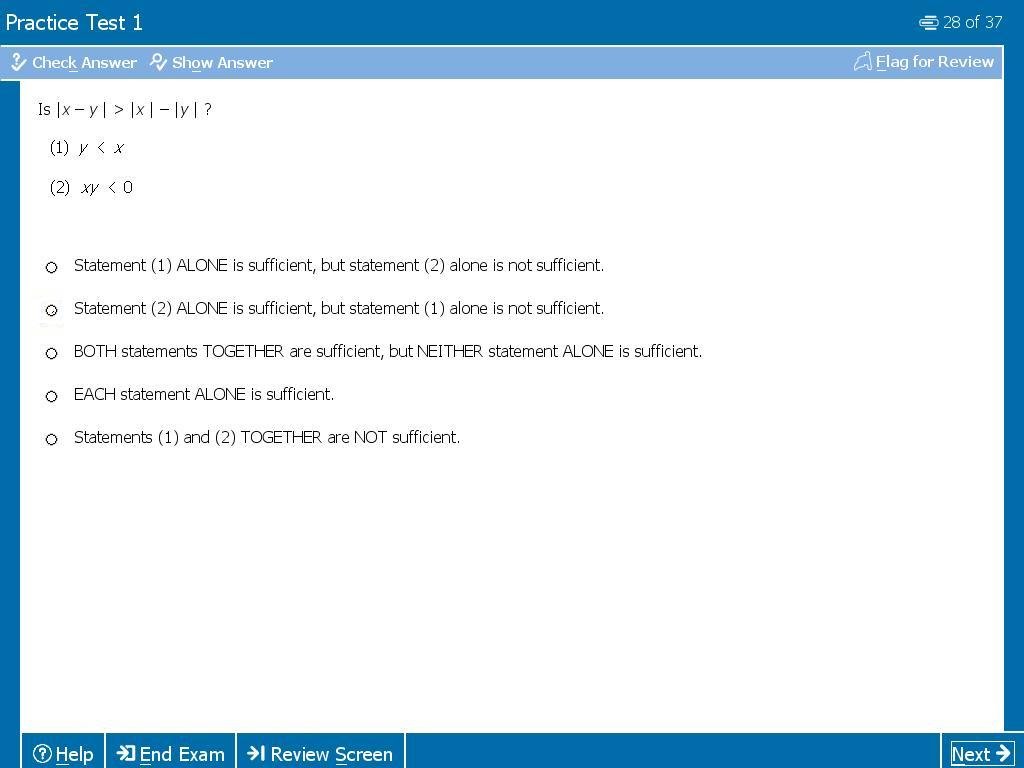
Is |x - y| > |x| - |y|?


(1) \(y<x\)

Try two positive number \(x=3>y=1\) --> is \(|3-1|>|3|-|1|\)? --> is \(2>2\)? Answer NO.

Try ANY other case but both positive: \(x=-5>y=-7\) --> is \(|-5-(-7)|>|-5|-|-7|\)? --> is \(2>-2\)? Answer YES.

Two different answers. Not sufficient.


(2) \(xy<0\), means \(x\) and \(y\) have different signs.

Now we can spot here that when \(x\) and \(y\) have different signs \(x-y\) always "contribute" to each other so that its absolute value will increase: \(x=3\), \(y=-1\) --> \(|x-y|=|3+1|=|4|=4\) or \(x=-3\), \(y=1\) --> \(|x-y|=|-3-1|=|4|=4\).

But \(|x|-|y|\) is difference (thus not "contributing") of two positive values (as neither equals to zero). \(x=3\), \(y=-1\) --> \(|x|-|y|=|3|-|-1|=2\) or \(x=-3\), \(y=1\) --> \(|x|-|y|=|-3|-|1|=2\).

So \(xy<0\) means \(|x-y|>|x|-|y|\) is always true.

Sufficient.


Answer: B.

Hope it helps.
avatar
SujD
Joined: 26 Jun 2010
Last visit: 26 Jun 2010
Posts: 1
Posts: 1
Kudos: 0
Kudos
Add Kudos
Bookmarks
Bookmark this Post
Bunuel
Basically the question asks whether the distance between the two points x and y on the line is greater than the difference between the individual distances of x and y from 0.

\(|x-y|>|x|-|y|\)?

(1) \(y<x\), 3 possible cases for \(|x-y|>|x|-|y|\):

A. ---------------\(0\)---\(y\)---\(x\)---, \(0<y<x\) --> in this case \(|x-y|>|x|-|y|\) becomes: \(x-y>x-y\) --> \(0>0\). Which is wrong;
B. ---------\(y\)---\(0\)---------\(x\)---, \(y<0<x\) --> in this case \(|x-y|>|x|-|y|\) becomes: \(x-y>x+y\) --> \(y<0\). Which is right, as we consider the range \(y<0<x\);
C. ---\(y\)---\(x\)---\(0\)--------------, \(y<x<0\) --> in this case \(|x-y|>|x|-|y|\) becomes: \(x-y>-x+y\) --> \(x>y\). Which is right, as we consider the range \(y<0<x\).

Two different answers. Not sufficient.

(2) \(xy<0\), means \(x\) and \(y\) have different signs, hence 2 cases for \(|x-y|>|x|-|y|\):

A. ----\(y\)-----\(0\)-------\(x\)---, \(y<0<x\) --> in this case \(|x-y|>|x|-|y|\) becomes: \(x-y>x+y\) --> \(y<0\). Which is right, as we consider the range \(y<0<x\);
B. ----\(x\)-----\(0\)-------\(y\)---, \(x<0<y\) --> in this case \(|x-y|>|x|-|y|\) becomes: \(-x+y>-x-y\) --> \(y>0\). Which is right, as we consider the range \(x<0<y\).

In both cases inequality holds true. Sufficient.

Answer: B.

Bunuel,
for 1.B when .. y ..0 .. x, you said \(|x-y|>|x|-|y|\) becomes: \(x-y>x+y\).
and
1.c when ... y ... x ... 0, you said \(|x-y|>|x|-|y|\) becomes: \(x-y>-x+y\) --> \(x>y\).

Can you explain this a little bit more? How did you go about removing the absolute signs for this scenarios?

Thanks for your help.
User avatar
Bunuel
User avatar
Math Expert
Joined: 02 Sep 2009
Last visit: 10 Sep 2026
Posts: 113,386
Own Kudos:
840,479
 [9]
Given Kudos: 111,450
Products:
Expert
Expert reply
Active GMAT Club Expert! Tag them with @ followed by their username for a faster response.
Posts: 113,386
Kudos: 840,479
 [9]
5
Kudos
Add Kudos
4
Bookmarks
Bookmark this Post
SujD


Bunuel,
for 1.B when .. y ..0 .. x, you said \(|x-y|>|x|-|y|\) becomes: \(x-y>x+y\).
and
1.c when ... y ... x ... 0, you said \(|x-y|>|x|-|y|\) becomes: \(x-y>-x+y\) --> \(x>y\).

Can you explain this a little bit more? How did you go about removing the absolute signs for this scenarios?

Thanks for your help.


Consider absolute value of some expression - \(|some \ expression|\):
If the expression in absolute value sign (||) is negative or if \(some \ expression<0\) then \(|some \ expression|=-(some \ expression)\);
If the expression in absolute value sign (||) is positive or if \(some \ expression>0\) then \(|some \ expression|=some \ expression\).

(It's the same as for \(|x|\): if \(x<0\), then \(|x|=-x\) and if \(x>0\), then \(|x|=x\))

We have \(|x-y|>|x|-|y|\):

For B: ---------\(y\)---\(0\)---------\(x\)---, \(y<0<x\) (\(x>y\)) --> so as \(x-y>0\), then \(|x-y|=x-y\). Also as \(x>0\), then \(|x|=x\) and as \(y<0\), then \(|y|=-y\). So in this case \(|x-y|>|x|-|y|\) becomes: \(x-y>x-(-y)\) or \(x-y>x+y\) --> \(2y<0\) --> \(y<0\). Which is right, as we consider the range \(y<0<x\);

The same for C.

Hope it's clear.
avatar
thisiszico2006
Joined: 16 Dec 2009
Last visit: 13 Aug 2018
Posts: 55
Own Kudos:
81
 [34]
Given Kudos: 11
GMAT 1: 680 Q49 V33
WE:Information Technology (Commercial Banking)
GMAT 1: 680 Q49 V33
Posts: 55
Kudos: 81
 [34]
19
Kudos
Add Kudos
14
Bookmarks
Bookmark this Post
Answer is (B).

Here's how I did it.

|x-y| has a range of possible values , min being |x|-|y| and max being |x|+|y|

Statement 1 : x>y . Scenarioes :- x=+ve , y=-ve , |x-y|= |x|+|y| ;
x=+ve , y=+ve , |x-y|=|x|-|y| ;
x=-ve , y=-ve , |x-y|= |-(x-y)|=|x|-|y|

So we cannot definitely say that |x-y| is greater than |x|-|y| because the min value for |x-y| is also |x|-|y|. So, statement 1 is not sufficient.

Statement 2 : xy<0 . Scenarios :- x=+ve , y=-ve , |x-y|= |x|+|y|;
x=-ve , y=+ve , |x-y| = |-(|x|+|y|)|=|x|+|y|.

Now we know |x| + |y| is definitely greater than |x|-|y|. So statement (2) is sufficient.
User avatar
askou
Joined: 06 Sep 2011
Last visit: 07 Aug 2012
Posts: 17
Own Kudos:
Given Kudos: 4
GMAT 1: 670 Q42 V40
GMAT 2: 750 Q50 V42
GMAT 2: 750 Q50 V42
Posts: 17
Kudos: 10
Kudos
Add Kudos
Bookmarks
Bookmark this Post
Funny, but I remember form university that |a-b|>||a|-|b||>|a|-|b|, therefore the above inequality is valid for all numbers a,b can somebody verify the inequality?

https://math.ucsd.edu/~wgarner/math4c/de ... nequal.htm
User avatar
KarishmaB
Joined: 16 Oct 2010
Last visit: 10 Sep 2026
Posts: 16,648
Own Kudos:
81,267
 [11]
Given Kudos: 491
Location: Pune, India
Expert
Expert reply
Active GMAT Club Expert! Tag them with @ followed by their username for a faster response.
Posts: 16,648
Kudos: 81,267
 [11]
8
Kudos
Add Kudos
3
Bookmarks
Bookmark this Post
askou
Funny, but I remember form university that |a-b|>||a|-|b||>|a|-|b|, therefore the above inequality is valid for all numbers a,b can somebody verify the inequality?

https://math.ucsd.edu/~wgarner/math4c/de ... nequal.htm

If you notice, you have missed the 'equal to' sign.
Generalizing,\(|a-b|\geq|a|-|b|\)

In some cases, the equality will hold.
e.g. a = 3, b = 2
You get 1 = 1

In others, the inequality will hold.
e.g. a = -3, b = 4
7 > -1

In this question, you have to figure out whether the inequality will hold.
User avatar
Bunuel
User avatar
Math Expert
Joined: 02 Sep 2009
Last visit: 10 Sep 2026
Posts: 113,386
Own Kudos:
Given Kudos: 111,450
Products:
Expert
Expert reply
Active GMAT Club Expert! Tag them with @ followed by their username for a faster response.
Posts: 113,386
Kudos: 840,479
 [409]
101
Kudos
Add Kudos
307
Bookmarks
Bookmark this Post
mmphf
Is |x-y|>|x|-|y| ?

(1) y < x
(2) xy < 0

Is |x-y|>|x|-|y|?

Probably the best way to solve this problem is plug-in method. Though there are two properties worth to remember:
1. Always true: \(|x+y|\leq{|x|+|y|}\), note that "=" sign holds for \(xy\geq{0}\) (or simply when \(x\) and \(y\) have the same sign);

2. Always true: \(|x-y|\geq{|x|-|y|}\), note that "=" sign holds when \(x \leq y \leq 0\) or when \(0 \leq y \leq x\). So, essentially when \(xy \geq 0\) AND \(|x| \geq |y|\). (Our case)

So, the question basically asks whether we can exclude "=" scenario from the second property.

(1) y < x --> we cannot determine the signs of \(x\) and \(y\). Not sufficient.
(2) xy < 0 --> "=" scenario is excluded from the second property, thus \(|x-y|>|x|-|y|\). Sufficient.

Answer: B.
User avatar
someone79
Joined: 15 Dec 2011
Last visit: 26 Apr 2016
Posts: 160
Own Kudos:
62
 [4]
Given Kudos: 13
Schools: LBS '14 (A)
GMAT 1: 730 Q50 V39
GPA: 3.9
Schools: LBS '14 (A)
GMAT 1: 730 Q50 V39
Posts: 160
Kudos: 62
 [4]
1
Kudos
Add Kudos
3
Bookmarks
Bookmark this Post
This is a very simple question. !x-y!>|x|-|y| can only happen if both the numbers are of different signs.

If xy<0 then these numbers are of opposite signs. Hope this clears.


X=2 y=3 then |x-y|=|x|-|y|
if x=-2 and y = 3 then |x-y|>|x|-|y|
User avatar
Bunuel
User avatar
Math Expert
Joined: 02 Sep 2009
Last visit: 10 Sep 2026
Posts: 113,386
Own Kudos:
Given Kudos: 111,450
Products:
Expert
Expert reply
Active GMAT Club Expert! Tag them with @ followed by their username for a faster response.
Posts: 113,386
Kudos: 840,479
 [12]
8
Kudos
Add Kudos
4
Bookmarks
Bookmark this Post
someone79
This is a very simple question. !x-y!>|x|-|y| can only happen if both the numbers are of different signs.

If xy<0 then these numbers are of opposite signs. Hope this clears.


X=2 y=3 then |x-y|=|x|-|y|
if x=-2 and y = 3 then |x-y|>|x|-|y|

Red part is not correct \(|x-y|>{|x|-|y|}\) also holds true when \(x\) and \(y\) have the same sign and the magnitude of \(y\) is more than that of \(x\) (so for \(|y|>|x|\)). Example:
\(x=2\) and \(y=3\) --> \(|x-y|=1>-1={|x|-|y|}\);
\(x=-2\) and \(y=-3\) --> \(|x-y|=1>-1={|x|-|y|}\).

Actually the only case when \(|x-y|>{|x|-|y|}\) does not hold true is when \(xy>{0}\) (so when \(x\) and \(y\) have the same sign) and \(|x|>|y|\) (simultaneously). In this case \(|x-y|={|x|-|y|}\) (as shown in my previous post). Example:
\(x=3\) and \(y=2\) --> \(|x-y|=1={|x|-|y|}\);
\(x=-3\) and \(y=-2\) --> \(|x-y|=1={|x|-|y|}\).

Hope it's clear.
User avatar
IanStewart
User avatar
GMAT Tutor
Joined: 24 Jun 2008
Last visit: 10 Sep 2026
Posts: 4,146
Own Kudos:
11,530
 [11]
Given Kudos: 98
Location: United States
GMAT 1: 780 Q51 V47
Expert
Expert reply
GMAT 1: 780 Q51 V47
Posts: 4,146
Kudos: 11,530
 [11]
7
Kudos
Add Kudos
4
Bookmarks
Bookmark this Post
study
Is |x - y| > |x| - |y|?

(1) y < x
(2) xy < 0

Attachment:
3_DS_Absolute_B.JPG


That's just asking: is the distance between x and y, plus the distance from y to zero, greater than the distance from x to zero. If we have 0 < y < x or x < y < 0, these distances will be equal- the inequality will be false. If y is further from zero than x, or if y and x are on opposite sides of zero, the inequality will be true. This is easy to see if you draw a number line.

From 1), it is possible y and x are both to the right of zero, and the inequality is false, or that y and x are on the opposite sides of zero, and the inequality is true (among other possibilities): insufficient.

From 2), we know y and x are on opposite sides of zero (they have opposite signs): sufficient.
avatar
wisc4llin
Joined: 21 Mar 2011
Last visit: 13 Sep 2016
Posts: 6
Own Kudos:
13
 [11]
Given Kudos: 17
Posts: 6
Kudos: 13
 [11]
8
Kudos
Add Kudos
2
Bookmarks
Bookmark this Post
I found talking through this one to be helpful.

Namely:

|x-y| represents the distance between x and y on the number line.

|x|-|y|, on the other hand, first takes the absolute value of both numbers - and thereby moving them both to the positive side of the number line - and THEN calculates the difference between x and y

Visually, it makes sense that if x and y are of different signs (for example, x=-5, y=5), then the difference between the two numbers on a number line is greater if measured before moving them both to the positive side of the number line.

At this point I logically deduced that it is impossible for |x-y| to be less than |x|-|y|. I also deduced at this point that if x and y have the same sign, it does not matter when the absolute value is taken because the difference between them will be the same either way.

After this thought process, the problem becomes much easier.
avatar
kancharana
Joined: 29 Oct 2012
Last visit: 06 May 2013
Posts: 5
Own Kudos:
Location: United States
Concentration: Finance, Technology
GMAT Date: 06-03-2013
GPA: 3.83
WE:Web Development (Computer Software)
Posts: 5
Kudos: 8
Kudos
Add Kudos
Bookmarks
Bookmark this Post
mmphf
Is |x-y|>|x|-|y| ?

(1) y < x
(2) xy < 0


How it is B? Did they mention that X and Y are integers? No right, the answer should be E. If they provide details about X and Y as integers then it will be B otherwise it will be E.

can anyone help me about the scenario whether we consider fractions or not in this case?

Scenario:

x=1/2, y=1/3 ==> |1/2-1/3|=1/6 and |1/2|-|1/3|=1/6
User avatar
KarishmaB
Joined: 16 Oct 2010
Last visit: 10 Sep 2026
Posts: 16,648
Own Kudos:
81,267
 [2]
Given Kudos: 491
Location: Pune, India
Expert
Expert reply
Active GMAT Club Expert! Tag them with @ followed by their username for a faster response.
Posts: 16,648
Kudos: 81,267
 [2]
1
Kudos
Add Kudos
1
Bookmarks
Bookmark this Post
kancharana
mmphf
Is |x-y|>|x|-|y| ?

(1) y < x
(2) xy < 0


How it is B? Did they mention that X and Y are integers? No right, the answer should be E. If they provide details about X and Y as integers then it will be B otherwise it will be E.

can anyone help me about the scenario whether we consider fractions or not in this case?

Scenario:

x=1/2, y=1/3 ==> |1/2-1/3|=1/6 and |1/2|-|1/3|=1/6

It is B because if you use the data of statement 2, you can say, "Yes, |x-y| is greater than |x|-|y|"

(2) xy < 0
This means that one of x and y is positive and the other is negative. You cannot take x = 1/2 and y = 1/3.
It is not about fractions/integers. It is about positive/negative numbers (most mod questions are about positive/negative numbers)
When xy < 0, |x-y|>|x|-|y| always holds.
Only when x and y both are positive or both are negative and |x|>|y|, then |x-y|=|x|-|y|
User avatar
KarishmaB
Joined: 16 Oct 2010
Last visit: 10 Sep 2026
Posts: 16,648
Own Kudos:
81,267
 [2]
Given Kudos: 491
Location: Pune, India
Expert
Expert reply
Active GMAT Club Expert! Tag them with @ followed by their username for a faster response.
Posts: 16,648
Kudos: 81,267
 [2]
2
Kudos
Add Kudos
Bookmarks
Bookmark this Post
kancharana
mmphf
Is |x-y|>|x|-|y| ?

(1) y < x
(2) xy < 0


How it is B? Did they mention that X and Y are integers? No right, the answer should be E. If they provide details about X and Y as integers then it will be B otherwise it will be E.

can anyone help me about the scenario whether we consider fractions or not in this case?

Scenario:

x=1/2, y=1/3 ==> |1/2-1/3|=1/6 and |1/2|-|1/3|=1/6

Fractions and integers have no role to play here. Check Bunuel's post above.

Whenever xy < 0, i.e. x is negative but y is positive OR x is positive but y is negative, |x-y| is greater than |x|-|y|.

e.g. x = -1/2, y = 1/3
|x-y| = |-1/2-1/3| = 5/6
|x|-|y| = 1/2 - 1/3 = 1/6

So |x - y| > |x|-|y|

Do you see the logic here? If one of x and y is positive and the other is negative, in |x - y|, absolute values of x and y get added and the sum is positive. While in |x|-|y|, the absolute values are subtracted.
User avatar
CrackverbalGMAT
User avatar
Major Poster
Joined: 03 Oct 2013
Last visit: 10 Sep 2026
Posts: 4,849
Own Kudos:
9,368
 [1]
Given Kudos: 230
Affiliations: CrackVerbal
Location: India
Expert
Expert reply
Posts: 4,849
Kudos: 9,368
 [1]
Kudos
Add Kudos
1
Bookmarks
Bookmark this Post
study
Is |x - y| > |x| - |y|?

(1) y < x
(2) xy < 0

Statement I is insufficient

x....y.....(|x|-|y|)....|x-y|.....YES/NO
3....2.......1..............1........NO
3..-3........0..............6........YES

Statement II is sufficient
xy<0 means that either one of the numbers is negative and other is positive

|x-y| will always result to be a greater value as negative - positive or positive - negative will result in addition of the numbers and |x| - |y| will always result in subtraction.

Hence the answer is B
User avatar
KarishmaB
Joined: 16 Oct 2010
Last visit: 10 Sep 2026
Posts: 16,648
Own Kudos:
81,267
 [17]
Given Kudos: 491
Location: Pune, India
Expert
Expert reply
Active GMAT Club Expert! Tag them with @ followed by their username for a faster response.
Posts: 16,648
Kudos: 81,267
 [17]
10
Kudos
Add Kudos
7
Bookmarks
Bookmark this Post
mmphf
Is |x-y|>|x|-|y| ?

(1) y < x
(2) xy < 0

Responding to a pm:
You can solve this question easily if you understand some basic properties of absolute values. They are discussed in detail here: https://www.gmatclub.com/forum/veritas-prep-resource-links-no-longer-available-399979.html#/2014/02 ... -the-gmat/

One of the properties is

(II) For all real x and y, \(|x - y| \geq |x| - |y|\)
\(|x - y| = |x| - |y|\) when (1) x and y have the same sign and x has greater (or equal) absolute value than y (2) y is 0
\(|x - y| > |x| - |y|\) in all other cases

Question: Is |x-y|>|x|-|y|?

We need to establish whether the "equal to" sign can hold or not.

(1) y < x
Doesn't tell us whether they have the same sign or opposite. So we don't know whether the equal to sign will hold or greater than. Not sufficient.

(2) xy < 0
Tells us that one of x and y is positive and the other is negative (they do not have same sign). Also tells us that neither x nor y is 0. Hence, the "equal to" sign cannot hold. Sufficient to answer 'Yes'

Answer (B)
User avatar
MathRevolution
User avatar
Math Revolution GMAT Instructor
Joined: 16 Aug 2015
Last visit: 27 Sep 2022
Posts: 10,057
Own Kudos:
20,402
 [1]
Given Kudos: 4
GMAT 1: 760 Q51 V42
GPA: 3.82
Expert
Expert reply
GMAT 1: 760 Q51 V42
Posts: 10,057
Kudos: 20,402
 [1]
1
Kudos
Add Kudos
Bookmarks
Bookmark this Post
Forget conventional ways of solving math questions. In DS, Variable approach is the easiest and quickest way to find the answer without actually solving the problem. Remember equal number of variables and independent equations ensures a solution.

Is |x - y| > |x| - |y|?

(1) y < x
(2) xy < 0

If we modify the original condition,
if |x|>=|y|,
|x-y|>|x|-|y|>=0, so we can square both sides, which gives us (|x-y|)^2>(|x|-|y|)^2, and (x-y)^2>(|x|-|y|)^2
This becomes x^2+y^2-2xy>x^2+y^2-2|xy|, and if we simplify the inequality, -2xy>-2|xy|, and we ultimately want to know whether xy<0. This makes condition 2 sufficient.
if |x|<|y|, then |x|-|y|<0,
so |x-y|>|x|-|y| always work. Hence we do not need to deal with this, so the answer becomes (B).

Once we modify the original condition and the question according to the variable approach method 1, we can solve approximately 30% of DS questions.
 1   2   3   
Moderator:
Math Expert
113385 posts

