Events & Promotions
|
|

GMAT Club Daily Prep
Thank you for using the timer - this advanced tool can estimate your performance and suggest more practice questions. We have subscribed you to Daily Prep Questions via email.
Customized
for You
Track
Your Progress
Practice
Pays
Not interested in getting valuable practice questions and articles delivered to your email? No problem, unsubscribe here.
 Sep 07
12:01 AM PDT
-11:59 PM PDT
On the 7th, GMAT Club Tests will be Free! Including all the Quizzes, Questions, and Tests. 12 AM - 11:59 PM PDT- Sep 09
07:00 AM PDT
-10:00 AM PDT
Meet AdComs and explore top Master’s programs - MiM, MiF, MSc, MSBA and more. - Application Fee Waivers - Free 1-Week of GMAT Club Tests: - Master's Application Toolkit - Grand Prize Giveaway


 03 Dec 2023, 03:37
Kudos
Bookmarks


Dropdown 1: Negative
Dropdown 2: Negative
Be sure to select an answer first to save it in the Error Log before revealing the correct answer (OA)!
Difficulty:
 45%
(medium)
45%
(medium)
Question Stats:
78% (02:10) correct 22%
(02:20)
wrong
based on 933
sessions
22%
(02:20)
wrong
based on 933
sessions
History
Date
Time
Result
Not Attempted Yet
Veritas Prep
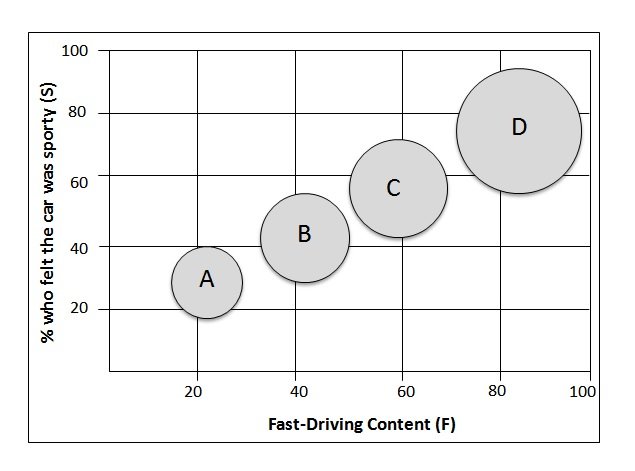 The graph represents the results of a survey taken by focus groups each shown a different version of an upcoming commercial for a sports car.
Each version had a different amount of content showing the car in fast-driving scenes.
After the group viewed the commercial, each member was asked two questions: "Did you feel that the car was sporty?" and "How likely are you to purchase this car?"
The position of the circles on the left indicate how much fast-driving content (F) was in the version of the commercial show and the % of viewers who found the car to be 'sporty' (S). The relative size of the circles indicates how likely the members of the group were to purchase the car (L). The bigger the circle, the more likely they were to purchase.
Use the drop-down menus to fill in the blanks in each of the following statements based on the information given by the graph.
3. If the relationship between L and S were inversed, then were would be a correlation between F and L.
4. If the relationship between L and S were inversed, then were would be a correlation between S and L.
Each version had a different amount of content showing the car in fast-driving scenes.
After the group viewed the commercial, each member was asked two questions: "Did you feel that the car was sporty?" and "How likely are you to purchase this car?"
The position of the circles on the left indicate how much fast-driving content (F) was in the version of the commercial show and the % of viewers who found the car to be 'sporty' (S). The relative size of the circles indicates how likely the members of the group were to purchase the car (L). The bigger the circle, the more likely they were to purchase.
Use the drop-down menus to fill in the blanks in each of the following statements based on the information given by the graph.
3. If the relationship between L and S were inversed, then were would be a correlation between F and L.
4. If the relationship between L and S were inversed, then were would be a correlation between S and L.
Archived Topic
Hi there,
This topic has been closed and archived due to inactivity or violation of community quality standards. No more replies are possible here.
Where to now? Join ongoing discussions on thousands of quality questions in our Graphs and Tables (G&T) Forum
Still interested in this question? Check out the "Best Topics" block below for a better discussion on this exact question, as well as several more related questions.
Thank you for understanding, and happy exploring!
ShowHide Answer
Official Answer
Dropdown 1: Negative
Dropdown 2: Negative

 13 Apr 2024, 07:38
Kudos
Bookmarks
Emily1122
the relationship between them probably meant the change in size( the probability of a person buying the car) with respect to the increase in the s(y-axis) graph i.e. increase. so when the relationship is inversed then the greater the s or f index the smaller the circle (i.e. L) so the correlation would be negative for both.







