|
|

GMAT Club Daily Prep
Thank you for using the timer - this advanced tool can estimate your performance and suggest more practice questions. We have subscribed you to Daily Prep Questions via email.
Customized
for You
Track
Your Progress
Practice
Pays
Not interested in getting valuable practice questions and articles delivered to your email? No problem, unsubscribe here.

 06 Aug 2013, 15:29
Kudos
Bookmarks


B
Be sure to select an answer first to save it in the Error Log before revealing the correct answer (OA)!
Difficulty:
 55%
(hard)
55%
(hard)
Question Stats:
60% (01:36) correct 40%
(01:31)
wrong
based on 419
sessions
40%
(01:31)
wrong
based on 419
sessions
History
Date
Time
Result
Not Attempted Yet
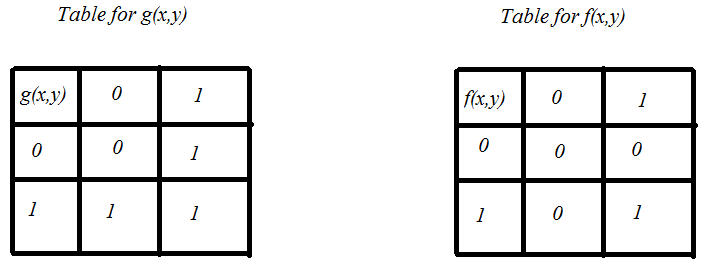
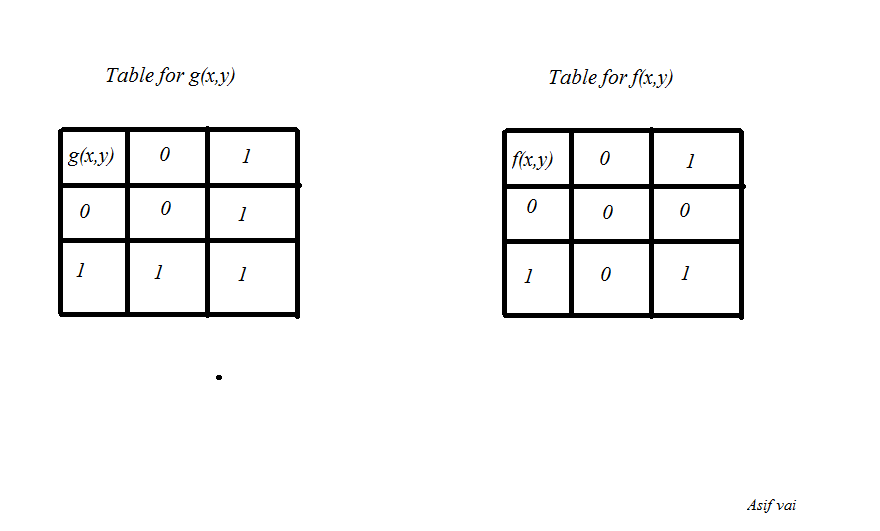
The possible arguments of the functions f(x,y) and g(x,y) are x=0 or 1 and y = 0 or 1 and are defined by the following tables (Attachment):
What is the value of f(a,b) + g(a,b) ?
(1) f(a,b) = 0
(2) g(a,b)= 0

Untitled.png [ 10.85 KiB | Viewed 4816 times ]
What is the value of f(a,b) + g(a,b) ?
(1) f(a,b) = 0
(2) g(a,b)= 0
Attachment:
File comment: Attachment
function 23.png [ 14.46 KiB | Viewed 7316 times ]
function 23.png [ 14.46 KiB | Viewed 7316 times ]
Attachment:
Untitled.png [ 10.85 KiB | Viewed 4816 times ]
Pure algebraic questions like this one are no longer part of the GMAT Data Sufficiency syllabus.
For relevant Data Sufficiency questions, please check the Data Sufficiency forum:
Data Sufficiency Forum
Data Sufficiency Forum
 06 Aug 2013, 23:16
Kudos
Bookmarks
What is the value of f(a,b) + g(a,b) ?
(1) f(a,b) = 0
This could be \(a,b=0\) and \(f(a,b) + g(a,b)=0\); or could be \(a=0\) and \(b=1\) and \(f(a,b) + g(a,b)=1\).
Not sufficient
(2) g(a,b)= 0
This works only for \(a,b=0\) so \(f(a,b) + g(a,b)=0\).
Sufficient
(1) f(a,b) = 0
This could be \(a,b=0\) and \(f(a,b) + g(a,b)=0\); or could be \(a=0\) and \(b=1\) and \(f(a,b) + g(a,b)=1\).
Not sufficient
(2) g(a,b)= 0
This works only for \(a,b=0\) so \(f(a,b) + g(a,b)=0\).
Sufficient
24 Apr 2014, 03:13
Kudos
Bookmarks
Asifpirlo
Can some one please explain the table to me . As of now I am not able to comprehend the two tables of f(a,b ) and g(a, b).
in a 2*2 table , rows stand for something and column stand for something. In this sum what does row stand for and what does column stand for?
Thank you members.





