Last visit was: 13 Sep 2026, 07:56 It is currently 13 Sep 2026, 07:56
Close
GMAT Club Daily Prep
Thank you for using the timer - this advanced tool can estimate your performance and suggest more practice questions. We have subscribed you to Daily Prep Questions via email.

Customized
for You

we will pick new questions that match your level based on your Timer History

Track
Your Progress

every week, we’ll send you an estimated GMAT score based on your performance

Practice
Pays

we will pick new questions that match your level based on your Timer History
Not interested in getting valuable practice questions and articles delivered to your email? No problem, unsubscribe here.
Close
Request Expert Reply
Confirm Cancel
User avatar
Bunuel
User avatar
Math Expert
Joined: 02 Sep 2009
Last visit: 13 Sep 2026
Posts: 113,481
Own Kudos:
Given Kudos: 111,490
Products:
Expert
Expert reply
Active GMAT Club Expert! Tag them with @ followed by their username for a faster response.
Posts: 113,481
Kudos: 841,026
 [34]
3
Kudos
Add Kudos
30
Bookmarks
Bookmark this Post
User avatar
chetan2u
User avatar
GMAT Expert
Joined: 02 Aug 2009
Last visit: 13 Sep 2026
Posts: 11,292
Own Kudos:
46,156
 [2]
Given Kudos: 339
Status:Math and DI Expert
Location: India
Concentration: Human Resources, General Management
GMAT Focus 1: 735 Q90 V89 DI81
Products:
Expert
Expert reply
GMAT Focus 1: 735 Q90 V89 DI81
Posts: 11,292
Kudos: 46,156
 [2]
1
Kudos
Add Kudos
1
Bookmarks
Bookmark this Post
User avatar
peachfuzz
Joined: 28 Feb 2014
Last visit: 27 Jan 2018
Posts: 266
Own Kudos:
375
 [1]
Given Kudos: 132
Location: United States
Concentration: Strategy, General Management
Products:
Posts: 266
Kudos: 375
 [1]
1
Kudos
Add Kudos
Bookmarks
Bookmark this Post
avatar
eddyki
Joined: 17 Dec 2013
Last visit: 23 Mar 2015
Posts: 47
Own Kudos:
41
 [1]
Given Kudos: 35
GMAT Date: 01-08-2015
Posts: 47
Kudos: 41
 [1]
1
Kudos
Add Kudos
Bookmarks
Bookmark this Post
Quote:
For triangle ABC, angle ABC = 90 degrees, and side AC has a length of 15. If point D lies on side AC, and a line is drawn from point B to point D, what is the length of line segment BD?

(1) Triangle ABC is isosceles.

(2) Line segment BD is perpendicular to side AC.

I start with (2): since we do not know
the length of AD and CD we can not use the similar triangle theorem, (sid/alt=alt/side)
not suff.
(1)triangle is a isosceles. but we do not know where is the point D on AC.

(1/2): since BD is perpendicular, we know that the isosceles ABC with °ABC=90 has BCA=45 and CAB=45. with AC = 15 we got AD=7,5 and CD=7,5. We could either use x:x:x*root(2) to determine AB / CB and afterwars BD (with pythagoras).
or we know that the perpendicular will build 2 triangles with 45-45-90 but as the ground we will get x, and as the legs we will get 0,5*15. so its suff
User avatar
82vkgmat
Joined: 02 Sep 2014
Last visit: 07 Nov 2017
Posts: 69
Own Kudos:
546
 [1]
Given Kudos: 32
Location: United States
GMAT 1: 770 Q50 V44
GPA: 3.97
Products:
GMAT 1: 770 Q50 V44
Posts: 69
Kudos: 546
 [1]
1
Kudos
Add Kudos
Bookmarks
Bookmark this Post
Bunuel
For triangle ABC, angle ABC = 90 degrees, and side AC has a length of 15. If point D lies on side AC, and a line is drawn from point B to point D, what is the length of line segment BD?

(1) Triangle ABC is isosceles.

(2) Line segment BD is perpendicular to side AC.

Kudos for a correct solution.


Answer C
1) If ABC is isosceles AB=BC but doesnt help us calculate BD.
2) If BD is perpendicular to AC we still dont know BD.

Combining, we know AB = BC from one so each of them can be calculated and the triangle is defined. So BD is calculable.
Or since area of triangle is constant AB*BC=AC*BD so BD can be calculated.

Answer =C.

Press kudos if I am right.
User avatar
Bunuel
User avatar
Math Expert
Joined: 02 Sep 2009
Last visit: 13 Sep 2026
Posts: 113,481
Own Kudos:
841,026
 [5]
Given Kudos: 111,490
Products:
Expert
Expert reply
Active GMAT Club Expert! Tag them with @ followed by their username for a faster response.
Posts: 113,481
Kudos: 841,026
 [5]
3
Kudos
Add Kudos
2
Bookmarks
Bookmark this Post
Bunuel
For triangle ABC, angle ABC = 90 degrees, and side AC has a length of 15. If point D lies on side AC, and a line is drawn from point B to point D, what is the length of line segment BD?

(1) Triangle ABC is isosceles.

(2) Line segment BD is perpendicular to side AC.

Kudos for a correct solution.

VERITAS PREP OFFICIAL SOLUTION:

C. For statement 1, it's helpful to just draw the triangle and several variations of line BD - you should see that point D can be extremely close to point A, right down the middle, or extremely close to point C, all with different lengths. This demonstrates that statement 1 is not sufficient.

For statement 2, recognize that triangle ABC and be a right angle with an extremely long side AB and an extremely short side BC, or (as alluded to in statement 1) it could be isosceles in which both sides are the same length. And in either case, the length of line BD will differ dramatically.

If both statements are taken together, however, you can find the length of BD. Since ABC is an isosceles right triangle with a hypotenuse of 15, sides AB and BC will each have a length equal to 15 divided by the square root of 2. And since line BD will bisect triangle ABC into two identical right triangles, each with either side AB or BC as the hypotenuse, you should note that side BD will have to equal the other "short" leg of each triangle (either AD or DC), and each of those is half of the long side AC, which is 15. So the length of BD is half of 15, which is 7.5
avatar
dharan
Joined: 07 Mar 2011
Last visit: 03 Sep 2025
Posts: 10
Own Kudos:
Given Kudos: 5
Posts: 10
Kudos: 61
Kudos
Add Kudos
Bookmarks
Bookmark this Post
Hi Bunuel,

I have understood your explanation. But I need one clarification.
What If I say, statement 2 alone is sufficient. Because we know hypotenuse is 15 and ABC is a right angled triangle and right angled at B. with Pythagoras tripplets, other two sides are 12 and 9. We know if we know 3 sides we can find out BD length.

with formula BD = (AB * BC) / AC.

With this I feel something I am missing. either I am assuming more than the required or carrying extra information. Can you tell me what is my mistake ?
User avatar
Bunuel
User avatar
Math Expert
Joined: 02 Sep 2009
Last visit: 13 Sep 2026
Posts: 113,481
Own Kudos:
Given Kudos: 111,490
Products:
Expert
Expert reply
Active GMAT Club Expert! Tag them with @ followed by their username for a faster response.
Posts: 113,481
Kudos: 841,026
Kudos
Add Kudos
Bookmarks
Bookmark this Post
dharan
Hi Bunuel,

I have understood your explanation. But I need one clarification.
What If I say, statement 2 alone is sufficient. Because we know hypotenuse is 15 and ABC is a right angled triangle and right angled at B. with Pythagoras tripplets, other two sides are 12 and 9. We know if we know 3 sides we can find out BD length.

with formula BD = (AB * BC) / AC.

With this I feel something I am missing. either I am assuming more than the required or carrying extra information. Can you tell me what is my mistake ?

Why do you assume that the sides should be Pythagorean Triples? Why do you assume that the sides should be integers at all?
User avatar
LogicGuru1
Joined: 04 Jun 2016
Last visit: 28 May 2024
Posts: 463
Own Kudos:
Given Kudos: 36
GMAT 1: 750 Q49 V43
GMAT 1: 750 Q49 V43
Posts: 463
Kudos: 2,684
Kudos
Add Kudos
Bookmarks
Bookmark this Post
Bunuel
For triangle ABC, angle ABC = 90 degrees, and side AC has a length of 15. If point D lies on side AC, and a line is drawn from point B to point D, what is the length of line segment BD?

(1) Triangle ABC is isosceles.

(2) Line segment BD is perpendicular to side AC.

Kudos for a correct solution.

I almost concluded D as the answer by confusing similarity for congruency and then realised that strict congruency can only be reached if apart from being isosceles and having BD as the common side BD is also a perpendicular bisector of the AC. But this condition was not found in statement 1.
Then i checked statement 2 and realised that statement 2 gives us exactly what was missing .. the condition for strict congruency and the both statement A and B are needed

Attached here is my wrong answer

THE CORRECT ANSWER IS C


Attached here is my WRONG answer


Attachments

IMG_20160630_213820.jpg
IMG_20160630_213820.jpg [ 550.5 KiB | Viewed 305015 times ]

User avatar
KarishmaB
Joined: 16 Oct 2010
Last visit: 13 Sep 2026
Posts: 16,650
Own Kudos:
81,314
 [2]
Given Kudos: 492
Location: Pune, India
Expert
Expert reply
Active GMAT Club Expert! Tag them with @ followed by their username for a faster response.
Posts: 16,650
Kudos: 81,314
 [2]
2
Kudos
Add Kudos
Bookmarks
Bookmark this Post
LogicGuru1
Bunuel
For triangle ABC, angle ABC = 90 degrees, and side AC has a length of 15. If point D lies on side AC, and a line is drawn from point B to point D, what is the length of line segment BD?

(1) Triangle ABC is isosceles.

(2) Line segment BD is perpendicular to side AC.

Kudos for a correct solution.

I almost concluded D as the answer by confusing similarity for congruency and then realised that strict congruency can only be reached if apart from being isosceles and having BD as the common side BD is also a perpendicular bisector of the AC. But this condition was not found in statement 1.
Then i checked statement 2 and realised that statement 2 gives us exactly what was missing .. the condition for strict congruency and the both statement A and B are needed

Attached here is my wrong answer

THE CORRECT ANSWER IS C


Attached here is my WRONG answer


Responding to a pm:

This is where you made a mistake: there is no SSA rule. The rule is SAS (two sides and the INCLUDED angle). If you say AB = BC and BD = BD, the angles which have to be same are DBA and DBC.
A special SSA rule works only in case of a right triangle - It is called the RHS rule. There has to be a right angle in both triangles, the hypotenuses have to be equal and any one set of sides should be equal.

Statement 1 gives you neither SAS nor RHS. So the two triangles may not be congruent.
The other congruency rules are SSS, ASA and AAS.
User avatar
LogicGuru1
Joined: 04 Jun 2016
Last visit: 28 May 2024
Posts: 463
Own Kudos:
Given Kudos: 36
GMAT 1: 750 Q49 V43
GMAT 1: 750 Q49 V43
Posts: 463
Kudos: 2,684
Kudos
Add Kudos
Bookmarks
Bookmark this Post
VeritasPrepKarishma
LogicGuru1
Bunuel
For triangle ABC, angle ABC = 90 degrees, and side AC has a length of 15. If point D lies on side AC, and a line is drawn from point B to point D, what is the length of line segment BD?

(1) Triangle ABC is isosceles.

(2) Line segment BD is perpendicular to side AC.

Kudos for a correct solution.

I almost concluded D as the answer by confusing similarity for congruency and then realised that strict congruency can only be reached if apart from being isosceles and having BD as the common side BD is also a perpendicular bisector of the AC. But this condition was not found in statement 1.
Then i checked statement 2 and realised that statement 2 gives us exactly what was missing .. the condition for strict congruency and the both statement A and B are needed

Attached here is my wrong answer

THE CORRECT ANSWER IS C


Attached here is my WRONG answer


Responding to a pm:

This is where you made a mistake: there is no SSA rule. The rule is SAS (two sides and the INCLUDED angle). If you say AB = BC and BD = BD, the angles which have to be same are DBA and DBC.
A special SSA rule works only in case of a right triangle - It is called the RHS rule. There has to be a right angle in both triangles, the hypotenuses have to be equal and any one set of sides should be equal.

Statement 1 gives you neither SAS nor RHS. So the two triangles may not be congruent.
The other congruency rules are SSS, ASA and AAS.

Many thanks Karishma

I realised I am arriving at that wrong answer if I am choosing D.
Just got confused about congruency.
You are a tremendous help..
User avatar
KarishmaB
Joined: 16 Oct 2010
Last visit: 13 Sep 2026
Posts: 16,650
Own Kudos:
81,314
 [1]
Given Kudos: 492
Location: Pune, India
Expert
Expert reply
Active GMAT Club Expert! Tag them with @ followed by their username for a faster response.
Posts: 16,650
Kudos: 81,314
 [1]
1
Kudos
Add Kudos
Bookmarks
Bookmark this Post
Bunuel
For triangle ABC, angle ABC = 90 degrees, and side AC has a length of 15. If point D lies on side AC, and a line is drawn from point B to point D, what is the length of line segment BD?

(1) Triangle ABC is isosceles.

(2) Line segment BD is perpendicular to side AC.

Kudos for a correct solution.

Responding to a pm:
Quote:

How come if angles ABC and ADB are equal at 90, and angle A is shared between triangles ABC and ADB, and these triangles also share AB as one of their sides...why aren't they similar making B sufficient?

Triangles ABC and ADB are similar using AA rule (two equal angles) - no problem there.
The point is - how do you get the length of the line segment BD?
All you know is that AC is 15. You don't know the ratio of the corresponding sides of the two triangles. You don't know AB/BC/AD. How will you find BD?
User avatar
BrentGMATPrepNow
User avatar
Major Poster
Joined: 12 Sep 2015
Last visit: 31 Oct 2025
Posts: 6,727
Own Kudos:
37,307
 [20]
Given Kudos: 799
Location: Canada
Expert
Expert reply
Posts: 6,727
Kudos: 37,307
 [20]
13
Kudos
Add Kudos
7
Bookmarks
Bookmark this Post
Bunuel
For triangle ABC, angle ABC = 90 degrees, and side AC has a length of 15. If point D lies on side AC, and a line is drawn from point B to point D, what is the length of line segment BD?

(1) Triangle ABC is isosceles.

(2) Line segment BD is perpendicular to side AC.

Kudos for a correct solution.

IMPORTANT: For geometry DS questions, we are typically checking to see whether the statements "lock" a particular angle or length into having just one value. This concept is discussed in much greater detail in our video at the bottom of this post.

This technique can save a lot of time.

Target question: What is the length of line segment BD?

Given: For triangle ABC, angle ABC = 90 degrees, and side AC has a length of 15.

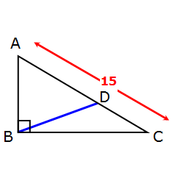
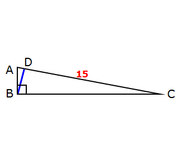
So, we have a shape that looks something like this . . .

. . . where the legs of the triangle can vary AND the location of point D can vary.

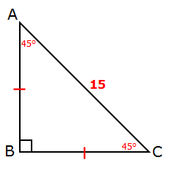
Statement 1: Triangle ABC is isosceles.
Since there is ONLY ONE isosceles right triangle with hypotenuse 15, this statement LOCKS triangle ABC into having one and only one shape.


However, statement 1 does NOT lock in the location of point D.
Since this statement does not lock in the location of point D, the length of BD is NOT LOCKED IN.
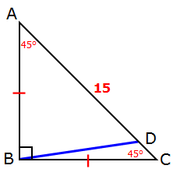
Consider these two examples.


Notice the different lengths of line segment BD
Since statement 1 does not lock in the length of line segment BD, it is NOT SUFFICIENT

Statement 2: Line segment BD is perpendicular to side AC.
This statement locks in the location of point D (in relation to the triangle's hypotenuse), but it does NOT lock in the shape of the triangle.
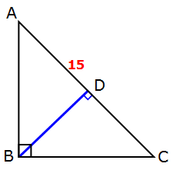
Consider these two examples:


Notice the different lengths of line segment BD
Since statement 2 does not lock in the length of line segment BD, it is NOT SUFFICIENT

Statements 1 and 2 combined
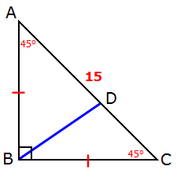
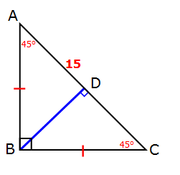
Statement 1 locks in the shape of triangle ABC.
Statement 2 then locks in the location of point D as follows:

Since there's only one diagram that can be drawn with the given information, there can be ONLY ONE length of line segment BD
Are we required to find this length? No. We need only recognize that there can be only one length.
Since we can answer the target question with certainty, the combined statements are SUFFICIENT

Answer =
RELATED VIDEO
avatar
cruiseav
Joined: 11 Feb 2018
Last visit: 19 May 2022
Posts: 33
Own Kudos:
Given Kudos: 3
Posts: 33
Kudos: 18
Kudos
Add Kudos
Bookmarks
Bookmark this Post
dharan
Hi Bunuel,

I have understood your explanation. But I need one clarification.
What If I say, statement 2 alone is sufficient. Because we know hypotenuse is 15 and ABC is a right angled triangle and right angled at B. with Pythagoras tripplets, other two sides are 12 and 9. We know if we know 3 sides we can find out BD length.

with formula BD = (AB * BC) / AC.

With this I feel something I am missing. either I am assuming more than the required or carrying extra information. Can you tell me what is my mistake ?


Hi Bunuel
Just curious which is the above highlighted formulae. Can u plz share its applicability.Thanks
User avatar
amanvermagmat
User avatar
Retired Moderator
Joined: 22 Aug 2013
Last visit: 28 Mar 2025
Posts: 1,142
Own Kudos:
Given Kudos: 480
Location: India
Posts: 1,142
Kudos: 3,093
Kudos
Add Kudos
Bookmarks
Bookmark this Post
cruiseav
dharan
Hi Bunuel,

I have understood your explanation. But I need one clarification.
What If I say, statement 2 alone is sufficient. Because we know hypotenuse is 15 and ABC is a right angled triangle and right angled at B. with Pythagoras tripplets, other two sides are 12 and 9. We know if we know 3 sides we can find out BD length.

with formula BD = (AB * BC) / AC.

With this I feel something I am missing. either I am assuming more than the required or carrying extra information. Can you tell me what is my mistake ?


Hi Bunuel
Just curious which is the above highlighted formulae. Can u plz share its applicability.Thanks


Hello

Consider a triangle ABC, which is 90 degrees at B. Now area of this triangle = 1/2 * base * height = 1/2 * AB * BC (AB, BC as base/height)
Now lets draw a perpendicular BD to side AC. Taking AC as base, BD would be the height. So Area can also be = 1/2 * BD * AC

Equating the two, AB*BC = BD*AC or BD = (AB * BC) / AC
User avatar
Bunuel
User avatar
Math Expert
Joined: 02 Sep 2009
Last visit: 13 Sep 2026
Posts: 113,481
Own Kudos:
Given Kudos: 111,490
Products:
Expert
Expert reply
Active GMAT Club Expert! Tag them with @ followed by their username for a faster response.
Posts: 113,481
Kudos: 841,026
Kudos
Add Kudos
Bookmarks
Bookmark this Post
cruiseav
dharan
Hi Bunuel,

I have understood your explanation. But I need one clarification.
What If I say, statement 2 alone is sufficient. Because we know hypotenuse is 15 and ABC is a right angled triangle and right angled at B. with Pythagoras tripplets, other two sides are 12 and 9. We know if we know 3 sides we can find out BD length.

with formula BD = (AB * BC) / AC.

With this I feel something I am missing. either I am assuming more than the required or carrying extra information. Can you tell me what is my mistake ?


Hi Bunuel
Just curious which is the above highlighted formulae. Can u plz share its applicability.Thanks

You can find the area of a righ triangle ABC (right angled at B) in several ways.

1. Area = leg1*leg2/2 = AB*BC/2
2. Area = height*base/2 = BD*AC/2 (where BD is altitude from B to the hypotenuse and hypotenuse AC is the base).

Equate: AB*BC/2 = BD*AC/2;

AB*BC = BD*AC;

BD = AB*BC/AC

Hope it's clear.
User avatar
CEdward
Joined: 11 Aug 2020
Last visit: 14 Apr 2022
Posts: 1,148
Own Kudos:
Given Kudos: 332
Posts: 1,148
Kudos: 306
Kudos
Add Kudos
Bookmarks
Bookmark this Post
For triangle ABC, angle ABC = 90 degrees, and side AC has a length of 15. If point D lies on side AC, and a line is drawn from point B to point D, what is the length of line segment BD?


(1) Triangle ABC is isosceles.
Insufficient b/c we don't know where specifically D is located on AC.

(2) Line segment BD is perpendicular to side AC.
Insufficient b/c we don't know what type of triangle we are looking at.

Combined: Sufficient.

We have a 45-45-90 triangle and D is the midpoint of AC.
User avatar
bumpbot
User avatar
Non-Human User
Joined: 09 Sep 2013
Last visit: 04 Jan 2021
Posts: 39,230
Own Kudos:
Posts: 39,230
Kudos: 1,158
Kudos
Add Kudos
Bookmarks
Bookmark this Post
Automated notice from GMAT Club BumpBot:

A member just gave Kudos to this thread, showing it’s still useful. I’ve bumped it to the top so more people can benefit. Feel free to add your own questions or solutions.

This post was generated automatically.
Moderator:
Math Expert
113481 posts