Events & Promotions
|
|

GMAT Club Daily Prep
Thank you for using the timer - this advanced tool can estimate your performance and suggest more practice questions. We have subscribed you to Daily Prep Questions via email.
Customized
for You
Track
Your Progress
Practice
Pays
Not interested in getting valuable practice questions and articles delivered to your email? No problem, unsubscribe here.
 Sep 02
01:00 PM EDT
-11:59 PM EDT
Take 30% off all study plans with code COURSEWORK - Expires on Monday 9/7 Sep 04
01:30 AM EDT
-02:30 AM EDT
This Labor Day, turn your hard work into real score gains. From 615→715 in 15 days to 705 in 30 days, our students prove what's possible with personalized, expert guidance. Save up to 25% on 1-on-1 tutoring. Sep 04
10:00 AM PDT
-11:00 AM PDT
What does test anxiety really look like on the GMAT? For many test takers, it does not look like a panic attack. Instead, it shows up as brain fog, rereading, negative comparisons, mental noise.... Sep 04
10:00 AM EDT
-11:59 PM EDT
We’ve worked incredibly hard to build TTP into the best test prep experience possible, and it would mean a lot to us to win Newsweek’s 2026 Readers’ Choice Award for Best Test Prep. If TTP has helped you, we’d be incredibly grateful for your vote. Sep 06
09:30 AM EDT
-12:30 PM EST
Top scores are possible when you enroll in a powerful EA course, taught live online + 6 months access to TTP OnDemand video courses included! Perfect class schedule and easy course access for working professionals. Class starts Sundays Sept. 6, 2026.- Sep 07
12:01 AM PDT
-11:59 PM PDT
On the 7th, GMAT Club Tests will be Free! Including all the Quizzes, Questions, and Tests. 12 AM - 11:59 PM PDT  Sep 07
12:30 AM EDT
-01:30 AM EDT
Tejas studied hard but kept repeating the same mistakes. After 3 attempts at 645, a focused 4-week strategy helped him identify and fix what was holding him back—leading to a 695 with just 12–15 hours of study per week.- Sep 07
10:00 AM PDT
-11:00 AM PDT
A complete walkthrough of GMAT Club’s free 12-week GMAT study plan: what you study each week, how progress and goals are tracked, how the error log works, and how your practice unlocks paid tools at no cost. - Sep 09
07:00 AM PDT
-10:00 AM PDT
Meet AdComs and explore top Master’s programs - MiM, MiF, MSc, MSBA and more. - Application Fee Waivers - Free 1-Week of GMAT Club Tests: - Master's Application Toolkit - Grand Prize Giveaway - Sep 09
10:00 AM PDT
-11:00 AM PDT
Three MBA applications. Three rejections. No interview invites. A year later, Aman was admitted to Cambridge Judge, SMU, and IMD. In this episode of MBA Admit Stories, Aman shares how he rebuilt his MBA application...  Sep 10
08:00 PM PDT
-09:00 PM PDT
Free- full-length test + 15 concept videos + 150+ short videos + study plan! Sep 15
07:00 PM EDT
-09:00 PM EST
Elite scores are possible when you enroll in a powerful GMAT course, taught live online + 6 months access to TTP OnDemand video courses included! Class starts Tues/Thurs Sept. 15, 2026 - Nov. 15, 2027, 7:00pm-9:00pm EST Sep 21
08:00 PM EDT
-10:00 PM EDT
Boost your GMAT score in less than one month in a live online class + 6 months access to TTP OnDemand video courses included! Class starts Mon, Tues, Wed, Thur, Fri Sept. 21, 2026 - Oct. 9, 2027, 7:00pm-10:00pm EST


 18 Aug 2025, 08:12
Kudos
Bookmarks
Hi everyone,
I'm Chirag, and I recently scored 675 on the GMAT (Q85, V85, DI82). This journey has been filled with ups and downs, but I'm excited to share what worked for me, especially my verbal transformation from V78 (39th percentile) to V85 (95th percentile).
I'm a working professional who had attempted the GMAT before, scoring in the low 600s. I knew I needed a more structured approach to break through to the next level. After researching various options, I enrolled in e-GMAT's course, attracted by their systematic approach and strong reviews for verbal preparation. Their Last Mile Push (LMP) program with personalized mentorship became a game-changer for my preparation.
The Foundation: Study Plan & Daily Milestones:
I'm someone who likes to plan and schedule things, writing down small targets for each day. e-GMAT's daily planner was perfect for me - it provided a milestone every day, which kept me accountable and on track. This wasn't just about checking boxes; each milestone had specific benchmarks to achieve before moving forward.
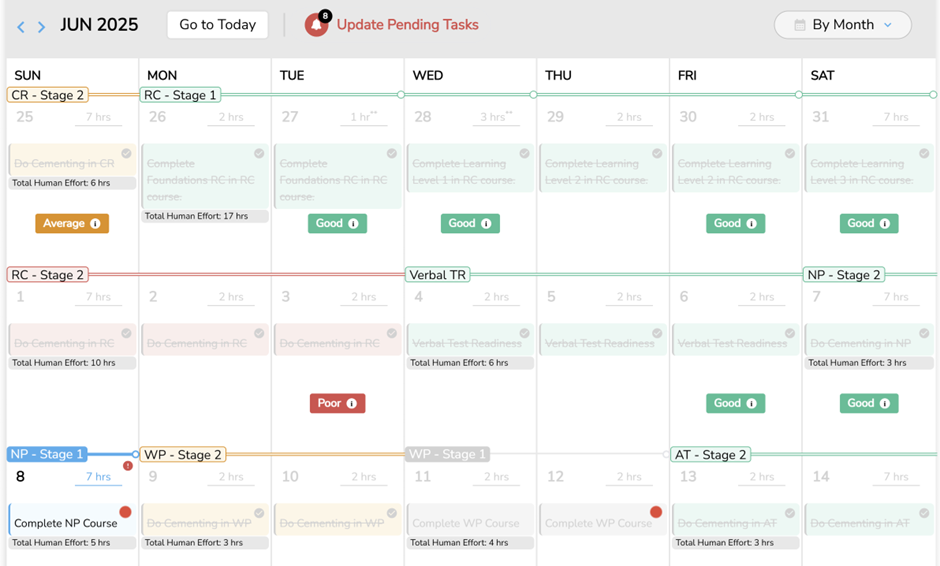
The study plan laid out a progressive learning path: Master Comprehension → Critical Reasoning → Reading Comprehension → Cementing. This sequence was crucial for building a strong foundation.
Verbal Transformation: V78 to V85
Master Comprehension - The Starting Point:
This is the first section in e-GMAT verbal and it taught me how to read sentences effectively. When facing long, complex sentences, I learned to chunk them down into smaller pieces and truly comprehend them. This foundational skill became the bedrock for everything that followed.
Critical Reasoning
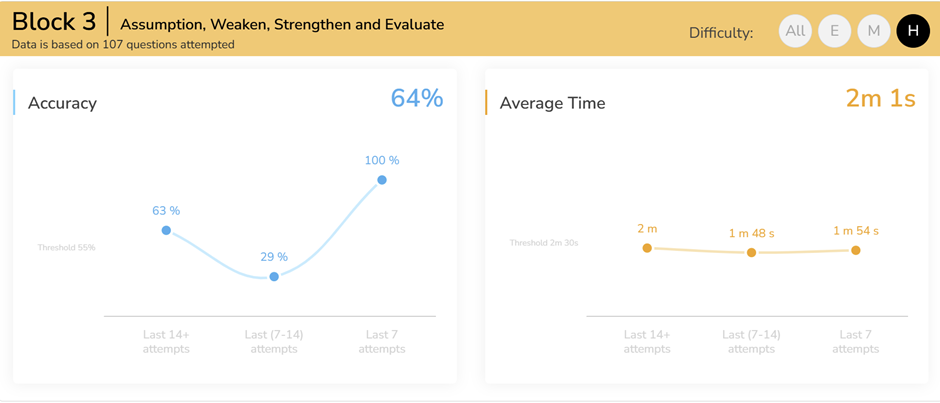
CR was my weakest area initially. The e-GMAT modules taught me a methodical way to approach different question types. The breakthrough came when I understood it's "not just about getting the answer right, but knowing that your thinking steps were correct."
I started maintaining a detailed error log for every cementing quiz, reviewing each question whether right or wrong. This helped me identify patterns:
This systematic approach took my CR accuracy from 55% to 80% on hard questions.
Reading Comprehension:
My biggest RC problem was losing focus mid-passage. The solution was breaking down passages into 3–4-line chunks, writing one-point summaries (just the important points, no examples), and spending maximum time on initial reading.
Initially, this felt time-consuming, but eventually, I could answer questions much faster because I had a clear mental map of the passage. No more getting lost or having to re-read entire sections!
The Power of Sectional Mocks:
One factor that significantly contributed to my improvement was the number of sectional mocks I took. Previously, I hadn't found resources for this many sectional practices. These mocks helped me:
Managing the Ups and Downs:
This journey wasn't linear. I had sectional mocks where I scored V79-V80, which was disappointing. But learnt the technique of "resetting" - one bad performance doesn't define your preparation.
After poor performances, I would:
Test Day Strategy & Execution:
My section order was Quant → DI → Break → Verbal
I started with Quant to get off to a strong start with my strongest section. After DI, I took the 10-minute break to cool down and reset before tackling Verbal. This strategy worked well for maintaining focus and energy throughout the exam.
Going into the test, I was "decently confident" about hitting my target. While I initially hoped for a 4-5 point improvement in verbal, achieving a 7-point jump exceeded my expectations!
The Last Mile Push Program Impact:
Having Rashmi as my mentor through the LMP program was invaluable. Beyond just strategy, she provided:
Key Takeaways:
Best regards,
Chirag

GMAT-Club-Forum-z9d52nkx.png [ 142.85 KiB | Viewed 982 times ]

GMAT-Club-Forum-i7cmd3m9.png [ 51.01 KiB | Viewed 974 times ]
I'm Chirag, and I recently scored 675 on the GMAT (Q85, V85, DI82). This journey has been filled with ups and downs, but I'm excited to share what worked for me, especially my verbal transformation from V78 (39th percentile) to V85 (95th percentile).
I'm a working professional who had attempted the GMAT before, scoring in the low 600s. I knew I needed a more structured approach to break through to the next level. After researching various options, I enrolled in e-GMAT's course, attracted by their systematic approach and strong reviews for verbal preparation. Their Last Mile Push (LMP) program with personalized mentorship became a game-changer for my preparation.
The Foundation: Study Plan & Daily Milestones:
I'm someone who likes to plan and schedule things, writing down small targets for each day. e-GMAT's daily planner was perfect for me - it provided a milestone every day, which kept me accountable and on track. This wasn't just about checking boxes; each milestone had specific benchmarks to achieve before moving forward.
The study plan laid out a progressive learning path: Master Comprehension → Critical Reasoning → Reading Comprehension → Cementing. This sequence was crucial for building a strong foundation.
Verbal Transformation: V78 to V85
Master Comprehension - The Starting Point:
This is the first section in e-GMAT verbal and it taught me how to read sentences effectively. When facing long, complex sentences, I learned to chunk them down into smaller pieces and truly comprehend them. This foundational skill became the bedrock for everything that followed.
Critical Reasoning
CR was my weakest area initially. The e-GMAT modules taught me a methodical way to approach different question types. The breakthrough came when I understood it's "not just about getting the answer right, but knowing that your thinking steps were correct."
I started maintaining a detailed error log for every cementing quiz, reviewing each question whether right or wrong. This helped me identify patterns:
- Was I jumping to answers too quickly?
- Did I misunderstand the question?
- Was I not reading all five options?
This systematic approach took my CR accuracy from 55% to 80% on hard questions.
Reading Comprehension:
My biggest RC problem was losing focus mid-passage. The solution was breaking down passages into 3–4-line chunks, writing one-point summaries (just the important points, no examples), and spending maximum time on initial reading.
Initially, this felt time-consuming, but eventually, I could answer questions much faster because I had a clear mental map of the passage. No more getting lost or having to re-read entire sections!
The Power of Sectional Mocks:
One factor that significantly contributed to my improvement was the number of sectional mocks I took. Previously, I hadn't found resources for this many sectional practices. These mocks helped me:
- Build stamina for each section
- Identify timing issues
- Practice my reset strategy between sections
Managing the Ups and Downs:
This journey wasn't linear. I had sectional mocks where I scored V79-V80, which was disappointing. But learnt the technique of "resetting" - one bad performance doesn't define your preparation.
After poor performances, I would:
- Analyze what went wrong (lack of focus? misreading questions? rushing?)
- Log the specific issues
- Reset mentally for the next practice
- Trust that the overall preparation was solid
Test Day Strategy & Execution:
My section order was Quant → DI → Break → Verbal
I started with Quant to get off to a strong start with my strongest section. After DI, I took the 10-minute break to cool down and reset before tackling Verbal. This strategy worked well for maintaining focus and energy throughout the exam.
Going into the test, I was "decently confident" about hitting my target. While I initially hoped for a 4-5 point improvement in verbal, achieving a 7-point jump exceeded my expectations!
The Last Mile Push Program Impact:
Having Rashmi as my mentor through the LMP program was invaluable. Beyond just strategy, she provided:
- Constant feedback on performance
- Customized practice plans based on my weaknesses
- Test day strategy planning
- Psychological support during low points
Key Takeaways:
- Systematic learning beats random practice: Following the Master Comprehension → CR → RC progression built a strong foundation
- Error logs are gold: Review every question, even correct ones, to understand your thinking process
- The reset mindset is crucial: One bad performance doesn't define your journey
- Quality resources matter: Having abundant practice questions through Scholaranium, NEURON, and sectional mocks meant I never had a shortage of materials
- Mentorship accelerates progress: Having expert guidance helps you focus efforts where they matter most
Best regards,
Chirag
Attachment:
GMAT-Club-Forum-z9d52nkx.png [ 142.85 KiB | Viewed 982 times ]
Attachment:
GMAT-Club-Forum-i7cmd3m9.png [ 51.01 KiB | Viewed 974 times ]


 18 Aug 2025, 08:36
Kudos
Bookmarks
Congratulations on your score 👍

 18 Aug 2025, 09:00
Kudos
Bookmarks
Congratulations for great score 👏!
JainChirag