Events & Promotions
|
|

GMAT Club Daily Prep
Thank you for using the timer - this advanced tool can estimate your performance and suggest more practice questions. We have subscribed you to Daily Prep Questions via email.
Customized
for You
Track
Your Progress
Practice
Pays
Not interested in getting valuable practice questions and articles delivered to your email? No problem, unsubscribe here.
 Sep 02
08:00 PM PDT
-09:00 PM PDT
Video explanations + diagnosis of 10 weakest areas + 150+ short videos + study plan! Sep 03
01:30 AM EDT
-02:30 AM EDT
At one point, she believed GMAT wasn’t for her. After scoring 595, self-doubt crept in and she questioned her potential. But instead of quitting, she made the right strategic changes. The result? A remarkable comeback to 695. Check out how Saakshi did it. Aug 27
10:00 AM EDT
-11:00 AM EDT
We’ve worked incredibly hard to build TTP into the best test prep experience possible, and it would mean a lot to us to win Newsweek’s 2026 Readers’ Choice Award for Best Test Prep. If TTP has helped you, we’d be incredibly grateful for your vote. Sep 02
12:30 AM EDT
-01:30 AM EDT
Thought your job leaves no time for GMAT prep? After multiple GMAT attempts and a demanding consulting job, Kshitij improved to 695 in under 2 months. Learn the mindset shifts, study strategy, and execution changes that made the breakthrough possible. Sep 04
10:00 AM PDT
-11:00 AM PDT
What does test anxiety really look like on the GMAT? For many test takers, it does not look like a panic attack. Instead, it shows up as brain fog, rereading, negative comparisons, mental noise.... Sep 06
09:30 AM EDT
-12:30 PM EST
Top scores are possible when you enroll in a powerful EA course, taught live online + 6 months access to TTP OnDemand video courses included! Perfect class schedule and easy course access for working professionals. Class starts Sundays Sept. 6, 2026.- Sep 07
12:01 AM PDT
-11:59 PM PDT
On the 7th, GMAT Club Tests will be Free! Including all the Quizzes, Questions, and Tests. 12 AM - 11:59 PM PDT - Sep 09
07:00 AM PDT
-10:00 AM PDT
Meet AdComs and explore top Master’s programs - MiM, MiF, MSc, MSBA and more. - Application Fee Waivers - Free 1-Week of GMAT Club Tests: - Master's Application Toolkit - Grand Prize Giveaway  Sep 15
07:00 PM EDT
-09:00 PM EST
Elite scores are possible when you enroll in a powerful GMAT course, taught live online + 6 months access to TTP OnDemand video courses included! Class starts Tues/Thurs Sept. 15, 2026 - Nov. 15, 2027, 7:00pm-9:00pm EST Sep 21
08:00 PM EDT
-10:00 PM EDT
Boost your GMAT score in less than one month in a live online class + 6 months access to TTP OnDemand video courses included! Class starts Mon, Tues, Wed, Thur, Fri Sept. 21, 2026 - Oct. 9, 2027, 7:00pm-10:00pm EST

 16 May 2026, 02:12
Kudos
Bookmarks
I did my entire bachelor’s degree in English. Four years of lectures, papers, presentations — all in English. So when I started prepping for the GMAT, I figured verbal would be the easy part. That confidence lasted about three days into my first round of Critical Reasoning practice.
Critical Reasoning: Where I Got Humbled
Reading Comprehension: From Passive to Active
Quant: Where Process Skills Saved Me (Q81 to Q86)
Data Insights: The Crossover Effect (D77 to D80)
Mocks and the Final Push
Key Takeaways
Final Thoughts

GMAT-Club-Forum-tjlerqf2.png [ 125.04 KiB | Viewed 2596 times ]
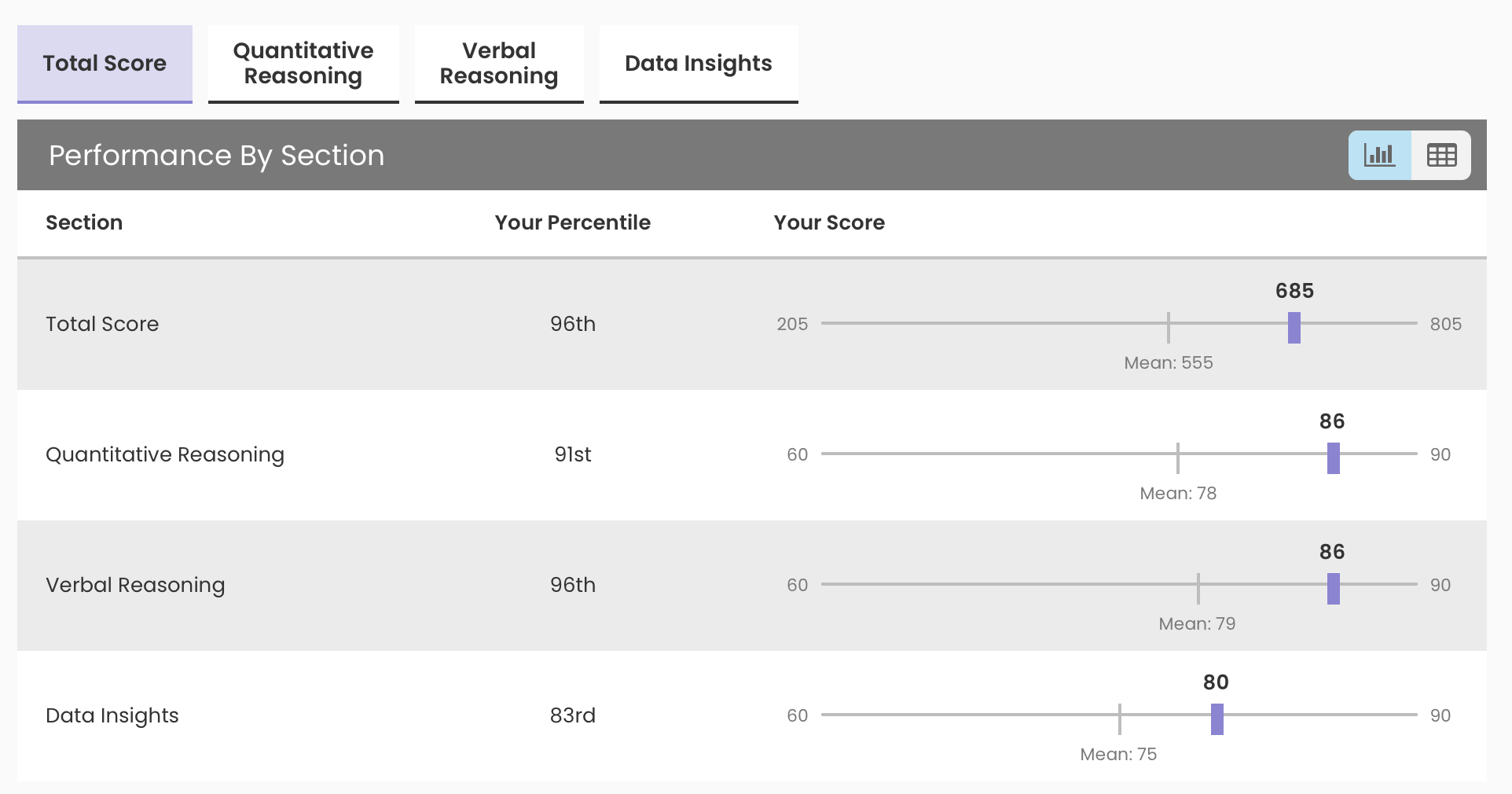
My starting scores were V80, Q81, DI77 — 57th percentile in Verbal. For the Master’s programs I was targeting, I needed to do significantly better. Being comfortable in English and being good at the GMAT’s version of English turned out to be two completely different things.
Critical Reasoning: Where I Got Humbled
CR frustrated me the most and taught me the most. It’s not about understanding English — it’s about focus. It’s about noticing that one word buried in a paragraph that separates the right answer from a very convincing wrong one. In my first period of working through CR, I got tricked by essentially every trap. Strengtheners that looked like weakeners. Two answer choices that looked almost identical, except one word changed everything.
The e-GMAT course introduced me to pre-thinking, and it completely rewired how I approached CR. Before ever looking at answer choices, I’d work through what the argument was actually saying, what it assumed, and what kind of answer I was looking for. The traps stopped working. That shift alone probably accounts for the bulk of my verbal improvement — V80 to V86, which is 57th to 96th percentile. Six points on the score, but nearly 40 percentile points in real terms.
Reading Comprehension: From Passive to Active
While going through the e-GMAT course, I discovered that RC isn’t about whether you understood a passage — it’s about distinguishing between what the passage said and what it almost said. e-GMAT’s reading strategies taught me to read actively: identifying the author’s purpose at each paragraph, noting where arguments shifted, tracking which claims were stated versus implied. It slowed me down initially, but accuracy improved so much that by the time I was doing timed practice, the speed came back naturally.
Quant: Where Process Skills Saved Me (Q81 to Q86)
I wasn’t starting from a weak position, but I was leaving points on the table through inefficiency. The e-GMAT quant course surprised me — what I found most useful weren’t formulas but the process skills and time-saving techniques. These process skills bypass 30 seconds of calculation here and there. In a GMAT environment, 30 seconds can be the difference between a rushed guess and a confident answer on the next question.
I used every e-GMAT tool available — Scholaranium, NEURON OG, cementing quizzes. The e-GMAT Scholaranium experience was a defining moment. When you sit down expecting a certain score and the result comes back lower, it stings. But it’s a reality check you need. The PRISM analysis after each quiz was particularly useful — it didn’t just tell me what I got wrong, it showed me the pattern. Was I missing questions because I didn’t know the concept, or because I ran out of time? That breakdown changed how I practiced, not just what I practiced.
The e-GMAT PACE framework also saved me considerable time by identifying which areas I actually needed to focus on versus which I could move through quickly. Toward the end, I used custom quizzes heavily — filtering by specific topics where accuracy was inconsistent, setting difficulty to hard. That targeted practice took my Quant from Q81 to Q86.
Data Insights: The Crossover Effect (D77 to D80)
DI was the section I spent the least dedicated time on. My Data Science background helped with the quantitative side, but what surprised me was how much the reasoning skills from e-GMAT’s Verbal course carried over. DI isn’t just quant — a lot of the time there’s a verbal element mixed in, and the test loves to blur the line between what the data actually shows and what you might assume it shows. The CR and RC skills I’d built through the e-GMAT course helped me avoid those traps in DI too.
Mocks and the Final Push
The e-GMAT Sigma-X mocks gave me a realistic sense of what to expect — the pacing, the difficulty curve, the mental fatigue. I tracked scores across mocks and used the analytics to identify remaining mistake patterns. The e-GMAT sectional mocks were equally valuable for maintaining sharpness without eating into my overall schedule.
Key Takeaways
- Don’t assume English fluency means GMAT verbal readiness. It’s a completely different skill set.
- The e-GMAT Scholaranium scores that come in lower than expected aren’t failures — they’re information. Trust the PRISM data more than your feelings.
- Pre-thinking turned CR from my weakest area into something I felt confident about.
- Every 30 seconds matters. The e-GMAT course’s process skills add up significantly.
- Verbal skills transfer to DI more than you’d expect. Don’t treat them as separate.
Final Thoughts
On test day, I scored 685 (V86, Q86, DI80). The verbal section felt completely different from my first attempt — I was pre-thinking CR answers, reading RC passages actively, and not falling for the traps that had caught me before. The e-GMAT platform is completely self-sufficient. Following the course structure systematically — from concept learning through cementing quizzes to Scholaranium to sectional mocks to Sigma-X — delivers results without needing external help. The GMAT is hard. It’s supposed to be. But with the right approach, it’s absolutely manageable.
Attachment:
GMAT-Club-Forum-tjlerqf2.png [ 125.04 KiB | Viewed 2596 times ]


 16 May 2026, 06:34
Kudos
Bookmarks
Congratulations for score..
All the best with application
All the best with application