Events & Promotions
| Last visit was: 06 Sep 2026, 16:53 |
It is currently 06 Sep 2026, 16:53 |
|
|

GMAT Club Daily Prep
Thank you for using the timer - this advanced tool can estimate your performance and suggest more practice questions. We have subscribed you to Daily Prep Questions via email.
Customized
for You
Track
Your Progress
Practice
Pays
Not interested in getting valuable practice questions and articles delivered to your email? No problem, unsubscribe here.
 Sep 07
12:01 AM PDT
-11:59 PM PDT
On the 7th, GMAT Club Tests will be Free! Including all the Quizzes, Questions, and Tests. 12 AM - 11:59 PM PDT Sep 07
12:30 AM EDT
-01:30 AM EDT
Tejas studied hard but kept repeating the same mistakes. After 3 attempts at 645, a focused 4-week strategy helped him identify and fix what was holding him back—leading to a 695 with just 12–15 hours of study per week.- Sep 07
10:00 AM PDT
-11:00 AM PDT
A complete walkthrough of GMAT Club’s free 12-week GMAT study plan: what you study each week, how progress and goals are tracked, how the error log works, and how your practice unlocks paid tools at no cost.  Sep 02
01:00 PM EDT
-11:59 PM EDT
Take 30% off all study plans with code COURSEWORK - Expires on Monday 9/7 Sep 04
01:30 AM EDT
-02:30 AM EDT
This Labor Day, turn your hard work into real score gains. From 615→715 in 15 days to 705 in 30 days, our students prove what's possible with personalized, expert guidance. Save up to 25% on 1-on-1 tutoring. Sep 04
10:00 AM EDT
-11:59 PM EDT
We’ve worked incredibly hard to build TTP into the best test prep experience possible, and it would mean a lot to us to win Newsweek’s 2026 Readers’ Choice Award for Best Test Prep. If TTP has helped you, we’d be incredibly grateful for your vote. Sep 06
09:30 AM EDT
-12:30 PM EST
Top scores are possible when you enroll in a powerful EA course, taught live online + 6 months access to TTP OnDemand video courses included! Perfect class schedule and easy course access for working professionals. Class starts Sundays Sept. 6, 2026.- Sep 09
07:00 AM PDT
-10:00 AM PDT
Meet AdComs and explore top Master’s programs - MiM, MiF, MSc, MSBA and more. - Application Fee Waivers - Free 1-Week of GMAT Club Tests: - Master's Application Toolkit - Grand Prize Giveaway - Sep 09
10:00 AM PDT
-11:00 AM PDT
Three MBA applications. Three rejections. No interview invites. A year later, Aman was admitted to Cambridge Judge, SMU, and IMD. In this episode of MBA Admit Stories, Aman shares how he rebuilt his MBA application...  Sep 10
08:00 PM PDT
-09:00 PM PDT
Free- full-length test + 15 concept videos + 150+ short videos + study plan! Sep 15
07:00 PM EDT
-09:00 PM EST
Elite scores are possible when you enroll in a powerful GMAT course, taught live online + 6 months access to TTP OnDemand video courses included! Class starts Tues/Thurs Sept. 15, 2026 - Nov. 15, 2027, 7:00pm-9:00pm EST Sep 21
08:00 PM EDT
-10:00 PM EDT
Boost your GMAT score in less than one month in a live online class + 6 months access to TTP OnDemand video courses included! Class starts Mon, Tues, Wed, Thur, Fri Sept. 21, 2026 - Oct. 9, 2027, 7:00pm-10:00pm EST

chaitanyab109

Joined: 19 Dec 2024
Last visit: 18 Nov 2025
Posts: 16
Given Kudos: 424
Location: India
Schools: Wharton '26 LBS '26 INSEAD Aug '26
GMAT Focus 1: 605 Q79 V83 DI78 
GMAT Focus 2: 725 Q87 V85 DI86
Products:
 17 Nov 2025, 13:54
Kudos
Bookmarks
Hi everyone,
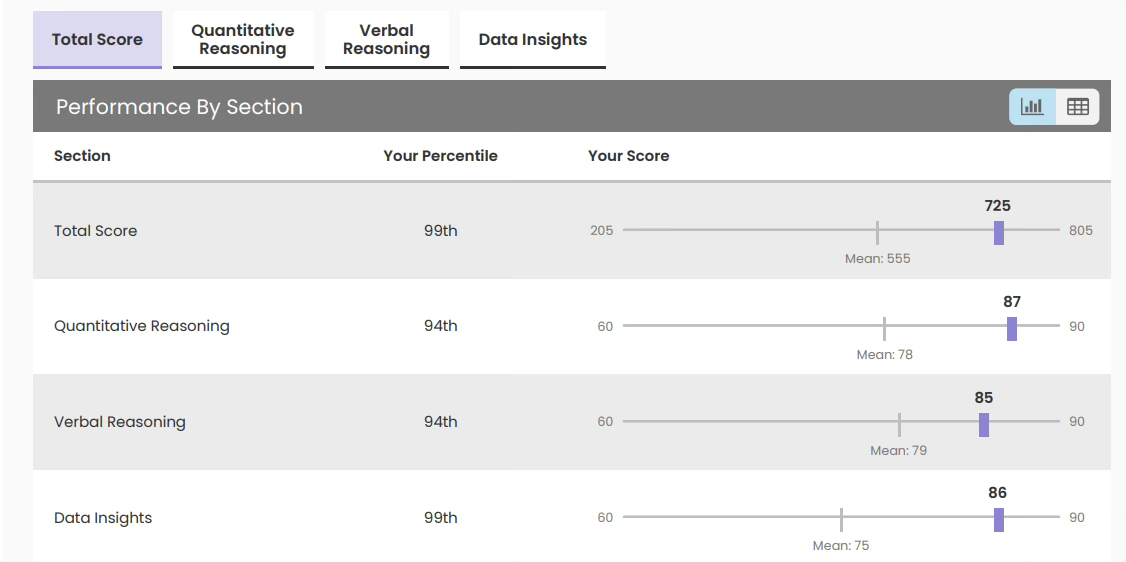
My name is Chaitanya, and I recently scored a 725 (Q87, V85, DI86) on the GMAT after starting at 605 (Q79, V83, DI78). I took the test at the test centre in Mumbai, India.
My score breakdown:
I first took the GMAT with fairly unstructured preparation, and relied predominantly on the Official Guide, piecemeal YouTube lessons and practice through GMAT Club. I got a score of 605, which, in hindsight, reflected that scattered prep. For this attempt, I decided to first strengthen my basics before attempting practice questions, so I thought that e-GMAT's full formal course would be helpful. Overall, I relied on their course material, some YouTube lessons, and the practice questions on GMAT Club.
Test Centre Experience
I took the test in Mumbai, and this attempt went smoothly. In one of my previous attempts, I encountered a technical error, which the test centre staff reported to GMAC on my behalf, and was resolved afterwards by the GMAC team. The test centre is well-connected, and the staff are fairly helpful. I found that my test-taking experience really was impacted by how close the workstation was to the main door, but that could just be me.
Quantitative: Q79 to Q87
I have had a contentious relationship with math since I can remember. So, when I decided to take the GMAT, I was intimidated by the Quant section, as well as quantitative elements spilling into Data Insights through Data Sufficiency, graphs, and tables. I think the improvement in Quant was the biggest mover in my total score, particularly given how the GMAT indexes Quant skills (i.e., an equivalent score is a lower percentile for Q than for V or DI). That's why going from the 57th percentile to the 94th percentile feels like a major accomplishment.
Clearing fundamentals
e-GMAT's structured approach to clearing fundamentals helped me a lot here. The course structure was planned to build on previously taught concepts and to be supplemented by a strong practice and testing system. This structured approach was a lifeline, as it simplified GMAT-specific math and made it easy for a learner to follow through first principles. I found these to be particularly helpful:
Practice questions
I used e-GMAT's practice framework through its Cementing quizzes and the Scholaranium platform, and supplemented it with GMAT Club's question repository to practise the concepts I'd learned already. I used filters (available on both platforms) to sort by topic and difficulty level, and this helped me improve both time taken and question accuracy. I supplemented practice with an error log, which helped me track patterns in my errors. e-GMAT helped with providing a base template, which I modified for my own use. (I'm happy to share my error logs in case anyone wants to see how it looks --> it helped me to see other candidates' filled logs, so I'm happy to help on that front)
Data Insights: DI78 to DI86
I employed a few different strategies to tackle DI questions:
Verbal: V83 to V85
While I had a strong foundation here without structured prep, I benefited from targeted troubleshooting for Critical Reasoning. A lot of times, I was getting confused between similarly phrased questions. Here are a few specific things that helped:
Test-day simulations: sectional and full-length mocks
After being reasonably confident about individual sections (and getting partial practice in), I tackled sectional mock tests first on e-GMAT, and then graduated to full-length mocks.
Personally, I found the sectional mocks more useful because they allow you to focus on individual sections that need more work rather than committing to a solid ~3-hour block in a day. e-GMAT provides detailed feedback on each question, and it has a large repository of questions for the sectional mocks that anyone with a reasonable prep time would find sufficient.
Full-length mocks, however, proved essential for me to nail down the nuances of test day, i.e., the order of sections, when to take the optional break, and the overall mindset I need to have on exam day. It also helped me a lot to simulate exam conditions as much as I could, by taking the test at the same time as my slot, and gauging my energy levels and fixing seemingly insignificant things around it (such as how I should plan meals and water on the day of the exam, bathroom breaks, etc.)
In conclusion
The GMAT is a pretty complex test with a lot of nuances and moving parts, and one can never truly understand all of it. I'll just encourage everyone who's still going through the journey to focus on a few things before taking the test:
Please feel free to reach out to me in the replies of this post or over DM to know more about my preparation, specific strategies, the e-GMAT platform features, or anything else about my journey. I'm happy to help!
Best,
Chaitanya
My name is Chaitanya, and I recently scored a 725 (Q87, V85, DI86) on the GMAT after starting at 605 (Q79, V83, DI78). I took the test at the test centre in Mumbai, India.
My score breakdown:
- Overall: 605 → 725 - 120-point jump
- Quant: Q79 (57th percentile) → Q87 (94th percentile)
- Verbal: V83 (83rd percentile) → V85 (94th percentile)
- Data Insights: DI78 (70th percentile) → DI86 (99th percentile)
I first took the GMAT with fairly unstructured preparation, and relied predominantly on the Official Guide, piecemeal YouTube lessons and practice through GMAT Club. I got a score of 605, which, in hindsight, reflected that scattered prep. For this attempt, I decided to first strengthen my basics before attempting practice questions, so I thought that e-GMAT's full formal course would be helpful. Overall, I relied on their course material, some YouTube lessons, and the practice questions on GMAT Club.
Test Centre Experience
I took the test in Mumbai, and this attempt went smoothly. In one of my previous attempts, I encountered a technical error, which the test centre staff reported to GMAC on my behalf, and was resolved afterwards by the GMAC team. The test centre is well-connected, and the staff are fairly helpful. I found that my test-taking experience really was impacted by how close the workstation was to the main door, but that could just be me.
Quantitative: Q79 to Q87
I have had a contentious relationship with math since I can remember. So, when I decided to take the GMAT, I was intimidated by the Quant section, as well as quantitative elements spilling into Data Insights through Data Sufficiency, graphs, and tables. I think the improvement in Quant was the biggest mover in my total score, particularly given how the GMAT indexes Quant skills (i.e., an equivalent score is a lower percentile for Q than for V or DI). That's why going from the 57th percentile to the 94th percentile feels like a major accomplishment.
Clearing fundamentals
e-GMAT's structured approach to clearing fundamentals helped me a lot here. The course structure was planned to build on previously taught concepts and to be supplemented by a strong practice and testing system. This structured approach was a lifeline, as it simplified GMAT-specific math and made it easy for a learner to follow through first principles. I found these to be particularly helpful:
- Compact video lessons: Easy to consume, but also sufficiently information-rich and engaging
- Logical progression: Concept files → Learning activities → Practice files
- PACE Framework: Fast-tracked structure that helps with time management and building confidence in conceptual knowledge
- Process skills: Important to review in any solution (@bunuel's solutions on GMAT Club call out specific points to note, and e-GMAT has coloured flags like 'Infer', 'All Cases' that are helpful when building an error log)
Practice questions
I used e-GMAT's practice framework through its Cementing quizzes and the Scholaranium platform, and supplemented it with GMAT Club's question repository to practise the concepts I'd learned already. I used filters (available on both platforms) to sort by topic and difficulty level, and this helped me improve both time taken and question accuracy. I supplemented practice with an error log, which helped me track patterns in my errors. e-GMAT helped with providing a base template, which I modified for my own use. (I'm happy to share my error logs in case anyone wants to see how it looks --> it helped me to see other candidates' filled logs, so I'm happy to help on that front)
Data Insights: DI78 to DI86
I employed a few different strategies to tackle DI questions:
- Recognising patterns in information provided: Honed through Quant practice, I learned to recognise patterns when provided with certain types of questions, especially for Data Sufficiency (e.g. with enough practice, it becomes apparent that an 'x' number of values are required to solve certain questions like rate, interest, etc., and this helps shortcut DS questions)
- "Owning the Dataset": A concept fronted by e-GMAT, it essentially talks about front-loading effort and time to fully understand the fields provided, trends, and values in the dataset, so that it's not necessary to keep going back to it in every question or sub-question
- Learning to let go: I used to subconsciously focus on attempting a question no matter how long it took, which sometimes meant spending 3-3.5 minutes per question. With practice and enforcing a 2.5-minute hard stop, I learned to move on from unsolvable questions
Verbal: V83 to V85
While I had a strong foundation here without structured prep, I benefited from targeted troubleshooting for Critical Reasoning. A lot of times, I was getting confused between similarly phrased questions. Here are a few specific things that helped:
- Active reading and detail analysis: I spent time to understand the nuances of every statement --> for me, visualisation of the statements and the relationships between sentences helped a lot to understand the flow of the argument (e-GMAT's CR concepts helped here)
- Concrete strategy for option selection: Initially, I focused on finding a single correct option, but I found that it is actually better for CR to concentrate on finding four incorrect options. This proved to be more foolproof for me, as it helped me build instincts and confidence around knowing what a correct/ incorrect answer felt like
- Specific exercise for time management: In my practice tests and previous attempts, I eventually arrived at the correct answer, but that was proving detrimental to the overall test flow (since I was taking >2.5-3 minutes per question). My mentor from e-GMAT helped out here and suggested an untimed practice session on their Neuron OG platform (which is functionally like GMAT Club with standardised solutions by their team). She suggested that I pair this practice with an in-depth analysis and tracking without stressing about time. This helped a lot, and I saw changes within a few days of rigorous prep
Test-day simulations: sectional and full-length mocks
After being reasonably confident about individual sections (and getting partial practice in), I tackled sectional mock tests first on e-GMAT, and then graduated to full-length mocks.
Personally, I found the sectional mocks more useful because they allow you to focus on individual sections that need more work rather than committing to a solid ~3-hour block in a day. e-GMAT provides detailed feedback on each question, and it has a large repository of questions for the sectional mocks that anyone with a reasonable prep time would find sufficient.
Full-length mocks, however, proved essential for me to nail down the nuances of test day, i.e., the order of sections, when to take the optional break, and the overall mindset I need to have on exam day. It also helped me a lot to simulate exam conditions as much as I could, by taking the test at the same time as my slot, and gauging my energy levels and fixing seemingly insignificant things around it (such as how I should plan meals and water on the day of the exam, bathroom breaks, etc.)
In conclusion
The GMAT is a pretty complex test with a lot of nuances and moving parts, and one can never truly understand all of it. I'll just encourage everyone who's still going through the journey to focus on a few things before taking the test:
- Prepare a broad study plan: ensure you focus on conceptual clarity, established accuracy, and effective time management
- Try and have a peer/ mentor/ buddy to get a fresh pair of eyes on your prep: e-GMAT helped me here with their mentors available over email and scheduled calls
- Leverage existing resources available online: Specific YouTube lessons (special shout-out to GMAT Ninja's Barbell Method for weighted averages) and templates (like error logs, flash cards, formulae, etc.) helped me a lot
- Have a test day schedule ready: nail down the logistics of test day, as well as the specifics of what you want to revise, test, and practise in the hours leading up to the test
Please feel free to reach out to me in the replies of this post or over DM to know more about my preparation, specific strategies, the e-GMAT platform features, or anything else about my journey. I'm happy to help!
Best,
Chaitanya
Attachments
GMAT-Club-Forum-1hr3eh2m.png [ 142.23 KiB | Viewed 747 times ]
 18 Nov 2025, 08:17
Kudos
Bookmarks
Congrats on the 725!! I wish you all the best with your applications.

 28 Nov 2025, 23:16
Kudos
Bookmarks
Hi Chaitanya, this is an amazing score congrats! I am looking for a review of e-GMAT's SigmaX mocks - how accurate are they really?
I started with a baseline of 595 and after some weeks of self prep I took their first free mock and landed at 655, so a bit skeptical of this good score. How did you find the mock scores compared to your official attempt?
I started with a baseline of 595 and after some weeks of self prep I took their first free mock and landed at 655, so a bit skeptical of this good score. How did you find the mock scores compared to your official attempt?








