Last visit was: 29 Apr 2026, 06:54 It is currently 29 Apr 2026, 06:54
Close
GMAT Club Daily Prep
Thank you for using the timer - this advanced tool can estimate your performance and suggest more practice questions. We have subscribed you to Daily Prep Questions via email.

Customized
for You

we will pick new questions that match your level based on your Timer History

Track
Your Progress

every week, we’ll send you an estimated GMAT score based on your performance

Practice
Pays

we will pick new questions that match your level based on your Timer History
Not interested in getting valuable practice questions and articles delivered to your email? No problem, unsubscribe here.
Close
Request Expert Reply
Confirm Cancel
avatar
whitman
Joined: 14 Oct 2014
Last visit: 06 Jun 2016
Posts: 89
Own Kudos:
Given Kudos: 9
Concentration: Strategy, Entrepreneurship
GMAT 1: 750 Q46 V48
GPA: 3.47
Kudos
Add Kudos
Bookmarks
Bookmark this Post
avatar
liseey02
Joined: 13 Mar 2016
Last visit: 03 Jun 2016
Posts: 2
GMAT 1: 650 Q40 V40
GMAT 1: 650 Q40 V40
Posts: 2
Kudos: 0
Kudos
Add Kudos
Bookmarks
Bookmark this Post
avatar
aleofriend
Joined: 31 Aug 2012
Last visit: 06 Dec 2016
Posts: 3
Own Kudos:
Location: United States
Concentration: Finance
Schools: CBS (A)
GPA: 2.91
Schools: CBS (A)
Posts: 3
Kudos: 7
Kudos
Add Kudos
Bookmarks
Bookmark this Post
avatar
aleofriend
Joined: 31 Aug 2012
Last visit: 06 Dec 2016
Posts: 3
Own Kudos:
Location: United States
Concentration: Finance
Schools: CBS (A)
GPA: 2.91
Schools: CBS (A)
Posts: 3
Kudos: 7
Kudos
Add Kudos
Bookmarks
Bookmark this Post
aleofriend
I received interview invite for Fri/Sat early decision program on Friday. I had applied on March 23rd which was the deadline for the ED application.

Anyone has any opinions/inputs on the interview process?

Thanks!

Since, no one replied to my post, let me post my own reply:

The ad com asked very generic questions.
Why MBA?
Why my chosen area of focus?
Why Columbia?
What do I do in my free time?
What are my short-term, long-term goals?
How did I find GMAT exam?
It was a very informal conversation.
avatar
rrv202
Joined: 17 May 2016
Last visit: 11 Jul 2016
Posts: 1
Own Kudos:
1
 [1]
Posts: 1
Kudos: 1
 [1]
Kudos
Add Kudos
1
Bookmarks
Bookmark this Post
Early decision timeline
Applied: End of March
Interview Notice: Mid April
Actual Interview: Late April
Admitted: Early/Mid May

Hope this helps
avatar
kndesai88
Joined: 18 Jul 2015
Last visit: 08 Jan 2017
Posts: 4
Own Kudos:
Location: United States
Concentration: Strategy, Healthcare
GMAT 1: 730 Q47 V42
GPA: 3.47
WE:Consulting (Healthcare/Pharmaceuticals)
GMAT 1: 730 Q47 V42
Posts: 4
Kudos: 5
Kudos
Add Kudos
Bookmarks
Bookmark this Post
Has anyone who was admitted for the Friday/Saturday program and initiated their Re Vera background check heard anything back yet? Submitted the Re Vera form on May 16th and still haven't heard anything. Coming up on 8 weeks now which is way past the 4-6 week estimate they provided...
User avatar
Accepted.com
User avatar
Major Poster
Joined: 20 Apr 2003
Last visit: 18 Dec 2022
Posts: 6,466
Own Kudos:
Given Kudos: 92
Location: Los Angeles CA
Posts: 6,466
Kudos: 859
Kudos
Add Kudos
Bookmarks
Bookmark this Post

There’s something for everyone at Columbia Business School.

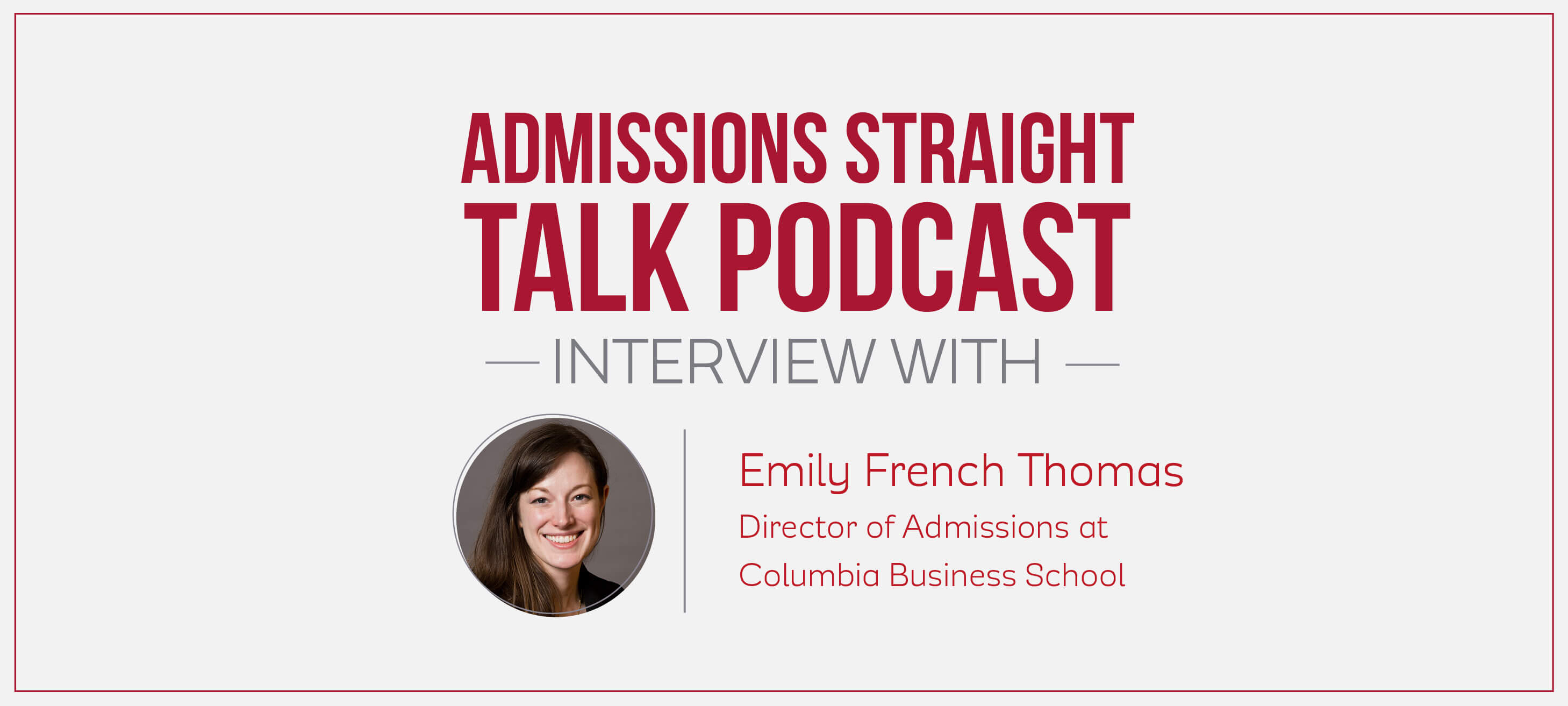
Today’s AST podcast is a first: an in-person interview! Our guest is Emily French Thomas, Director of Admissions at Columbia Business School, and we’ll be talking about the menu of programs available at CBS. Welcome, Emily!

What is the common thread that unites the many programs at CBS? [1:18]

When people think of getting an MBA, they’re often thinking about shifting careers, or building their network. And we definitely provide those strengths. But the more intangible benefit of a Columbia MBA is learning to see the world in a more holistic way – gaining a framework for all the decisions you’ll make in your future career.

Our goal is to cultivate an entrepreneurial mindset. That doesn’t just mean starting your own company – it’s about identifying opportunity. We’re training business leaders who think entrepreneurially.

Our core curriculum (accounting, marketing, big data, etc) teaches students how to look at a problem from multiple perspectives. It’s really a transformative experience.

We bring theories into the real world. And students have access to so many industries and business leaders in NY, to learn how the knowledge applies in the real world. And the networking opportunities from that are also invaluable. (For example, our students have regular coffee chats with alumni.) There’s just an incredible amount of access that comes from being at the center of business.

Can you give an overview of the fulltime MBA program? [6:05]

There are two streams. One is a 20-month traditional program with August entry: there’s a semester of core, a semester of electives, a summer internship, then the second year. We take about 550 students a year for the August entry. They’re broken into clusters of 60-70 students and further divided into learning teams. So you have a home base of people you get to know really well.

We do have exemption exams, so you can test out of specific core courses if you have expertise in the area, and replace them with an elective. But generally students are happier if they have at least some core courses, in order to build relationships with their learning team.

What about the January program? [9:00]

This is an accelerated 16-month program. The difference between this and the August entry is the summer internship. January students start one semester later and take classes in the summer, and are in the same place as the traditional students when they start the second year. It’s a great way to minimize the opportunity cost.

It’s a wonderful option for students who are sponsored by companies or who are coming from family business.

If you’re changing your career in a major way (industry-function-geography) – you can probably change one area but not two through the January program. For more radical changes, in general, you need the summer internship. However, there are also school year internships, and JTerm students can do those.

You’re in a stronger position to succeed if you have a very clear sense of your goals and are proactive – that’s one of the things we’re looking for in applicants (people who have direction).

What else are you looking for in an applicant? [16:20]

We’re looking at the whole application. Any one part of the application is just a data point.

We’re looking for academic achievement: we require either the GMAT or the GRE. (If you’re planning to retake, it’s best to stick with the one you already took.)

Linda: Is it better to cancel a low score or show improvement?

Showing hard work to improve is worthwhile. We don’t need people to be perfect.

In addition to academics, we’re also looking for professional experience – particularly what you’ve achieved in your work.

Recommendations are important. People are often hung up on getting recommendations from people with fancy titles: but get the recommendation from the person who knows you best. They can write something more interesting and constructive about who you are.

Our essays are personality questions – we want to think about you as a human being.

What makes qualitatively impressive work experience?
[21:25]

We’re interested in seeing what a person has done with what they have. Is your work impressive relative to your peers? Do you have leadership experience and have you taken initiative? Sometimes people working in small family companies or small firms have had more opportunities for leadership.

What are the hiring strengths at Columbia? [23:00]

It comes back to that question of access.

A recent grad had a lot of coffee chats with alumni and had met a lot of people at his target company, so when he went for his interview, it was much easier and more natural, thanks to his extensive research and networking, and he got the job.

There’s also a very strong career management service and very active clubs.

There are three EMBA programs (NY, Americas, Global) at Columbia. What is common to the three? [25:20]

The Columbia EMBA programs have the same core as the FT programs. The EMBA NY takes in around 144 students, starting in August, for a 20-month program (meeting on Fridays and Saturdays for 9 weekends/semester). There’s also a program on Saturdays only for 13 weekends/semester. There’s no summer internship. The Saturday-only program is 24-months.

The other programs are modular, with a 1 week intensive format. The Americas program is designed for people coming from farther away (outside NY) – students come from all over the country, and also from Latin America. There are even some students from Europe. There’s one week of class each month for the first three semesters.

EMBA Global is modular, too.
[30:00]

It’s a partnership with LBS, and incorporates LBS courses. Students can take courses from either school, and can tailor their electives to whatever structure works better for them (Saturday vs modular week).

Finally, there’s the EMBA Global Asia program, which is a joint program with LBS and Hong Kong University; students actually earn a joint degree.

Would you consider the EMBA a part-time degree or a degree for more experienced students? [32:25]

It really feels like a full-time program.

It’s also lockstep – students take courses with their clusters, developing relationships in a way you generally don’t in a part-time program.

It’s not necessary to have reams and reams of work experience, but we do look more closely at work experience than academics for the EMBA. If you’re junior in your career, just think about how you’d contribute.

If you can, come and visit – talk to students. It’s the only way you’ll know how you’ll feel in the program.

What’s the EMBA admissions process? [35:40]

It’s a rolling process (just like the FT MBA, but different from our peer schools with rounds). It becomes more competitive closer to the deadline.

For EMBA: we look at your academics. We do require a test. We now accept the Executive Assessment, which has been popular with EMBA applicants.

There are three required essays. Instead of the question we ask FT applicants (about how they would take advantage of the New York location), we ask EMBA applicants how you will balance work, life, and school.

And we weight work experience a little more than academics.

What is the career benefit of the EMBA? [39:00]

Bringing new knowledge back to work in real time, and applying what you’re learning right away. It’s also a benefit to the company.

EMBA students also benefit from networking opportunities.

We had a recent student who came to the program after working in finance, and started thinking about how tough it was for vets to get services. He hooked up with other students, created a tech platform, and launched a company – it’s a real success story.

How much do EMBA and FT students mix? And is there mixing among the different EMBA programs? [44:20]

There’s definitely mixing among EMBA students.

EMBA students can take FT electives, and vice versa. International Seminars bring EMBA students together.

There’s also interaction in electives and clubs. And there’s leadership from the EMBA class in student government.

A lot of what clubs do is recruiting-focused, but they also bring speakers to campus, and EMBA students get involved with that.

As an applicant, what should I do? [48:20]

Think about your strategy. Know what you’re investing in. Visit if you can, but if you can’t, learn about the program in other ways: talk to a student on the phone; come to one of our info sessions. You need to know what you’re investing in. Also, the more you know, the stronger your essays will be.

Early decision vs regular decision for the FT MBA – how to decide? [50:00]

It’s a rolling process, so it gets more competitive later in the process.

Don’t apply Early Decision unless you know that Columbia is where you want to be, because it is binding. So make sure there aren’t any other factors determining that decision (ie a partner who might not move to NY, finances, etc).

You can still apply on the early side of the rolling process without the binding requirement of Early Decision. There’s a deadline in January for merit aid – that’s when most people apply. The final deadline is in April – by then, it’s very competitive.

Any last advice?
[52:40]

Be yourself in the application. Sometimes we read an application from someone who seems to be trying to push their story into a preconceived idea of what they think the adcom wants to read, and it doesn’t match up.

You’re not competing with anyone else (especially because of the way our rolling deadline works) – you’re competing with yourself. We want students who are nice and engaged. If we get a sense that you’re completely transactional, we’ll think that’s how you’d be on campus.


Related Links:

Columbia Business School 2016-17 MBA Essay Tips & Deadlines
Columbia 2016-17 Executive MBA Essay Tips & Deadlines
Get Accepted to Columbia Business School [On-Demand Webinar]

Related Shows:

Bruce DelMonico on The Yale School of Management
Mission and Admissions at Yale School of Management
Too Old for an MBA? Check Out 3 Outstanding MBA and EMBA Alternatives
A 20-Year MBA Admissions Veteran Shares His Insights

Subscribe:


This article originally appeared on blog.accepted.com.

Applying to a top b-school? The talented folks at Accepted have helped hundreds of applicants get accepted to their dream programs. Whether you are figuring out where apply, writing your application essays, or prepping for your interviews, we are just a call (or click) away.

Contact us, and get matched up with the consultant who will help you get accepted!
User avatar
Accepted.com
User avatar
Major Poster
Joined: 20 Apr 2003
Last visit: 18 Dec 2022
Posts: 6,466
Own Kudos:
Given Kudos: 92
Location: Los Angeles CA
Posts: 6,466
Kudos: 859
Kudos
Add Kudos
Bookmarks
Bookmark this Post

These essay questions focus mostly on the present and future, so don’t expect to elaborately portray your professional development as a prelude to your goals. Be guided by Columbia adcom’s focus and give them what they ask for, in aggregate: a vivid sense of engagement; focused career plans; and knowledge of the program and why you need it. Considering the lack of opportunity to discuss past professional achievements and experience, your resume carries all the more weight in the Columbia EMBA application – attend to it accordingly.

Short Answer Question:

What is your immediate post-MBA professional goal? (51 characters maximum)

A factual phrase or bullet will suffice; don’t worry about responding with a whole sentence. Do include function and industry.

Essays:

1. Through your resume and recommendations, we have a clear sense of your professional path to date. What are your career goals going forward, and how will the Columbia MBA help you achieve them? (100 – 750 words)

You may want to start by discussing your current career situation to set the context, and clarify how the MBA education will enable you to achieve your immediate goals. You can then naturally move on to your future goals sequentially. Give more detail in the roles you plan immediately post-MBA and the several years following; this time frame should comprise the bulk of your goals discussion. Longer-term goals need less detail, but they still should present a clear direction. In describing your goals at any given point, indicate why you are taking that step.

In discussing how the program will benefit you, be specific: identify what skills and knowledge you need, and how the program meets those needs. Refer to specific aspects of the curriculum, structure and/or special features of the program, detailing how they will support you and your goals.

As far as that length guideline, bear in mind that Columbia has always looked for practical discussion about how you’ll realize your goals, not just what they are. It’s unlikely fewer than 400 words or so would give you sufficient space to deliver the substantiating detail. I’d suggest an essay in the 500-750 word range.


2. Columbia Business School’s Executive MBA will challenge you by offering a rigorous academic experience, global exposure through the international seminar, and the opportunity to immediately apply what you learn to your career. How will you approach balancing the demands of the program with your professional and personal life while you are in school? (100 – 500 words)

Discuss the accommodations you will make at work, such as delegating more, adjusting travel schedules, etc. You don’t have to tell them every single thing you can think of – focus on the most significant two or three adjustments.

Also address your personal responsibilities and how you will meet them with this additional demand on your time and energy; even acknowledging that you’ll have less time at the playground with your toddler or mentioning the support of your significant other will show that you’re facing this issue squarely.

If you’ve already successfully balanced school and working full time, by all means mention it.

You may well not need 500 words for this essay, but don’t skimp at 100 either (you don’t want to look like you’re blowing it off). A range of 350-450 should be right for most people.


3. CBS Matters, a key element of the School’s culture, allows the people in your Cluster to learn more about you on a personal level. What will your Clustermates be pleasantly surprised to learn about you? (100 – 500 words)

It’s tricky, in that your audience for this essay is twofold: the adcom and your future Clustermates. Ideally you’ll want to pleasantly surprise both… Hence, let’s break down the phrase “pleasantly surprised.”

1. First, don’t repeat a resume point – “surprised” indicates something not obvious from the available information.

2. “Pleasantly” means something that will generate positive interest. It doesn’t have to be directly applicable or “useful” to your Clustermates.

It can be something from work or outside work – but if from work, do not make it a “great achievement” or “stellar leadership” type of essay – the tone of the question suggests something more revealing and touching about you as a person. If it’s far in the past, it should be something of continuing relevance. DON’T present a boring explanation. DO root your response in actual experience.

Most important: DO select a topic that will add something to your profile, something that lets the adcom know you better as a person.

If your answer puts a smile on the reader’s face, or even better elicits a happy, surprised laugh, high five!


Optional Essay. An optional fourth essay will allow you to discuss any issues that do not fall within the purview of the required essays.

This question invites you to present new material that will enhance your application, as well as explain anything that needs explaining (e.g., gap in employment, choice of recommender if not using a direct supervisor, etc.). As far as non-necessary points, since you are making the adcom read more than is required, there should be a clear value to the information you’re sharing. Finally, keep it short.

***Disclaimer: Information is subject to change. Please check with individual programs to verify the essay questions, instructions and deadlines.***

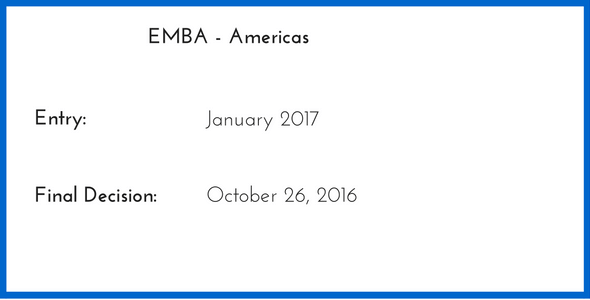
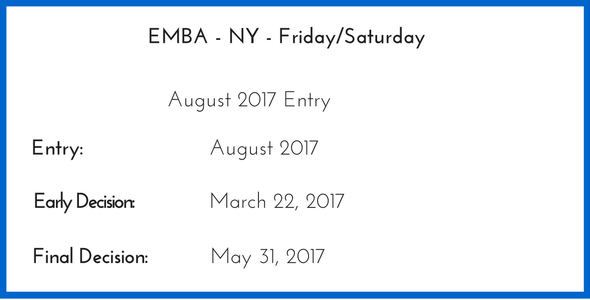
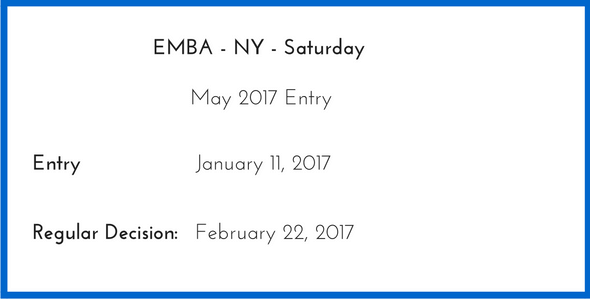
Columbia EMBA Deadlines:


By Cindy Tokumitsu, co-author of The EMBA Edge, and author of the free guide, Ace the EMBA. Cindy has helped MBA applicants get accepted to top EMBA programs around the world. She is delighted to help you too - click here to get in touch!

Related Resources:

Best MBA Programs: A Guide to Selecting the Right One
5 Key Qualifying Factors the EMBA Adcoms Look For
3 Key Ways to Stand Out Through Your EMBA Essays

This article originally appeared on blog.accepted.com.

Applying to a top b-school? The talented folks at Accepted have helped hundreds of applicants get accepted to their dream programs. Whether you are figuring out where apply, writing your application essays, or prepping for your interviews, we are just a call (or click) away.

Contact us, and get matched up with the consultant who will help you get accepted!
avatar
Anabanana
Joined: 05 Apr 2017
Last visit: 06 Jun 2017
Posts: 3
Posts: 3
Kudos: 0
Kudos
Add Kudos
Bookmarks
Bookmark this Post
Hello - wondering if anyone has applied or think of applying to this program in the coming months?
avatar
sg153
avatar
Current Student
Joined: 02 Dec 2015
Last visit: 10 May 2017
Posts: 6
Own Kudos:
Given Kudos: 1
Posts: 6
Kudos: 6
Kudos
Add Kudos
Bookmarks
Bookmark this Post
Anabanana
Hello - wondering if anyone has applied or think of applying to this program in the coming months?

Hi! I applied and got admitted. Any questions in particular?
avatar
Anabanana
Joined: 05 Apr 2017
Last visit: 06 Jun 2017
Posts: 3
Posts: 3
Kudos: 0
Kudos
Add Kudos
Bookmarks
Bookmark this Post
sg153
Anabanana
Hello - wondering if anyone has applied or think of applying to this program in the coming months?

Hi! I applied and got admitted. Any questions in particular?

Thanks for the reply! I applied early decision for Fri/Sat program on March 22 - wondering when i should expect to hear back?
User avatar
bb
User avatar
Founder
Joined: 04 Dec 2002
Last visit: 28 Apr 2026
Posts: 43,171
Own Kudos:
Given Kudos: 24,683
Location: United States
GMAT 1: 750 Q49 V42
GPA: 3
Products:
Expert
Expert reply
GMAT 1: 750 Q49 V42
Posts: 43,171
Kudos: 83,750
Kudos
Add Kudos
Bookmarks
Bookmark this Post
Archived 'Calling All CBS Applicants' Topic
Hi there,
You've reached an old 'Calling All CBS Applicants' discussion which is now outdated and has been archived. No more replies are possible here.
Looking for the latest discussion? Check out this up-to-date Calling All CBS Applicants Discussion for the most recent conversations on this topic.
Interested in more from this school? Visit our dedicated CBS Forum to dive into all things related to CBS's MBA program.
Thank you for understanding, and happy exploring!
   1   2 
Moderator:
GMAT Club Verbal Expert
7391 posts