Events & Promotions
|
|

GMAT Club Daily Prep
Thank you for using the timer - this advanced tool can estimate your performance and suggest more practice questions. We have subscribed you to Daily Prep Questions via email.
Customized
for You
Track
Your Progress
Practice
Pays
Not interested in getting valuable practice questions and articles delivered to your email? No problem, unsubscribe here.
 Sep 02
01:00 PM EDT
-11:59 PM EDT
Take 30% off all study plans with code COURSEWORK - Expires on Monday 9/7 Sep 04
01:30 AM EDT
-02:30 AM EDT
This Labor Day, turn your hard work into real score gains. From 615→715 in 15 days to 705 in 30 days, our students prove what's possible with personalized, expert guidance. Save up to 25% on 1-on-1 tutoring. Sep 04
10:00 AM PDT
-11:00 AM PDT
What does test anxiety really look like on the GMAT? For many test takers, it does not look like a panic attack. Instead, it shows up as brain fog, rereading, negative comparisons, mental noise.... Sep 04
10:00 AM EDT
-11:59 PM EDT
We’ve worked incredibly hard to build TTP into the best test prep experience possible, and it would mean a lot to us to win Newsweek’s 2026 Readers’ Choice Award for Best Test Prep. If TTP has helped you, we’d be incredibly grateful for your vote. Sep 06
09:30 AM EDT
-12:30 PM EST
Top scores are possible when you enroll in a powerful EA course, taught live online + 6 months access to TTP OnDemand video courses included! Perfect class schedule and easy course access for working professionals. Class starts Sundays Sept. 6, 2026.- Sep 07
12:01 AM PDT
-11:59 PM PDT
On the 7th, GMAT Club Tests will be Free! Including all the Quizzes, Questions, and Tests. 12 AM - 11:59 PM PDT  Sep 07
12:30 AM EDT
-01:30 AM EDT
Tejas studied hard but kept repeating the same mistakes. After 3 attempts at 645, a focused 4-week strategy helped him identify and fix what was holding him back—leading to a 695 with just 12–15 hours of study per week.- Sep 07
10:00 AM PDT
-11:00 AM PDT
A complete walkthrough of GMAT Club’s free 12-week GMAT study plan: what you study each week, how progress and goals are tracked, how the error log works, and how your practice unlocks paid tools at no cost. - Sep 09
07:00 AM PDT
-10:00 AM PDT
Meet AdComs and explore top Master’s programs - MiM, MiF, MSc, MSBA and more. - Application Fee Waivers - Free 1-Week of GMAT Club Tests: - Master's Application Toolkit - Grand Prize Giveaway - Sep 09
10:00 AM PDT
-11:00 AM PDT
Three MBA applications. Three rejections. No interview invites. A year later, Aman was admitted to Cambridge Judge, SMU, and IMD. In this episode of MBA Admit Stories, Aman shares how he rebuilt his MBA application...  Sep 10
08:00 PM PDT
-09:00 PM PDT
Free- full-length test + 15 concept videos + 150+ short videos + study plan! Sep 15
07:00 PM EDT
-09:00 PM EST
Elite scores are possible when you enroll in a powerful GMAT course, taught live online + 6 months access to TTP OnDemand video courses included! Class starts Tues/Thurs Sept. 15, 2026 - Nov. 15, 2027, 7:00pm-9:00pm EST Sep 21
08:00 PM EDT
-10:00 PM EDT
Boost your GMAT score in less than one month in a live online class + 6 months access to TTP OnDemand video courses included! Class starts Mon, Tues, Wed, Thur, Fri Sept. 21, 2026 - Oct. 9, 2027, 7:00pm-10:00pm EST

 14 Sep 2025, 10:12
Kudos
Bookmarks
Hi GMAT Club!
Scholaranium: The question bank was extensive and incredibly well-categorized. I could create custom quizzes targeting my specific weak areas, whether it was boldface CR questions or complex DI scenarios.
PACE Engine: This helped me identify exactly which concepts I needed to focus on in Quant versus which ones I could skim through, saving me valuable study time.
Video Lessons: The instructional content was clear, comprehensive, and actually engaging. Complex concepts were broken down into digestible chunks.
The Mental Game
Beyond the technical preparation, this journey taught me a lot about persistence and mental resilience. Starting with a 555 was demoralizing, but having a clear structure and seeing consistent improvement kept me motivated.
There were definitely moments of doubt, especially when my practice scores would occasionally dip. But the comprehensive tracking showed me that these were temporary fluctuations in an overall upward trend.
Test day itself was nerve-wracking, but because I had followed such a structured approach, I felt prepared. I knew exactly what to expect from each section and had developed specific strategies for managing time and stress.
Key Takeaways
1. Foundation first: Don't rush to practice questions without understanding the underlying concepts and strategies.
2. Consistency over intensity: Regular, structured practice was more valuable than occasional marathon study sessions.
3. Trust the process: Even when progress feels slow, if you're following a proven approach, improvement will come.
4. Mock tests are crucial: They provide reality checks and help you develop test-day strategies under actual time pressure.
For anyone considering a similar journey, especially if you're starting from a low baseline: embrace the process, trust the data over your emotions, and remember that every expert was once a beginner. Your 695 (or 715, or 650, or whatever your target is) is waiting for you - you just have to be willing to put in the work to reach it.
Best of luck to everyone on their GMAT journey!
Shruti
[/align]
GMAT-Club-Forum-93fhujho.png [ 137.15 KiB | Viewed 557 times ]
GMAT-Club-Forum-k3i6q13y.png [ 77.09 KiB | Viewed 541 times ]
GMAT-Club-Forum-6pk185q7.png [ 59.04 KiB | Viewed 539 times ]
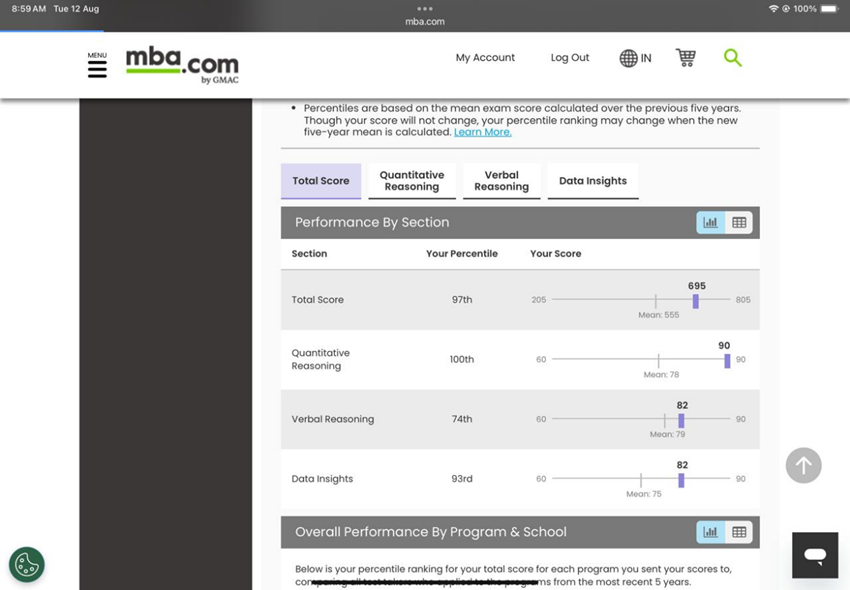
I'm Shruti, and I'm thrilled to share my GMAT journey with you all. After months of preparation and what felt like an uphill battle, I finally achieved a 695 (Q90, V82, DI82) in August.

When I first started my GMAT prep through self-study, I honestly had no idea what I was getting myself into. The score of 555 was humbling, to say the least. But looking back now, that low starting point became my biggest motivation to find the right approach and stick with it.
After struggling with self-preparation for a while, I decided to invest in a structured approach and joined e-GMAT in February.
The Three-Stage Learning Journey
One of the biggest game-changers for me was e-GMAT's structured three-stage learning approach.
Stage 1: Foundation Building
It wasn't just about knowing math concepts or grammar rules - it was about understanding how the GMAT tests these concepts in very specific ways.
For Verbal, this stage helped me understand the fundamental approaches to Critical Reasoning and Reading Comprehension. I learned about pre-thinking in CR, which was completely new to me. Instead of jumping straight to answer choices, I started having internal conversations about what the question was really asking.
For Quant, even though my diagnostic showed Q85, I discovered I had significant gaps in my problem-solving approach. The foundation lessons taught me systematic methods for tackling different question types, which became crucial for reaching Q90.
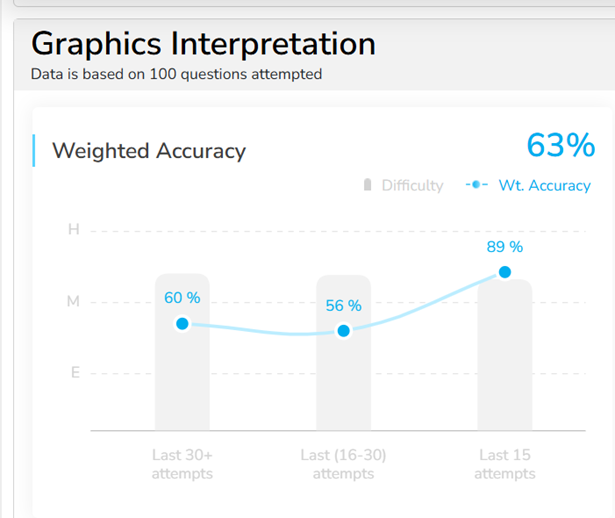
Data Insights was perhaps where the foundation stage helped me most. Starting with DI75, I was completely lost in this section. The foundation lessons broke down each question type - Data Sufficiency, Multi-Source Reasoning, Table Analysis, and Graphics Interpretation - into manageable components.
Stage 2: Cementing
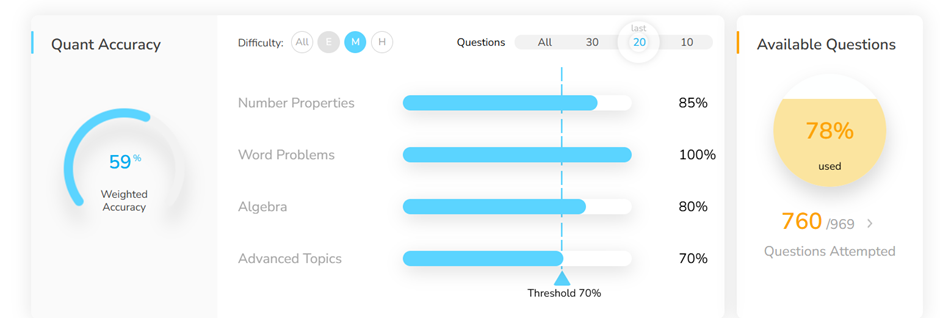
The cementing stage was where theory met practice. After learning the concepts, I needed to internalize them through targeted practice. This is where e-GMAT's Scholaranium platform became invaluable.
The cementing quizzes were designed to reinforce what I'd learned in the foundation stage. What I loved about this approach was that it wasn't just random practice - each quiz was specifically designed to cement particular concepts or skills.
For instance, after learning pre-thinking in CR, the cementing quizzes forced me to apply this technique consistently. Initially, it felt slow and unnatural, but with repeated practice, it became second nature. By the end of this stage, I could pre-think effectively on even the most complex CR questions.
Stage 3: Sectionals and Mocks
The final stage focused on bringing everything together under test conditions. This was where I learned that knowing how to solve questions wasn't enough - I needed to execute consistently under time pressure.
The sectional tests were particularly helpful for identifying timing issues and building stamina for each section. I remember my first few sectional tests being disasters in terms of time management, but gradually, I developed an internal clock for pacing.
Section-Wise Breakdown
Verbal: From V79 to V82
While my Verbal improvement might seem modest numerically, the journey was transformative. Starting at V79 meant I had fundamental gaps in my approach to both CR and RC.
The breakthrough in Critical Reasoning came when I truly understood pre-thinking. Instead of reading the stimulus and immediately scanning answer choices, I learned to pause and think: "What am I looking for in the correct answer?" This simple shift eliminated so many trap answers.
Reading Comprehension was initially my nightmare. I would read passages multiple times and still miss key details. The e-GMAT approach taught me to read functionally - understanding the author's purpose and the passage structure rather than trying to memorize every detail.
By test day, I was consistently hitting 75-80% accuracy on hard Verbal questions in my practice sessions.
Quant: From Q85 to Q90
My Quant journey was about refining execution rather than learning new concepts. The jump from Q85 to Q90 required addressing behavioral issues that were costing me points.
The biggest revelation was understanding that at the Q90 level, it's not about solving the hardest questions - it's about not making careless mistakes on questions you know how to solve. I learned to slow down, read questions carefully, and double-check my work.
e-GMAT's error log feature was instrumental here. It showed me patterns in my mistakes - was I making calculation errors? Misreading questions? Marking wrong answers despite solving correctly? Identifying these patterns allowed me to develop specific strategies to avoid them.

Data Insights: From DI75 to DI82
DI became my success story. Going from DI75 to DI82 represented moving from struggling with the section to actually enjoying it.
The key was learning specific approaches for each question type. For Multi-Source Reasoning, I learned to invest time upfront in understanding the data thoroughly rather than rushing through it. For Table Analysis and Graphics Interpretation, I developed systematic approaches for reading data accurately.
[align=center]
Some standout features of e-GMAT that made the difference:When I first started my GMAT prep through self-study, I honestly had no idea what I was getting myself into. The score of 555 was humbling, to say the least. But looking back now, that low starting point became my biggest motivation to find the right approach and stick with it.
After struggling with self-preparation for a while, I decided to invest in a structured approach and joined e-GMAT in February.
The Three-Stage Learning Journey
One of the biggest game-changers for me was e-GMAT's structured three-stage learning approach.
Stage 1: Foundation Building
It wasn't just about knowing math concepts or grammar rules - it was about understanding how the GMAT tests these concepts in very specific ways.
For Verbal, this stage helped me understand the fundamental approaches to Critical Reasoning and Reading Comprehension. I learned about pre-thinking in CR, which was completely new to me. Instead of jumping straight to answer choices, I started having internal conversations about what the question was really asking.
For Quant, even though my diagnostic showed Q85, I discovered I had significant gaps in my problem-solving approach. The foundation lessons taught me systematic methods for tackling different question types, which became crucial for reaching Q90.
Data Insights was perhaps where the foundation stage helped me most. Starting with DI75, I was completely lost in this section. The foundation lessons broke down each question type - Data Sufficiency, Multi-Source Reasoning, Table Analysis, and Graphics Interpretation - into manageable components.
Stage 2: Cementing
The cementing stage was where theory met practice. After learning the concepts, I needed to internalize them through targeted practice. This is where e-GMAT's Scholaranium platform became invaluable.
The cementing quizzes were designed to reinforce what I'd learned in the foundation stage. What I loved about this approach was that it wasn't just random practice - each quiz was specifically designed to cement particular concepts or skills.
For instance, after learning pre-thinking in CR, the cementing quizzes forced me to apply this technique consistently. Initially, it felt slow and unnatural, but with repeated practice, it became second nature. By the end of this stage, I could pre-think effectively on even the most complex CR questions.
Stage 3: Sectionals and Mocks
The final stage focused on bringing everything together under test conditions. This was where I learned that knowing how to solve questions wasn't enough - I needed to execute consistently under time pressure.
The sectional tests were particularly helpful for identifying timing issues and building stamina for each section. I remember my first few sectional tests being disasters in terms of time management, but gradually, I developed an internal clock for pacing.
Section-Wise Breakdown
Verbal: From V79 to V82
While my Verbal improvement might seem modest numerically, the journey was transformative. Starting at V79 meant I had fundamental gaps in my approach to both CR and RC.
The breakthrough in Critical Reasoning came when I truly understood pre-thinking. Instead of reading the stimulus and immediately scanning answer choices, I learned to pause and think: "What am I looking for in the correct answer?" This simple shift eliminated so many trap answers.
Reading Comprehension was initially my nightmare. I would read passages multiple times and still miss key details. The e-GMAT approach taught me to read functionally - understanding the author's purpose and the passage structure rather than trying to memorize every detail.
By test day, I was consistently hitting 75-80% accuracy on hard Verbal questions in my practice sessions.
Quant: From Q85 to Q90
My Quant journey was about refining execution rather than learning new concepts. The jump from Q85 to Q90 required addressing behavioral issues that were costing me points.
The biggest revelation was understanding that at the Q90 level, it's not about solving the hardest questions - it's about not making careless mistakes on questions you know how to solve. I learned to slow down, read questions carefully, and double-check my work.
e-GMAT's error log feature was instrumental here. It showed me patterns in my mistakes - was I making calculation errors? Misreading questions? Marking wrong answers despite solving correctly? Identifying these patterns allowed me to develop specific strategies to avoid them.
Data Insights: From DI75 to DI82
DI became my success story. Going from DI75 to DI82 represented moving from struggling with the section to actually enjoying it.
The key was learning specific approaches for each question type. For Multi-Source Reasoning, I learned to invest time upfront in understanding the data thoroughly rather than rushing through it. For Table Analysis and Graphics Interpretation, I developed systematic approaches for reading data accurately.
[align=center]
Scholaranium: The question bank was extensive and incredibly well-categorized. I could create custom quizzes targeting my specific weak areas, whether it was boldface CR questions or complex DI scenarios.
PACE Engine: This helped me identify exactly which concepts I needed to focus on in Quant versus which ones I could skim through, saving me valuable study time.
Video Lessons: The instructional content was clear, comprehensive, and actually engaging. Complex concepts were broken down into digestible chunks.
The Mental Game
Beyond the technical preparation, this journey taught me a lot about persistence and mental resilience. Starting with a 555 was demoralizing, but having a clear structure and seeing consistent improvement kept me motivated.
There were definitely moments of doubt, especially when my practice scores would occasionally dip. But the comprehensive tracking showed me that these were temporary fluctuations in an overall upward trend.
Test day itself was nerve-wracking, but because I had followed such a structured approach, I felt prepared. I knew exactly what to expect from each section and had developed specific strategies for managing time and stress.
Key Takeaways
1. Foundation first: Don't rush to practice questions without understanding the underlying concepts and strategies.
2. Consistency over intensity: Regular, structured practice was more valuable than occasional marathon study sessions.
3. Trust the process: Even when progress feels slow, if you're following a proven approach, improvement will come.
4. Mock tests are crucial: They provide reality checks and help you develop test-day strategies under actual time pressure.
For anyone considering a similar journey, especially if you're starting from a low baseline: embrace the process, trust the data over your emotions, and remember that every expert was once a beginner. Your 695 (or 715, or 650, or whatever your target is) is waiting for you - you just have to be willing to put in the work to reach it.
Best of luck to everyone on their GMAT journey!
Shruti
[/align]
Attachment:
GMAT-Club-Forum-93fhujho.png [ 137.15 KiB | Viewed 557 times ]
Attachment:
GMAT-Club-Forum-k3i6q13y.png [ 77.09 KiB | Viewed 541 times ]
Attachment:
GMAT-Club-Forum-6pk185q7.png [ 59.04 KiB | Viewed 539 times ]

 14 Sep 2025, 11:03
Kudos
Bookmarks
Congratulations on a stellar score!!!
All the best for the journey ahead !
All the best for the journey ahead !
shruti1507
 14 Sep 2025, 11:12
Kudos
Bookmarks
shruti1507
Shruti, your journey is truly inspiring! I really appreciate the detailed breakdown of your preparation and how you turned a 555 into a 695 through consistent effort. Wishing you all the best for your future endeavors!