Events & Promotions
|
|

GMAT Club Daily Prep
Thank you for using the timer - this advanced tool can estimate your performance and suggest more practice questions. We have subscribed you to Daily Prep Questions via email.
Customized
for You
Track
Your Progress
Practice
Pays
Not interested in getting valuable practice questions and articles delivered to your email? No problem, unsubscribe here.
 Sep 15
07:00 PM EDT
-09:00 PM EST
Elite scores are possible when you enroll in a powerful GMAT course, taught live online + 6 months access to TTP OnDemand video courses included! Class starts Tues/Thurs Sept. 15, 2026 - Nov. 15, 2027, 7:00pm-9:00pm EST Sep 18
08:00 PM PDT
-09:00 PM PDT
Video explanations + diagnosis of 10 weakest areas + 150+ short videos + study plan! Sep 21
07:00 PM EDT
-10:00 PM EDT
Boost your GMAT score in less than one month in a live online class + 6 months access to TTP OnDemand video courses included! Class starts Mon, Tues, Wed, Thur, Fri Sept. 21, 2026 - Oct. 9, 2027, 7:00pm-10:00pm EST


 30 Jul 2026, 03:14
Kudos
Bookmarks
Everyone treats Data Insights like a monster. It humbled me too, until I found a way to work with it.
Facing the DI monster
The course that taught me approach, not just content
Playing my strengths under the clock
Quant: building from a commerce base
Tracking everything, honestly
The mock journey and test-day nerves
If DI is your monster too
GMAT-Club-Forum-8w4ujocc.png [ 81.33 KiB | Viewed 230 times ]
GMAT-Club-Forum-i28bv6lz.png [ 41.52 KiB | Viewed 228 times ]
I finished at a 665, a 120-point jump, and while every section moved, the part I most want to talk about is Data Insights. I went from a DI76, the 53rd percentile, to a DI84, the 97th. DI is the section most people are afraid of, and it genuinely intimidated me at the start, so if it's the one keeping you up at night, I hope my experience helps. Here is how I worked through it, along with the Quant and Verbal that made it possible.
Facing the DI monster
When I saw a DI76 on my diagnostic mock, I was demotivated, but I noticed something about the section that changed how I approached it. DI is far more diverse than Quant or Verbal; every question type is genuinely different and has to be thought about differently. I felt my analytical instincts were reasonable, so I hoped that if I could learn to adapt to each question type instead of treating DI as one big section, I would slowly improve. So I stopped looking at it as a wall and started taking it step by step, question type by question type.
The course that taught me approach, not just content
What stood out when I opened the e-GMAT DI course was that it is built around approach. Rather than reading a whole question and then trying to work out what to do, the course gives you a set of steps that center your attention on what actually needs to be analyzed. That saved enormous time. I have looked at other platforms, and none of them treat DI as specifically or as comprehensively as this. Even after I got comfortable with each question type on its own, the hardest part was still adapting from one type to the next, and that is exactly where the e-GMAT sectional mocks helped, they trained me to jump and switch between question types in a way I did not find anywhere else. Approach was the single most important thing I gained, and it helped both my timing and my accuracy.
Playing my strengths under the clock
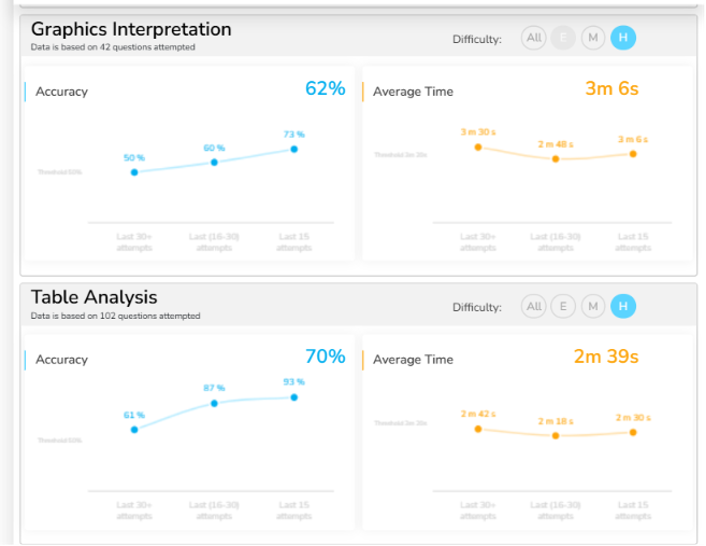
My fundamental rule for DI time management was to know my strengths well. DI is forgiving, you can miss a few and still score high, so the game is about where you spend your time. In my mocks I had gradually become comfortable with table analysis and graphical interpretation, so on test day I tried to move through those quickly, even the hard ones, and bank the time for the question types that eat it, like multi-source reasoning and two-part analysis, where you have to separate a large amount of information. Finding my stronger areas, which the analytics made obvious, and then spending my time deliberately rather than evenly, is what got me through the section.
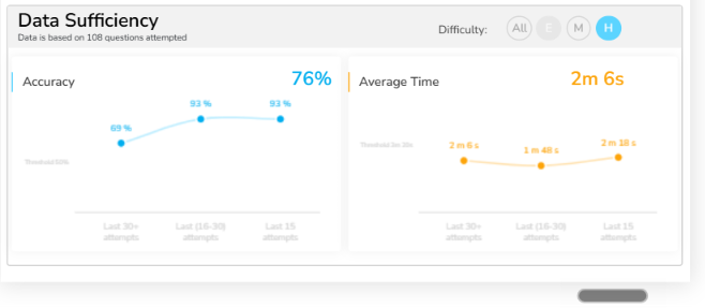
The data reflected the progress. My hard-question accuracy in graphical interpretation moved from 50 percent to 73, table analysis from 61 percent to 93, and data sufficiency from 69 percent to 93. Those steady gains are what took DI from my weakest area to a genuine strength:
Quant: building from a commerce base
I am a commerce graduate, not an engineer, so when I saw a Q76 I was not surprised, my fundamentals simply were not sharp yet. I was not too discouraged though, because I could tell the base was the issue, and a base can be built. The thing that helped most in Quant was the PACE system: before you begin a topic it gives you a diagnostic to check your current level, then places you at the right difficulty to build from, so you never waste time on what you already know. It saved me somewhere around 25 to 26 hours of prep. The Quant Basics course strengthened my foundations, and then the cementing quizzes did the real work, they run first at a relaxed timing so you can adapt to each question type, then at standard test-level timing of about two minutes, which is where you find out whether your method actually holds up under pressure. That taught me to look only at the parts of a question that matter and solve faster with higher accuracy.
Tracking everything, honestly
With so many topics across so many sections, you cannot keep progress in your head, and the data analytics on the portal is what kept me honest. It showed my accuracy and time per topic, where I was losing time on hard questions, and a trajectory to aim for. The part I would recommend most to anyone is the error log, which the course treats as mandatory: every wrong question gets labelled with why it went wrong, whether I rushed, over-spent, or picked a tempting wrong option. Seeing the real reason behind each mistake, instead of just noting that I got it wrong, is what let me improve steadily rather than randomly.
The mock journey and test-day nerves
I have not sat many competitive exams, so nerves built up for a long time and affected the start of my real test. What pulled me through was that I had recreated the exam environment in my mocks, a quiet room, just a sheet of paper, no distractions, so once I settled in I was in familiar territory. The e-GMAT mocks are a touch harder than the real test, which sounds discouraging but is the opposite, it makes the actual exam feel easier. My biggest advice is to stay in the moment: do not carry the last question into the next, and do not let a negative thought take over. My confidence climbed through the test as I stopped doubting myself.
If DI is your monster too
If Data Insights is the section keeping you up at night, I promise it is more approachable than it looks. It is not about being a genius, it is about learning the right approach to each question type, finding where your strengths are, and spending your time where it pays off. That mindset, plus honest tracking of every mistake, is what took me from a DI76 to a DI84 and a 665 overall.


Attachment:
GMAT-Club-Forum-8w4ujocc.png [ 81.33 KiB | Viewed 230 times ]
Attachment:
GMAT-Club-Forum-i28bv6lz.png [ 41.52 KiB | Viewed 228 times ]
 30 Jul 2026, 06:01
Kudos
Bookmarks
Congrats on getting a solid 665. Now the fun begins with the apps. Good luck!

 30 Jul 2026, 08:24
Kudos
Bookmarks
congratulations for score.. all the best with applications








