Last visit was: 23 Apr 2026, 04:13 It is currently 23 Apr 2026, 04:13
Close
GMAT Club Daily Prep
Thank you for using the timer - this advanced tool can estimate your performance and suggest more practice questions. We have subscribed you to Daily Prep Questions via email.

Customized
for You

we will pick new questions that match your level based on your Timer History

Track
Your Progress

every week, we’ll send you an estimated GMAT score based on your performance

Practice
Pays

we will pick new questions that match your level based on your Timer History
Not interested in getting valuable practice questions and articles delivered to your email? No problem, unsubscribe here.
Close
Request Expert Reply
Confirm Cancel
User avatar
144144
Joined: 08 Nov 2010
Last visit: 26 May 2013
Posts: 192
Own Kudos:
560
 [231]
Given Kudos: 161
GPA: 3.9
WE 1: Business Development
Posts: 192
Kudos: 560
 [231]
18
Kudos
Add Kudos
213
Bookmarks
Bookmark this Post
Most Helpful Reply
User avatar
Bunuel
User avatar
Math Expert
Joined: 02 Sep 2009
Last visit: 23 Apr 2026
Posts: 109,774
Own Kudos:
Given Kudos: 105,853
Products:
Expert
Expert reply
Active GMAT Club Expert! Tag them with @ followed by their username for a faster response.
Posts: 109,774
Kudos: 810,746
 [106]
44
Kudos
Add Kudos
62
Bookmarks
Bookmark this Post
User avatar
123mba123
Joined: 14 Mar 2015
Last visit: 12 Nov 2018
Posts: 8
Own Kudos:
52
 [36]
Given Kudos: 8
Location: India
Concentration: General Management, Strategy
GPA: 3.53
WE:Engineering (Other)
Posts: 8
Kudos: 52
 [36]
29
Kudos
Add Kudos
6
Bookmarks
Bookmark this Post
General Discussion
User avatar
sudhir18n
User avatar
Current Student
Joined: 26 May 2005
Last visit: 13 Feb 2013
Posts: 351
Own Kudos:
616
 [5]
Given Kudos: 13
Posts: 351
Kudos: 616
 [5]
3
Kudos
Add Kudos
2
Bookmarks
Bookmark this Post
WishMasterUA
an investment of d dollars at k percent simple annual interest yield $600 interest over a 2-year period. in term of d, what dollar amount invested at the same rate will yild $2400 interest income over a 3-year period?
1) 2d/3
2) 3d/4
3) 4d/3
4) 3d/2
5) 8d/3

Please explain in detail how to solve this problem.
simple interest = PNR/100
dk2=600
d = 300/k
thus
(x*300/k)*k*3= 2400
X= 2400/900= 24/9 = 8/3

hence E
User avatar
gamezfreak
Joined: 05 Jan 2012
Last visit: 21 Apr 2020
Posts: 40
Own Kudos:
52
 [16]
Given Kudos: 17
WE:Sales (Internet and New Media)
Posts: 40
Kudos: 52
 [16]
8
Kudos
Add Kudos
8
Bookmarks
Bookmark this Post
Since you want to earn 4 times more interest in 1.5 times the current time period, the answer will be 4d/1.5 or 8d/3
avatar
nitestr
Joined: 03 Feb 2011
Last visit: 28 Mar 2015
Posts: 11
Own Kudos:
Given Kudos: 16
Posts: 11
Kudos: 22
Kudos
Add Kudos
Bookmarks
Bookmark this Post
Hi Bunuel,

If we take simple annual interest of 2% for $10,000 investment, for 2 years it will amount to $404.

How do we know "An investment of d dollars at k percent simple annual interest yields $600 over a 2 year period" = d*k/100 *2
and not similar to $404 calc?

Thanks
User avatar
EMPOWERgmatRichC
User avatar
Major Poster
Joined: 19 Dec 2014
Last visit: 31 Dec 2023
Posts: 21,777
Own Kudos:
13,045
 [12]
Given Kudos: 450
Status:GMAT Assassin/Co-Founder
Affiliations: EMPOWERgmat
Location: United States (CA)
GMAT 1: 800 Q51 V49
GRE 1: Q170 V170
Expert
Expert reply
GMAT 1: 800 Q51 V49
GRE 1: Q170 V170
Posts: 21,777
Kudos: 13,045
 [12]
4
Kudos
Add Kudos
8
Bookmarks
Bookmark this Post
Hi nitestr,

The GMAT will likely ask you to deal with an "interest formula" question once or twice, so you need to note the wording of the prompt and you need to know the formulas for simple interest and compound interest.

Simple Interest = (Principal)(1 + RT)

Compound Interest = (Principal)(1 + R)^T

R = interest rate written as a decimal
T = length of time (usually years)

So, if we calculate 2% simple interest on a $10,000 principal over 2 years, we'll have...

(10,000)(1 + (.02)(2))
(10,000)(1.04) = 10,400
The interest = 400 (not 404)

GMAT assassins aren't born, they're made,
Rich
avatar
SD007
Joined: 03 Dec 2014
Last visit: 06 Jan 2018
Posts: 9
Own Kudos:
19
 [1]
Given Kudos: 484
GMAT 1: 620 Q43 V32
GPA: 2.9
Products:
GMAT 1: 620 Q43 V32
Posts: 9
Kudos: 19
 [1]
1
Kudos
Add Kudos
Bookmarks
Bookmark this Post
EMPOWERgmatRichC
Hi nitestr,

The GMAT will likely ask you to deal with an "interest formula" question once or twice, so you need to note the wording of the prompt and you need to know the formulas for simple interest and compound interest.

Simple Interest = (Principal)(1 + RT)

Compound Interest = (Principal)(1 + R)^T

R = interest rate written as a decimal
T = length of time (usually years)

So, if we calculate 2% simple interest on a $10,000 principal over 2 years, we'll have...

(10,000)(1 + (.02)(2))
(10,000)(1.04) = 10,400
The interest = 400 (not 404)

GMAT assassins aren't born, they're made,
Rich

Hi Rich,

The formula for the Simple interest is S.I = Principal (RT) no ?

Thanks for your clarification.

Regards
S
User avatar
EMPOWERgmatRichC
User avatar
Major Poster
Joined: 19 Dec 2014
Last visit: 31 Dec 2023
Posts: 21,777
Own Kudos:
13,045
 [3]
Given Kudos: 450
Status:GMAT Assassin/Co-Founder
Affiliations: EMPOWERgmat
Location: United States (CA)
GMAT 1: 800 Q51 V49
GRE 1: Q170 V170
Expert
Expert reply
GMAT 1: 800 Q51 V49
GRE 1: Q170 V170
Posts: 21,777
Kudos: 13,045
 [3]
3
Kudos
Add Kudos
Bookmarks
Bookmark this Post
Hi SD007,

If you want to calculate the amount of simple interest generated, then YES, the calculation is...

(Principal)(RT)

If you're interested in the TOTAL amount of money (e.g. in a bank account) AFTER the simple interest is generated, then the calculation is....

(Principal)(1 + RT)

GMAT assassins aren't born, they're made,
Rich
User avatar
BrainLab
User avatar
Current Student
Joined: 10 Mar 2013
Last visit: 26 Jan 2025
Posts: 343
Own Kudos:
3,214
 [4]
Given Kudos: 200
Location: Germany
Concentration: Finance, Entrepreneurship
GMAT 1: 580 Q46 V24
GPA: 3.7
WE:Marketing (Telecommunications)
GMAT 1: 580 Q46 V24
Posts: 343
Kudos: 3,214
 [4]
2
Kudos
Add Kudos
2
Bookmarks
Bookmark this Post
144144
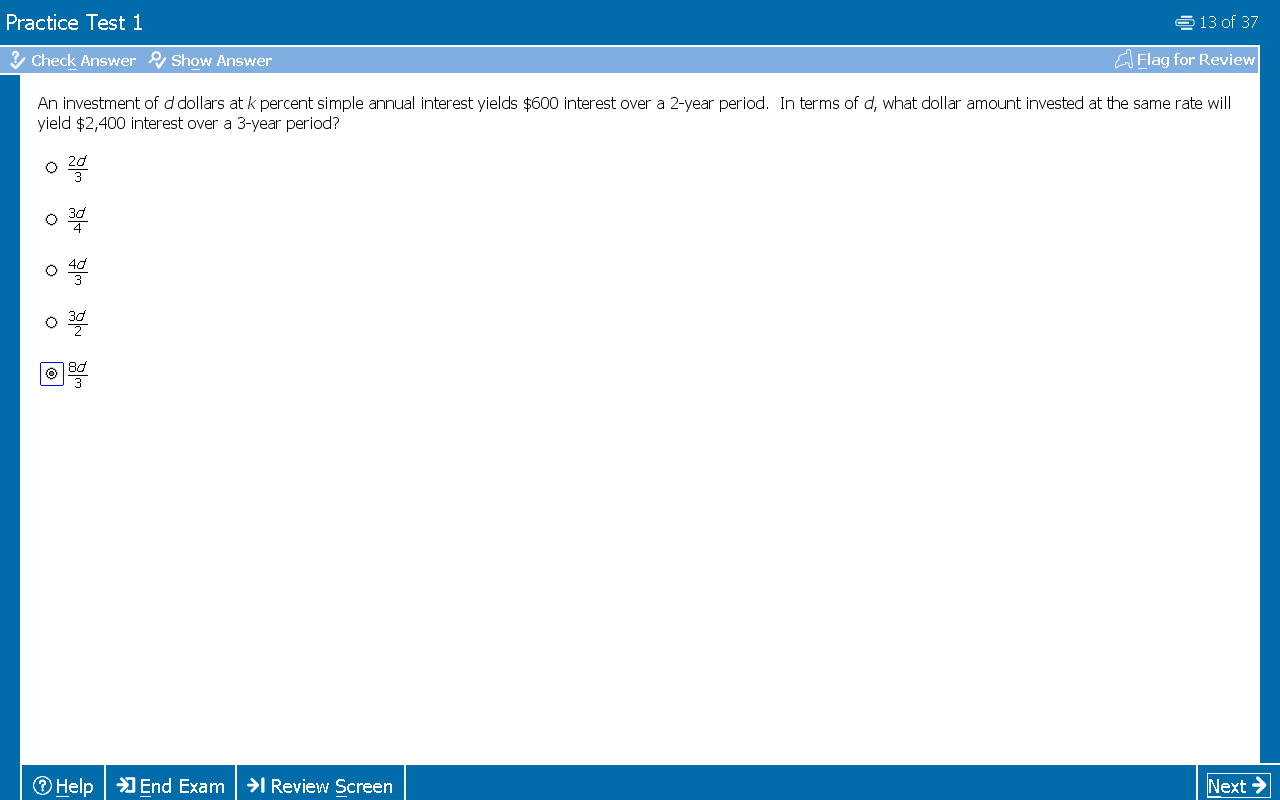
An investment of d dollars at k percent simple annual interest yields $600 over a 2 year period. In terms of d, what dollar amount invested at the same rate will yield $2,400 over a 3 year period?

A. (2d)/3
B. (3d)/4
C. (4d)/3
D. (3d)/2
E. (8d)/3
Hi guys, I just did my first CAT and this one was the first question that I answered correctly.
We don't need to involve any intetrest formulas at all here: the ratio of interest earnings per year = \(\frac{800}{300} = \frac{8}{3}\) so the ratio of the investment that generates 2400 (let it be X) to D is the same (interest rate remains the same)
\(\frac{8}{3}\)=\(\frac{x}{d}\) --> \(x=\frac{8}{3}*d\)
Answer E
User avatar
BrentGMATPrepNow
User avatar
Major Poster
Joined: 12 Sep 2015
Last visit: 31 Oct 2025
Posts: 6,733
Own Kudos:
36,448
 [5]
Given Kudos: 799
Location: Canada
Expert
Expert reply
Posts: 6,733
Kudos: 36,448
 [5]
2
Kudos
Add Kudos
2
Bookmarks
Bookmark this Post
144144
An investment of d dollars at k percent simple annual interest yields $600 over a 2 year period. In terms of d, what dollar amount invested at the same rate will yield $2,400 over a 3 year period?

A. (2d)/3
B. (3d)/4
C. (4d)/3
D. (3d)/2
E. (8d)/3

An investment of d dollars at k percent simple annual interest yields $600 over a 2-year period.
In other words, an investment of d dollars yields $300 in interest each year.

What dollar amount invested at the same rate will yield $2,400 interest over a 3-year period?
In other words, how much money must we invest to earn $800 in interest EACH YEAR?

If a d dollar investment yields $300 in interest EACH YEAR, then:
- a 2d dollar investment would yield $600 (2 times $300) in interest EACH YEAR
- a 3d dollar investment would yield $900 (3 times $300) in interest EACH YEAR
- a 4d dollar investment would yield $1200 (4 times $300) in interest EACH YEAR
- etc.

From here there are two approaches.

APPROACH #1
We want the ANNUAL interest to be $800.
This means we must invest an amount that is BETWEEN 2d dollars and 3d dollars [since $800 is BETWEEN $600 and $900].
When we check the answer choices, only E, which can be written as (8/3)d, is BETWEEN 2d dollars and 3d
So, the correct answer must be E


APPROACH #2
To increase the ANNUAL interest from $300 to $800, we must invest 800/300 TIMES as much money.
800/300 = 8/3, so we must invest (8/3)d dollars [aka 8d/3 dollars]
Answer = E

Cheers,
Brent
User avatar
MarkHanna
Joined: 02 Feb 2014
Last visit: 20 Nov 2020
Posts: 35
Own Kudos:
Given Kudos: 2
Concentration: Finance, General Management
GPA: 3.5
Posts: 35
Kudos: 6
Kudos
Add Kudos
Bookmarks
Bookmark this Post
Bunuel
An investment of d dollars at k percent simple annual interest yields $600 over a 2 year period. In terms of d, what dollar amount invested at the same rate will yield $2,4,00 over a 3 year period?
A. (2d)/3
B. (3d)/4
C. (4d)/3
D. (3d)/2
E. (8d)/3

Simple interest = principal * interest rate * time, where "principal" is the starting amount and "rate" is the interest rate at which the money grows per a given period of time (note: express the rate as a decimal in the formula). Time must be expressed in the same units used for time in the Rate.

An investment of d dollars at k percent simple annual interest yields $600 over a 2 year period --> \(d*\frac{k}{100}*2=600\) --> \(k=\frac{30,000}{d}\)

What (x) dollar amount invested at the same rate will yield $2,400 over a 3 year period --> \(x*\frac{k}{100}*3=2,400\) --> \(x*\frac{30,000}{100d}*3=2,400\) --> \(x=\frac{8d}{3}\).

Answer: E.

Or another way: In order interest to be 4 times more in 1.5 times longer time period then investment must be 4d/1.5=8d/3.

Answer: E.
Bunuel.

I'm more interested in the "Another way" to solve it. I get the "4 times more" but I can't get to the "1.5 times longer". How do you calculate this?

Thanks.

Best.
User avatar
Bunuel
User avatar
Math Expert
Joined: 02 Sep 2009
Last visit: 23 Apr 2026
Posts: 109,774
Own Kudos:
Given Kudos: 105,853
Products:
Expert
Expert reply
Active GMAT Club Expert! Tag them with @ followed by their username for a faster response.
Posts: 109,774
Kudos: 810,746
Kudos
Add Kudos
Bookmarks
Bookmark this Post
MarkHanna
Bunuel
An investment of d dollars at k percent simple annual interest yields $600 over a 2 year period. In terms of d, what dollar amount invested at the same rate will yield $2,4,00 over a 3 year period?
A. (2d)/3
B. (3d)/4
C. (4d)/3
D. (3d)/2
E. (8d)/3

Simple interest = principal * interest rate * time, where "principal" is the starting amount and "rate" is the interest rate at which the money grows per a given period of time (note: express the rate as a decimal in the formula). Time must be expressed in the same units used for time in the Rate.

An investment of d dollars at k percent simple annual interest yields $600 over a 2 year period --> \(d*\frac{k}{100}*2=600\) --> \(k=\frac{30,000}{d}\)

What (x) dollar amount invested at the same rate will yield $2,400 over a 3 year period --> \(x*\frac{k}{100}*3=2,400\) --> \(x*\frac{30,000}{100d}*3=2,400\) --> \(x=\frac{8d}{3}\).

Answer: E.

Or another way: In order interest to be 4 times more in 1.5 times longer time period then investment must be 4d/1.5=8d/3.

Answer: E.
Bunuel.

I'm more interested in the "Another way" to solve it. I get the "4 times more" but I can't get to the "1.5 times longer". How do you calculate this?

Thanks.

Best.

(3 year period)/(2 year period) = 1.5.
User avatar
ScottTargetTestPrep
User avatar
Target Test Prep Representative
Joined: 14 Oct 2015
Last visit: 22 Apr 2026
Posts: 22,278
Own Kudos:
26,529
 [5]
Given Kudos: 302
Status:Founder & CEO
Affiliations: Target Test Prep
Location: United States (CA)
Expert
Expert reply
Active GMAT Club Expert! Tag them with @ followed by their username for a faster response.
Posts: 22,278
Kudos: 26,529
 [5]
4
Kudos
Add Kudos
1
Bookmarks
Bookmark this Post
144144
An investment of d dollars at k percent simple annual interest yields $600 over a 2 year period. In terms of d, what dollar amount invested at the same rate will yield $2,400 over a 3 year period?

A. (2d)/3
B. (3d)/4
C. (4d)/3
D. (3d)/2
E. (8d)/3

Recall that the amount of simple interest, I, is equal to the principal, P, times the annual interest rate, r, times the number of years, t. That is, I = Prt.

We are given that I = 600, P = d, r = k/100 and t = 2, so we have:

600 = d(k/100)(2)

300 = dk/100

dk = 30,000

However, we are being asked for the dollar amount invested, in terms of d, at the annual interest rate of k percent that will yield $2,400 interest over a 3-year period. If we let this dollar amount be x, then

2,400 = x(k/100)(3)

800 = xk/100

xk = 80,000

Since dk = 30,000 and xk = 80,000, k = 30,000/d and k = 80,000/x. Thus, we can equate 30,000/d and 80,000/x and isolate x.

30,000/d = 80,000/x

30,000x = 80,000d

3x = 8d

x = 8d/3

Answer: E
User avatar
GmatPoint
Joined: 02 Jan 2022
Last visit: 13 Oct 2022
Posts: 246
Own Kudos:
Given Kudos: 3
GMAT 1: 760 Q50 V42
GMAT 1: 760 Q50 V42
Posts: 246
Kudos: 140
Kudos
Add Kudos
Bookmarks
Bookmark this Post
Simple Interest = P*r*t/100

From the first condition,

600 = d*k*2/100 .......(i)

Let the principal invested for 3 years be x

Thus, 2400 = x*k*3/100 .....(ii)

After dividing (ii) by (i),

4 = x*3/d*2

Thus, x = 8d/3

Thus, the correct option is E.
User avatar
bumpbot
User avatar
Non-Human User
Joined: 09 Sep 2013
Last visit: 04 Jan 2021
Posts: 38,956
Own Kudos:
Posts: 38,956
Kudos: 1,117
Kudos
Add Kudos
Bookmarks
Bookmark this Post
Automated notice from GMAT Club BumpBot:

A member just gave Kudos to this thread, showing it’s still useful. I’ve bumped it to the top so more people can benefit. Feel free to add your own questions or solutions.

This post was generated automatically.
Moderators:
Math Expert
109774 posts
Tuck School Moderator
853 posts