Events & Promotions
|
|

GMAT Club Daily Prep
Thank you for using the timer - this advanced tool can estimate your performance and suggest more practice questions. We have subscribed you to Daily Prep Questions via email.
Customized
for You
Track
Your Progress
Practice
Pays
Not interested in getting valuable practice questions and articles delivered to your email? No problem, unsubscribe here.
 Oct 01
07:00 AM BST
-08:00 AM GMT
Welcome to the GMAT Club's Free Interview Prep Event for Top MBA Programs! Buy tickets - Virtual series that’s all set to equip you to -excel in your MBA interviews.

 19 Nov 2014, 16:28
Kudos
Bookmarks


C
Be sure to select an answer first to save it in the Error Log before revealing the correct answer (OA)!
Difficulty:
 95%
(hard)
95%
(hard)
Question Stats:
38% (02:44) correct 62%
(02:54)
wrong
based on 194
sessions
62%
(02:54)
wrong
based on 194
sessions
History
Date
Time
Result
Not Attempted Yet
In the diagram below, if angle BAC is a right angle, is triangle ADC an equilateral triangle?
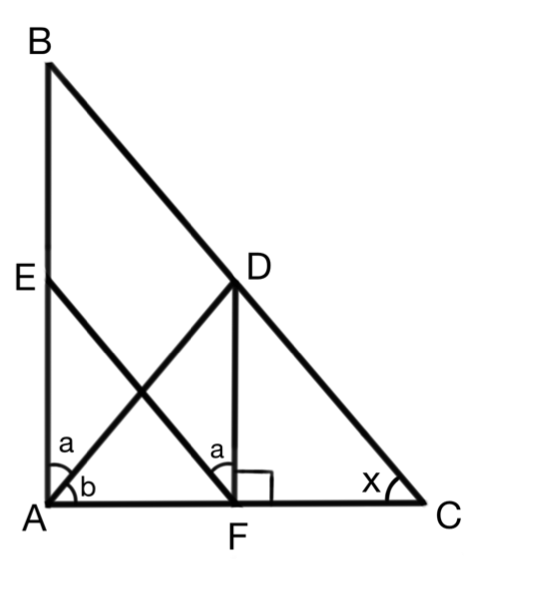
(1) ADC = 60 degrees
(2) EF is parallel to BC

Untitled.png [ 44.79 KiB | Viewed 3028 times ]
(1) ADC = 60 degrees
(2) EF is parallel to BC
Attachment:
Untitled.png [ 44.79 KiB | Viewed 3028 times ]
Pure algebraic questions like this one are no longer part of the GMAT Data Sufficiency syllabus.
For relevant Data Sufficiency questions, please check the Data Sufficiency forum:
Data Sufficiency Forum
Data Sufficiency Forum
21 Nov 2014, 10:16
Kudos
Bookmarks
Solution in the video below:
[youtube]https://www.youtube.com/watch?v=5tMBn-s_GGQ[/youtube]
[youtube]https://www.youtube.com/watch?v=5tMBn-s_GGQ[/youtube]
 26 Jul 2020, 18:41
Kudos
Bookmarks
To find: Whether triangle ADC is equilateral
To do this, we can either determine whether AD = DC = AC or that each interior angle = 60 degree
Statement 1: ADC = 60 degrees
At least one angle is equal to 60 degree, but we don't know whether AD = DC, so we can't say ADC is equilateral.
Insufficient (BCE)
Statement 2: EF is parallel to BC
This is a very interesting statement.
Let the point where EF and AD intersect be X
If EF is parallel to BC, then ADC = AXF (Corresponding angles)
Also, DFA = 90 and EAF = 90
Thus, EFA = b (since DAF has to be equal to EFA)
So, we have established that: in triangle AXF, XAF = XFA = b and AXF = ADC.
If we get to know the value of ADC, we will be able to determine whether triangle ADC is equilateral.
But, without concrete numbers, we can't say.
Insufficient (CE)
Let's combine the two statements now:
From statement 1 we get ADC = 60 degree
Thus, AXF = ADC = 60 degree
Applying angle sum property in triangle AXF, we have
2 b + AXF = 180
2b + 60 = 180
2b = 120
b = 60.
Now, in triangle ADC,
Angle ADC = 60 (acc to statement 1)
Angle DAC = b = 60 (just inferred by combining statements 1 and 2)
Thus, the third angle (ACD) will also be 60.
We can say for sure that triangle ADC is an equilateral triangel.
Sufficient
(C)
To do this, we can either determine whether AD = DC = AC or that each interior angle = 60 degree
Statement 1: ADC = 60 degrees
At least one angle is equal to 60 degree, but we don't know whether AD = DC, so we can't say ADC is equilateral.
Insufficient (BCE)
Statement 2: EF is parallel to BC
This is a very interesting statement.
Let the point where EF and AD intersect be X
If EF is parallel to BC, then ADC = AXF (Corresponding angles)
Also, DFA = 90 and EAF = 90
Thus, EFA = b (since DAF has to be equal to EFA)
So, we have established that: in triangle AXF, XAF = XFA = b and AXF = ADC.
If we get to know the value of ADC, we will be able to determine whether triangle ADC is equilateral.
But, without concrete numbers, we can't say.
Insufficient (CE)
Let's combine the two statements now:
From statement 1 we get ADC = 60 degree
Thus, AXF = ADC = 60 degree
Applying angle sum property in triangle AXF, we have
2 b + AXF = 180
2b + 60 = 180
2b = 120
b = 60.
Now, in triangle ADC,
Angle ADC = 60 (acc to statement 1)
Angle DAC = b = 60 (just inferred by combining statements 1 and 2)
Thus, the third angle (ACD) will also be 60.
We can say for sure that triangle ADC is an equilateral triangel.
Sufficient
(C)





