Last visit was: 22 Apr 2026, 04:23 It is currently 22 Apr 2026, 04:23
Close
GMAT Club Daily Prep
Thank you for using the timer - this advanced tool can estimate your performance and suggest more practice questions. We have subscribed you to Daily Prep Questions via email.

Customized
for You

we will pick new questions that match your level based on your Timer History

Track
Your Progress

every week, we’ll send you an estimated GMAT score based on your performance

Practice
Pays

we will pick new questions that match your level based on your Timer History
Not interested in getting valuable practice questions and articles delivered to your email? No problem, unsubscribe here.
Close
Request Expert Reply
Confirm Cancel
User avatar
GMATBusters
User avatar
GMAT Tutor
Joined: 27 Oct 2017
Last visit: 21 Apr 2026
Posts: 1,921
Own Kudos:
6,854
 [14]
Given Kudos: 241
WE:General Management (Education)
Expert
Expert reply
Posts: 1,921
Kudos: 6,854
 [14]
Kudos
Add Kudos
13
Bookmarks
Bookmark this Post
Most Helpful Reply
User avatar
GMATBusters
User avatar
GMAT Tutor
Joined: 27 Oct 2017
Last visit: 21 Apr 2026
Posts: 1,921
Own Kudos:
6,854
 [2]
Given Kudos: 241
WE:General Management (Education)
Expert
Expert reply
Posts: 1,921
Kudos: 6,854
 [2]
1
Kudos
Add Kudos
1
Bookmarks
Bookmark this Post
General Discussion
avatar
NikuHBS
Joined: 21 Apr 2018
Last visit: 09 Nov 2022
Posts: 42
Own Kudos:
26
 [1]
Given Kudos: 36
Posts: 42
Kudos: 26
 [1]
1
Kudos
Add Kudos
Bookmarks
Bookmark this Post
User avatar
monikakumar
Joined: 23 Jan 2020
Last visit: 31 Dec 2021
Posts: 234
Own Kudos:
Given Kudos: 467
Products:
Posts: 234
Kudos: 146
Kudos
Add Kudos
Bookmarks
Bookmark this Post
Is the triangle ABC with sides a, b, c an acute angles triangle?
1) The Sides AB (length = c) and BC (length = a) are 13 and 17 respectively and the angle ABC is 30 deg.
2) The triangle with sides a^2, b^2 and c^2 is a right-angled triangle.

1) using law of cosine,
c^2= a^2+b^2-2abcos(c)
we can find length and check if it is acute or not
sufficient

2) a,b,c is right angled
sufficient

Ans D
avatar
NikuHBS
Joined: 21 Apr 2018
Last visit: 09 Nov 2022
Posts: 42
Own Kudos:
Given Kudos: 36
Posts: 42
Kudos: 26
Kudos
Add Kudos
Bookmarks
Bookmark this Post
Statement 1:
The two sides (AB and BC) and the included angle (Angle B) are given. We can deduce that the other two angles are fixed as the two sides are also fixed.
Sufficient.

Statement 2:
If the three sides A^2, B^2, C^2 together satisfy the pythagoras theorem then the triangle is a right angled triangle.
Hence, A^4 + B^4 = C^4

Let's assume
A^2 = 3
B^2 = 4
C^2 = 5
So,
3^2 + 4^2 = 5^2

Now,
A = \(\sqrt{3}\)
B =\(\sqrt{4}\)
C =\( \sqrt{5}\)

For a triangle to be acute, A^2 + B^2 > C^2
Here, 3 + 4 > 7
Thus, the given triangle is acute angled triangle.
Hence Sufficient.

Option D
User avatar
urshi
Joined: 21 Feb 2018
Last visit: 19 May 2021
Posts: 126
Own Kudos:
Given Kudos: 448
Location: India
Concentration: General Management, Strategy
WE:Consulting (Consulting)
Products:
Posts: 126
Kudos: 142
Kudos
Add Kudos
Bookmarks
Bookmark this Post
Option B
Attachments

IMG_20200712_080439.jpg
IMG_20200712_080439.jpg [ 121.11 KiB | Viewed 5787 times ]

avatar
dragonking
Joined: 21 May 2020
Last visit: 07 May 2025
Posts: 3
Given Kudos: 1
Posts: 3
Kudos: 0
Kudos
Add Kudos
Bookmarks
Bookmark this Post
Statement (1) ALONE is sufficient, but statement (2) alone is not sufficient
User avatar
MayankSingh
Joined: 08 Jan 2018
Last visit: 20 Dec 2024
Posts: 289
Own Kudos:
Given Kudos: 249
Location: India
Concentration: Operations, General Management
GMAT 1: 640 Q48 V27
GMAT 2: 730 Q51 V38
GPA: 3.9
WE:Project Management (Manufacturing)
Products:
Kudos
Add Kudos
Bookmarks
Bookmark this Post
IMO D

Is the triangle ABC with sides a, b, c an acute angles triangle?

1) The Sides AB (length = c) and BC (length = a) are 13 and 17 respectively and the angle ABC is 30 deg.

Lets draw the altitude AD from A

In triangle ABD, AB=13, Angle ABD=30
So, AD= 13 sin30= 6.5
BD=13cos30= 11.25

AlSo, in triangle ACD, tan Angle DAC= (13-11.25)/6.5=0.88

Therefore , 30< DAC < 45
So angle BAC= 60+DAC = > 90
Sufficient.

2) The triangle with sides a^2, b^2 and c^2 is a right-angled triangle.

Let a^2=3, b^2=4, C^2=5 Forms a right angle triangle

Now , From cosine rule, Cos angle ABC= [(c^2+a^2)-b^2]/2ac = 4/2sqrt15= 2/4=1/2 ~ 60 degree
Similarly, other angles can be found.

Sufficient.
User avatar
ashwini2k6jha
Joined: 11 Jun 2014
Last visit: 02 Mar 2026
Posts: 93
Own Kudos:
Given Kudos: 48
Location: India
Schools: ISB '23
GMAT 1: 700 Q49 V37
Schools: ISB '23
GMAT 1: 700 Q49 V37
Posts: 93
Kudos: 99
Kudos
Add Kudos
Bookmarks
Bookmark this Post
answer :D
State 1:sufficient
given AC=b,AB=c=13 and BC=a=17,Angle ABC=30
triangle ABC WILL be acute if BC^2<AB^2+AC^2
Now applying cos30=a^2+c^2-b^2/2ac
putting value and solving, we get b^2=458-221sqrt3= approx. 76
conditionBC^2>AB^2+AC^2 is satisfied as 289>13^2+76
State 2:sufficient
from given condition ,let c^2 be the largest side,then c^4=a^4+b^4=(a^2+b^2)^2-2 x a^2 x b^2
c^2<a^2+b^2
avatar
Spunk17
Joined: 28 Mar 2015
Last visit: 02 Oct 2021
Posts: 11
Given Kudos: 90
Posts: 11
Kudos: 0
Kudos
Add Kudos
Bookmarks
Bookmark this Post
IMO E

First statement does not give us enough information about the angles of the triangle, there is a possibility that one of the anglkes can be more than 90 degree.
From the second statement alone we cant get the answer, knowing that a^2, b^2,c^2 makes a right angle triangle does not give us enough information if the triangle with a,b,c is a right angle triangle or not.

Using both statements we cannot conclude anything here.
avatar
nothing345
Joined: 30 May 2020
Last visit: 13 Oct 2020
Posts: 25
Own Kudos:
Given Kudos: 14
Posts: 25
Kudos: 19
Kudos
Add Kudos
Bookmarks
Bookmark this Post
Is the triangle ABC with sides a, b, c an acute angles triangle?
1) The Sides AB (length = c) and BC (length = a) are 13 and 17 respectively and the angle ABC is 30 deg.
2) The triangle with sides a^2, b^2 and c^2 is a right-angled triangle.

Sum of angles of a triangle = 180

S1: Enough to know that sum of remaining angles will be 150. Could be 90+70 (not acute) or 75+75 (acute)
IS

S2: Square of the sides makes it Pythagoras and since one anglie is 90 deg the other two will add up to 90 deg i.e. their values will also be less than 90 deg.
Suffiecient

Answer is B.
avatar
YuvarajUmapathi
Joined: 03 Mar 2019
Last visit: 02 Jun 2022
Posts: 16
Own Kudos:
Given Kudos: 24
Posts: 16
Kudos: 20
Kudos
Add Kudos
Bookmarks
Bookmark this Post
IMO D

For the solution, PFA
Attachments

solution.pdf [661.39 KiB]
Downloaded 111 times

avatar
Rampant
Joined: 03 Sep 2019
Last visit: 27 May 2021
Posts: 7
Given Kudos: 23
Posts: 7
Kudos: 0
Kudos
Add Kudos
Bookmarks
Bookmark this Post
1- from statement side a is 4<a<30. Since angle C has to be less than 30 degree , been shorter than side b of angel B equals to 30 degree. Hence taking the max value of angle C +angle b = 29.99+30= 59.99. Angle A = 180-59.99= 120.01.
So not an acute angle triangle

2- Since Pythagoras triangle property is applicable, not an acute angle triangle .

Ans is D
avatar
123456789007
Joined: 07 Sep 2019
Last visit: 25 Oct 2020
Posts: 30
Own Kudos:
Given Kudos: 75
Location: India
Schools: Kellogg '23
Products:
Schools: Kellogg '23
Posts: 30
Kudos: 33
Kudos
Add Kudos
Bookmarks
Bookmark this Post
only option 2 is sufficient
User avatar
aggvipul
Joined: 15 Nov 2017
Last visit: 13 Apr 2022
Posts: 227
Own Kudos:
Given Kudos: 28
Status:Current Student
Concentration: Operations, Marketing
WE:Operations (Retail: E-commerce)
Posts: 227
Kudos: 431
Kudos
Add Kudos
Bookmarks
Bookmark this Post
Awesome question
Acute triangle ?
1. Two sides and one included angle is given. Follow below method


For this type of triangle, we must use The Law of Cosines first to calculate the third side of the triangle; then we can use The Law of Sines to find one of the other two angles, and finally use Angles of a Triangle to find the last angle.

Law of cosines:

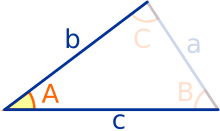
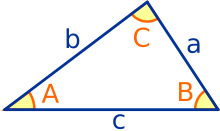
The Law of Cosines (or Cosine Rule) says:
c2 = a2 + b2 − 2ab cos(C)

Law of Sines: (refer above picture)
\(\frac{(a}{sin A)} = \frac{b}{sin B} = \frac{c}{sin C}\)

Angles of a Triangle:

A + B + C = 180°

So, all in all statement 1 is sufficient to know the type of triangle

2. This means that \(a^2 b^2 and c^2\) form a Pythagorean triplet(there are many of them- (3, 4, 5) (5, 12, 13) (7, 24, 25) (8, 15, 17) (9, 40, 41) (11, 60, 61) (12, 35, 37) (13, 84, 85) (16, 63, 65) (20, 21,29) (28, 45, 53) (33, 56, 65) (36, 77, 85) (39, 80, 89) (48, 55, 73) (65, 72, 97)

Square root of these triplet form the sides of the triangle. e.g. triplet - 3,4,5
corresponding sides-\( \sqrt{3}, 2 and \sqrt{5}\)

Now a triangle can be formed using - https://www.mathopenref.com/consttrianglesss.html

But point worth noting here is that - side is \(c ^2 = a^2 + b^2\) that means the angle between sides sides a and b is 90 degrees, but
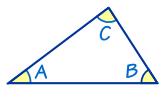
This does not make us sure that the other angles are acute- refer picture below. Even if other angles are acute or obtuse atleast one angle is 90 degree(triangle is not acute)

Hence, Statement 2 is sufficient
Answer Option D
Attachments

Triangles side concept.jpg
Triangles side concept.jpg [ 119.93 KiB | Viewed 5579 times ]

User avatar
Archit3110
User avatar
Major Poster
Joined: 18 Aug 2017
Last visit: 22 Apr 2026
Posts: 8,627
Own Kudos:
Given Kudos: 243
Status:You learn more from failure than from success.
Location: India
Concentration: Sustainability, Marketing
GMAT Focus 1: 545 Q79 V79 DI73
GMAT Focus 2: 645 Q83 V82 DI81
GPA: 4
WE:Marketing (Energy)
Products:
GMAT Focus 2: 645 Q83 V82 DI81
Posts: 8,627
Kudos: 5,190
Kudos
Add Kudos
Bookmarks
Bookmark this Post
Is the triangle ABC with sides a, b, c an acute angles triangle?
1) The Sides AB (length = c) and BC (length = a) are 13 and 17 respectively and the angle ABC is 73.8 deg.
2) The triangle with sides a^2, b^2 and c^2 is a right-angled triangle.

an acute ∆ ; a^2+b^2>c^2 is a<=b<=c
all angles are <90*
#1
The Sides AB (length = c) and BC (length = a) are 13 and 17 respectively and the angle ABC is 73.8 deg.
third side angle is 73.8 ; and sum of angle for length c & a ; 106.2 whose sum of can 90+16.2 or it can be 73 +33.2 we get yes and no ; insufficient
#2
The triangle with sides a^2, b^2 and c^2 is a right-angled triangle.
a right angled ∆ a^2+b^2=c^2
such that one of the angles is 90* ; so we can say that a, b, c is not an acute angles triangle.
OPTION B
User avatar
CEdward
Joined: 11 Aug 2020
Last visit: 14 Apr 2022
Posts: 1,162
Own Kudos:
Given Kudos: 332
Posts: 1,162
Kudos: 289
Kudos
Add Kudos
Bookmarks
Bookmark this Post
I don't think trigonometry is part of the GMAT? Is there something here we could learn regardless?
User avatar
GMATBusters
User avatar
GMAT Tutor
Joined: 27 Oct 2017
Last visit: 21 Apr 2026
Posts: 1,921
Own Kudos:
Given Kudos: 241
WE:General Management (Education)
Expert
Expert reply
Posts: 1,921
Kudos: 6,854
Kudos
Add Kudos
Bookmarks
Bookmark this Post
The solution posted here (https://gmatclub.com/forum/is-the-triangle-abc-with-sides-a-b-329024.html#p2566960) is not based on Trignometry.

CEdward
I don't think trigonometry is part of the GMAT? Is there something here we could learn regardless?
User avatar
Karthik740
Joined: 20 Oct 2020
Last visit: 18 Jul 2025
Posts: 37
Own Kudos:
Given Kudos: 20
Location: India
Concentration: Strategy, Finance
GMAT 1: 720 Q50 V38
GPA: 4
Products:
GMAT 1: 720 Q50 V38
Posts: 37
Kudos: 78
Kudos
Add Kudos
Bookmarks
Bookmark this Post
The question is very tricky and full of traps. Must take into account a strategy
User avatar
Fdambro294
Joined: 10 Jul 2019
Last visit: 20 Aug 2025
Posts: 1,331
Own Kudos:
Given Kudos: 1,656
Posts: 1,331
Kudos: 771
Kudos
Add Kudos
Bookmarks
Bookmark this Post
The key for solving a lot of high end Data Sufficiency geometry questions is to determine and know when a figure is fixed and can not move (I believe Manhattan Prep refers to the concept as Rubber Band Geometry).

Generally, if we know definitive values for the dimensions and angles that make up the Triangle Congruency Rules (S-A-S , A-S-A, S-S-S, R-H-S), we can say that the triangle given if FIXED and will not move.

When the triangle is fixed and we have known values that fix the triangle, theoretically anything about that triangle can be determined, even if we can’t do the operations ourselves.


(1) side AB is adjacent to Side BC —-> we are given both lengths (13 and 17)

The Included Angle in between the 2 side lengths is Angle ABC.

Therefore, we are given a fixed value for:

Side of a Triangle (S)

The Included Angle in between adjacent Sides of the Triangle (A)

And the Adjacent Side of the Triangle (S)

Given these fixed values, it would be theoretically possible to determine any other dimension:

We could use the cosine file to find the 3rd side. Then we could use the sine rule proportions to find the other angles.

Since the triangle is fixed in place, the answer will be either a definitive Yes or definitive No.

S1 is Sufficient

(2) again, we are given that the side lengths squared make up a right triangle.

Regardless of the values you put in for the a , b , and c you will always find a triangle in which the inequality

(Longest side)^2 < (shorter side)^2 + (other shorter side)^2

And the triangle will be Acute

D


GMATBusters

GMATBusters’ Quant Quiz Question -5


Is the triangle ABC with sides a, b, c an acute angles triangle?
1) The Sides AB (length = c) and BC (length = a) are 13 and 17 respectively and the angle ABC is 73.8 deg.
2) The triangle with sides a^2, b^2 and c^2 is a right-angled triangle.

Posted from my mobile device
Moderators:
Math Expert
109740 posts
498 posts
211 posts