Events & Promotions
|
|

GMAT Club Daily Prep
Thank you for using the timer - this advanced tool can estimate your performance and suggest more practice questions. We have subscribed you to Daily Prep Questions via email.
Customized
for You
Track
Your Progress
Practice
Pays
Not interested in getting valuable practice questions and articles delivered to your email? No problem, unsubscribe here.
 Sep 21
07:00 PM EDT
-10:00 PM EDT
Boost your GMAT score in less than one month in a live online class + 6 months access to TTP OnDemand video courses included! Sep 23
12:30 AM EDT
-01:30 AM EDT
Learn how Keshav, a Chartered Accountant, scored an impressive 705 on GMAT in just 30 days with GMATWhiz's expert guidance. In this video, he shares preparation tips and strategies that worked for him, including the mock, time management, and more Sep 24
01:30 AM EDT
-01:30 AM EDT
Tejas studied hard but kept repeating the same mistakes. After 3 attempts at 645, a focused 4-week strategy helped him identify and fix what was holding him back—leading to a 695 with just 12–15 hours of study per week. Sep 26
06:00 PM PDT
-07:00 PM PDT
Free- full-length test + 15 concept videos + 150+ short videos + study plan!


 20 Jun 2015, 11:12
Kudos
Bookmarks
ABC is a right triangle with right angle at point B. If the ratio of AB to BC is 8 to 15, what is the area of the triangle?
(1) The length of the perpendicular from point B to the hypotenuse is 120.
(2) The perimeter of the triangle is 680.
(1) The length of the perpendicular from point B to the hypotenuse is 120.
(2) The perimeter of the triangle is 680.
20 Jun 2015, 11:12
Kudos
Bookmarks
Official Solution:
ABC is a right triangle with right angle at point B. If the ratio of AB to BC is 8 to 15, what is the area of the triangle?
First of all, since the ration of AB to BC is \(8x:15x\), then the hypotenuse is \(\sqrt{(8x)^2+(15x)^2}=17x\).
(1) The length of the perpendicular from point B to the hypotenuse is 120.
Consider the image below:
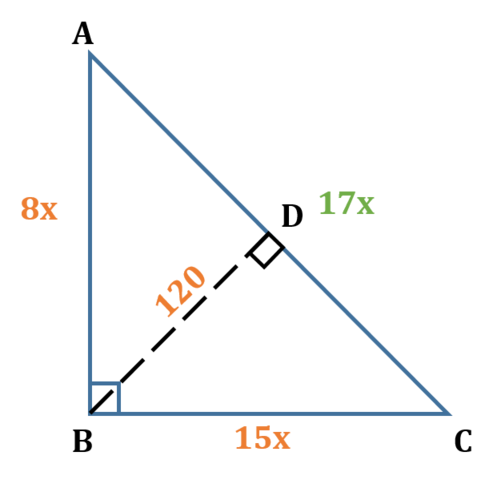
The area of a right triangle equals to \(\frac{1}{2}*leg_1*leg_2=\frac{1}{2}**AB*BC\). But the area of a right triangle can also be found by \(\frac{1}{2}*(altitude \ from \ right \ angle)*(hypotenuse)=\frac{1}{2}*BD*AC\).
Equate these expressions:
\(\frac{1}{2}*AB*BC=\frac{1}{2}*BD*AC\);
\(\frac{1}{2}*8x*15x=\frac{1}{2}*120*17x\);
\(120x=120*17\);
\(x=17\).
The area = \(\frac{1}{2}*AB*BC=\frac{1}{2}*8x*15x=60x^2=60*17^2\). Sufficient.
(2) The perimeter of the triangle is 680.
The perimeter = \(8x+15x+17x=680\). We can find x, thus we can find the area. Sufficient.
Answer: D
ABC is a right triangle with right angle at point B. If the ratio of AB to BC is 8 to 15, what is the area of the triangle?
First of all, since the ration of AB to BC is \(8x:15x\), then the hypotenuse is \(\sqrt{(8x)^2+(15x)^2}=17x\).
(1) The length of the perpendicular from point B to the hypotenuse is 120.
Consider the image below:
The area of a right triangle equals to \(\frac{1}{2}*leg_1*leg_2=\frac{1}{2}**AB*BC\). But the area of a right triangle can also be found by \(\frac{1}{2}*(altitude \ from \ right \ angle)*(hypotenuse)=\frac{1}{2}*BD*AC\).
Equate these expressions:
\(\frac{1}{2}*AB*BC=\frac{1}{2}*BD*AC\);
\(\frac{1}{2}*8x*15x=\frac{1}{2}*120*17x\);
\(120x=120*17\);
\(x=17\).
The area = \(\frac{1}{2}*AB*BC=\frac{1}{2}*8x*15x=60x^2=60*17^2\). Sufficient.
(2) The perimeter of the triangle is 680.
The perimeter = \(8x+15x+17x=680\). We can find x, thus we can find the area. Sufficient.
Answer: D
 04 Feb 2018, 12:39
Kudos
Bookmarks
Hi,
a really stupid question, how do we get 17x out of this equation?
Thank you for your answer!
a really stupid question, how do we get 17x out of this equation?
Thank you for your answer!





