Last visit was: 22 Apr 2026, 21:02 It is currently 22 Apr 2026, 21:02
Close
GMAT Club Daily Prep
Thank you for using the timer - this advanced tool can estimate your performance and suggest more practice questions. We have subscribed you to Daily Prep Questions via email.

Customized
for You

we will pick new questions that match your level based on your Timer History

Track
Your Progress

every week, we’ll send you an estimated GMAT score based on your performance

Practice
Pays

we will pick new questions that match your level based on your Timer History
Not interested in getting valuable practice questions and articles delivered to your email? No problem, unsubscribe here.
Close
Request Expert Reply
Confirm Cancel
User avatar
kilukilam
Joined: 16 Apr 2010
Last visit: 01 Aug 2010
Posts: 13
Own Kudos:
877
 [386]
Posts: 13
Kudos: 877
 [386]
38
Kudos
Add Kudos
347
Bookmarks
Bookmark this Post
Most Helpful Reply
User avatar
Bunuel
User avatar
Math Expert
Joined: 02 Sep 2009
Last visit: 22 Apr 2026
Posts: 109,754
Own Kudos:
Given Kudos: 105,823
Products:
Expert
Expert reply
Active GMAT Club Expert! Tag them with @ followed by their username for a faster response.
Posts: 109,754
Kudos: 810,691
 [158]
65
Kudos
Add Kudos
93
Bookmarks
Bookmark this Post
User avatar
KarishmaB
Joined: 16 Oct 2010
Last visit: 21 Apr 2026
Posts: 16,439
Own Kudos:
79,389
 [26]
Given Kudos: 484
Location: Pune, India
Expert
Expert reply
Active GMAT Club Expert! Tag them with @ followed by their username for a faster response.
Posts: 16,439
Kudos: 79,389
 [26]
18
Kudos
Add Kudos
8
Bookmarks
Bookmark this Post
General Discussion
User avatar
shaselai
User avatar
Current Student
Joined: 12 Jun 2009
Last visit: 17 Jun 2019
Posts: 1,673
Own Kudos:
Given Kudos: 52
Status:What's your raashee?
Location: United States (NC)
Concentration: Strategy, Finance
Schools: UNC (Kenan-Flagler) - Class of 2013
GMAT 1: 720 Q49 V39
WE:Programming (Computer Software)
Products:
Schools: UNC (Kenan-Flagler) - Class of 2013
GMAT 1: 720 Q49 V39
Posts: 1,673
Kudos: 405
Kudos
Add Kudos
Bookmarks
Bookmark this Post
so before exchange ratio is 5x:3x (x basically cancels out but they might have 10:6, 15:9 etc. which reduces to 5:3) so after exchange we have 5x-10:3x+10 = 7:5 You can represent this in fractions like:
(5x-10)/(3x+10) = 7/5 and cross multiply to get
25x-50 = 21x + 70 -> 4x = 120 x = 30
NOW 30 IS NOT THE ANSWER - that is the multiplier so you need to find the number of stamps in possession so...

Kaye 7*30 =210
Alberto 5*30 = 150
210-150 = 60 = D
User avatar
Bunuel
User avatar
Math Expert
Joined: 02 Sep 2009
Last visit: 22 Apr 2026
Posts: 109,754
Own Kudos:
Given Kudos: 105,823
Products:
Expert
Expert reply
Active GMAT Club Expert! Tag them with @ followed by their username for a faster response.
Posts: 109,754
Kudos: 810,691
 [19]
15
Kudos
Add Kudos
4
Bookmarks
Bookmark this Post
shaselai
i think the problem here is yes you get X=30 BUT the new result is the ratio 7x:5x where the +/- 10 has already been taken into account or maybe i am wrong...?

Answer to this question is C (40), provided OA is wrong.

When we write \(\frac{K}{A}=\frac{5x}{3x}\) it means that \(x\) is the multiple of the initial ratio of 5/3 and not 7/5.

We found that \(x=30\): initially K had \(5*30=150\) stamps and now K has \(150-10=140\) stamps. Initially A had \(3*30=90\) stamps and now A has \(90+10=100\) stamps. Current difference is \(140-100=40\).

Hope it's clear.
User avatar
SVaidyaraman
Joined: 17 Dec 2012
Last visit: 11 Jul 2025
Posts: 566
Own Kudos:
1,833
 [5]
Given Kudos: 20
Location: India
Expert
Expert reply
Posts: 566
Kudos: 1,833
 [5]
3
Kudos
Add Kudos
2
Bookmarks
Bookmark this Post
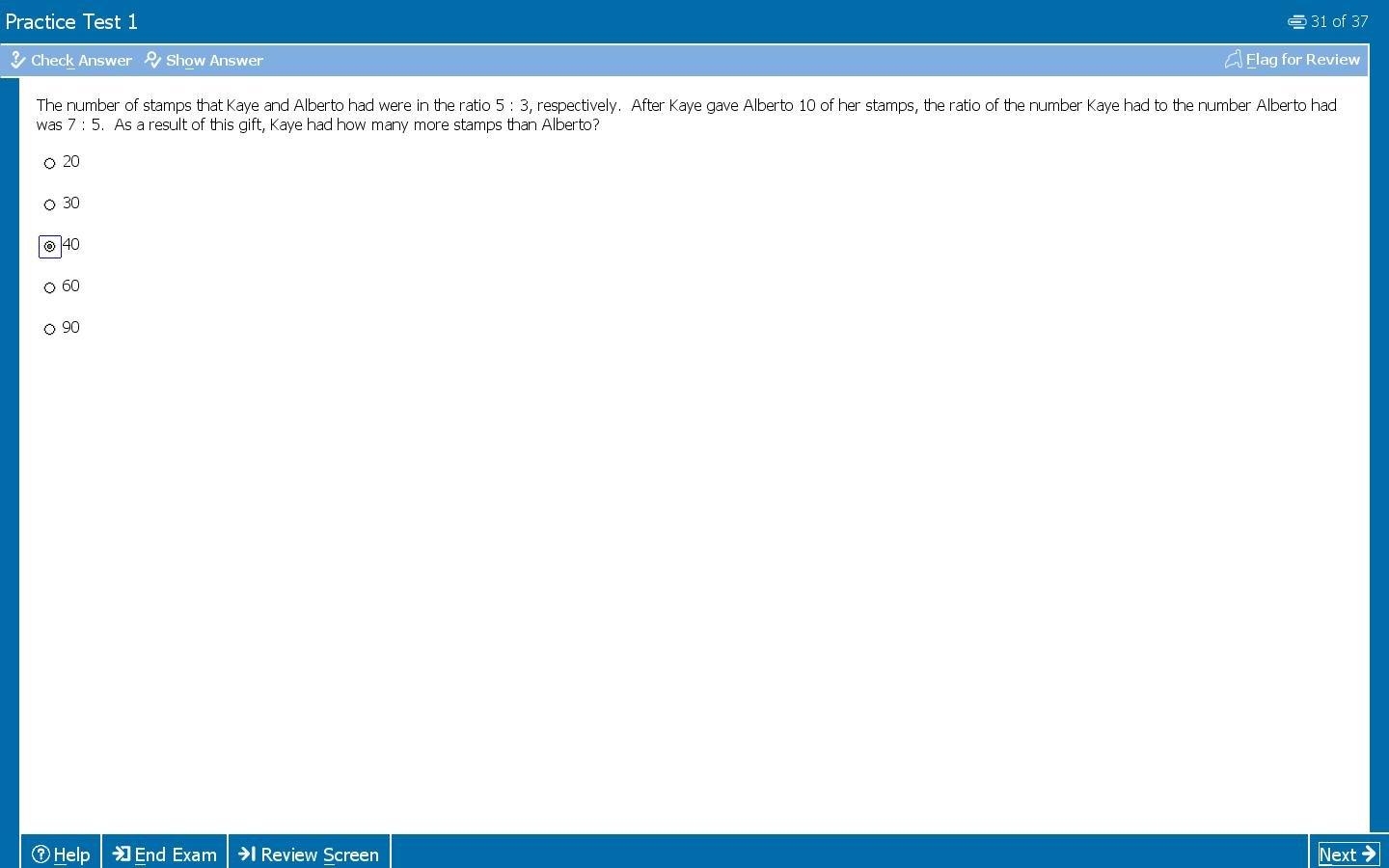
kilukilam
The number of stamps that Kaye and Alberto had were in the ration of 5:3 respecctively. After Kaye gave Alberto 10 of her stamps, the ration of the number of Kaye had to the number of Alberto had was 7:5. As a result of the gift, Kaye had how many more stamps than Alberto

A. 20
B. 30
C. 40
D. 60
E. 90

1. We know the initial ratio of the number of stamps. We can represent the initial number of stamps that Kaye and Alberto had, as 5x and 3x resp
2. We can represent the final number of stamps that Kaye and Alberto had as 5x-10 and 3x + 10 resp. The final ratio is 5x-10/3x+10
3. The final ratio is also given as 7:5
4. As (2) and (3) both represent the final ratio of number of stamps and so as both are equivalent we can equate the two. 5x-10/ 3x+10 = 7/5
5. x=30
6. We now need to find out how many stamps Kaye and Alberto had after the gift.
7. Kaye had 5x-10 = 140 stamps. Alberto had 3x-10 = 100 stamps
8. So Kaye has 40 more stamps than Alberto after the gift.

Correct choice is c.
avatar
Genfi
Joined: 08 Sep 2012
Last visit: 03 Jan 2014
Posts: 5
Own Kudos:
10
 [4]
Given Kudos: 28
Posts: 5
Kudos: 10
 [4]
3
Kudos
Add Kudos
1
Bookmarks
Bookmark this Post
kilukilam
The number of stamps that Kaye and Alberto had were in the ration of 5:3 respecctively. After Kaye gave Alberto 10 of her stamps, the ration of the number of Kaye had to the number of Alberto had was 7:5. As a result of the gift, Kaye had how many more stamps than Alberto

A. 20
B. 30
C. 40
D. 60
E. 90

5+3 = 8
7+5= 12
LCM of 12 and 8 = 24
8*3 = 24. Thus (5*3) / (3*3) = 15/9
12*2 = 24. Thus (7*2) / (5*2) = 14/10
10 – 9 = 1unit
What we need is 14-10= 4
Therefore 10*4 = 40
User avatar
rrsnathan
Joined: 30 May 2013
Last visit: 04 Aug 2014
Posts: 121
Own Kudos:
463
 [3]
Given Kudos: 72
Location: India
Concentration: Entrepreneurship, General Management
GPA: 3.82
2
Kudos
Add Kudos
1
Bookmarks
Bookmark this Post
Initially their counts is
5x:3x

After K gave 10 stamps to A their new ratio is
7y:5y

i.e. 5x-10=7y-----Eq 1
3x+10=5y ----- eq 2

Solving eq 1 qnd 2 we get y=20

so from 2nd ratio

7*20 - 5 *20 = 40
avatar
PareshGmat
Joined: 27 Dec 2012
Last visit: 10 Jul 2016
Posts: 1,531
Own Kudos:
8,271
 [2]
Given Kudos: 193
Status:The Best Or Nothing
Location: India
Concentration: General Management, Technology
WE:Information Technology (Computer Software)
Posts: 1,531
Kudos: 8,271
 [2]
2
Kudos
Add Kudos
Bookmarks
Bookmark this Post
Bunuel
kilukilam
The number of stamps that Kaye and Alberto had were in the ration of 5:3 respecctively. After Kaye gave Alberto 10 of her stamps, the ration of the number of Kaye had to the number of Alberto had was 7:5. As a result of the gift, Kaye had how many more stamps than Alberto

A. 20
B. 30
C. 40
D. 60
E. 90

Given: \(\frac{K}{A}=\frac{5x}{3x}\) (where \(x\) is a positive integer) and \(\frac{5x-10}{3x+10}=\frac{7}{5}\) --> \(x=30\) --> \(K=150\) and \(A=90\).

Question: \((K-10)-(A+10)=?\) --> \((K-10)-(A+10)=40\).

Answer: C.

Once x = 30 is calculated, we require to calculate (5x-10) - (3x+10)
= 2x-20
= 60-20
= 40 = Answer = C
User avatar
elizaanne
Joined: 21 Apr 2014
Last visit: 30 Nov 2016
Posts: 32
Own Kudos:
93
 [2]
Posts: 32
Kudos: 93
 [2]
2
Kudos
Add Kudos
Bookmarks
Bookmark this Post
so you can think about it this way. For some number (x) Kaye had 5x stamps and Alberto had 3x
then kaye gave 10 stamps and the ration became 7:5, we can turn this into an equation like so:

(5x-10)/(3x+10)=7/5
cross multiplying gives us: 21x+70=25x-50 or 120=4x x=30
but remember, we are trying to figure out how many more stamps kaye had than alberto after she gave him ten.
originally, kaye had 150 stamps and alberto had 90
then she gave alberto 10, so she had 140 and he had 100
the difference is 40 stamps (C)
User avatar
BrentGMATPrepNow
User avatar
Major Poster
Joined: 12 Sep 2015
Last visit: 31 Oct 2025
Posts: 6,733
Own Kudos:
36,446
 [4]
Given Kudos: 799
Location: Canada
Expert
Expert reply
Posts: 6,733
Kudos: 36,446
 [4]
1
Kudos
Add Kudos
3
Bookmarks
Bookmark this Post
kilukilam
The number of stamps that Kaye and Alberto had were in the ration of 5:3 respecctively. After Kaye gave Alberto 10 of her stamps, the ration of the number of Kaye had to the number of Alberto had was 7:5. As a result of the gift, Kaye had how many more stamps than Alberto

A. 20
B. 30
C. 40
D. 60
E. 90

One option is to solve the question using TWO VARIABLES.
Let K = # of stamps K had after the exchange
Let A = # of stamps A had after the exchange
This means that K+10 = # of stamps K had before the exchange
This means that A-10 = # of stamps A had before the exchange

Note: Our goal is to find the value of K-A

The number of stamps that K and A (originally) had were in the ratio 5:3
So, (K+10)/(A-10) = 5/3
We want a prettier equation, so let's cross multiply to get 3(K+10) = 5(A-10)
Expand: 3K + 30 = 5A - 50
Rearrange: 3K - 5A = -80

After K gave A 10 of her stamps, the ratio of the number K had to the number A had was 7:5
So, K/A = 7/5
We want a prettier equation, so let's cross multiply to get 5K = 7A
Rearrange to get: 5K - 7A = 0

At this point we have two equations:
5K - 7A = 0
3K - 5A = -80

Our goal is to find the value of K - A.
IMPORTANT: We need not solve for the individual values of K and A. This is great, because something nice happens when we subtract the blue equation from the red equation.
We get: 2K - 2A = 80
Now divide both sides by 2 to get: K - A = 40

Answer:
Cheers,
Brent
User avatar
Abhishek009
User avatar
Board of Directors
Joined: 11 Jun 2011
Last visit: 17 Dec 2025
Posts: 5,904
Own Kudos:
5,450
 [11]
Given Kudos: 463
Status:QA & VA Forum Moderator
Location: India
GPA: 3.5
WE:Business Development (Commercial Banking)
Posts: 5,904
Kudos: 5,450
 [11]
4
Kudos
Add Kudos
7
Bookmarks
Bookmark this Post
kilukilam
The number of stamps that Kaye and Alberto had were in the ration of 5:3 respecctively. After Kaye gave Alberto 10 of her stamps, the ration of the number of Kaye had to the number of Alberto had was 7:5. As a result of the gift, Kaye had how many more stamps than Alberto

A. 20
B. 30
C. 40
D. 60
E. 90

Lets work -
Quote:
The number of stamps that Kaye and Alberto had were in the ration of 5:3 respectively.
Attachment:
1.PNG
1.PNG [ 1.09 KiB | Viewed 77009 times ]
Quote:
After Kaye gave Alberto 10 of her stamps, the ration of the number of Kaye had to the number of Alberto had was 7:5.
Attachment:
2.PNG
2.PNG [ 1.48 KiB | Viewed 76656 times ]
So, \(\frac{(5x-10)}{(3x+10)} = \frac{7}{5}\)

Or, \(25x - 50 = 21x + 70\)

Or, \(4x = 120\)

Or, \(x = 30\)

We are asked to find -
Quote:
As a result of the gift, Kaye had how many more stamps than Alberto

Or, (5x-10) - (3x+10) => 2x - 20

Or, 2(30) - 20 =40

Hence answer is (C) 40
User avatar
ScottTargetTestPrep
User avatar
Target Test Prep Representative
Joined: 14 Oct 2015
Last visit: 22 Apr 2026
Posts: 22,278
Own Kudos:
26,528
 [5]
Given Kudos: 302
Status:Founder & CEO
Affiliations: Target Test Prep
Location: United States (CA)
Expert
Expert reply
Active GMAT Club Expert! Tag them with @ followed by their username for a faster response.
Posts: 22,278
Kudos: 26,528
 [5]
1
Kudos
Add Kudos
4
Bookmarks
Bookmark this Post
kilukilam
The number of stamps that Kaye and Alberto had were in the ration of 5:3 respecctively. After Kaye gave Alberto 10 of her stamps, the ration of the number of Kaye had to the number of Alberto had was 7:5. As a result of the gift, Kaye had how many more stamps than Alberto

A. 20
B. 30
C. 40
D. 60
E. 90

We are given that the number of stamps that Kaye and Alberto had were in the ratio 5 : 3. We can represent this as:

K : A = 5x : 3x

We are next given that after Kaye gave Alberto 10 of her stamps, the ratio of the number Kaye had to the number Alberto had was 7 : 5. Using this information we can create the following equation:

(5x – 10)/(3x + 10)= 7/5

5(5x – 10) = 7(3x + 10)

25x – 50 = 21x + 70

4x = 120

x = 30

Kaye now has 5(30) – 10 = 140 stamps and Alberto has 3(30) + 10 = 100 stamps. So Kaye has 140 – 100 = 40 more stamps than Alberto.

Answer: C
User avatar
JeffTargetTestPrep
User avatar
Target Test Prep Representative
Joined: 04 Mar 2011
Last visit: 05 Jan 2024
Posts: 2,974
Own Kudos:
Given Kudos: 1,646
Status:Head GMAT Instructor
Affiliations: Target Test Prep
Expert
Expert reply
Posts: 2,974
Kudos: 8,710
Kudos
Add Kudos
Bookmarks
Bookmark this Post
kilukilam
The number of stamps that Kaye and Alberto had were in the ration of 5:3 respecctively. After Kaye gave Alberto 10 of her stamps, the ration of the number of Kaye had to the number of Alberto had was 7:5. As a result of the gift, Kaye had how many more stamps than Alberto

A. 20
B. 30
C. 40
D. 60
E. 90

We are given that the number of stamps that Kaye and Alberto had was in the ratio 5 : 3. We can represent this as:

K : A = 5x : 3x

We are next given that after Kaye gave Alberto 10 of her stamps, the ratio of the number Kaye had to the number Alberto had was 7 : 5. Using this information, we can create the following equation:

(5x – 10)/(3x + 10) = 7/5

5(5x – 10) = 7(3x + 10)

25x – 50 = 21x + 70

4x = 120

x = 30

Kaye now has 5(30) – 10 = 140 stamps, and Alberto has 3(30) + 10 = 100 stamps. So Kaye has 140 – 100 = 40 more stamps than Alberto has.

Answer: C
User avatar
CrackverbalGMAT
User avatar
Major Poster
Joined: 03 Oct 2013
Last visit: 22 Apr 2026
Posts: 4,846
Own Kudos:
9,180
 [3]
Given Kudos: 226
Affiliations: CrackVerbal
Location: India
Expert
Expert reply
Posts: 4,846
Kudos: 9,180
 [3]
3
Kudos
Add Kudos
Bookmarks
Bookmark this Post
This is a fairly easy question on ratios, but with a big trap in terms of language. The most common answer that a lot of students get on this question is 60 i.e. option D. However, this is the trap answer.

Questions like these on ratios test your knowledge of mutliples of numbers. As such, although the conventional approach of assuming the stamps as 5x and 3x and then building an equation followed by solving the equation yields you the answer, it’s always good to approach ratio questions using numbers.

We know that the number of stamps that Kaye and Alberto had are multiples of 5 and 3 respectively. So, what do we do? Do we start with 5 and 3? The answer is a bigg no. Observe the options, all the options are bigger numbers than 5 and 3. And remember that we are trying to find the difference between the number of stamps. We need to take bigger multiples of 5 and 3, which are multiples of 10 as well (preferably).

Let’s try 50 and 30, then. After gifting 10 stamps to Alberto, the respective numbers with Kaye and Alberto would be 40 and 40. This is not in the ratio of 7:5. So, 50 and 30 are not the number of stamps.

If we try 100 and 60, we obtain the numbers 90 and 70 after the gifting process. This is in the ratio of 9:7, NOT 7:5.

When we try 150 and 90, we see that the resultant numbers after Kaye gifts alberto would be 140 and 100 which are in the ratio of 7:5. Therefore, Kaye must have started off with 150 stamps and Alberto with 90 stamps. So, Kaye had 60 more stamps than Alberto?? No, that’s not correct.

Observe that the question mentions “As a result of the gift…”. This means, we need to find out how much more Kaye had AFTER gifting 10 stamps to Alberto. AFTER gifting 10 stamps to Alberto, Kaye had 140 and Alberto had 100, so Kaye had 40 more stamps.

The correct answer option is C.

Every word, every phrase and every sentence in a GMAT question is valuable. If you rush through the questions without paying due attention, you run the risk of falling for the trap answers. If required, after you compute an answer, re-read the question statement and satisfy yourselves that you have indeed answered the actual question and NOT what you thought the question was.

Hope that helps!
User avatar
jabhatta2
Joined: 15 Dec 2016
Last visit: 21 Apr 2023
Posts: 1,251
Own Kudos:
Given Kudos: 188
Posts: 1,251
Kudos: 328
Kudos
Add Kudos
Bookmarks
Bookmark this Post
VeritasKarishma
kilukilam
The number of stamps that Kaye and Alberto had were in the ration of 5:3 respecctively. After Kaye gave Alberto 10 of her stamps, the ration of the number of Kaye had to the number of Alberto had was 7:5. As a result of the gift, Kaye had how many more stamps than Alberto

A. 20
B. 30
C. 40
D. 60
E. 90

Another method is to use ratios:

Note that the total number of stamps is the same in both the cases.
On ratio scale, 5:3 gives 8 total stamps while 7:5 gives 12 total stamps. So total stamps must be at least LCM of 8 and 12 i.e. 24.
So in first case, Kaye had 15 stamps while Alberto had 9. After the exchange, Kaye had 14 stamps while Alberto had 10. So Kaye gave 1 stamp to Alberto. But actually, Kaye gave 10 stamps to Alberto. So actual total number of stamps is 240.
So the multiplier of 7:5 is 20 (because 12*20 = 240). Kaye had (7-5)*20 = 40 more stamps than Alberto.

Answer (C)

Hi VeritasKarishma

Two quick questions

Q1) Where can one learn more about this ratio methodology as i would like to inculcate this / practice some more problems using this methodology ?


Q2) Also -- can one assume, this ratio methodology can be done ONLY IF THE TOTAL remains the same ?

Reason is, In this problem also involving ratios -- the total has changed and thus ONLY ALGEBRA works in this problem

https://gmatclub.com/forum/the-present- ... 29648.html
User avatar
KarishmaB
Joined: 16 Oct 2010
Last visit: 21 Apr 2026
Posts: 16,439
Own Kudos:
79,389
 [1]
Given Kudos: 484
Location: Pune, India
Expert
Expert reply
Active GMAT Club Expert! Tag them with @ followed by their username for a faster response.
Posts: 16,439
Kudos: 79,389
 [1]
Kudos
Add Kudos
1
Bookmarks
Bookmark this Post
VeritasKarishma
kilukilam
The number of stamps that Kaye and Alberto had were in the ration of 5:3 respecctively. After Kaye gave Alberto 10 of her stamps, the ration of the number of Kaye had to the number of Alberto had was 7:5. As a result of the gift, Kaye had how many more stamps than Alberto

A. 20
B. 30
C. 40
D. 60
E. 90

Another method is to use ratios:

Note that the total number of stamps is the same in both the cases.
On ratio scale, 5:3 gives 8 total stamps while 7:5 gives 12 total stamps. So total stamps must be at least LCM of 8 and 12 i.e. 24.
So in first case, Kaye had 15 stamps while Alberto had 9. After the exchange, Kaye had 14 stamps while Alberto had 10. So Kaye gave 1 stamp to Alberto. But actually, Kaye gave 10 stamps to Alberto. So actual total number of stamps is 240.
So the multiplier of 7:5 is 20 (because 12*20 = 240). Kaye had (7-5)*20 = 40 more stamps than Alberto.

Answer (C)

Hi VeritasKarishma

Two quick questions

Q1) Where can one learn more about this ratio methodology as i would like to inculcate this / practice some more problems using this methodology ?


Q2) Also -- can one assume, this ratio methodology can be done ONLY IF THE TOTAL remains the same ?

Reason is, In this problem also involving ratios -- the total has changed and thus ONLY ALGEBRA works in this problem

https://gmatclub.com/forum/the-present- ... 29648.html

Here are some videos to understand the "ratio methodology"

Ratios: https://youtu.be/5ODENGG5dvc
Weighted Averages: https://www.youtube.com/watch?v=_GOAU7moZ2Q
Mixtures: https://www.youtube.com/watch?v=VdBl9Hw0HBg
TSD: https://youtu.be/7ASEIvxYPCM
Work - Rate: https://youtu.be/88NFTttkJmA

and here are some posts:
https://anaprep.com/arithmetic-ratios-t ... ll-starts/
https://anaprep.com/arithmetic-weighted-averages/
https://anaprep.com/arithmetic-mixtures/
https://anaprep.com/arithmetic-applying ... -concepts/
https://anaprep.com/arithmetic-work-rat ... s-and-all/
https://anaprep.com/arithmetic-avoiding ... work-rate/
avatar
NuclearNadal
Joined: 24 Jun 2021
Last visit: 17 Apr 2022
Posts: 2
Given Kudos: 16
Location: India
Posts: 2
Kudos: 0
Kudos
Add Kudos
Bookmarks
Bookmark this Post
kilukilam
The number of stamps that Kaye and Alberto had were in the ration of 5:3 respecctively. After Kaye gave Alberto 10 of her stamps, the ration of the number of Kaye had to the number of Alberto had was 7:5. As a result of the gift, Kaye had how many more stamps than Alberto

A. 20
B. 30
C. 40
D. 60
E. 90

K : A
before sharing 5 : 3 =8
after sharing 7 : 5 =12

Even after quantities are exchange overall quantity remain same so LCM of 8 and 12 is 24

Multiply before share quantity by 3 and after sharing by 2
Then apply unit law

5 : 3 => 15 : 9 =24
14 : 10=> 14 : 10=24

now 1 unit =10 (15-14=1 also 10-9=1)

Ans=(14-10)x10=40(14 and 10 are after sharing ratio)

Ans:C.40
User avatar
totaltestprepNick
Joined: 25 Aug 2014
Last visit: 22 Apr 2026
Posts: 469
Own Kudos:
Given Kudos: 2
GMAT 1: 750 Q49 V42
GMAT 1: 750 Q49 V42
Posts: 469
Kudos: 4
Kudos
Add Kudos
Bookmarks
Bookmark this Post
kilukilam
The number of stamps that Kaye and Alberto had were in the ration of 5:3 respectively. After Kaye gave Alberto 10 of her stamps, the ration of the number of Kaye had to the number of Alberto had was 7:5. As a result of the gift, Kaye had how many more stamps than Alberto

A. 20
B. 30
C. 40
D. 60
E. 90


Nick Slavkovich, GMAT/GRE tutor with 20+ years of experience

[email protected]
User avatar
Saurav1408
Joined: 26 Oct 2023
Last visit: 22 Apr 2026
Posts: 10
Own Kudos:
Given Kudos: 278
Status:Active
Posts: 10
Kudos: 5
Kudos
Add Kudos
Bookmarks
Bookmark this Post
I guess this question could be solved in many ways, using Ratio's difference, LCM and conventional way of forming an equation. I guess the easiest and fastest way to do it using equation method. What are your views on it?

KarishmaB


Another method is to use ratios:

Note that the total number of stamps is the same in both the cases.
On ratio scale, 5:3 gives 8 total stamps while 7:5 gives 12 total stamps. So total stamps must be at least LCM of 8 and 12 i.e. 24.
So in first case, Kaye had 15 stamps while Alberto had 9. After the exchange, Kaye had 14 stamps while Alberto had 10. So Kaye gave 1 stamp to Alberto. But actually, Kaye gave 10 stamps to Alberto. So actual total number of stamps is 240.
So the multiplier of 7:5 is 20 (because 12*20 = 240). Kaye had (7-5)*20 = 40 more stamps than Alberto.

Answer (C)
Moderators:
Math Expert
109754 posts
Tuck School Moderator
853 posts