Last visit was: 26 Sep 2026, 13:19 It is currently 26 Sep 2026, 13:19
Close
GMAT Club Daily Prep
Thank you for using the timer - this advanced tool can estimate your performance and suggest more practice questions. We have subscribed you to Daily Prep Questions via email.

Customized
for You

we will pick new questions that match your level based on your Timer History

Track
Your Progress

every week, we’ll send you an estimated GMAT score based on your performance

Practice
Pays

we will pick new questions that match your level based on your Timer History
Not interested in getting valuable practice questions and articles delivered to your email? No problem, unsubscribe here.
Close
Request Expert Reply
Confirm Cancel
655-705 (Hard)|   Math Related|                  
User avatar
imhimanshu
Joined: 07 Sep 2010
Last visit: 08 Nov 2013
Posts: 216
Own Kudos:
6,600
 [439]
Given Kudos: 136
GMAT 1: 650 Q49 V30
Posts: 216
Kudos: 6,600
 [439]
20
Kudos
Add Kudos
417
Bookmarks
Bookmark this Post
Most Helpful Reply
User avatar
KarishmaB
Joined: 16 Oct 2010
Last visit: 25 Sep 2026
Posts: 16,669
Own Kudos:
Given Kudos: 492
Location: Pune, India
Expert
Expert reply
Active GMAT Club Expert! Tag them with @ followed by their username for a faster response.
Posts: 16,669
Kudos: 81,548
 [122]
90
Kudos
Add Kudos
32
Bookmarks
Bookmark this Post
User avatar
mikemcgarry
User avatar
Magoosh GMAT Instructor
Joined: 28 Dec 2011
Last visit: 06 Aug 2018
Posts: 4,474
Own Kudos:
31,170
 [32]
Given Kudos: 130
Expert
Expert reply
Posts: 4,474
Kudos: 31,170
 [32]
23
Kudos
Add Kudos
8
Bookmarks
Bookmark this Post
User avatar
fameatop
Joined: 24 Aug 2009
Last visit: 09 Jun 2017
Posts: 382
Own Kudos:
2,586
 [29]
Given Kudos: 275
Concentration: Finance
Schools:Harvard, Columbia, Stern, Booth, LSB,
Posts: 382
Kudos: 2,586
 [29]
20
Kudos
Add Kudos
9
Bookmarks
Bookmark this Post
this question is a application of AP. and yes the previous answers are correct.

Speed at time '0' = v0
Speed at time '10' = v10
Lets assume the speed is increasing at a rate of 'd' m/s
Note:- Distance traveled in any 1 second is equal to the speed during that second.
Distance traveled in 1st sec = v0
Distance traveled in 2nd sec = v0+d
Distance traveled in 3rd sec = v0+2d
Distance traveled in 10th sec = v0+9d

So Total Distance traveled in 10 second can be given by
v0 + (v0+d) + (v0+2d)+.........+(v0+8d)+(v0+9d) = 10/2[2v0 + (10-1)d]=10/2[2v0 + 9d]

& as per question the bumper has traveled 125 m at the end of 10th second. So
10/2[2v0 + 9d]= 125
[2v0 + 9d]= 25
v0 + (v0+9d) = 25
v0 + v10 = 25......(1)

We are asked the value for speed at 0th & 10th second. From equation (1) we can say that the sum of speed at these moments is equal to 25.
The only options available are 5 , 20.

The speed v0 must be 5 & v10 must 20 because the speed is increasing at constant rate.
Note:- If the speed was decreasing at a constant rate, then v0=20 & v10=5

Hope it helps.
User avatar
SOURH7WK
Joined: 15 Jun 2010
Last visit: 03 Aug 2022
Posts: 234
Own Kudos:
1,308
 [22]
Given Kudos: 50
Concentration: Marketing
GPA: 3.2
WE 1: 7 Yrs in Automobile (Commercial Vehicle industry)
Products:
13
Kudos
Add Kudos
9
Bookmarks
Bookmark this Post
Wow it looks like a different Question. I am trying to solve it with a physics average speed formula: Avg Velocity : (u+v)/2, where u=initial velocity, V=final velocity.

From Question We understand the Car travels 125 m in 10 sec. Therefore the average velocity = 125/10 m/s or 12.5 or 25/2.

Now from the formula (u+v)/2 = 25/2, Hence u+v=25. By scanning the answer choices answer choice u=5 & v=20 fits. Hence it may be the answer.
General Discussion
User avatar
EvaJager
Joined: 22 Mar 2011
Last visit: 31 Aug 2016
Posts: 512
Own Kudos:
2,403
 [4]
Given Kudos: 43
WE:Science (Education)
Posts: 512
Kudos: 2,403
 [4]
1
Kudos
Add Kudos
3
Bookmarks
Bookmark this Post
SOURH7WK
Wow it looks like a different Question. I am trying to solve it with a physics average speed formula: Avg Velocity : (u+v)/2, where u=initial velocity, V=final velocity.

From Question We understand the Car travels 125 m in 10 sec. Therefore the average velocity = 125/10 m/s or 12.5 or 25/2.

Now from the formula (u+v)/2 = 25/2, Hence u+v=25. By scanning the answer choices answer choice u=5 & v=20 fits. Hence it may be the answer.

In this case, your reasoning is correct. The average speed is the mean between the initial and the final speed because the sequence of the speeds for every minute is an arithmetic progression (each speed is the previous one increased by the same amount).
User avatar
Vips0000
User avatar
Current Student
Joined: 15 Sep 2012
Last visit: 02 Feb 2016
Posts: 521
Own Kudos:
1,335
 [8]
Given Kudos: 23
Status:Done with formalities.. and back..
Location: India
Concentration: Strategy, General Management
Schools: Olin - Wash U - Class of 2015
WE:Information Technology (Computer Software)
Products:
Schools: Olin - Wash U - Class of 2015
Posts: 521
Kudos: 1,335
 [8]
8
Kudos
Add Kudos
Bookmarks
Bookmark this Post
Wow this appears to be more of a physics question :D

Can be solved by
s =(v+u)*t /2

or combining
v=u+at and
v^2 =u^2+2as
User avatar
mbmanoj
Joined: 06 Sep 2012
Last visit: 04 Nov 2013
Posts: 9
Own Kudos:
10
 [2]
Given Kudos: 2
Concentration: Entrepreneurship, Sustainability
GPA: 3.11
Posts: 9
Kudos: 10
 [2]
2
Kudos
Add Kudos
Bookmarks
Bookmark this Post
danzig
A car is traveling on a straight stretch of roadway, and the speed of the car is increasing at a constant rate. At time 0 seconds, the speed of the car is V0 meters per second; 10 seconds later, the front bumper of the car has traveled 125 meters and the speed of the car is V10 meters per second.

In the table below, select values of V0 and V10 that are together consistent with the information provided. Make only two selections, one in each column.

t=0 speed V0
t=10 " V10

speed is raised at const rate. SO, V0, V1 ,....V10 are in AM
Let V10= V0 + (10-1)X .....X is increment for every sec

Since d=SXt
125= (V0(1sec) +V1(1sec) +...V10(1sec

So, 125= V0+ V0+1X + V0+2X +...V0+9X = 10V0 + (1+2+3+..9)X= 10V0 + (9*5)X
But, 9X=V10-V0
So, 125 = 5V0+5V10.................V0+v10=25 (5+20)
User avatar
Hadrienlbb
Joined: 21 Oct 2017
Last visit: 24 Mar 2020
Posts: 67
Own Kudos:
140
 [16]
Given Kudos: 123
Location: France
Concentration: Entrepreneurship, Technology
GMAT 1: 750 Q48 V44
GPA: 4
WE:Project Management (Internet and New Media)
GMAT 1: 750 Q48 V44
Posts: 67
Kudos: 140
 [16]
7
Kudos
Add Kudos
9
Bookmarks
Bookmark this Post
We are told that the speed of the car is increasing at a constant rate with respect to time, that time is 10 seconds and that the car has traveled 125 meters.

Therefore, I conclude that my Speed at V0 will be lower than 12.5 meters (125/10 = 12.5 meters / second). Then there is only one choice for V0 in the table. V0 = 5.

Then I know I need the rate to constantly increase until V10 and need to get to 125 meters.
(V10 + V0)/2 = 12.5 meters/s
(V10 + 5)/2 = 12.5
V10 + 5 = 12.5*2
V10 = 25 - 5 = 20

Thanks!
User avatar
Sajjad1994
User avatar
GRE Forum Moderator
Joined: 02 Nov 2016
Last visit: 24 Sep 2026
Posts: 16,434
Own Kudos:
53,876
 [7]
Given Kudos: 6,474
GPA: 3.62
Products:
Posts: 16,434
Kudos: 53,876
 [7]
4
Kudos
Add Kudos
3
Bookmarks
Bookmark this Post
Official Explanation

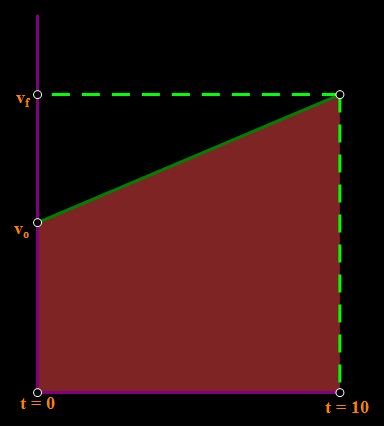
Since the speed of the car increases at a constant rate, the car's average speed, in meters per second, over the 10-second period is equal to \(\frac{1}{2} (v_{0} + v_{10})\). Thus, the distance the car traveled, in meters, over that period is equal to \(\frac{1}{2} (v_{0} + v_{10})(10)\), or \(5(v_{0} + v_{10})\). But this value is given to be 125, so it must be true that \(v_{0} + v_{10} = \frac{125}{5}\), or 25. Because speed must be positive, both \(v_{0}\) and \(v_{10}\) must be less than 25, ruling out 36 and 72 as possible values.
Among the available alternatives—5, 18, and 20—the only pair that sum to 25 are 5 and 20. Since the speed is increasing, it must also be true that \(v_{0} ≤ v_{10}.\) Therefore \(v_{0} = 5.\)

The correct answer is 5.

Following the analysis above, the value of \(v_{10}\) must correspond to \(v_{0} = 5\), and it is given by \(v_{10} = 20.\)

The correct answer is 20.
User avatar
Elite097
Joined: 20 Apr 2022
Last visit: 16 Sep 2026
Posts: 730
Own Kudos:
Given Kudos: 337
Location: India
GPA: 3.64
Posts: 730
Kudos: 579
Kudos
Add Kudos
Bookmarks
Bookmark this Post
KarishmaB @anishpassai pls explain this.

How do we know it is not in GP? Quest says it is increasing at 'constt growth rate'.

And since everyone has taken it in Ap, then does it mean there are a total of 11 terms from 0 secs to 10secs: v0,.......,v10. Thus shouldnt sum of ap be (11/2)(2v0+ 10d) and not (10/2)(2v0+ 9d)?
User avatar
KarishmaB
Joined: 16 Oct 2010
Last visit: 25 Sep 2026
Posts: 16,669
Own Kudos:
81,548
 [1]
Given Kudos: 492
Location: Pune, India
Expert
Expert reply
Active GMAT Club Expert! Tag them with @ followed by their username for a faster response.
Posts: 16,669
Kudos: 81,548
 [1]
1
Kudos
Add Kudos
Bookmarks
Bookmark this Post
Elite097
KarishmaB @anishpassai pls explain this.

How do we know it is not in GP? Quest says it is increasing at 'constt growth rate'.

And since everyone has taken it in Ap, then does it mean there are a total of 11 terms from 0 secs to 10secs: v0,.......,v10. Thus shouldnt sum of ap be (11/2)(2v0+ 10d) and not (10/2)(2v0+ 9d)?

 
"the speed of the car is increasing at a constant rate" means the speed is increasing by a fixed amount. This 'fixed amount' is the common diff and it has to be AP. 
When it is a GP, the speed increases exponentially, not at a constant rate. 
­
User avatar
Elite097
Joined: 20 Apr 2022
Last visit: 16 Sep 2026
Posts: 730
Own Kudos:
Given Kudos: 337
Location: India
GPA: 3.64
Posts: 730
Kudos: 579
Kudos
Add Kudos
Bookmarks
Bookmark this Post
KarishmaB yes but constant rate refers to constant percentage hence it could still increase exponentially and other questions also use growth rate to refer to GP so not clear
User avatar
KarishmaB
Joined: 16 Oct 2010
Last visit: 25 Sep 2026
Posts: 16,669
Own Kudos:
81,548
 [2]
Given Kudos: 492
Location: Pune, India
Expert
Expert reply
Active GMAT Club Expert! Tag them with @ followed by their username for a faster response.
Posts: 16,669
Kudos: 81,548
 [2]
2
Kudos
Add Kudos
Bookmarks
Bookmark this Post
Elite097
KarishmaB yes but constant rate refers to constant percentage hence it could still increase exponentially and other questions also use growth rate to refer to GP so not clear
 
No. If speed is increasing at a variable rate, how does "constant rate" make sense? It means acceleration is constant, say 2m/s^2.

­
User avatar
Purnank
Joined: 05 Jan 2024
Last visit: 29 Apr 2026
Posts: 665
Own Kudos:
640
 [1]
Given Kudos: 167
Location: India
Concentration: General Management, Strategy
GMAT Focus 1: 635 Q88 V76 DI80
Products:
GMAT Focus 1: 635 Q88 V76 DI80
Posts: 665
Kudos: 640
 [1]
1
Kudos
Add Kudos
Bookmarks
Bookmark this Post
­Dude Physics in GMAT.
Vt = speed at t
Vo = initial speed of car
a = acceleration 
t = time
s = distance travel.
\(Vt = Vo + at\) and \(Vt^2 = Vo^2 + 2as\)­
now,
\(Vt^2 - Vo^2 = 2as\)
\((Vt - Vo)*(Vt + Vo) = 2as\)
from \(Vt = Vo + at\)
\(Vt + Vo = 2*\frac{s}{t}\)­
s=125 t=10
substittue and solve 
\(Vt + Vo = 25\) and we know Vt>Vo
check the values in the table that will satisfy this.
Vo = 5 and V10= 20.
User avatar
heeeya
Joined: 14 Sep 2024
Last visit: 25 Mar 2025
Posts: 17
Own Kudos:
Posts: 17
Kudos: 3
Kudos
Add Kudos
Bookmarks
Bookmark this Post
Thanks for the helpful adive.
But I wonder why the speed at 2nd sec is V0+d not V0 x r when it is said to increase at a 'rate'.
Doesn't it meant that V1/V0 = V2/V1?
fameatop
this question is a application of AP. and yes the previous answers are correct.

Speed at time '0' = v0
Speed at time '10' = v10
Lets assume the speed is increasing at a rate of 'd' m/s
Note:- Distance traveled in any 1 second is equal to the speed during that second.
Distance traveled in 1st sec = v0
Distance traveled in 2nd sec = v0+d
Distance traveled in 3rd sec = v0+2d
Distance traveled in 10th sec = v0+9d

So Total Distance traveled in 10 second can be given by
v0 + (v0+d) + (v0+2d)+.........+(v0+8d)+(v0+9d) = 10/2[2v0 + (10-1)d]=10/2[2v0 + 9d]

& as per question the bumper has traveled 125 m at the end of 10th second. So
10/2[2v0 + 9d]= 125
[2v0 + 9d]= 25
v0 + (v0+9d) = 25
v0 + v10 = 25......(1)

We are asked the value for speed at 0th & 10th second. From equation (1) we can say that the sum of speed at these moments is equal to 25.
The only options available are 5 , 20.

The speed v0 must be 5 & v10 must 20 because the speed is increasing at constant rate.
Note:- If the speed was decreasing at a constant rate, then v0=20 & v10=5

Hope it helps.
User avatar
caedmego
Joined: 31 Jul 2024
Last visit: 25 Apr 2025
Posts: 2
Own Kudos:
2
 [2]
Given Kudos: 9
Posts: 2
Kudos: 2
 [2]
2
Kudos
Add Kudos
Bookmarks
Bookmark this Post
Not an expert on this but; it worked for me thinking of it as an average,

So the average speed is 12.5 and I need a max and a min speeds so 3 speeds in total so 12.5* 3 is 37.5 minus the average speed= 25

The min speed + the max speed must be = 25 so the answer choices from there are straightforward.
User avatar
egmat
User avatar
e-GMAT Representative
Joined: 02 Nov 2011
Last visit: 25 Sep 2026
Posts: 6,369
Own Kudos:
Given Kudos: 716
GMAT Date: 08-19-2020
Expert
Expert reply
Active GMAT Club Expert! Tag them with @ followed by their username for a faster response.
Posts: 6,369
Kudos: 33,963
Kudos
Add Kudos
Bookmarks
Bookmark this Post
When the question says speed is increasing at a constant rate with respect to time, it means the amount of speed added per second is the same.

Think of it this way:
- Second 1: speed increases by 1.5 m/s
- Second 2: speed increases by 1.5 m/s
- Second 3: speed increases by 1.5 m/s
- ... and so on

This is linear growth (arithmetic): v = v0 + (constant × time)

What you're thinking of:
If V1/V0 = V2/V1 (constant ratio), that would be exponential growth - where speed multiplies by the same factor each second.

Why exponential doesn't match "constant rate":

Let's test: If v0 = 5 and speed multiplies by 1.15 each second:
- After 1 sec: 5 × 1.15 = 5.75 (increase of 0.75)
- After 2 sec: 5.75 × 1.15 = 6.61 (increase of 0.86)
- After 3 sec: 6.61 × 1.15 = 7.60 (increase of 0.99)

Notice: the increase keeps getting larger each second (0.75 → 0.86 → 0.99). That's NOT a constant rate - the rate itself is growing!

The correct interpretation:
"Constant rate of increase" = same amount added each second = linear/arithmetic growth

This is why we use: v10 = v0 + (acceleration × 10)

And for distance with constant acceleration:
Distance = Average Speed × Time = (v0 + v10)/2 × 10 = 125

This gives us: v0 + v10 = 25

Answer: v0 = 5, v10 = 20
User avatar
egmat
User avatar
e-GMAT Representative
Joined: 02 Nov 2011
Last visit: 25 Sep 2026
Posts: 6,369
Own Kudos:
Given Kudos: 716
GMAT Date: 08-19-2020
Expert
Expert reply
Active GMAT Club Expert! Tag them with @ followed by their username for a faster response.
Posts: 6,369
Kudos: 33,963
Kudos
Add Kudos
Bookmarks
Bookmark this Post
Hi heeeya,

Great question! This is a very common and important distinction in math and physics.

The phrase 'speed is increasing at a constant rate with respect to time' means the speed increases by the SAME AMOUNT every second. This is an additive (linear) relationship, not a multiplicative (geometric) one.

Think of it this way:
- 'Constant rate of change' = the derivative is constant = the change per second is the same.
- So if speed increases by d meters per second every second: v(1) = v0 + d, v(2) = v0 + 2d, v(3) = v0 + 3d, etc.

What you're describing — V1/V0 = V2/V1 — would be a constant RATIO of change, which is geometric/exponential growth. The problem would need to say something like 'speed increases by a constant percentage each second' or 'speed doubles every second' for that interpretation.

In physics, 'increasing at a constant rate with respect to time' is simply constant acceleration. And with constant acceleration, we can use the formula:

Distance = Average Speed × Time
Distance = ((v0 + v10) / 2) × 10

Plugging in the given distance of [b]125 meters:[/b]
125 = ((v0 + v10) / 2) × 10
125 = 5 × (v0 + v10)
v0 + v10 = 25

Now we just need two choices that add to 25. Looking at our options: 5 + 20 = 25. That gives us v0 = 5 (Row 1 for v0) and v10 = 20 (Row 3 for v10).

Quick rule of thumb for the GMAT: 'constant rate' = additive/linear. 'Constant ratio' or 'constant percent' = multiplicative/geometric.

Answer: 1A, 3B
User avatar
sohumchojar4626
Joined: 26 Aug 2019
Last visit: 26 Sep 2026
Posts: 1
Given Kudos: 8
Products:
Posts: 1
Kudos: 0
Kudos
Add Kudos
Bookmarks
Bookmark this Post
Kinematic equations

v = u + at

s = ut + 1 + (at^2)/2

From these equations, we can derive

s = [(v + u)t ]/2

In this question,

u = v0 and v = v10

From the equation s = [(v + u)t ]/2,

s = 125 and t = 10

we will have final equation

v10 + v0 = 25

v10 = 25 - v0
 1   2   
Moderators:
Math Expert
113941 posts
DI Forum Moderator
409 posts