| Last visit was: 20 Sep 2026, 12:45 |
It is currently 20 Sep 2026, 12:45 |
|
|

GMAT Club Daily Prep
Thank you for using the timer - this advanced tool can estimate your performance and suggest more practice questions. We have subscribed you to Daily Prep Questions via email.
Customized
for You
Track
Your Progress
Practice
Pays
Not interested in getting valuable practice questions and articles delivered to your email? No problem, unsubscribe here.


 11 Oct 2018, 01:35
Kudos
Bookmarks


C
Be sure to select an answer first to save it in the Error Log before revealing the correct answer (OA)!
Difficulty:
 15%
(low)
15%
(low)
Question Stats:
80% (00:45) correct 20%
(00:57)
wrong
based on 105
sessions
20%
(00:57)
wrong
based on 105
sessions
History
Date
Time
Result
Not Attempted Yet
[Math Revolution GMAT math practice question]
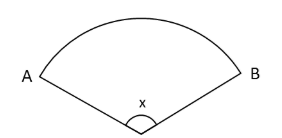
11.11.png [ 6.48 KiB | Viewed 2992 times ]
The above figure shows a sector of a circle. What is the area of the sector?
\(1) x = 120^o.\)
\(2) AB=6√3.\)
Attachment:
11.11.png [ 6.48 KiB | Viewed 2992 times ]
The above figure shows a sector of a circle. What is the area of the sector?
\(1) x = 120^o.\)
\(2) AB=6√3.\)
Pure algebraic questions like this one are no longer part of the GMAT Data Sufficiency syllabus.
For relevant Data Sufficiency questions, please check the Data Sufficiency forum:
Data Sufficiency Forum
Data Sufficiency Forum


 11 Oct 2018, 01:41
Kudos
Bookmarks
From statement 1:
Area of a sector is given by pi*\(r^2\)*\(\frac{120}{360}\)
only angle is given. no info about the radius.
Hence insufficient.
From statement 2:
Length of the Arc is given. No info about the angle.
Insufficient.
Combining both:
The area can be found.
C is the answer.
Area of a sector is given by pi*\(r^2\)*\(\frac{120}{360}\)
only angle is given. no info about the radius.
Hence insufficient.
From statement 2:
Length of the Arc is given. No info about the angle.
Insufficient.
Combining both:
The area can be found.
C is the answer.
 11 Oct 2018, 02:14
Kudos
Bookmarks
MathRevolution
Statement 1: \(x= 120^0\). Clearly NOT sufficient . This information can be useful if we know the total area or part of the area of the circle.
Statement 2: AB =6√3 . Using this information , all we can do is to find out the total area. AB is basically diameter here. As we don't know the ration of % of this sector , This pieces of information alone is useless. NOT sufficient.
Combining both statements :
we have total area from statement 2 and the % from statement 1. Sufficient.
The best answer is C.
 11 Oct 2018, 07:32
Kudos
Bookmarks
MathRevolution
(We assume - as part of the definition of a sector a circle - that the "origin" of the angle x shown in the figure is the center of the circle.)
The variable R will denote the radius of the circle. All angles are measured in degrees.
\(? = \frac{{x\,}}{{360\,}}\left( {\pi {R^{\,2}}} \right)\)

\(x = 120\,\,\,\left( {{\text{both}}\,\,{\text{figures}}} \right)\)

\(AB = 6\sqrt 3 \,\,\,\left( {{\text{both}}\,\,{\text{figures}}} \right)\)
\(x = 90\,\,\,\mathop {\,\,\, \Rightarrow \,\,\,\,}\limits^{L\,,\,L\,,\,L\sqrt 2 } \,\,\,R\sqrt 2 = 6\sqrt 3 \,\,\,\,\,\,\mathop \Rightarrow \limits^{ \cdot \,\,\frac{{\sqrt 2 }}{2}\,} \,\,\,\,\,R = 3\sqrt 6 \,\,\,\,\,\,\,\, \Rightarrow \,\,\,\,\,\,\,\,\,?\,\,\, = \,\,\,\frac{1}{4}\,\left( {\pi \, \cdot 9 \cdot 6} \right)\)
\(x = 120\,\,\,\mathop \Rightarrow \limits_{\left( * \right)}^{30\,,\,60\,,\,90\,\,} \,\,\,\,?\,\,\, = \,\,\,\frac{1}{3}\,\left( {\pi \, \cdot 36} \right)\,\,\, = 12\pi \,\,\, \ne \,\,\,\,\frac{1}{4}\,\left( {\pi \, \cdot 9 \cdot 6} \right)\,\,\,\,\,\,\)
\(\left( * \right)\,\,30\,,\,60\,,\,90\,\,\,\, \Rightarrow \,\,\,\,\left\{ \begin{gathered}\\
\,L\sqrt 3 \,\,\, = \,\,\frac{{6\sqrt 3 }}{2} \hfill \\\\
\,2L = R \hfill \\ \\
\end{gathered} \right.\,\,\,\,\,\,\,\,\, \Rightarrow \,\,\,\,\,\,R = 6\)
\(\left( {1 + 2} \right)\,\,\,?\,\, = \,\,12\pi \,\,\,\left( {{\text{shown}}\,\,{\text{above}}} \right)\)
This solution follows the notations and rationale taught in the GMATH method.
Regards,
Fabio.





