Events & Promotions
|
|

GMAT Club Daily Prep
Thank you for using the timer - this advanced tool can estimate your performance and suggest more practice questions. We have subscribed you to Daily Prep Questions via email.
Customized
for You
Track
Your Progress
Practice
Pays
Not interested in getting valuable practice questions and articles delivered to your email? No problem, unsubscribe here.
 Sep 23
12:30 AM EDT
-01:30 AM EDT
Learn how Keshav, a Chartered Accountant, scored an impressive 705 on GMAT in just 30 days with GMATWhiz's expert guidance. In this video, he shares preparation tips and strategies that worked for him, including the mock, time management, and more Sep 24
01:30 AM EDT
-01:30 AM EDT
Tejas studied hard but kept repeating the same mistakes. After 3 attempts at 645, a focused 4-week strategy helped him identify and fix what was holding him back—leading to a 695 with just 12–15 hours of study per week. Sep 26
01:00 PM EDT
-04:00 PM EDT
Top scores are possible when you enroll in a powerful GMAT course, taught live online + 6 months access to TTP OnDemand video courses included. Class starts Saturdays Sept. 26, 2026 - Dec. 19, 2026, 1:00pm-4:00pm ES Sep 26
06:00 PM PDT
-07:00 PM PDT
Free- full-length test + 15 concept videos + 150+ short videos + study plan! Sep 29
11:00 AM EDT
-01:00 PM EDT
" Description: Top scores are possible when you enroll in a powerful GMAT course, taught live online + 6 months access to TTP OnDemand video courses included! Class starts Tues/Thur Sept. 29, 2026 - Dec. 3, 2026, 11:00am-1:00pm EST Oct 01
07:00 AM BST
-08:00 AM GMT
Welcome to the GMAT Club's Free Interview Prep Event for Top MBA Programs! Buy tickets - Virtual series that’s all set to equip you to -excel in your MBA interviews.

TargetMBA007
Joined: 22 Nov 2019
Last visit: 20 Mar 2026
Posts: 257
Own Kudos:
Given Kudos: 215
Schools: Stanford (S)
GPA: 4.0
 14 Jan 2020, 20:07
Kudos
Bookmarks
Hi Guys.
Here is a quick calculation, which I know is incorrect as the answer is negative 5/3. However, I was just curious, as to which math rule is being broken here? -4 has been factored out and then divided by 0. As 0 divided by any number would always be 0, should this not eliminate the negative sign?
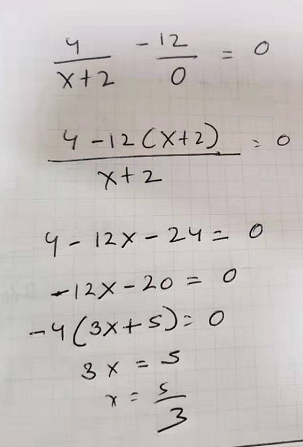
Screenshot_3.png [ 158.95 KiB | Viewed 3948 times ]
Thanks
Here is a quick calculation, which I know is incorrect as the answer is negative 5/3. However, I was just curious, as to which math rule is being broken here? -4 has been factored out and then divided by 0. As 0 divided by any number would always be 0, should this not eliminate the negative sign?
Attachment:
Screenshot_3.png [ 158.95 KiB | Viewed 3948 times ]
Thanks
Archived Topic
Hi there,
This topic has been closed and archived due to inactivity or violation of community quality standards. No more replies are possible here.
Where to now? Join ongoing discussions on thousands of quality questions in our Quantitative Questions Forum
Still interested in this question? Check out the "Best Topics" block below for a better discussion on this exact question, as well as several more related questions.
Thank you for understanding, and happy exploring!


 15 Jan 2020, 04:47
Kudos
Bookmarks
TargetMBA007
First of all you cannot divide any number by 0 but you have taken -12/0, so I believe it should be just -12 or -12/1.
Now in your calculations -4(3x+5)=0.....3x+5=0/(-4)=0.....3x=-5....x=-5/3

 31 Jan 2020, 18:36
Kudos
Bookmarks
TargetMBA007
You've made three different math mistakes in this calculation!
First, there's one that you already noticed yourself. It's in this line:
-4(3x + 5) = 0
3x = 5
You skipped a step there, and that's where the error happened. A good rule of thumb is to stay aware of what math operation you're actually doing (adding? subtracting? multiplying? etc) at each step, and to only do one math operation in each step.
If you have -4(3x + 5) = 0, then the first step is to divide both sides by -4.
-4(3x + 5) = 0
3x + 5 = 0/(-4) = 0
(You're correct that dividing zero by -4 just comes out to 0. No need to worry about the negative.)
Now you have 3x + 5 = 0. The next step is to subtract 5 from both sides:
3x + 5 - 5 = 0 - 5
3x = -5
So, you want to end up with 3x = -5, not 3x = 5.
----
One other mistake is that you can't start out with 12/0 in your original equation. Since 12/0 is undefined, the equation you've written will never be true - that is, there will never be a value of x that makes everything come out correctly, since you'll always have that 'undefined' term on the left side. There's no value of x that'll fix it!
----
Finally, it looks like you turned the 12/0 into 12(x + 2)/(x + 2) when you went from the first line to the second. It's fine to multiply the top and bottom of a fraction by the same value. For instance, this would be fine:
7/3
= 7(x + 1)/3(x + 1)
But if you try to multiply the top and bottom of 12/0 by x + 2, then you actually end up getting 12(x+2) / 0. That's because 0 times anything (even with a variable in it) is still just 0. 12(x+2) / (x + 2) is actually equal to 12/1, not 12/0.
Archived Topic
Hi there,
This topic has been closed and archived due to inactivity or violation of community quality standards. No more replies are possible here.
Where to now? Join ongoing discussions on thousands of quality questions in our Quantitative Questions Forum
Still interested in this question? Check out the "Best Topics" block above for a better discussion on this exact question, as well as several more related questions.
Thank you for understanding, and happy exploring!




