Events & Promotions
|
|

GMAT Club Daily Prep
Thank you for using the timer - this advanced tool can estimate your performance and suggest more practice questions. We have subscribed you to Daily Prep Questions via email.
Customized
for You
Track
Your Progress
Practice
Pays
Not interested in getting valuable practice questions and articles delivered to your email? No problem, unsubscribe here.
 Sep 21
07:00 PM EDT
-10:00 PM EDT
Boost your GMAT score in less than one month in a live online class + 6 months access to TTP OnDemand video courses included! Sep 18
10:00 AM IST
-11:00 PM IST
Start your journey with a fully customized action plan and work with a dedicated mentor to achieve a 735+ score. Sep 26
01:00 PM EDT
-04:00 PM EDT
Top scores are possible when you enroll in a powerful GMAT course, taught live online + 6 months access to TTP OnDemand video courses included. Class starts Saturdays Sept. 26, 2026 - Dec. 19, 2026, 1:00pm-4:00pm ES

 31 Mar 2025, 06:03
Kudos
Bookmarks
Good chance your issues are primarily related to test taking skills -- the impact of weakness in that area is not capturing all the available information and failing to visualise it properly so you can quickly find the quickest path to the answer. Your specific gaps are better identified with a diagnostic session with a coach.
DarshilShah9999


 31 Mar 2025, 06:13
Kudos
Bookmarks
Bill has a set of 6 black cards and a set of 6 red cards. Each card has a number from 1 through 6, such that each of the numbers 1 through 6 appears on 1 black card and 1 red card. Bill likes to play a game in which he shuffles all 12 cards, turns over 4 cards, and looks for pairs of cards that have the same value. What is the chance that Bill finds at least one pair of cards that have the same value?
P = 1 − (12/12 * 10/11 * 8/10 * 6/9)
In a blind taste competition, there are 3 types of tea: Type A, Type B, and Type C. Each type is presented in 3 cups, for a total of 9 cups. If a contestant tastes 4 different cups of tea at random, what is the probability that the contestant does not taste all 3 types of tea?
P = 1 - (3/9 * 3/8 * 3/7 * 6/6 * 4!/2!)
Can someone help me spot the difference in probability technique on why 4!/2! multiplier is needed in the second question but 4! isn’t required in the first question?
P = 1 − (12/12 * 10/11 * 8/10 * 6/9)
In a blind taste competition, there are 3 types of tea: Type A, Type B, and Type C. Each type is presented in 3 cups, for a total of 9 cups. If a contestant tastes 4 different cups of tea at random, what is the probability that the contestant does not taste all 3 types of tea?
P = 1 - (3/9 * 3/8 * 3/7 * 6/6 * 4!/2!)
Can someone help me spot the difference in probability technique on why 4!/2! multiplier is needed in the second question but 4! isn’t required in the first question?
 31 Mar 2025, 08:00
Kudos
Bookmarks
March 31st Quant Question of the Day
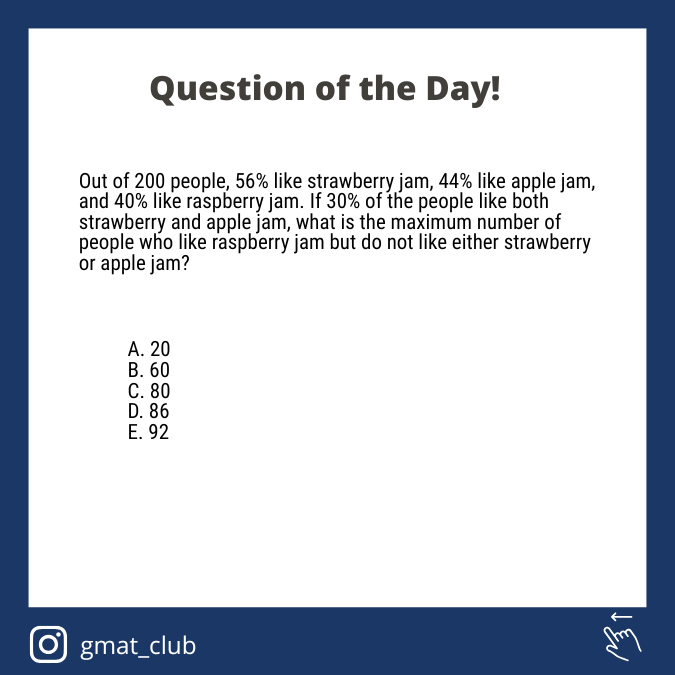
Answer and Explanation | Subscribe via E-mail, Forum, Instagram, or YouTube
Answer and Explanation | Subscribe via E-mail, Forum, Instagram, or YouTube
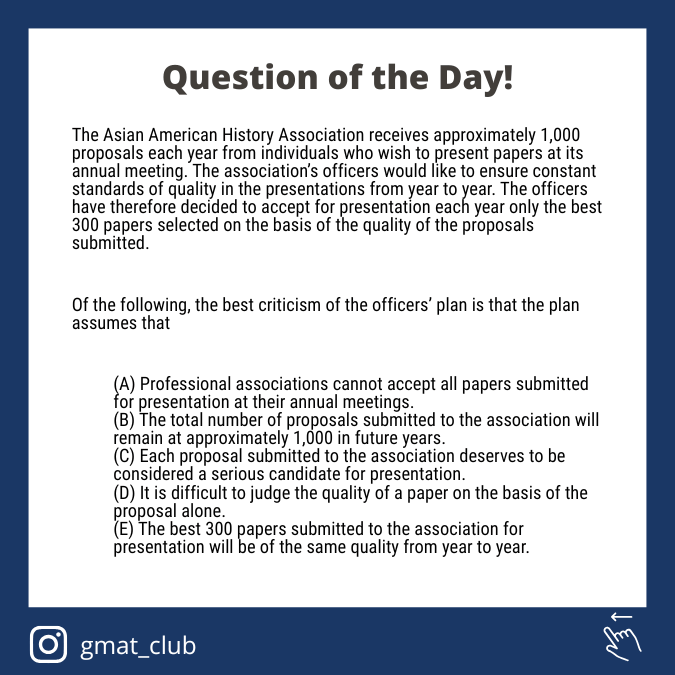




 ! Here is today’s (March 31) DI Butler Question:








