Events & Promotions
| Last visit was: 27 Sep 2026, 06:25 |
It is currently 27 Sep 2026, 06:25 |
|
|

GMAT Club Daily Prep
Thank you for using the timer - this advanced tool can estimate your performance and suggest more practice questions. We have subscribed you to Daily Prep Questions via email.
Customized
for You
Track
Your Progress
Practice
Pays
Not interested in getting valuable practice questions and articles delivered to your email? No problem, unsubscribe here.
 Sep 27
01:30 AM EDT
-02:30 AM EDT
At one point, she believed GMAT wasn’t for her. After scoring 595, self-doubt crept in and she questioned her potential. But instead of quitting, she made the right strategic changes. The result? A remarkable comeback to 695. Check out how Saakshi did it. Sep 28
07:00 PM EDT
-10:00 PM EDT
Boost your GMAT score in less than one month in a live online class + 6 months access to TTP OnDemand video courses included! Class starts Mon, Tues, Wed, Thur, Fri Sept. 28, 2026 - Oct. 16, 2027, 7:00pm-10:00pm EST Sep 29
11:00 AM EDT
-01:00 PM EDT
" Description: Top scores are possible when you enroll in a powerful GMAT course, taught live online + 6 months access to TTP OnDemand video courses included! Class starts Tues/Thur Sept. 29, 2026 - Dec. 3, 2026, 11:00am-1:00pm EST Oct 01
02:00 AM EDT
-03:00 AM EDT
Tejas studied hard but kept repeating the same mistakes. After 3 attempts at 645, a focused 4-week strategy helped him identify and fix what was holding him back—leading to a 695 with just 12–15 hours of study per week. Oct 01
07:00 AM BST
-08:00 AM GMT
Welcome to the GMAT Club's Free Interview Prep Event for Top MBA Programs! Buy tickets - Virtual series that’s all set to equip you to -excel in your MBA interviews. Oct 03
01:00 PM EDT
-04:00 PM EDT
Top scores are possible when you enroll in a powerful GMAT course, taught live online + 6 months access to TTP OnDemand video courses included! Class starts Saturdays Oct. 3, 2026 - Dec. 26, 2026, 1:00pm-4:00pm EST

Swagatalaxmi

Joined: 05 Sep 2023
Last visit: 09 Jul 2026
Posts: 132
Given Kudos: 329
Location: India
Concentration: Healthcare, General Management
Schools: Wharton '27 (D) Columbia '27 (D) Booth '27 (WL) MIT '27 (D) Kellog '27 (D) Stern '27 (WL) Yale '27 (D) Fuqua '27 (D) Ross '27 (A$) Darden '26 (A$$$) Goizueta '26 (A$$$) Mashall '26 (A$) Tepper '26 (A$)
GMAT Focus 1: 695 Q85 V88 DI80 
GPA: 3.19
WE:Medicine and Health (Healthcare/Pharmaceuticals)
Products:
Schools: Wharton '27 (D) Columbia '27 (D) Booth '27 (WL) MIT '27 (D) Kellog '27 (D) Stern '27 (WL) Yale '27 (D) Fuqua '27 (D) Ross '27 (A$) Darden '26 (A$$$) Goizueta '26 (A$$$) Mashall '26 (A$) Tepper '26 (A$)
GMAT Focus 1: 695 Q85 V88 DI80
Posts: 132
 20 Jun 2024, 23:26
Kudos
Bookmarks
The ABC Reservoir on Clear River is used to prevent flooding in downstream cities and to provide a recreation area for fishing, swimming and boating. Engineers control the depth of the reservoir by controlling the outflow rate - the rate at which water flows out of the reservoir. The inflow rate - the rate at which water flows into the reservoir - is uncontrolled and varies. The engineers use a computer model to predict the inflow rate. It is considered a rare event for the actual average inflow to differ from the model's prediction by more than 4% of the prediction.
The reservoir depth decreases whenever the outflow exceeds the inflow. Similarly, the reservoir depth increases whenever the inflow exceeds the outflow. Whenever possible, the engineers are expected to keep the reservoir depth within a certain 23 meter allowable range - high enough to support recreational activities and not above the reservoir's maximum allowable depth - and to keep the outflow rates within a certain 25 cubic meters per second (m3/s) allowable range. The engineers have never failed to satisfy these constraints.
The reservoir depth decreases whenever the outflow exceeds the inflow. Similarly, the reservoir depth increases whenever the inflow exceeds the outflow. Whenever possible, the engineers are expected to keep the reservoir depth within a certain 23 meter allowable range - high enough to support recreational activities and not above the reservoir's maximum allowable depth - and to keep the outflow rates within a certain 25 cubic meters per second (m3/s) allowable range. The engineers have never failed to satisfy these constraints.


An upstream water division project on the Clear River permanently reduces the average inflow to the reservoir by 50³/s: Yes
An equipment failure prevents engineers from increasing the reservoir's outflow for 12 hours: No
A new source of funding allows the engineers to purchase additional computers to increase the speed and accuracy of the model's prediction.: No
Be sure to select an answer first to save it in the Error Log before revealing the correct answer (OA)!
Difficulty:
 65%
(hard)
65%
(hard)
Question Stats:
47% (03:10) correct 53%
(03:11)
wrong
based on 2796
sessions
53%
(03:11)
wrong
based on 2796
sessions
History
Date
Time
Result
Not Attempted Yet
For each of the following changes in conditions, select Yes if the information provided suggests that the change would have a negative long-term impact on the engineers' ability to stay within the given constraints. Otherwise, select No.
| Yes | No | |
| An upstream water division project on the Clear River permanently reduces the average inflow to the reservoir by 50³/s | ||
| An equipment failure prevents engineers from increasing the reservoir's outflow for 12 hours | ||
| A new source of funding allows the engineers to purchase additional computers to increase the speed and accuracy of the model's prediction. |
ShowHide Answer
Official Answer
An upstream water division project on the Clear River permanently reduces the average inflow to the reservoir by 50³/s: Yes
An equipment failure prevents engineers from increasing the reservoir's outflow for 12 hours: No
A new source of funding allows the engineers to purchase additional computers to increase the speed and accuracy of the model's prediction.: No
The predictions indicate that the reservoir's depth will be sufficient for recreational activities.: Yes
The predictions indicate that the reservoir will reach its maximum allowable depth.: Yes
The predictions indicate that the reservoir will exceed its maximum depth.: No
Be sure to select an answer first to save it in the Error Log before revealing the correct answer (OA)!
Difficulty:
 15%
(low)
15%
(low)
Question Stats:
76% (01:27) correct
24%
(01:50)
wrong
based on 2388
sessions
History
Date
Time
Result
Not Attempted Yet
Suppose that the reservoir depth is currently at 217 m. If the engineers maintain the current outflow rate, the inflow rates predicted by the model will cause the depth to increase by 1 m in the next day and remain at that depth for the following 2 days. For each of the following statements about the model's predictions, select Yes if the information provided suggests that the statement is true. Otherwise, select No.
| Yes | No | |
| The predictions indicate that the reservoir's depth will be sufficient for recreational activities. | ||
| The predictions indicate that the reservoir will reach its maximum allowable depth. | ||
| The predictions indicate that the reservoir will exceed its maximum depth. |
ShowHide Answer
Official Answer
The predictions indicate that the reservoir's depth will be sufficient for recreational activities.: Yes
The predictions indicate that the reservoir will reach its maximum allowable depth.: Yes
The predictions indicate that the reservoir will exceed its maximum depth.: No
Day 5
Be sure to select an answer first to save it in the Error Log before revealing the correct answer (OA)!
Difficulty:
15%
(low)
Question Stats:
74% (01:07) correct
26%
(01:22)
wrong
based on 2285
sessions
History
Date
Time
Result
Not Attempted Yet
Assuming the predictions made by the model about Days 1 through 7 were all accurate, on which one of the following days can it be most logically inferred that the average outflow was greater than the average inflow?
| Day 1 | |
| Day 2 | |
| Day 3 | |
| Day 4 | |
| Day 5 |
Attachment:
File comment: Tab 3
Tab 3.jpg [ 50.65 KiB | Viewed 25283 times ]
Tab 3.jpg [ 50.65 KiB | Viewed 25283 times ]
Attachment:
File comment: Tab 2
Tab 2.jpg [ 20.69 KiB | Viewed 25249 times ]
Tab 2.jpg [ 20.69 KiB | Viewed 25249 times ]
Using official mocks already?
Add GMAT Club Tests for harder practice, analytics, and explanations without overlapping Official Guide or official mock questions.
Try it now →
Try it now →
 Updated on: 18 Nov 2025, 09:57
Originally posted by HarshavardhanR on 22 Jun 2024, 06:41.
Last edited by Bunuel on 18 Nov 2025, 09:57, edited 3 times in total.
Last edited by Bunuel on 18 Nov 2025, 09:57, edited 3 times in total.
Kudos
Bookmarks
Q1:
We need to select "Yes" if the statement suggests long-term negative impact on the ability to stay within the given constraints (depth and/or outflow rate).
S1: An upstream water division project on the Clear River permanently reduces the average inflow to the reservoir by 50m3/s
Yes. This could have a serious impact. Let's understand why.
Remember that the engineers control the depth by varying the outflow rate.
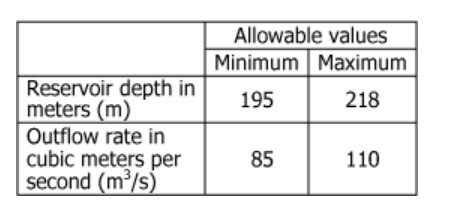
If they want to increase the depth, they lower the outflow rate to a point below inflow rate (max lower limit being 85 m3/s).
If they want to decrease the depth, they increase the outflow rate to a point above inflow rate (max higher limit being 110 m3/s).
For the engineers to be able to do the above, the inflow rate has to be between 85 m3/s and 110 m3/s.
Examples to understand this
- If the inflow rate was, say, 111 m3/s, then, within these constraints (85 to 110 m3/s), there is no way to reduce depth (inflow always > outflow)
- if the inflow rate was, on average, 84 m3/s, then, within these constraints (85 to 110 m3/s), there is no way to increase depth (inflow always < outflow)
Thus, we can say that even the inflow rate will be somewhere between 85 m3/s and 110 m3/s, because only then can the engineers control depth in all scenarios using the given outflow range.
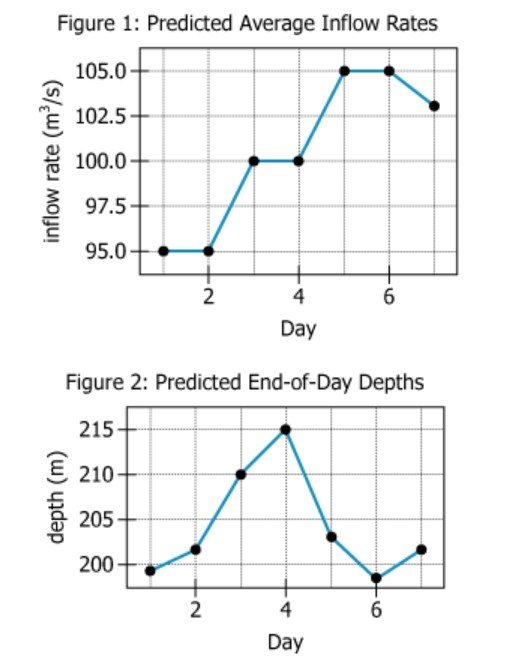
Even in the data for inflow rates from the 7-day period, we can see that inflow rates are within this range.
An example of how the engineers control the depth
- if the inflow rate was, on average, 100 m3/s, then,
1) If engineers want to increase the depth, they can bring down outflow rate to below 100 m3/s (but not below 85 m3/s).
2) If they want to decrease the depth, they can increase outflow rate to above 100 m3/s (but not above 110 m3/s).
But what if the average inflow rate has been permanently reduced by 50 m3/s?
Example: New inflow rate is 100 - 50 = 50 m3/s.
Then, the engineers would not be able to control the depth of the reservoir with the constraints (85 to 110 m3/s).
Inflow would always be < outflow. No way to control depth.
Whether the average inflow rate is 85.1 m3/s or 109.9 m3/s, a reduction of 50 takes it to such a low point that the engineers would not be able to stay within the set constraints to control depth.
Thus Statement 1 suggests a clear long-term negative impact on the engineers' ability to stay within the given constraints. Hence, YES.
S2: An equipment failure prevents engineers from increasing the reservoir's outflow for 12 hours
Remember - we are looking for long-term negative impact. This seems to be a problem that can get fixed in 12 hours. The engineers may even get lucky in the sense that during this failure, there may be no actual need to increase outflow!
While there could be some short-term negative impact, there is nothing to suggest long-term negative impact. No.
S3: A new source of funding allows the engineers to purchase additional computers to increase the speed and accuracy of the model's prediction.
Better model -> better prediction -> better choices of outflow rate, perhaps. This does not really suggest that the new outflow rates/depths will go beyond the set constraints. It is a stretch to say that a better model will have a negative long-term impact on the ability to stay within the constraints.
Hope this helps.
___
Harsha
We need to select "Yes" if the statement suggests long-term negative impact on the ability to stay within the given constraints (depth and/or outflow rate).
S1: An upstream water division project on the Clear River permanently reduces the average inflow to the reservoir by 50m3/s
Yes. This could have a serious impact. Let's understand why.
Remember that the engineers control the depth by varying the outflow rate.
If they want to increase the depth, they lower the outflow rate to a point below inflow rate (max lower limit being 85 m3/s).
If they want to decrease the depth, they increase the outflow rate to a point above inflow rate (max higher limit being 110 m3/s).
For the engineers to be able to do the above, the inflow rate has to be between 85 m3/s and 110 m3/s.
Examples to understand this
- If the inflow rate was, say, 111 m3/s, then, within these constraints (85 to 110 m3/s), there is no way to reduce depth (inflow always > outflow)
- if the inflow rate was, on average, 84 m3/s, then, within these constraints (85 to 110 m3/s), there is no way to increase depth (inflow always < outflow)
Thus, we can say that even the inflow rate will be somewhere between 85 m3/s and 110 m3/s, because only then can the engineers control depth in all scenarios using the given outflow range.
Even in the data for inflow rates from the 7-day period, we can see that inflow rates are within this range.
An example of how the engineers control the depth
- if the inflow rate was, on average, 100 m3/s, then,
1) If engineers want to increase the depth, they can bring down outflow rate to below 100 m3/s (but not below 85 m3/s).
2) If they want to decrease the depth, they can increase outflow rate to above 100 m3/s (but not above 110 m3/s).
But what if the average inflow rate has been permanently reduced by 50 m3/s?
Example: New inflow rate is 100 - 50 = 50 m3/s.
Then, the engineers would not be able to control the depth of the reservoir with the constraints (85 to 110 m3/s).
Inflow would always be < outflow. No way to control depth.
Whether the average inflow rate is 85.1 m3/s or 109.9 m3/s, a reduction of 50 takes it to such a low point that the engineers would not be able to stay within the set constraints to control depth.
Thus Statement 1 suggests a clear long-term negative impact on the engineers' ability to stay within the given constraints. Hence, YES.
S2: An equipment failure prevents engineers from increasing the reservoir's outflow for 12 hours
Remember - we are looking for long-term negative impact. This seems to be a problem that can get fixed in 12 hours. The engineers may even get lucky in the sense that during this failure, there may be no actual need to increase outflow!
While there could be some short-term negative impact, there is nothing to suggest long-term negative impact. No.
S3: A new source of funding allows the engineers to purchase additional computers to increase the speed and accuracy of the model's prediction.
Better model -> better prediction -> better choices of outflow rate, perhaps. This does not really suggest that the new outflow rates/depths will go beyond the set constraints. It is a stretch to say that a better model will have a negative long-term impact on the ability to stay within the constraints.
Hope this helps.
___
Harsha
Updated on: 10 Feb 2025, 21:51
Originally posted by HarshavardhanR on 26 Jun 2024, 06:40.
Last edited by HarshavardhanR on 10 Feb 2025, 21:51, edited 2 times in total.
Last edited by HarshavardhanR on 10 Feb 2025, 21:51, edited 2 times in total.
Kudos
Bookmarks
Q2
Given Model Predictions:
Current Depth: 217m
By Next Day: 217 + 1 = 218m
Next Two days: 218m (will remain at this depth)
Question: For each of the statements, say "Yes" if it is true. Else, "No".
S1 -> The predictions indicate that the reservoir's depth will be sufficient for recreational activities.
The constraint for depth is 195m to 218m. As long as the depth stays in this range, the depth is OK for recreational activities. In all these days, depth is 217 to 218m, sufficient for recreational activities. YES.
S2 -> The predictions indicate that the reservoir will reach its maximum allowable depth.
The upper limit is 218m. Clearly, as per the predictions, the maximum allowable depth (218m) is being reached. YES.
S3 -> The predictions indicate that the reservoir will exceed its maximum depth.
These predictions indicate that the depth will reach 218m but not anything more. It is reaching the maximum depth but not exceeding it. NO.
Q3
Question: Given the data from the model (Day 1 to Day 7), on which day (among the options) was average outflow greater than average inflow?
Let's think about this -> What would happen if, on a certain day, outflow rate was lesser than inflow rate?
On that day -> More water would be coming in than going out. Thus the depth of water would see an increase from previous day's measurement.
Similarly, What would happen if, on a certain day, outflow rate was more than inflow rate?
On that day -> More water would be going out than coming in. Thus the depth of water would see a decrease from previous day's measurement.
We need to find on what day the outflow is more than inflow. That would be the day(s) when we see a reduction in the water level.
Now, look at the graph.
- On Day 2, we see an increase in depth from day 1. This means that inflow>outflow.
- On Day 3, we see an increase in depth from day 2. This means that inflow>outflow.
- On Day 4, we see an increase in depth from day 3. This means that inflow>outflow.
- On Day 5, we see a decrease in depth from Day 4. This means that outflow>inflow.
- On Day 6, we see a decrease in depth from Day 5. This means that outflow>inflow.
- On Day 7, we see an increase in depth from Day 6. This means that inflow>outflow.
Day 5 and Day 6 are both valid answers. We say Day 5 as a choice. It is the correct answer.
___
Harsha
Given Model Predictions:
Current Depth: 217m
By Next Day: 217 + 1 = 218m
Next Two days: 218m (will remain at this depth)
Question: For each of the statements, say "Yes" if it is true. Else, "No".
S1 -> The predictions indicate that the reservoir's depth will be sufficient for recreational activities.
The constraint for depth is 195m to 218m. As long as the depth stays in this range, the depth is OK for recreational activities. In all these days, depth is 217 to 218m, sufficient for recreational activities. YES.
S2 -> The predictions indicate that the reservoir will reach its maximum allowable depth.
The upper limit is 218m. Clearly, as per the predictions, the maximum allowable depth (218m) is being reached. YES.
S3 -> The predictions indicate that the reservoir will exceed its maximum depth.
These predictions indicate that the depth will reach 218m but not anything more. It is reaching the maximum depth but not exceeding it. NO.
Q3
Question: Given the data from the model (Day 1 to Day 7), on which day (among the options) was average outflow greater than average inflow?
Let's think about this -> What would happen if, on a certain day, outflow rate was lesser than inflow rate?
On that day -> More water would be coming in than going out. Thus the depth of water would see an increase from previous day's measurement.
Similarly, What would happen if, on a certain day, outflow rate was more than inflow rate?
On that day -> More water would be going out than coming in. Thus the depth of water would see a decrease from previous day's measurement.
We need to find on what day the outflow is more than inflow. That would be the day(s) when we see a reduction in the water level.
Now, look at the graph.
- On Day 2, we see an increase in depth from day 1. This means that inflow>outflow.
- On Day 3, we see an increase in depth from day 2. This means that inflow>outflow.
- On Day 4, we see an increase in depth from day 3. This means that inflow>outflow.
- On Day 5, we see a decrease in depth from Day 4. This means that outflow>inflow.
- On Day 6, we see a decrease in depth from Day 5. This means that outflow>inflow.
- On Day 7, we see an increase in depth from Day 6. This means that inflow>outflow.
Day 5 and Day 6 are both valid answers. We say Day 5 as a choice. It is the correct answer.
___
Harsha
General Discussion
 05 Jul 2024, 23:03
Kudos
Bookmarks
HarshR9
Bunuel bb GMATNinja
I have an issue with the question language. To arrive at this answer we need to consider depth=height, which is not true. I was comfortable with whole data set with my understanding of depth as defined below, except in this question. Does GMAT leave such loopholes ?
Please update if I am wrong here or how to avoid/tackle such loose words' meaning
Depth usually refers to something that extends downward or beneath grade . Conversely height, refers to something that extends upward, above ground or grade.