Thank you for using the timer - this advanced tool can estimate your performance and suggest more practice questions. We have subscribed you to Daily Prep Questions via email.
Customized for You
we will pick new questions that match your level based on your Timer History
Track Your Progress
every week, we’ll send you an estimated GMAT score based on your performance
Practice Pays
we will pick new questions that match your level based on your Timer History
Not interested in getting valuable practice questions and articles delivered to your email? No problem, unsubscribe here.
Thank you for using the timer!
We noticed you are actually not timing your practice. Click the START button first next time you use the timer.
There are many benefits to timing your practice, including:
Originally posted by 282552 on 21 Aug 2016, 08:14.
Last edited by Bunuel on 11 Jun 2024, 04:34, edited 8 times in total.
13
Kudos
Add Kudos
123
Bookmarks
Bookmark this Post
Show timer
00:00
Start Timer
Pause Timer
Resume Timer
Show Answer
Hide Answer
Correct Answer
Hide
Show
History
Dropdown 1: London
Dropdown 2: 20%
Be sure to select an answer first to save it in the Error Log before revealing the correct answer (OA)!
Select the dropdowns below and click "Submit" to add this question to your Error log.
Difficulty:
45%
(medium)
Question Stats:
58%
(01:44)
correct 42%
(02:06)
wrong
based on 4362
sessions
History
Date
Time
Result
Not Attempted Yet
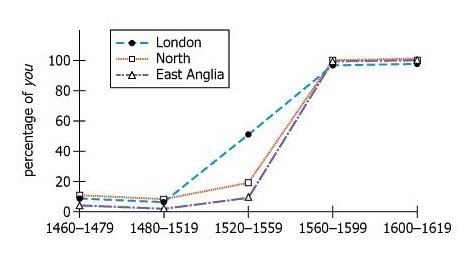
The graph indicates the results of a survey of written material from three areas in early modern England. The graph shows the percent of use of you when either you or ye would be appropriate. Select the option from each drop-down menu that creates the statement that most accurately reflects the information provided.
The area of early modern England that was first to favor the use of you over ye was .
In the surveyed writings from the area of the North between 1520 and 1559, you constituted of the instances in which either you or ye would have been appropriate.
The graph shows that all three areas greatly favored ye over you until 1520–1559. During that period, London began to favor you, since the percent use of you shown in the graph corresponding to London during that time period is slightly greater than 50 percent, as indicated by the height of the black circle for 1520–1559. The percents shown in the graph for that time period in the North and in East Anglia were each less than 50 percent. So the graph indicates that the first area of modern England that favored the use of you over ye was London.
The correct answer is London.
The percent use of you shown in the graph corresponding to the area of the North between 1520 and 1559 is approximately 20 percent, as indicated by the height of the white square for 1520–1559. As the text indicates, this is the percent of the surveyed writings from the area of the North between 1520 and 1559 in which you was used when either you or ye would be appropriate.
The graph indicates the results of a survey of written material from three areas in early modern England. The graph shows the percent of use of you when either you or ye would be appropriate. Select the option from each drop-down menu that creates the statement that most accurately reflects the information provided.
The area of early modern England that was first to favor the use of you over ye was : The graph shows % of 'you' used in early modern England. The area first to favor 'you' will be the area that crossed 50% usage 1st . Clearly, London achieved that in 1520-99. Hence, answer is London. . In the surveyed writings from the area of the North between 1520 and 1559, you constituted of the instances in which either you or ye would have been appropriate. : Clear cut answer from the graph. You can infer that North area is at 20% in 1520-99 period.
Here is a detailed video solution for this interesting question. See how this question can be solved in the test environment using "Owning the Dataset" approach.
Could you please clarify the first ques here, the first to favour should be North, which is on the left most side, why are we taking the first to favour as the country where the percentage reached 50% first? Thank you in advance
Show more
Out of 100 instances in which you/ye should be used, when would we say that we favor 'you' over 'ye'? When we are using 'you' in more than 50% of the instances. Which area started using 'you' in more than 50% of the instances first? London in 1520 to 1559.
I have a doubt in below's reasoning. Favoring something doesn't have to mean that something is used or preferred over 50%, we could slowly start to use something more and that could imply a favour towards it, and if we are asked when it happened first, it should be North. For eg if i preferred chocolate over cookies 10 out of 10 times but now it has changed to 8 out of 10, that could mean i am slowly starting to favour cookies, which could or couldn't increase over time.
Could you please clarify the first ques here, the first to favour should be North, which is on the left most side, why are we taking the first to favour as the country where the percentage reached 50% first? Thank you in advance
Out of 100 instances in which you/ye should be used, when would we say that we favor 'you' over 'ye'? When we are using 'you' in more than 50% of the instances. Which area started using 'you' in more than 50% of the instances first? London in 1520 to 1559.
If you have two hands and you use one more than the other you are favoring that one hand. Same in this case. If you can only eat chocolate or cookies and you prefer chocolate 8/10 times you're still favoring chocolate. It doesn't matter that your are starting to like cookies, as you still favor chocolate over cookies. The 50% threshold is very important here as it's the ONLY turning point.
Natansha
I have a doubt in below's reasoning. Favoring something doesn't have to mean that something is used or preferred over 50%, we could slowly start to use something more and that could imply a favour towards it, and if we are asked when it happened first, it should be North. For eg if i preferred chocolate over cookies 10 out of 10 times but now it has changed to 8 out of 10, that could mean i am slowly starting to favour cookies, which could or couldn't increase over time.
Could you please clarify the first ques here, the first to favour should be North, which is on the left most side, why are we taking the first to favour as the country where the percentage reached 50% first? Thank you in advance
Out of 100 instances in which you/ye should be used, when would we say that we favor 'you' over 'ye'? When we are using 'you' in more than 50% of the instances. Which area started using 'you' in more than 50% of the instances first? London in 1520 to 1559.
The first part of the question asks " The area of early modern England that was first to favor the use of you over ye " -------> so why can't we consider NORTH as the answer, because if we see the graph of North, it is above all. Doesn't it indicate first to favor it.
Please explain this aspect ?? what is wrong here in assumption.
The first part of the question asks " The area of early modern England that was first to favor the use of you over ye " -------> so why can't we consider NORTH as the answer, because if we see the graph of North, it is above all. Doesn't it indicate first to favor it.
Please explain this aspect ?? what is wrong here in assumption.
Thanks.
Show more
It seems that you ignored the discussion above, because a couple of very detailed solutions are already given, as well as posts addressing this exact doubt. But here it is again.
“The area of early modern England that was first to favor the use of you over ye” means the first region where you made up more than 50% of the usage. The first graph to cross that 50% mark is the blue line for London. That is why the answer is London, not the North.
Great question! The wording are tricky it basically means that there are two options either "you" or ye" but the graph shown only talks of percent of ONLY "you". So its like yes or no situation and ur given a graph of percentage of ppl saying yes and they are exhaustive events so remaining is no or in this case "ye".
For question 1: To favor one over the other you need >50% to support it which is first done by London. Thus London is the answer.
282552
The graph indicates the results of a survey of written material from three areas in early modern England. The graph shows the percent of use of you when either you or ye would be appropriate. Select the option from each drop-down menu that creates the statement that most accurately reflects the information provided.
The area of early modern England that was first to favor the use of you over ye was .
In the surveyed writings from the area of the North between 1520 and 1559, you constituted of the instances in which either you or ye would have been appropriate.
You have your answer in your very statement. You say you are "starting" to favour one over the other.
Its the same as percentage and real numerical value differentiations. If you have -20% increase from year 1 to year 2 in one case and +20% increase from year 1 to year 2 in another case. Can you say the numerical value of the latter case was higher than first one? No because you dont know from which value they began with. Similarly in your case you move from 10/10 to 8/10 u decrease ur liking and tend towards cookies u are having a -20% decrease but ur still gravitating towards chocolates only as compared to cookies. You are MOVING towards a different direction doesnt mean that you DONT favour that one.
Natansha
I have a doubt in below's reasoning. Favoring something doesn't have to mean that something is used or preferred over 50%, we could slowly start to use something more and that could imply a favour towards it, and if we are asked when it happened first, it should be North. For eg if i preferred chocolate over cookies 10 out of 10 times but now it has changed to 8 out of 10, that could mean i am slowly starting to favour cookies, which could or couldn't increase over time.