Events & Promotions
|
|

GMAT Club Daily Prep
Thank you for using the timer - this advanced tool can estimate your performance and suggest more practice questions. We have subscribed you to Daily Prep Questions via email.
Customized
for You
Track
Your Progress
Practice
Pays
Not interested in getting valuable practice questions and articles delivered to your email? No problem, unsubscribe here.
 Sep 26
06:00 PM PDT
-07:00 PM PDT
Free- full-length test + 15 concept videos + 150+ short videos + study plan! Sep 27
01:30 AM EDT
-02:30 AM EDT
At one point, she believed GMAT wasn’t for her. After scoring 595, self-doubt crept in and she questioned her potential. But instead of quitting, she made the right strategic changes. The result? A remarkable comeback to 695. Check out how Saakshi did it. Sep 26
12:30 AM EDT
-01:30 AM EDT
Struggling to find the right strategies to score a 99 %ile on GMAT Focus? Riya (GMAT 715) boosted her score by 100-points in just 15 days! Discover how the right mentorship, tailored strategies, and an unwavering mindset can transform your GMAT prep. Sep 28
07:00 PM EDT
-10:00 PM EDT
Boost your GMAT score in less than one month in a live online class + 6 months access to TTP OnDemand video courses included! Class starts Mon, Tues, Wed, Thur, Fri Sept. 28, 2026 - Oct. 16, 2027, 7:00pm-10:00pm EST Sep 29
11:00 AM EDT
-01:00 PM EDT
" Description: Top scores are possible when you enroll in a powerful GMAT course, taught live online + 6 months access to TTP OnDemand video courses included! Class starts Tues/Thur Sept. 29, 2026 - Dec. 3, 2026, 11:00am-1:00pm EST Oct 01
07:00 AM BST
-08:00 AM GMT
Welcome to the GMAT Club's Free Interview Prep Event for Top MBA Programs! Buy tickets - Virtual series that’s all set to equip you to -excel in your MBA interviews. Oct 03
01:00 PM EDT
-04:00 PM EDT
Top scores are possible when you enroll in a powerful GMAT course, taught live online + 6 months access to TTP OnDemand video courses included! Class starts Saturdays Oct. 3, 2026 - Dec. 26, 2026, 1:00pm-4:00pm EST

 02 Sep 2023, 08:00
Kudos
Bookmarks
Question 1


B
Be sure to select an answer first to save it in the Error Log before revealing the correct answer (OA)!
Difficulty:
 85%
(hard)
85%
(hard)
Question Stats:
46% (03:16) correct 54%
(03:25) wrong
based on 1670
sessions
54%
(03:25) wrong
based on 1670
sessions
History
Date
Time
Result
Not Attempted Yet
Question 2
D
Be sure to select an answer first to save it in the Error Log before revealing the correct answer (OA)!
Difficulty:
55%
(hard)
Question Stats:
55% (01:13) correct 45%
(01:19) wrong
based on 2077
sessions
History
Date
Time
Result
Not Attempted Yet
Question 3
C
Be sure to select an answer first to save it in the Error Log before revealing the correct answer (OA)!
Difficulty:
 45%
(medium)
45%
(medium)
Question Stats:
59% (01:05) correct 41%
(01:25) wrong
based on 2024
sessions
History
Date
Time
Result
Not Attempted Yet
Question 4
A
Be sure to select an answer first to save it in the Error Log before revealing the correct answer (OA)!
Difficulty:
65%
(hard)
Question Stats:
52% (01:30) correct 48%
(01:28) wrong
based on 1908
sessions
History
Date
Time
Result
Not Attempted Yet
Question 5
A
Be sure to select an answer first to save it in the Error Log before revealing the correct answer (OA)!
Difficulty:
95%
(hard)
Question Stats:
15% (01:06) correct 85%
(01:08) wrong
based on 1849
sessions
History
Date
Time
Result
Not Attempted Yet
Question 6
B
Be sure to select an answer first to save it in the Error Log before revealing the correct answer (OA)!
Difficulty:
85%
(hard)
Question Stats:
42% (01:22) correct 58%
(01:29) wrong
based on 1667
sessions
History
Date
Time
Result
Not Attempted Yet
Question 7
A
Be sure to select an answer first to save it in the Error Log before revealing the correct answer (OA)!
Difficulty:
65%
(hard)
Question Stats:
50% (01:17) correct 50%
(01:18) wrong
based on 1595
sessions
History
Date
Time
Result
Not Attempted Yet
Question 8
D
Be sure to select an answer first to save it in the Error Log before revealing the correct answer (OA)!
Difficulty:
25%
(medium)
Question Stats:
72% (01:03) correct 28%
(01:04) wrong
based on 1584
sessions
History
Date
Time
Result
Not Attempted Yet
Those scholars who are engaged in the attempt to explain human experience realize that while experience is ungraspable in one sense, it is also a human construct. Feminist theory brings the added awareness that the construction of women's experience has never been adequate. Whether that experience was made trivial or enviable, sanctified or mystified, it has been peripheral. Described and explained primarily not by women themselves, but by men. Since women's experience has so rarely been a direct focus for theoretical consciousness, a whole range and spectrum of human life remains to be explored, depicted, and understood.
For this reason, feminist theory is fundamentally experiential. Its subject is women's lives, past or present, historically recorded or known only by inference, experienced in association with men of the dominant culture or with men who are also oppressed. Feminist theory reconsiders historical, economic, religious, biological, artistic, and anthropological constructs and explanations. It brings to theoretical consciousness facets of women's experience that have hitherto escaped attention because they have not been part of, and may even have contradicted, predominant theoretical accounts of human life. It rethinks thinking itself, for to conceive women's lives as actual often fractures the theoretical and philosophical constructs that Ica those lives out of amount.
Thus, the essential first step in feminist theory is consciousness-raising, which supplies, as Catharine MacKinnon points out, "the major technique of analysis, structure of organization, method of practice, and theory of social change [for] the women's movement." At one level, all women's experiences must be embraced in statements about women in general; and yet, as Mary O'Brien puts it, "There is no Woman but real flesh and blood female creatures with brains and pains and aspirations." Individual women have become conscious of their situation by a personal re-vision of the economic practices, sexual mores, and political realities that have assigned that situation to them. Those of them who are feminist theorists must also come to terms with the philosophical constructs that shape their milieu, and with the theorists who first produced those constructs as living thought Marx, Confucius, Freud, and Saint Paul. They must scan the beacons that flare along the horizon of all culture, asking whether any one of those beacons is their own lighthouse.
Feminist theory must also criticize itself and counter the tendency to congeal into a new ideology. Ideologies encompass unexamined thoughts about people's lives; they are frozen theory, adopted as convenient or embraced fervently as dogma, unquestioned. To remain true to their own vision of the truth, feminist theorists must continue to test thinking against experience, making sure that it remains rooted in the real lives of women.
For this reason, feminist theory is fundamentally experiential. Its subject is women's lives, past or present, historically recorded or known only by inference, experienced in association with men of the dominant culture or with men who are also oppressed. Feminist theory reconsiders historical, economic, religious, biological, artistic, and anthropological constructs and explanations. It brings to theoretical consciousness facets of women's experience that have hitherto escaped attention because they have not been part of, and may even have contradicted, predominant theoretical accounts of human life. It rethinks thinking itself, for to conceive women's lives as actual often fractures the theoretical and philosophical constructs that Ica those lives out of amount.
Thus, the essential first step in feminist theory is consciousness-raising, which supplies, as Catharine MacKinnon points out, "the major technique of analysis, structure of organization, method of practice, and theory of social change [for] the women's movement." At one level, all women's experiences must be embraced in statements about women in general; and yet, as Mary O'Brien puts it, "There is no Woman but real flesh and blood female creatures with brains and pains and aspirations." Individual women have become conscious of their situation by a personal re-vision of the economic practices, sexual mores, and political realities that have assigned that situation to them. Those of them who are feminist theorists must also come to terms with the philosophical constructs that shape their milieu, and with the theorists who first produced those constructs as living thought Marx, Confucius, Freud, and Saint Paul. They must scan the beacons that flare along the horizon of all culture, asking whether any one of those beacons is their own lighthouse.
Feminist theory must also criticize itself and counter the tendency to congeal into a new ideology. Ideologies encompass unexamined thoughts about people's lives; they are frozen theory, adopted as convenient or embraced fervently as dogma, unquestioned. To remain true to their own vision of the truth, feminist theorists must continue to test thinking against experience, making sure that it remains rooted in the real lives of women.
1. The primary purpose of the passage is to
A. refute a theoretical argument
B. discuss a theoretical approach
C. broaden a theoretical category
D. support a hypothesis
E. modify an explanation
A. refute a theoretical argument
B. discuss a theoretical approach
C. broaden a theoretical category
D. support a hypothesis
E. modify an explanation
2. According to the passage, feminist theory is "fundamentally experiential" (Highlighted) in that it
A. considers experience to be the source of all knowledge
B. infers the usefulness of traditional theoretical constructs on the basis of experience
C. rejects the principle that experience is ungraspable
D. takes women's experience as its subject
E. compares women's experiences to those of men
A. considers experience to be the source of all knowledge
B. infers the usefulness of traditional theoretical constructs on the basis of experience
C. rejects the principle that experience is ungraspable
D. takes women's experience as its subject
E. compares women's experiences to those of men
3. According to the author, the construction of women’s experience has in the past inadequate in which of the following ways?
I. Women's experience has been recounted mainly by men, rather than by women.
II. Women's experience has typically been the focus of experiential rather than theoretical analysis by male theorists.
III. Woman's experience has usually been a marginal rather than a primary subject for male theorists.
A. I only
B. I and II only
C. I and III only
D. II and III only
E. I, II, and III
I. Women's experience has been recounted mainly by men, rather than by women.
II. Women's experience has typically been the focus of experiential rather than theoretical analysis by male theorists.
III. Woman's experience has usually been a marginal rather than a primary subject for male theorists.
A. I only
B. I and II only
C. I and III only
D. II and III only
E. I, II, and III
4. In the context of the passage, the quotation from Catharine MacKinnon (Highlighted) most clearly functions as which of the following?
A. A description of the multiple purposes of consciousness-raising in the construction of feminist theory
B. A refutation of the argument that consciousness-raising is of little importance to feminist theory
C. A suggestion that consciousness-raising is more important to the women's movement than it is to feminist theory
D. An explanation of how the technique of consciousness-raising operates
E. An analysis of the importance of consciousness-raising in the growth of the women's movement
A. A description of the multiple purposes of consciousness-raising in the construction of feminist theory
B. A refutation of the argument that consciousness-raising is of little importance to feminist theory
C. A suggestion that consciousness-raising is more important to the women's movement than it is to feminist theory
D. An explanation of how the technique of consciousness-raising operates
E. An analysis of the importance of consciousness-raising in the growth of the women's movement
5. According to the author, feminist theory can avoid becoming a new ideology if feminist theorists do which of the following?
A. Continually test feminist theory against the actual experiences of women
B. Strongly emphasize the role of feminist theory in women's social consciousness
C. Critically challenge theories produced by members of the dominant culture
D. Carefully question the philosophical constructs produced by Marx, Confucius, Freud, and Saint Paul
E. Frequently reject new historical, economic, religious, biological, artistic, and anthropological constructs and explanations
A. Continually test feminist theory against the actual experiences of women
B. Strongly emphasize the role of feminist theory in women's social consciousness
C. Critically challenge theories produced by members of the dominant culture
D. Carefully question the philosophical constructs produced by Marx, Confucius, Freud, and Saint Paul
E. Frequently reject new historical, economic, religious, biological, artistic, and anthropological constructs and explanations
6. The author quotes Mary O'Brien (Highlighted) most probably in order to
A. provide a contrast to the next sentence concerning individual women
B. qualify the preceding statement concerning all women's experiences
C. allude to women's physical beings as well as to their intellectual and emotional experiences
D. suggest that women have too rarely been viewed as individuals
E. reinforce the argument that consciousness raising is the major technique of analysis of the women's movement
A. provide a contrast to the next sentence concerning individual women
B. qualify the preceding statement concerning all women's experiences
C. allude to women's physical beings as well as to their intellectual and emotional experiences
D. suggest that women have too rarely been viewed as individuals
E. reinforce the argument that consciousness raising is the major technique of analysis of the women's movement
7. It can be inferred from the passage that "the beacons that flare along the horizon of all culture" (Highlighted) are most probably meant to symbolize which of the following?
A. Philosophical constructs that have become influential
B. Unexamined ideologies that many embrace as dog-ma
C. Economic practices, sexual mores and political realities of which women are aware
D. Feminist philosophical constructs that draw on Marx, Confucius, Freud, and Saint Paul
E. Religious philosophies formulated by Confucius, Saint Paul, and other well-known thinkers
A. Philosophical constructs that have become influential
B. Unexamined ideologies that many embrace as dog-ma
C. Economic practices, sexual mores and political realities of which women are aware
D. Feminist philosophical constructs that draw on Marx, Confucius, Freud, and Saint Paul
E. Religious philosophies formulated by Confucius, Saint Paul, and other well-known thinkers
8. According to the author, some aspects of women's experiences have in the past been overlooked for which of the following reasons?
A. They occurred before the development of Freud's theories.
B. They were experienced by only a few individual women.
C. They did not fit feminist theorists' ideology.
D. They did not fit generally accepted theories of human experience.
E. They were not consistent with women's theoretical insights.
A. They occurred before the development of Freud's theories.
B. They were experienced by only a few individual women.
C. They did not fit feminist theorists' ideology.
D. They did not fit generally accepted theories of human experience.
E. They were not consistent with women's theoretical insights.
 02 Sep 2023, 23:21
Kudos
Bookmarks
Note: highlighted option is the correct answer; options that have been been stricken through are incorrect
1. The primary purpose of the passage is to
The passage discusses the importance and role of feminist theory and does not refute an argument
B. discuss a theoretical approach
The passage discusses the theoretical approach of feminist theory, its importance, and how it should evolve to accurately represent women's experiences.
While the passage discusses the need for feminist theory to encompass all women's experiences, it does not specifically aim to broaden a theoretical category. Option B is better
The passage does not present a hypothesis and then provide evidence or arguments to support it. Instead it discusses a theoretical approach.
The passage does not aim to modify an existing explanation. It discusses the role and importance of feminist theory.
----
2. According to the passage, feminist theory is "fundamentally experiential" (Highlighted) in that it
While feminist theory values experience, the passage does not state that it considers experience to be the source of all knowledge.
The passage does mention that feminist theory reconsiders various constructs but it does not state that it infers their usefulness based on experience
The passage does not state that feminist theory rejects this principle
D. takes women's experience as its subject
The passage clearly states that the subject of feminist theory is women's lives and experiences.
Passage does not state that feminist theory's main function is to compare women's experiences to those of men
--
3. According to the author, the construction of women’s experience has in the past inadequate in which of the following ways?
I. Women's experience has been recounted mainly by men, rather than by women.
This is stated in the passage, so correct
Passage says that women's experience has rarely been a direct focus for theoretical consciousness but it does not compare experiential and theoretical analysis by male theorists
III. Woman's experience has usually been a marginal rather than a primary subject for male theorists.
This is implied in the passage when it says that women's experience has been peripheral.
C. I and III only
Answer: C: I and III only
---
4. In the context of the passage, the quotation from Catharine MacKinnon (Highlighted) most clearly functions as which of the following?
A. A description of the multiple purposes of consciousness-raising in the construction of feminist theory
The quote from Catharine MacKinnon outlines the various roles of consciousness-raising in feminist theory
The passage does not present an argument that states that consciousness-raising is of little importance to feminist theory
The quote does not suggest that consciousness-raising is more important to one than the other
While the quote does mention the roles of consciousness-raising, it does not explain how the technique operates.
The quote does mention the women's movement but it does not specifically analyze the importance of consciousness-raising in its growth.
---
5. According to the author, feminist theory can avoid becoming a new ideology if feminist theorists do which of the following?
A. Continually test feminist theory against the actual experiences of women
The passage states that to avoid becoming a new ideology, feminist theorists must continue to test thinking against experience, ensuring it remains rooted in the real lives of women.
Passage does not state that this will prevent feminist theory from becoming a new ideology
While the passage does mention the need for feminist theorists to come to terms with the philosophical constructs, it does not state that this will prevent feminist theory from becoming a new ideology.
Again, while the passage mentions these theorists, it does not state that questioning their constructs will prevent feminist theory from becoming a new ideology
The passage does not suggest that rejecting new constructs and explanations will prevent feminist theory from becoming a new ideology
---
6. The author quotes Mary O'Brien (Highlighted) most probably in order to
The quote from Mary O'Brien does not provide a contrast to the next sentence. Instead, it complements the discussion about individual women's experiences
B. qualify the preceding statement concerning all women's experiences
The quote from Mary O'Brien emphasizes that while all women's experiences must be considered, to remember that women are individual, real beings with their own unique experiences.
While the quote does mention "real flesh and blood female creatures," it does not specifically allude to women's intellectual and emotional experiences
The quote emphasizes the individuality of women but it does not comment on how often women have been viewed as individuals
The quote does not relate to the discussion about consciousness-raising.
----
7. It can be inferred from the passage that "the beacons that flare along the horizon of all culture" (Highlighted) are most probably meant to symbolize which of the following?
A. Philosophical constructs that have become influential
The "beacons that flare along the horizon of all culture" are likely symbolic of influential philosophical constructs that shape societal understanding and norms.
The passage does not suggest that the "beacons" symbolize unexamined ideologies
While these are mentioned in the passage, they are not suggested to be the "beacons" that the author refers to
The passage does not suggest that the "beacons" symbolize feminist philosophical constructs specifically
The passage does not suggest that the "beacons" symbolize religious philosophies specifically
---
8. According to the author, some aspects of women's experiences have in the past been overlooked for which of the following reasons?
The passage does not suggest that the timing of women's experiences in relation to the development of Freud's theories has caused some aspects to be overlooked.
The passage does not suggest that the experiences of only a few individual women have been overlooked.
The passage does not suggest that experiences that did not fit feminist theorists' ideology have been overlooked.
D. They did not fit generally accepted theories of human experience.
The passage states that facets of women's experience that have not been part of, or contradicted, predominant theoretical accounts of human life have escaped attention.
The passage does not suggest that experiences inconsistent with women's theoretical insights have been overlooked.
Attachment:
File comment: Mind map of Feminist Theory Passage
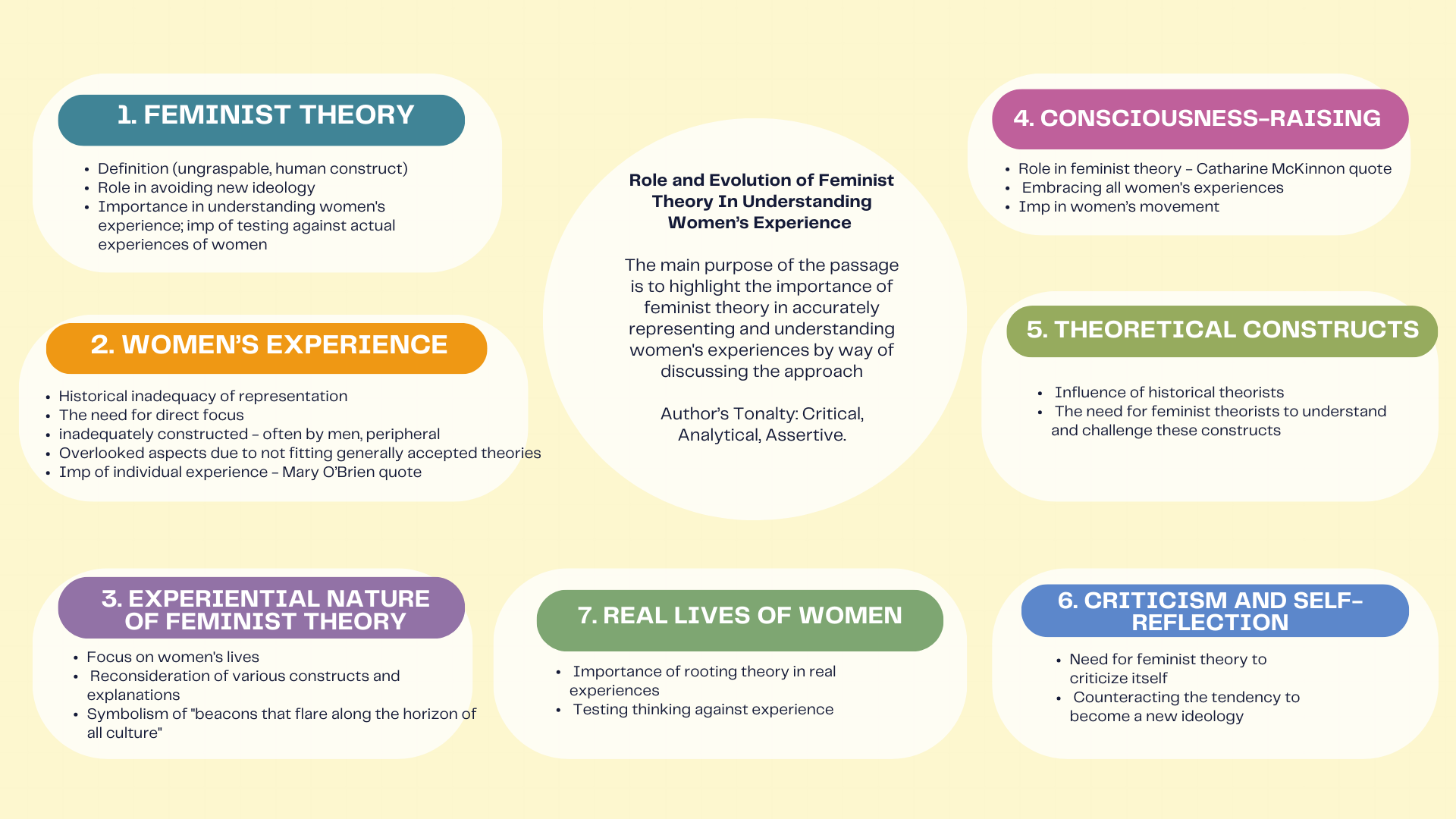
Feminist Theory.png [ 358.77 KiB | Viewed 25357 times ]
Feminist Theory.png [ 358.77 KiB | Viewed 25357 times ]
General Discussion

 02 Sep 2023, 12:52
Kudos
Bookmarks
Para 1: Scholars trying to explain human experience realize that experience could be human construct. Feminist theory suggests women experiences have never been adequate as they have been described explained by men. Women experience has rarely been a direct focus and need to be explored
Para 2: For the reason that women experience has been rarely a focus, feminist theory considers facets of women and all such constructs that affects them and that escaped attention
Para 3: thus essential first part of feminist theory is conscious raising where one individual become conscious of their situation and feminist theorist come into terms with philosophical constructs and people who proposed those constructs
Para 4: What Feminist theory can do- criticise itself, test thinking against experience and ensure this thought process remains rooted in lives of women
Purpose: feminist theory highlights issues with women's experience construct and discusses the approach it should take to study women's experiences
1. The primary purpose of the passage is to
A. refute a theoretical argument
-- No where any argument is refuted...passage is more descriptive in nature
B. discuss a theoretical approach
-- The passage does discuss how the theoretical approach should be
This is the answer
C. broaden a theoretical category
-- The passage does talk about what theory must do but in most of the passages it is discussing the theoretical approach
D. support a hypothesis
-- The passage is not about supporting hypothesis. Nowhere author is seen supporting explicitly
E. modify an explanation
-- The passage does not talk about modifying explanation rather emphasizing
2. According to the passage, feminist theory is "fundamentally experiential" (Highlighted) in that it
"Since women's experience has so rarely been a direct focus for theoretical consciousness, a whole range and spectrum of human life remains to be explored, depicted, and understood.
For this reason, feminist theory is fundamentally experiential. Its subject is women's lives, past or present, historically recorded or known only by inference, experienced in association with men of the dominant culture"
A. considers experience to be the source of all knowledge
-- It does not focus on experience as source of knowledge rather considers that so far women's experience has rarely been explored, depicted and understood properly
B. infers the usefulness of traditional theoretical constructs on the basis of experience
-- It does not infer usefulness of traditional theoretical constructs as that construct has been of men rather than women's experiences. It says "Described and explained primarily not by women themselves, but by men"
C. rejects the principle that experience is ungraspable
-- The purpose of fundamentally experiential is not to reject the principle that experience is ungraspable
D. takes women's experience as its subject
-- It mentions fundamental experiential to mention that to understand women's experience the focus should be on women and all the constructs around it
This is the answer
E. compares women's experiences to those of men
-- No discussion of comparison is indicated
3. According to the author, the construction of women’s experience has in the past inadequate in which of the following ways?
I. Women's experience has been recounted mainly by men, rather than by women.
-- Passage does say this..."Feminist theory brings the added awareness that the construction of women's experience has never been adequate... and has been peripheral. Described and explained primarily not by women themselves, but by men." Looks good
II. Women's experience has typically been the focus of experiential rather than theoretical analysis by male theorists.
-- "Since women's experience has so rarely been a direct focus for theoretical consciousness" and male theorists describe women's experiences so inference is it should be focus of experiential. Looks good
III. Woman's experience has usually been a marginal rather than a primary subject for male theorists.
-- on construction of women's experience it says it is inadequate "Whether that experience was made trivial or enviable, sanctified or mystified, it has been peripheral" . ALso it says women experience has so rarely been direct focus for theoretical consciousness. Looks good
A. I only
B. I and II only
C. I and III only
D. II and III only
E. I, II, and III
This is the answer
4. In the context of the passage, the quotation from Catharine MacKinnon (Highlighted) most clearly functions as which of the following?
CM [Catharine Mackinnon]
A. A description of the multiple purposes of consciousness-raising in the construction of feminist theory
-- CM does not mean just to describe multiple purpose of consciousness in construction of feminist theory
B. A refutation of the argument that consciousness-raising is of little importance to feminist theory
-- CM purpose is not to do any refutation of argument
C. A suggestion that consciousness-raising is more important to the women's movement than it is to feminist theory
-- CM does not compare feminist theory to women's movement
D. An explanation of how the technique of consciousness-raising operates
-- CM does not provide explanation of the technique as in how it operates
E. An analysis of the importance of consciousness-raising in the growth of the women's movement
-- CM does emphasize on the importance of consciousness raising ...Conscious raising is "the major technique of analysis, structure of organization, method of practice, and theory of social change [for] the women's movement."
This is the answer
5. According to the author, feminist theory can avoid becoming a new ideology if feminist theorists do which of the following?
"Feminist theory must also criticize itself and counter the tendency to congeal into a new ideology. Ideologies encompass unexamined thoughts about people's lives; they are frozen theory, adopted as convenient or embraced fervently as dogma, unquestioned."
A. Continually test feminist theory against the actual experiences of women
-- Author suggests to avoid new ideology but not to test feminist theory against actual experiences of women. not supported
B. Strongly emphasize the role of feminist theory in women's social consciousness
-- It does not want to emphasize role by asking feminist theory to avoid new ideology
C. Critically challenge theories produced by members of the dominant culture
-- It does ask to criticise itself and critically challenge theories, examine thoughts which are conveniently adopted and embraced as unquestioned. It asks to test thinking against experience.
This is the answer
D. Carefully question the philosophical constructs produced by Marx, Confucius, Freud, and Saint Paul
-- It does not suggest to carefully question philosophical constructs..It wants to say that critically examine ideologies as they are unexamined thoughts and adopted conveniently and rather than adopt new ideology conveniently criticise itself.
E. Frequently reject new historical, economic, religious, biological, artistic, and anthropological constructs and explanations
-- It does not say that frequently reject the constructs....not supported
6. The author quotes Mary O'Brien (Highlighted) most probably in order to
"At one level, all women's experiences must be embraced in statements about women in general; and yet, as Mary O'Brien puts it, "There is no Woman but real flesh and blood female creatures with brains and pains and aspirations." Individual women have become conscious of their situation by a personal re-vision of the economic practices, sexual mores, and political realities that have assigned that situation to them."
MB = Mary O'Brien
A. provide a contrast to the next sentence concerning individual women
-- MB does not want to say the highlighted sentence to contrast against next sentence concerning individual woemen.
B. qualify the preceding statement concerning all women's experiences
-- MB statement does qualify preceding statement as her statement is there is no women but flesh and blood female creatures with brains and pains and aspirations. Preceding statement is at one level all women's experiences must be embraced in statements about women in general. So it reinforces that idea
This is the answer
C. allude to women's physical beings as well as to their intellectual and emotional experiences
-- MB statement does say brains, pains and aspirations but not to physical being ...also that is not why MB puts her statement
D. suggest that women have too rarely been viewed as individuals
-- MB statement does not want to emphasize women has rarely been viewed as individuals
E. reinforce the argument that consciousness raising is the major technique of analysis of the women's movement
-- MB statement though comes after conscious raising as fundamental first step but her statement is to make give one view for women's experiences in general
7. It can be inferred from the passage that "the beacons that flare along the horizon of all culture" (Highlighted) are most probably meant to symbolize which of the following?
"Those of them who are feminist theorists must also come to terms with the philosophical constructs that shape their milieu, and with the theorists who first produced those constructs as living thought Marx, Confucius, Freud, and Saint Paul. They must scan the beacons that flare along the horizon of all culture, asking whether any one of those beacons is their own lighthouse."
A. Philosophical constructs that have become influential
-- It does not want to emphasize philosophical constructs that are influential
B. Unexamined ideologies that many embrace as dog-ma
-- It does not talk about unexamined ideology which is discussed in last paragraph.
C. Economic practices, sexual mores and political realities of which women are aware
-- It does not want to emphasize economic practise, political realities with which women are aware
D. Feminist philosophical constructs that draw on Marx, Confucius, Freud, and Saint Paul
-- It asks for scanning beacon that flare along horizon of all cultures and hence we can say that find feminist philosophical constructs that draw on these theorists
This is the answer
E. Religious philosophies formulated by Confucius, Saint Paul, and other well-known thinkers
-- it does not mean to say religious philosophies , it is out of scope
8. According to the author, some aspects of women's experiences have in the past been overlooked for which of the following reasons?
Discussed in second para
"It brings to theoretical consciousness facets of women's experience that have hitherto escaped attention because they have not been part of, and may even have contradicted, predominant theoretical accounts of human life. It rethinks thinking itself, for to conceive women's lives as actual often fractures the theoretical and philosophical constructs that Ica those lives out of amount."
A. They occurred before the development of Freud's theories
-- Not supported.
B. They were experienced by only a few individual women.
-- It does not say that it has been overlooked as it was experienced by only a few individual women
C. They did not fit feminist theorists' ideology.
-- It did not fit predominant theoretical account of human life not feminist theorists ideology
D. They did not fit generally accepted theories of human experience.
-- predominant is generally accepted and goes well with the text "hey have not been part of, and may even have contradicted, predominant theoretical accounts of human life"
This is the answer
E. They were not consistent with women's theoretical insights.[/box_in][/box_out][/align]
-- It is not supported.No where it mentions that they were not consistent with women's theoretical insights.
Para 2: For the reason that women experience has been rarely a focus, feminist theory considers facets of women and all such constructs that affects them and that escaped attention
Para 3: thus essential first part of feminist theory is conscious raising where one individual become conscious of their situation and feminist theorist come into terms with philosophical constructs and people who proposed those constructs
Para 4: What Feminist theory can do- criticise itself, test thinking against experience and ensure this thought process remains rooted in lives of women
Purpose: feminist theory highlights issues with women's experience construct and discusses the approach it should take to study women's experiences
1. The primary purpose of the passage is to
A. refute a theoretical argument
-- No where any argument is refuted...passage is more descriptive in nature
B. discuss a theoretical approach
-- The passage does discuss how the theoretical approach should be
This is the answer
C. broaden a theoretical category
-- The passage does talk about what theory must do but in most of the passages it is discussing the theoretical approach
D. support a hypothesis
-- The passage is not about supporting hypothesis. Nowhere author is seen supporting explicitly
E. modify an explanation
-- The passage does not talk about modifying explanation rather emphasizing
2. According to the passage, feminist theory is "fundamentally experiential" (Highlighted) in that it
"Since women's experience has so rarely been a direct focus for theoretical consciousness, a whole range and spectrum of human life remains to be explored, depicted, and understood.
For this reason, feminist theory is fundamentally experiential. Its subject is women's lives, past or present, historically recorded or known only by inference, experienced in association with men of the dominant culture"
A. considers experience to be the source of all knowledge
-- It does not focus on experience as source of knowledge rather considers that so far women's experience has rarely been explored, depicted and understood properly
B. infers the usefulness of traditional theoretical constructs on the basis of experience
-- It does not infer usefulness of traditional theoretical constructs as that construct has been of men rather than women's experiences. It says "Described and explained primarily not by women themselves, but by men"
C. rejects the principle that experience is ungraspable
-- The purpose of fundamentally experiential is not to reject the principle that experience is ungraspable
D. takes women's experience as its subject
-- It mentions fundamental experiential to mention that to understand women's experience the focus should be on women and all the constructs around it
This is the answer
E. compares women's experiences to those of men
-- No discussion of comparison is indicated
3. According to the author, the construction of women’s experience has in the past inadequate in which of the following ways?
I. Women's experience has been recounted mainly by men, rather than by women.
-- Passage does say this..."Feminist theory brings the added awareness that the construction of women's experience has never been adequate... and has been peripheral. Described and explained primarily not by women themselves, but by men." Looks good
II. Women's experience has typically been the focus of experiential rather than theoretical analysis by male theorists.
-- "Since women's experience has so rarely been a direct focus for theoretical consciousness" and male theorists describe women's experiences so inference is it should be focus of experiential. Looks good
III. Woman's experience has usually been a marginal rather than a primary subject for male theorists.
-- on construction of women's experience it says it is inadequate "Whether that experience was made trivial or enviable, sanctified or mystified, it has been peripheral" . ALso it says women experience has so rarely been direct focus for theoretical consciousness. Looks good
A. I only
B. I and II only
C. I and III only
D. II and III only
E. I, II, and III
This is the answer
4. In the context of the passage, the quotation from Catharine MacKinnon (Highlighted) most clearly functions as which of the following?
CM [Catharine Mackinnon]
A. A description of the multiple purposes of consciousness-raising in the construction of feminist theory
-- CM does not mean just to describe multiple purpose of consciousness in construction of feminist theory
B. A refutation of the argument that consciousness-raising is of little importance to feminist theory
-- CM purpose is not to do any refutation of argument
C. A suggestion that consciousness-raising is more important to the women's movement than it is to feminist theory
-- CM does not compare feminist theory to women's movement
D. An explanation of how the technique of consciousness-raising operates
-- CM does not provide explanation of the technique as in how it operates
E. An analysis of the importance of consciousness-raising in the growth of the women's movement
-- CM does emphasize on the importance of consciousness raising ...Conscious raising is "the major technique of analysis, structure of organization, method of practice, and theory of social change [for] the women's movement."
This is the answer
5. According to the author, feminist theory can avoid becoming a new ideology if feminist theorists do which of the following?
"Feminist theory must also criticize itself and counter the tendency to congeal into a new ideology. Ideologies encompass unexamined thoughts about people's lives; they are frozen theory, adopted as convenient or embraced fervently as dogma, unquestioned."
A. Continually test feminist theory against the actual experiences of women
-- Author suggests to avoid new ideology but not to test feminist theory against actual experiences of women. not supported
B. Strongly emphasize the role of feminist theory in women's social consciousness
-- It does not want to emphasize role by asking feminist theory to avoid new ideology
C. Critically challenge theories produced by members of the dominant culture
-- It does ask to criticise itself and critically challenge theories, examine thoughts which are conveniently adopted and embraced as unquestioned. It asks to test thinking against experience.
This is the answer
D. Carefully question the philosophical constructs produced by Marx, Confucius, Freud, and Saint Paul
-- It does not suggest to carefully question philosophical constructs..It wants to say that critically examine ideologies as they are unexamined thoughts and adopted conveniently and rather than adopt new ideology conveniently criticise itself.
E. Frequently reject new historical, economic, religious, biological, artistic, and anthropological constructs and explanations
-- It does not say that frequently reject the constructs....not supported
6. The author quotes Mary O'Brien (Highlighted) most probably in order to
"At one level, all women's experiences must be embraced in statements about women in general; and yet, as Mary O'Brien puts it, "There is no Woman but real flesh and blood female creatures with brains and pains and aspirations." Individual women have become conscious of their situation by a personal re-vision of the economic practices, sexual mores, and political realities that have assigned that situation to them."
MB = Mary O'Brien
A. provide a contrast to the next sentence concerning individual women
-- MB does not want to say the highlighted sentence to contrast against next sentence concerning individual woemen.
B. qualify the preceding statement concerning all women's experiences
-- MB statement does qualify preceding statement as her statement is there is no women but flesh and blood female creatures with brains and pains and aspirations. Preceding statement is at one level all women's experiences must be embraced in statements about women in general. So it reinforces that idea
This is the answer
C. allude to women's physical beings as well as to their intellectual and emotional experiences
-- MB statement does say brains, pains and aspirations but not to physical being ...also that is not why MB puts her statement
D. suggest that women have too rarely been viewed as individuals
-- MB statement does not want to emphasize women has rarely been viewed as individuals
E. reinforce the argument that consciousness raising is the major technique of analysis of the women's movement
-- MB statement though comes after conscious raising as fundamental first step but her statement is to make give one view for women's experiences in general
7. It can be inferred from the passage that "the beacons that flare along the horizon of all culture" (Highlighted) are most probably meant to symbolize which of the following?
"Those of them who are feminist theorists must also come to terms with the philosophical constructs that shape their milieu, and with the theorists who first produced those constructs as living thought Marx, Confucius, Freud, and Saint Paul. They must scan the beacons that flare along the horizon of all culture, asking whether any one of those beacons is their own lighthouse."
A. Philosophical constructs that have become influential
-- It does not want to emphasize philosophical constructs that are influential
B. Unexamined ideologies that many embrace as dog-ma
-- It does not talk about unexamined ideology which is discussed in last paragraph.
C. Economic practices, sexual mores and political realities of which women are aware
-- It does not want to emphasize economic practise, political realities with which women are aware
D. Feminist philosophical constructs that draw on Marx, Confucius, Freud, and Saint Paul
-- It asks for scanning beacon that flare along horizon of all cultures and hence we can say that find feminist philosophical constructs that draw on these theorists
This is the answer
E. Religious philosophies formulated by Confucius, Saint Paul, and other well-known thinkers
-- it does not mean to say religious philosophies , it is out of scope
8. According to the author, some aspects of women's experiences have in the past been overlooked for which of the following reasons?
Discussed in second para
"It brings to theoretical consciousness facets of women's experience that have hitherto escaped attention because they have not been part of, and may even have contradicted, predominant theoretical accounts of human life. It rethinks thinking itself, for to conceive women's lives as actual often fractures the theoretical and philosophical constructs that Ica those lives out of amount."
A. They occurred before the development of Freud's theories
-- Not supported.
B. They were experienced by only a few individual women.
-- It does not say that it has been overlooked as it was experienced by only a few individual women
C. They did not fit feminist theorists' ideology.
-- It did not fit predominant theoretical account of human life not feminist theorists ideology
D. They did not fit generally accepted theories of human experience.
-- predominant is generally accepted and goes well with the text "hey have not been part of, and may even have contradicted, predominant theoretical accounts of human life"
This is the answer
E. They were not consistent with women's theoretical insights.[/box_in][/box_out][/align]
-- It is not supported.No where it mentions that they were not consistent with women's theoretical insights.