Events & Promotions
|
|

GMAT Club Daily Prep
Thank you for using the timer - this advanced tool can estimate your performance and suggest more practice questions. We have subscribed you to Daily Prep Questions via email.
Customized
for You
Track
Your Progress
Practice
Pays
Not interested in getting valuable practice questions and articles delivered to your email? No problem, unsubscribe here.
 Sep 28
07:00 PM EDT
-10:00 PM EDT
Boost your GMAT score in less than one month in a live online class + 6 months access to TTP OnDemand video courses included! Class starts Mon, Tues, Wed, Thur, Fri Sept. 28, 2026 - Oct. 16, 2027, 7:00pm-10:00pm EST Sep 29
11:00 AM EDT
-01:00 PM EDT
" Description: Top scores are possible when you enroll in a powerful GMAT course, taught live online + 6 months access to TTP OnDemand video courses included! Class starts Tues/Thur Sept. 29, 2026 - Dec. 3, 2026, 11:00am-1:00pm EST Oct 01
07:00 AM BST
-08:00 AM GMT
Welcome to the GMAT Club's Free Interview Prep Event for Top MBA Programs! Buy tickets - Virtual series that’s all set to equip you to -excel in your MBA interviews. Oct 03
01:00 PM EDT
-04:00 PM EDT
Top scores are possible when you enroll in a powerful GMAT course, taught live online + 6 months access to TTP OnDemand video courses included! Class starts Saturdays Oct. 3, 2026 - Dec. 26, 2026, 1:00pm-4:00pm EST


Dropdown 1: 3.6
Dropdown 2: greater than
Be sure to select an answer first to save it in the Error Log before revealing the correct answer (OA)!
Difficulty:
 95%
(hard)
95%
(hard)
Question Stats:
55% (03:38) correct 45%
(03:36)
wrong
based on 1406
sessions
45%
(03:36)
wrong
based on 1406
sessions
History
Date
Time
Result
Not Attempted Yet
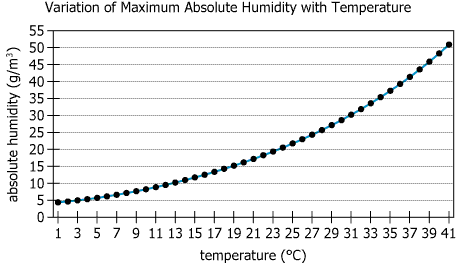
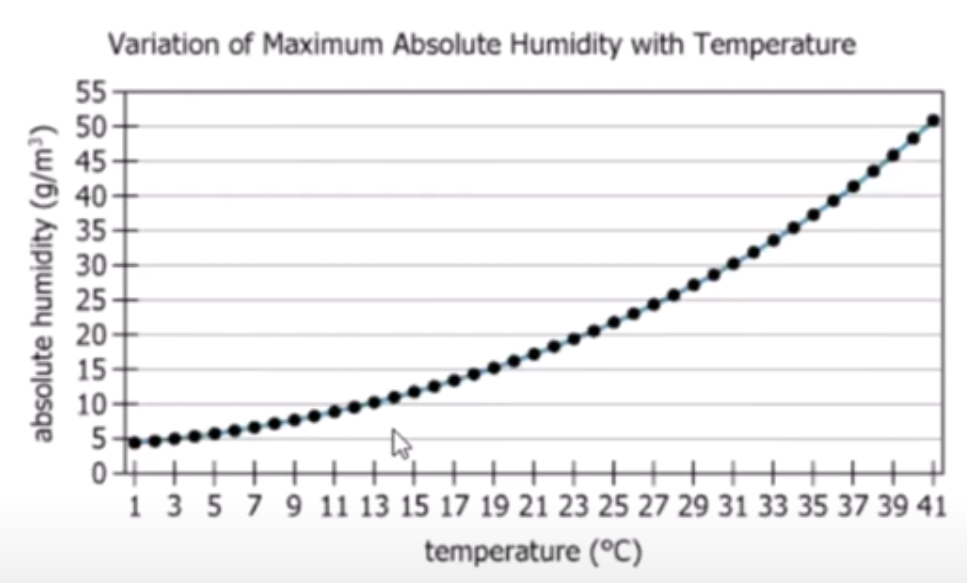
The graph shows the maximum absolute humidity—the maximum amount of water vapor that atmospheric air at sea level can hold—in grams of water vapor per cubic meter (g/m^3), for integer-valued temperatures on the Celsius scale from 1°C through 41°C. When the air contains this maximum amount of water vapor, the air is said to be at its saturation point. In addition, at sea level and at a temperature of T °C, the density of air containing no water vapor is \(\frac{10^5}{287(T + 273)}\) \(kg/m^3 \)where 1 kg = 1 kilogram = 1,000 g.
From each drop-down menu, select the option that creates the most accurate statement based on the information provided.
At 37°C, and at sea level, the weight of water vapor in 1 m^3 of air at its saturation point is % of the weight of 1 \(m^3\) of air containing no water vapor.
The average rate of change of maximum absolute humidity from 31°C to 41°C is the average rate of change of maximum absolute humidity from 11°C to 21°C.
ID: 700158
Graph.png [ 198.78 KiB | Viewed 15809 times ]
Attachment:
Graph.png [ 198.78 KiB | Viewed 15809 times ]
ShowHide Answer
Official Answer
Dropdown 1: 3.6
Dropdown 2: greater than
Using official mocks already?
Add GMAT Club Tests for harder practice, analytics, and explanations without overlapping Official Guide or official mock questions.
Try it now →
Try it now →


 25 Oct 2024, 21:06
Kudos
Bookmarks
The units don’t play much of a role in this question. The units are the same and there’s no conversion needed, you only have percentage conversion.
I solved this on the back of the napkin without a calculator or the napkin. Of course I was casually looking on my phone without timing myself for the time pressure of the question but it is possible to solve it without the calculator. You should make a challenge for yourself to figure out how to solve every DI question without a calculator. I don’t mean to force yourself to do calculations in your head but figure out if there is a shortcut that would allow you to solve the question without doing calculations.
1. If you look at this scary equation you will notice that at the top you have 100,000 in the numerator and denominator is basically going to be 300×300. I don’t think you need to have a more precise calculation there.
This means the weight of air going to be 1.1 kg approx. Since it’s over 1 , and water vapor Weighs 40 g, it’s not going to be 4% it’s going to be approx 10% less than 4% but not quite as little as 3.2% which is 20% less.
I hesitated a little because it was slightly over 40 g but 40 to 41 It’s only a 2 1/2% change whereas from one to 1.1 is a 10% change. So the final answer would likely be slightly higher than 3.6. Maybe it’s 3.7 but still less than 4% and closer to 3.6%
The second question is fairly easy because you just look at the chart and you see the rate of change and it’s clearly greater because it’s exponential or at least it looks to me like that and that was the correct answer 😇
The key to this question was a good understanding between the numerator and denominator so you understand what happens when you divide a number by 1.1 or 0.9. Key for mental math.
I solved this on the back of the napkin without a calculator or the napkin. Of course I was casually looking on my phone without timing myself for the time pressure of the question but it is possible to solve it without the calculator. You should make a challenge for yourself to figure out how to solve every DI question without a calculator. I don’t mean to force yourself to do calculations in your head but figure out if there is a shortcut that would allow you to solve the question without doing calculations.
1. If you look at this scary equation you will notice that at the top you have 100,000 in the numerator and denominator is basically going to be 300×300. I don’t think you need to have a more precise calculation there.
This means the weight of air going to be 1.1 kg approx. Since it’s over 1 , and water vapor Weighs 40 g, it’s not going to be 4% it’s going to be approx 10% less than 4% but not quite as little as 3.2% which is 20% less.
I hesitated a little because it was slightly over 40 g but 40 to 41 It’s only a 2 1/2% change whereas from one to 1.1 is a 10% change. So the final answer would likely be slightly higher than 3.6. Maybe it’s 3.7 but still less than 4% and closer to 3.6%
The second question is fairly easy because you just look at the chart and you see the rate of change and it’s clearly greater because it’s exponential or at least it looks to me like that and that was the correct answer 😇
The key to this question was a good understanding between the numerator and denominator so you understand what happens when you divide a number by 1.1 or 0.9. Key for mental math.
 18 Jun 2024, 07:17
Kudos
Bookmarks
1.)
At 37°C the weight of water vapor in \(1m^3\) is around \(40\)g of absolute humidity.
At 37°C the weight of air containing no water vapor is \(\frac{10^5}{287(37+273)}\) kg.
As the weight of water vapor is in grams and the weight of air containing no water vapor is in kg, one needs to alter one so that they are in the same unit of measure. \(40\)g is equal to \(\frac{40}{1000}\)kg
To find the what percent the weight of water vapor in 1\(m^3\) of air at its saturation point is of the weight of 1\(m^3\) of air containing no water vapor one will go:
\(\frac{\frac{40}{1000}}{\frac{10^5}{287(37+273)}}*100\)
\(\frac{40}{1000}*\frac{287(310)}{10^5}*100\) [Let 287*310 ≈ 90 000]
\(4 * \frac{9}{10}\)
\(3.6\)%
At 37°C the weight of water vapor in \(1m^3\) is around \(40\)g of absolute humidity.
At 37°C the weight of air containing no water vapor is \(\frac{10^5}{287(37+273)}\) kg.
As the weight of water vapor is in grams and the weight of air containing no water vapor is in kg, one needs to alter one so that they are in the same unit of measure. \(40\)g is equal to \(\frac{40}{1000}\)kg
To find the what percent the weight of water vapor in 1\(m^3\) of air at its saturation point is of the weight of 1\(m^3\) of air containing no water vapor one will go:
\(\frac{\frac{40}{1000}}{\frac{10^5}{287(37+273)}}*100\)
\(\frac{40}{1000}*\frac{287(310)}{10^5}*100\) [Let 287*310 ≈ 90 000]
\(4 * \frac{9}{10}\)
\(3.6\)%