Events & Promotions
|
|

GMAT Club Daily Prep
Thank you for using the timer - this advanced tool can estimate your performance and suggest more practice questions. We have subscribed you to Daily Prep Questions via email.
Customized
for You
Track
Your Progress
Practice
Pays
Not interested in getting valuable practice questions and articles delivered to your email? No problem, unsubscribe here.
 Sep 27
01:30 AM EDT
-02:30 AM EDT
At one point, she believed GMAT wasn’t for her. After scoring 595, self-doubt crept in and she questioned her potential. But instead of quitting, she made the right strategic changes. The result? A remarkable comeback to 695. Check out how Saakshi did it. Sep 28
07:00 PM EDT
-10:00 PM EDT
Boost your GMAT score in less than one month in a live online class + 6 months access to TTP OnDemand video courses included! Class starts Mon, Tues, Wed, Thur, Fri Sept. 28, 2026 - Oct. 16, 2027, 7:00pm-10:00pm EST Sep 29
11:00 AM EDT
-01:00 PM EDT
" Description: Top scores are possible when you enroll in a powerful GMAT course, taught live online + 6 months access to TTP OnDemand video courses included! Class starts Tues/Thur Sept. 29, 2026 - Dec. 3, 2026, 11:00am-1:00pm EST Oct 01
02:00 AM EDT
-03:00 AM EDT
Tejas studied hard but kept repeating the same mistakes. After 3 attempts at 645, a focused 4-week strategy helped him identify and fix what was holding him back—leading to a 695 with just 12–15 hours of study per week. Oct 01
07:00 AM BST
-08:00 AM GMT
Welcome to the GMAT Club's Free Interview Prep Event for Top MBA Programs! Buy tickets - Virtual series that’s all set to equip you to -excel in your MBA interviews. Oct 03
01:00 PM EDT
-04:00 PM EDT
Top scores are possible when you enroll in a powerful GMAT course, taught live online + 6 months access to TTP OnDemand video courses included! Class starts Saturdays Oct. 3, 2026 - Dec. 26, 2026, 1:00pm-4:00pm EST Oct 04
08:00 PM PDT
-09:00 PM PDT
15 Full-length GMAT FE mocks with insightful analytics, weakness diagnosis, and video explanations!

bhanu29


GMAT Forum Director
Joined: 02 Oct 2024
Last visit: 27 Sep 2026
Posts: 1,001
Given Kudos: 749
Location: India
Schools: Anderson '27 Booth '27 (S) Foster '27 Haas '27 (S) Ross '27 (S) Tepper '27 Stanford '27 CBS '27 (S) NYU Stern Johnson (Cornell) McCombs '27 Kellogg '27 Sloan '27
GMAT Focus 1: 675 Q87 V85 DI79 
GMAT Focus 2: 715 Q87 V84 DI86
GPA: 9.11
WE:Engineering (Technology)
Products:
Schools: Anderson '27 Booth '27 (S) Foster '27 Haas '27 (S) Ross '27 (S) Tepper '27 Stanford '27 CBS '27 (S) NYU Stern Johnson (Cornell) McCombs '27 Kellogg '27 Sloan '27
GMAT Focus 2: 715 Q87 V84 DI86
Posts: 1,001
 17 Feb 2026, 08:13
Kudos
Bookmarks


Dropdown 1: 52
Dropdown 2: 124
Be sure to select an answer first to save it in the Error Log before revealing the correct answer (OA)!
Difficulty:
 35%
(medium)
35%
(medium)
Question Stats:
77% (02:46) correct 23%
(03:05)
wrong
based on 750
sessions
23%
(03:05)
wrong
based on 750
sessions
History
Date
Time
Result
Not Attempted Yet
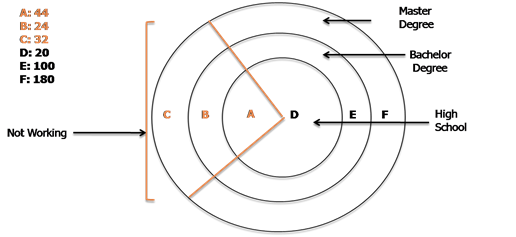
Refer to the pictograph reflecting the academic degrees obtained by all the members of a cultural club. The three circles represent the number of residents with high school degree, bachelor's degree, and master's degree respectively. Each member of the club carries a minimum qualification of a high school degree. Any person carrying a bachelor's degree also carries a high school degree, and any person carrying a master's degree also carries a bachelor's degree and high school degree. The legends A, B, and C represent the number of people currently not working in the respective categories whereas the legends D, E, and F represent the number of people currently working in the respective categories.
Use the dropdown menus to complete the statements accurately, using the information provided in the diagram.
members of the group either carry master's degree and are currently not working or do not carry bachelor's or higher degree and are currently working.
members of the group carry bachelor's degree but not master's degree.
ShowHide Answer
Official Answer
Dropdown 1: 52
Dropdown 2: 124
bhanu29
GMAT Forum Director
Joined: 02 Oct 2024
Last visit: 27 Sep 2026
Posts: 1,001
Own Kudos:
Given Kudos: 749
Location: India
Schools: Anderson '27 Booth '27 (S) Foster '27 Haas '27 (S) Ross '27 (S) Tepper '27 Stanford '27 CBS '27 (S) NYU Stern Johnson (Cornell) McCombs '27 Kellogg '27 Sloan '27
GMAT Focus 1: 675 Q87 V85 DI79
GMAT Focus 2: 715 Q87 V84 DI86
GPA: 9.11
WE:Engineering (Technology)
Products:
Schools: Anderson '27 Booth '27 (S) Foster '27 Haas '27 (S) Ross '27 (S) Tepper '27 Stanford '27 CBS '27 (S) NYU Stern Johnson (Cornell) McCombs '27 Kellogg '27 Sloan '27
GMAT Focus 2: 715 Q87 V84 DI86
Posts: 1,001
Kudos:
549
17 Feb 2026, 08:15
Kudos
Bookmarks
bhanu29
I.
Number of members of the group who carry master's degree and are currently not working = C = 32
Number of members of the group who do not carry bachelor's or higher degree and are currently working = D = 20
Required set = 32 + 20 = 52
Hence, 52 is the correct answer choice.
II.
Number of members of the group who carry bachelor's degree but not master's degree = B and E = 24 + 100 = 124
Hence, 124 is the correct answer choice.
 19 Feb 2026, 05:12
Kudos
Bookmarks
Key Concept: Graphs and Tables — Nested Set Interpretation
This is a classic G&T question where the diagram looks complex but breaks down cleanly once you map the regions. The key insight is that the three circles are nested (not overlapping independently) — every master's degree holder also has a bachelor's and high school degree.
Reading the diagram correctly:
The legend splits each education category into Not Working (A, B, C) and Working (D, E, F):
— A = 44: High school only, not working
— B = 24: Bachelor's only (not master's), not working
— C = 32: Master's degree, not working
— D = 20: High school only, working
— E = 100: Bachelor's only (not master's), working
— F = 180: Master's degree, working
Statement I — "carry master's degree AND not working" OR "do NOT carry bachelor's/higher AND working"
First group: C = 32 (master's degree, not working)
Second group: D = 20 (high school only = no bachelor's/higher, working)
Total = 32 + 20 = 52 ✓
Statement II — "carry bachelor's degree but NOT master's degree"
This is the ring between bachelor's and master's circles — B and E:
= 24 + 100 = 124 ✓
The trap: The most common mistake is treating the circles as independent Venn diagram regions instead of nested sets. "Bachelor's but not master's" means you want B + E only — not all bachelor's degree holders (which would include master's holders too). The nesting structure is everything here.
Also worth flagging: "do not carry bachelor's or higher" in Statement I specifically means high school only (zones A and D), so you're looking at D = 20 for the working subset. Students sometimes accidentally include bachelor's holders here.
Takeaway: In nested-circle G&T questions, always map out which region each label refers to before calculating — five seconds of diagram-reading saves you from combining the wrong groups.
This is a classic G&T question where the diagram looks complex but breaks down cleanly once you map the regions. The key insight is that the three circles are nested (not overlapping independently) — every master's degree holder also has a bachelor's and high school degree.
Reading the diagram correctly:
The legend splits each education category into Not Working (A, B, C) and Working (D, E, F):
— A = 44: High school only, not working
— B = 24: Bachelor's only (not master's), not working
— C = 32: Master's degree, not working
— D = 20: High school only, working
— E = 100: Bachelor's only (not master's), working
— F = 180: Master's degree, working
Statement I — "carry master's degree AND not working" OR "do NOT carry bachelor's/higher AND working"
First group: C = 32 (master's degree, not working)
Second group: D = 20 (high school only = no bachelor's/higher, working)
Total = 32 + 20 = 52 ✓
Statement II — "carry bachelor's degree but NOT master's degree"
This is the ring between bachelor's and master's circles — B and E:
= 24 + 100 = 124 ✓
The trap: The most common mistake is treating the circles as independent Venn diagram regions instead of nested sets. "Bachelor's but not master's" means you want B + E only — not all bachelor's degree holders (which would include master's holders too). The nesting structure is everything here.
Also worth flagging: "do not carry bachelor's or higher" in Statement I specifically means high school only (zones A and D), so you're looking at D = 20 for the working subset. Students sometimes accidentally include bachelor's holders here.
Takeaway: In nested-circle G&T questions, always map out which region each label refers to before calculating — five seconds of diagram-reading saves you from combining the wrong groups.





