|
|

GMAT Club Daily Prep
Thank you for using the timer - this advanced tool can estimate your performance and suggest more practice questions. We have subscribed you to Daily Prep Questions via email.
Customized
for You
Track
Your Progress
Practice
Pays
Not interested in getting valuable practice questions and articles delivered to your email? No problem, unsubscribe here.

 Updated on: 03 Jun 2026, 23:25
Originally posted by vjsharma25 on 22 Mar 2011, 04:43.
Last edited by Bunuel on 03 Jun 2026, 23:25, edited 3 times in total.
Last edited by Bunuel on 03 Jun 2026, 23:25, edited 3 times in total.
Kudos
Bookmarks


E
Be sure to select an answer first to save it in the Error Log before revealing the correct answer (OA)!
Difficulty:
 55%
(hard)
55%
(hard)
Question Stats:
65% (02:17) correct 35%
(02:27)
wrong
based on 1508
sessions
35%
(02:27)
wrong
based on 1508
sessions
History
Date
Time
Result
Not Attempted Yet
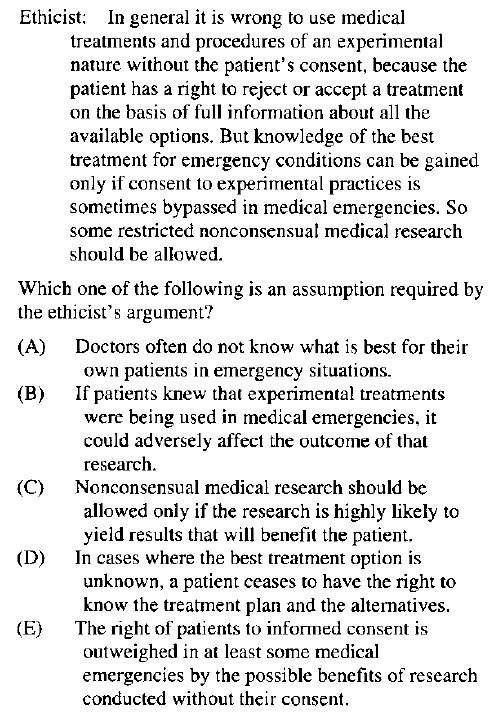
Ethicist: In general it is wrong to use medical treatments and procedures of an experimental nature without the patient's consent, because the patient has a right to reject or accept a treatment on the basis of full information about all the available options. But knowledge of the best treatment for emergency conditions can be gained only if consent to experimental practices is sometimes bypassed in medical emergencies. So some restricted nonconsensual medical research should be allowed.
Which one of the following is an assumption required by the ethicist's argument?
(A) Doctors often do not know what is best for their own patients in emergency situations.
(B) If patients knew that experimental treatments were being used in medical emergencies, it could adversely affect the outcome of that research.
(C) Nonconsensual medical research should be allowed only if the research is highly likely to yield results that will benefit the patient.
(D) In cases where the best treatment option is unknown, a patient ceases to have the right to know the treatment plan and the alternatives.
(E) The right of patients to informed consent is outweighed in at least some medical emergencies by the possible benefits of research conducted without their consent.
medical treatment.jpg [ 174.61 KiB | Viewed 17311 times ]
Which one of the following is an assumption required by the ethicist's argument?
(A) Doctors often do not know what is best for their own patients in emergency situations.
(B) If patients knew that experimental treatments were being used in medical emergencies, it could adversely affect the outcome of that research.
(C) Nonconsensual medical research should be allowed only if the research is highly likely to yield results that will benefit the patient.
(D) In cases where the best treatment option is unknown, a patient ceases to have the right to know the treatment plan and the alternatives.
(E) The right of patients to informed consent is outweighed in at least some medical emergencies by the possible benefits of research conducted without their consent.
Attachment:
medical treatment.jpg [ 174.61 KiB | Viewed 17311 times ]

 30 Mar 2011, 08:36
Kudos
Bookmarks
(1) in general it is wrong to use experimental medical treatments/procedures w/out patient's consent.
(2) knowledge of best treatment for mergency conditions can be gained only if consent to experimental procedures is bypassed in medical emergencies.
conclusion - some nonconsensual medical research should be allowed.
(A) is implied. in (2) it is implied that the doctors dont already know the best treatment. this is basically a restatement of one of the premises, not an assumption.
(B) this is not claimed. and it is not required to reach the conclusion.
(C) this is not claimed. the argument is saying that consent should be bypassed so that more information can be gained regarding best course of action in emergencies.
(D) mis-stating the overall argument. the argument is about in cases that are emergencies, not cases that the best treatment option is unknown.
(E) correct, in taking (1) and (2) and reaching the conclusion, it's indicating that gaining knowledge is more important in certain situations.
(2) knowledge of best treatment for mergency conditions can be gained only if consent to experimental procedures is bypassed in medical emergencies.
conclusion - some nonconsensual medical research should be allowed.
(A) is implied. in (2) it is implied that the doctors dont already know the best treatment. this is basically a restatement of one of the premises, not an assumption.
(B) this is not claimed. and it is not required to reach the conclusion.
(C) this is not claimed. the argument is saying that consent should be bypassed so that more information can be gained regarding best course of action in emergencies.
(D) mis-stating the overall argument. the argument is about in cases that are emergencies, not cases that the best treatment option is unknown.
(E) correct, in taking (1) and (2) and reaching the conclusion, it's indicating that gaining knowledge is more important in certain situations.
 15 Sep 2011, 22:35
Kudos
Bookmarks
A, B and C are irrelevant. They aren't assumptions.
D talks about unknown treatments - out of scope
E is the answer.
D talks about unknown treatments - out of scope
E is the answer.









