Events & Promotions
|
|

GMAT Club Daily Prep
Thank you for using the timer - this advanced tool can estimate your performance and suggest more practice questions. We have subscribed you to Daily Prep Questions via email.
Customized
for You
Track
Your Progress
Practice
Pays
Not interested in getting valuable practice questions and articles delivered to your email? No problem, unsubscribe here.
 Sep 02
08:00 PM PDT
-09:00 PM PDT
Video explanations + diagnosis of 10 weakest areas + 150+ short videos + study plan! Sep 03
01:30 AM EDT
-02:30 AM EDT
At one point, she believed GMAT wasn’t for her. After scoring 595, self-doubt crept in and she questioned her potential. But instead of quitting, she made the right strategic changes. The result? A remarkable comeback to 695. Check out how Saakshi did it. Aug 27
10:00 AM EDT
-11:00 AM EDT
We’ve worked incredibly hard to build TTP into the best test prep experience possible, and it would mean a lot to us to win Newsweek’s 2026 Readers’ Choice Award for Best Test Prep. If TTP has helped you, we’d be incredibly grateful for your vote. Sep 02
12:30 AM EDT
-01:30 AM EDT
Thought your job leaves no time for GMAT prep? After multiple GMAT attempts and a demanding consulting job, Kshitij improved to 695 in under 2 months. Learn the mindset shifts, study strategy, and execution changes that made the breakthrough possible. Sep 04
10:00 AM PDT
-11:00 AM PDT
What does test anxiety really look like on the GMAT? For many test takers, it does not look like a panic attack. Instead, it shows up as brain fog, rereading, negative comparisons, mental noise.... Sep 06
09:30 AM EDT
-12:30 PM EST
Top scores are possible when you enroll in a powerful EA course, taught live online + 6 months access to TTP OnDemand video courses included! Perfect class schedule and easy course access for working professionals. Class starts Sundays Sept. 6, 2026.- Sep 07
12:01 AM PDT
-11:59 PM PDT
On the 7th, GMAT Club Tests will be Free! Including all the Quizzes, Questions, and Tests. 12 AM - 11:59 PM PDT - Sep 09
07:00 AM PDT
-10:00 AM PDT
Meet AdComs and explore top Master’s programs - MiM, MiF, MSc, MSBA and more. - Application Fee Waivers - Free 1-Week of GMAT Club Tests: - Master's Application Toolkit - Grand Prize Giveaway  Sep 15
07:00 PM EDT
-09:00 PM EST
Elite scores are possible when you enroll in a powerful GMAT course, taught live online + 6 months access to TTP OnDemand video courses included! Class starts Tues/Thurs Sept. 15, 2026 - Nov. 15, 2027, 7:00pm-9:00pm EST Sep 21
08:00 PM EDT
-10:00 PM EDT
Boost your GMAT score in less than one month in a live online class + 6 months access to TTP OnDemand video courses included! Class starts Mon, Tues, Wed, Thur, Fri Sept. 21, 2026 - Oct. 9, 2027, 7:00pm-10:00pm EST


A
Be sure to select an answer first to save it in the Error Log before revealing the correct answer (OA)!
Difficulty:
 25%
(medium)
25%
(medium)
Question Stats:
77% (01:30) correct 23%
(01:55)
wrong
based on 2504
sessions
23%
(01:55)
wrong
based on 2504
sessions
History
Date
Time
Result
Not Attempted Yet
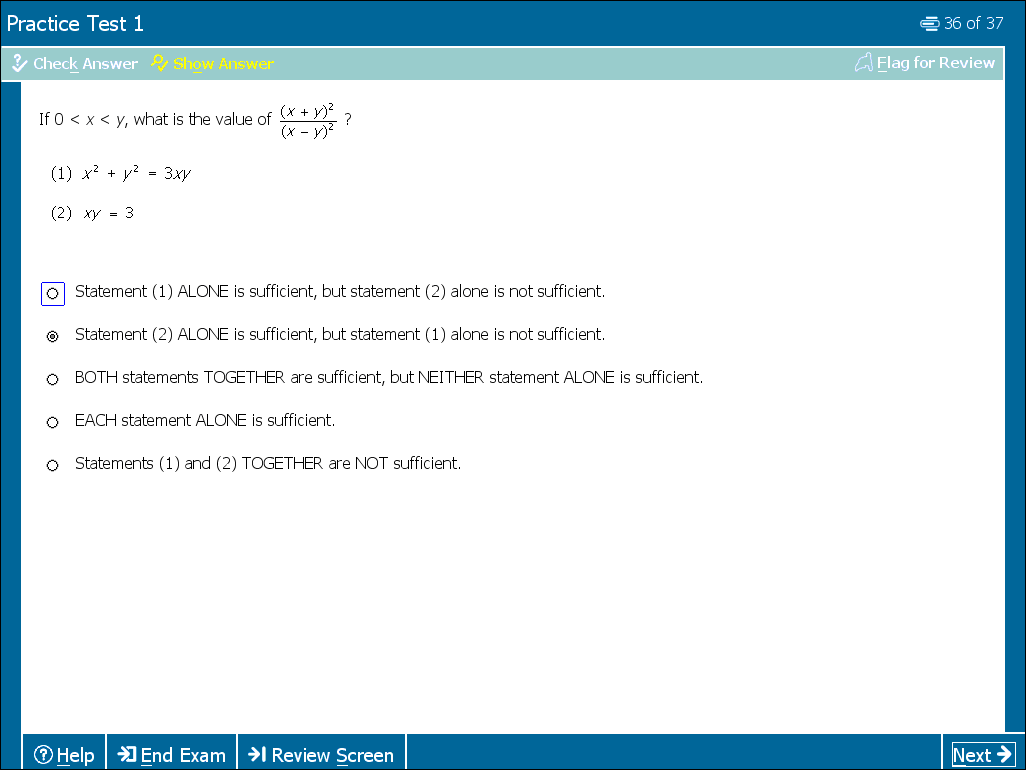
If 0 < x < y, what is the value of \(\frac{(x + y)^2}{(x- y)^2}\)?
(1) \(x^2 + y^2 = 3xy\)
(2) \(xy = 3\)
15.gif [ 19.21 KiB | Viewed 19752 times ]
(1) \(x^2 + y^2 = 3xy\)
(2) \(xy = 3\)
Attachment:
15.gif [ 19.21 KiB | Viewed 19752 times ]


 24 Mar 2013, 02:40
Kudos
Bookmarks
If 0 < x < y, what is the value of (x + y)^2/( x- y)^2?
\(\frac{(x + y)^2}{( x- y)^2}=\frac{x^2+2xy+y^2}{x^2-2xy+y^2}\)
(1) x^2 + y^2 = 3xy. Substitute: what is the value of \(\frac{x^2+2xy+y^2}{x^2-2xy+y^2}=\frac{3xy+2xy}{3xy-2xy}=\frac{5xy}{xy}=5\). Sufficient.
(2) xy = 3. Not sufficient.
Answer: A.
\(\frac{(x + y)^2}{( x- y)^2}=\frac{x^2+2xy+y^2}{x^2-2xy+y^2}\)
(1) x^2 + y^2 = 3xy. Substitute: what is the value of \(\frac{x^2+2xy+y^2}{x^2-2xy+y^2}=\frac{3xy+2xy}{3xy-2xy}=\frac{5xy}{xy}=5\). Sufficient.
(2) xy = 3. Not sufficient.
Answer: A.
 24 Mar 2013, 00:29
Kudos
Bookmarks
1)
x^2+y^2=3xy => x^2+y^2-2xy=xy => (x-y)^2=xy
So you can replace : (x+y)^2/xy
And then just finish the work : (x+y)^2/xy => (x^2+y^2+2xy)/xy => (3xy+2xy)/xy => 5
1 is enough
2) not enough. (x+y)^2/(x-y)^2 => (x^2+y^2+2xy)/(x^2+y^2-2xy) => (x^2+y^2+6)/(x^2+y^2-6) => you can't know the value of x^2 or y^2
Hope it helps.
x^2+y^2=3xy => x^2+y^2-2xy=xy => (x-y)^2=xy
So you can replace : (x+y)^2/xy
And then just finish the work : (x+y)^2/xy => (x^2+y^2+2xy)/xy => (3xy+2xy)/xy => 5
1 is enough
2) not enough. (x+y)^2/(x-y)^2 => (x^2+y^2+2xy)/(x^2+y^2-2xy) => (x^2+y^2+6)/(x^2+y^2-6) => you can't know the value of x^2 or y^2
Hope it helps.







