Last visit was: 21 Apr 2026, 20:21 It is currently 21 Apr 2026, 20:21
Close
GMAT Club Daily Prep
Thank you for using the timer - this advanced tool can estimate your performance and suggest more practice questions. We have subscribed you to Daily Prep Questions via email.

Customized
for You

we will pick new questions that match your level based on your Timer History

Track
Your Progress

every week, we’ll send you an estimated GMAT score based on your performance

Practice
Pays

we will pick new questions that match your level based on your Timer History
Not interested in getting valuable practice questions and articles delivered to your email? No problem, unsubscribe here.
Close
Request Expert Reply
Confirm Cancel
User avatar
LM
Joined: 03 Sep 2006
Last visit: 04 Apr 2015
Posts: 444
Own Kudos:
7,888
 [209]
Given Kudos: 33
Posts: 444
Kudos: 7,888
 [209]
10
Kudos
Add Kudos
199
Bookmarks
Bookmark this Post
Most Helpful Reply
User avatar
RaviChandra
Joined: 02 Oct 2009
Last visit: 06 Feb 2023
Posts: 305
Own Kudos:
4,311
 [31]
Given Kudos: 412
GMAT 1: 530 Q47 V17
GMAT 2: 710 Q50 V36
WE:Business Development (Consulting)
Products:
GMAT 2: 710 Q50 V36
Posts: 305
Kudos: 4,311
 [31]
24
Kudos
Add Kudos
6
Bookmarks
Bookmark this Post
User avatar
BrentGMATPrepNow
User avatar
Major Poster
Joined: 12 Sep 2015
Last visit: 31 Oct 2025
Posts: 6,733
Own Kudos:
36,441
 [25]
Given Kudos: 799
Location: Canada
Expert
Expert reply
Posts: 6,733
Kudos: 36,441
 [25]
16
Kudos
Add Kudos
9
Bookmarks
Bookmark this Post
General Discussion
User avatar
abhas59
Joined: 06 Mar 2010
Last visit: 31 Dec 2010
Posts: 56
Own Kudos:
23
 [6]
Given Kudos: 11
Posts: 56
Kudos: 23
 [6]
6
Kudos
Add Kudos
Bookmarks
Bookmark this Post
The arguement here describes a plan by city government to stop "serious" crimes teenagers commit and thereafter, the argument criticizes the plan as "most" crimes commited by teenagers are in afternoon.
Please emphasize on the word "serious" used in favour & "most" used to oppose. If any option proves that "most" crimes committed are not serious, then the government plan will still hold true as its main purpose is to decrease "serious" crimes.

Hence option B is the best choice among others.
User avatar
crick20002002
Joined: 29 Aug 2010
Last visit: 05 Oct 2012
Posts: 283
Own Kudos:
562
 [2]
Given Kudos: 37
Status:Prep started for the n-th time
Posts: 283
Kudos: 562
 [2]
2
Kudos
Add Kudos
Bookmarks
Bookmark this Post
+1 for B

Conclusion of the argument : they(the steps) are unlikely to affect the problem that concerns citizens.

The Key player in the conclusion is "the problem", which is defined in the first sentence of the argument => Citizens of parktown are worried by the increased frequency of serious crimes committed by local teenagers

B weakens the argument by suggesting that crimes that would be committed by teenagers would not be serious crimes.

Crick
User avatar
mejia401
Joined: 15 Sep 2011
Last visit: 26 Nov 2018
Posts: 251
Own Kudos:
1,438
 [7]
Given Kudos: 46
Location: United States
WE:Corporate Finance (Manufacturing)
Posts: 251
Kudos: 1,438
 [7]
4
Kudos
Add Kudos
3
Bookmarks
Bookmark this Post
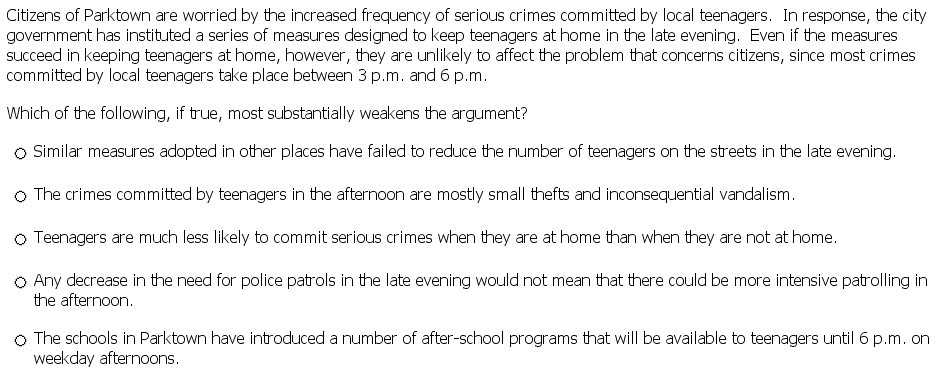
Conclusion: they are unlikely to affect the problem that concerns citizens, since most crimes committed by local teenagers take place between 3 p.m. and 6 p.m.

Reasoning: The incorrect answers are ones that strengthen the answer choices or others that are neutral. Weakening the conclusion must attack the conclusion so as to prove that it's not likely crimes are committed between 3 pm to 6 pm (with the series of measures instituted)

A. Similar measure adopted in other places have failed to reduce the number of teenagers on the streets in the late evening Wrong - opposite answer; we need why the measures work. It's certainly a trap answer.

B. The crimes committed by teenagers in the afternoon are mostly small thefts and inconsequential vandalism. Correct - "serious" modifies the crimes, whereas the "small" and "inconsequential" modify most of the crimes that occur from 3pm to 6pm.

C. Teenagers are much less likely to commit serious crimes when they are at home than when they are not at home. Wrong - Neutral. Indeed teenagers can't commit serious crimes when they are at home.

D. Any decrease in the need for police patrols in the late evening would not mean that there could be more intensive patrolling in the afternoon. Wrong - opposite answer. This is opposite because the answer must weaken the conclusion that the measures are likely to succeed.

E. The schools in Parktown have introduced a number of after-school programs that will be available to teenagers until 6 p.m. on weekday afternoons. [color=#ed1c24]Wrong - this does not properly weaken the conclusion because we don't know if the teenagers will attend /color]

IMO B
avatar
JaneDobbbs
Joined: 02 Oct 2014
Last visit: 28 Jul 2016
Posts: 6
Own Kudos:
4
 [2]
Given Kudos: 8
Posts: 6
Kudos: 4
 [2]
2
Kudos
Add Kudos
Bookmarks
Bookmark this Post
Here's how I would answer this weaken the argument question:
First, Summarize the main point - Increase in serious crimes by teens therefore current plan is to keep teens indoors at night.
Second, State the assumption -Most Serious crimes happen between 3pm and 6pm only/daytime
Goal - Destroy the assumption

Option A: Out of scope - similar measures adopted in other places is irrelevant to this argument
Option B: Correct - The crimes committed by teenagers in the afternoon are mostly small thefts and inconsequential vandalism - This destroys the assumption that most serious crimes are committed between 3pm and 6pm or daytime only.
Option C: Out of scope - Redundant information and also no mention of the actual time of day
Option D: Completely Out of scope
Option E: Warp answer - Kind of addresses a part of the argument but not fully because it only takes the weekdays into account

Hope this makes sense
avatar
SamBoyle
Joined: 31 Dec 2016
Last visit: 25 Oct 2017
Posts: 40
Own Kudos:
74
 [2]
Given Kudos: 22
Posts: 40
Kudos: 74
 [2]
2
Kudos
Add Kudos
Bookmarks
Bookmark this Post
A. Similar measure adopted in other places have failed to reduce the number of teenagers on the streets in the late evening

This strengthens his argument that it won't work

B. The crimes committed by teenagers in the afternoon are mostly small thefts and inconsequential vandalism.

This one looks good for now. His conclusion is that most crimes happen between 3PM and 6PM and therefore unlikely to help concerned citizens. However, this sells all the crimes are small so this is a good answer.


C. Teenagers are much less likely to commit serious crimes when they are at home than when they are not at home.

This conclusion if true is fine but it doesn't weaken the authors argument that most crimes happen between 3-6PM. So he says fine it will work from 7-10PM but it won't work from 3-6 when they are not at home. So it is out of the scope. It restates what we know.


D. Any decrease in the need for police patrols in the late evening would not mean that there could be more intensive patrolling in the afternoon.

Notice the weird use of not after "would." Also GMAT doesn't like weak language like "there could be." Clearly this could doesn't substantially weaken his argument. It does weaken but not substantially cuz of weak language. Also the weird negative may mean not at all.


E. The schools in Parktown have introduced a number of after-school programs that will be available to teenagers until 6 p.m. on weekday afternoons.

This is probably the second best answer. GMAT doesn't like you to assume to much. So we have no data if the students will attend or anything. So this weakens a little bit. Also, one would think the students committing the crimes wouldn't attend these programs anyways.


so the answer is B, E is the second closest
User avatar
dcummins
Joined: 14 Feb 2017
Last visit: 16 Mar 2026
Posts: 1,021
Own Kudos:
2,377
 [4]
Given Kudos: 368
Location: Australia
Concentration: Technology, Strategy
GMAT 1: 560 Q41 V26
GMAT 2: 550 Q43 V23
GMAT 3: 650 Q47 V33
GMAT 4: 650 Q44 V36
GMAT 5: 600 Q38 V35
GMAT 6: 710 Q47 V41
WE:Management Consulting (Consulting)
Products:
4
Kudos
Add Kudos
Bookmarks
Bookmark this Post
Conclusion: The police program will not affect the increased frequency of serious crimes committed by local teenagers

Premise: most crimes take place between 3pm and 6pm
Prem2: The plan is to keep teenagers at home in the late evening

Weaken the conclusion

A - what is true of other places may not be true of this place. Incorrect.
B -
Afternoon = 12pm till sunset (typically 6pm)
Evening =part of the day between end of afternoon and night
Late evening = into the night

B is correct as it says that since most crimes occur between 3pm and 6pm are not serious, the serious crimes could either be committed in the morning or the evening, so potentially the plan will have its desired affect.

B is correct.

C is incorrect as it says that since most serious crimes are comitted outdoors the citizens still have cause for concern that serious crimes will increase since most of the crimes are comitted in the late afternoon.
We would need to spin more of a story than B to determine when exactly the serious crimes would be committed.

D is incorrect - it appears to strengthen the argument as D says that police patrol resources won't be re-routed to reduce crimes taking place between 3 and 6pm, so there is still cause for concern that serious crimes occur here.

E is incorrect - we don't know whether teenagers will take up these programs to start. Second, if the schools have already introduced the program --as indicated-- but the crimes are still taking place, then this program is obviously failing
User avatar
TheAlchemist36
Joined: 19 Oct 2021
Last visit: 03 Nov 2022
Posts: 12
Own Kudos:
Given Kudos: 50
Location: India
Posts: 12
Kudos: 3
Kudos
Add Kudos
Bookmarks
Bookmark this Post
I tried to work with numbers here but somehow can't justify B as the answer.

Let's say there are 100 crimes in Total out of which 45 are 'Not Serious' and 55 are 'Serious' (increased frequency of serious crimes)
Let crimes between 3-6 PM be 80(most) and post 6 PM be 20.
If I take into account statement B,
Let's assume 'Not Serious' crimes in afternoon=45 and 'Serious' crimes=35
Then, 'Not Serious' crimes in evening=0 and 'Serious' crimes=20.
So effectively, by deploying curfew in the evening, Serious crimes eliminated =20. Rest of the 35 are still being committed in the afternoon.
Can this plan be called effective?
GMATNinja GMATNinja2 ThatDudeKnows
RonTargetTestPrep avigutman ExpertsGlobal5
ChiranjeevSingh KarishmaB
User avatar
avigutman
Joined: 17 Jul 2019
Last visit: 30 Sep 2025
Posts: 1,285
Own Kudos:
1,906
 [1]
Given Kudos: 66
Location: Canada
GMAT 1: 780 Q51 V45
GMAT 2: 780 Q50 V47
GMAT 3: 770 Q50 V45
Expert
Expert reply
GMAT 3: 770 Q50 V45
Posts: 1,285
Kudos: 1,906
 [1]
1
Kudos
Add Kudos
Bookmarks
Bookmark this Post
TheAlchemist36
By deploying curfew in the evening, Serious crimes eliminated =20. Rest of the 35 are still being committed in the afternoon.
Can this plan be called effective?
The language we're trying to weaken is this:
Quote:
[keeping teenagers at home in the late evening is] unlikely to affect the problem that concerns citizens [that problem being increased frequency of serious crimes committed by local teenagers]
So, you shouldn't ask whether this plan can be called effective, TheAlchemist36. Instead, you should ask whether this plan is likely to affect the increased frequency of serious crimes committed by local teenagers.
User avatar
KarishmaB
Joined: 16 Oct 2010
Last visit: 21 Apr 2026
Posts: 16,438
Own Kudos:
79,375
 [3]
Given Kudos: 484
Location: Pune, India
Expert
Expert reply
Active GMAT Club Expert! Tag them with @ followed by their username for a faster response.
Posts: 16,438
Kudos: 79,375
 [3]
3
Kudos
Add Kudos
Bookmarks
Bookmark this Post
TheAlchemist36
I tried to work with numbers here but somehow can't justify B as the answer.

Let's say there are 100 crimes in Total out of which 45 are 'Not Serious' and 55 are 'Serious' (increased frequency of serious crimes)
Let crimes between 3-6 PM be 80(most) and post 6 PM be 20.
If I take into account statement B,
Let's assume 'Not Serious' crimes in afternoon=45 and 'Serious' crimes=35
Then, 'Not Serious' crimes in evening=0 and 'Serious' crimes=20.
So effectively, by deploying curfew in the evening, Serious crimes eliminated =20. Rest of the 35 are still being committed in the afternoon.
Can this plan be called effective?
GMATNinja GMATNinja2 ThatDudeKnows
RonTargetTestPrep avigutman ExpertsGlobal5
ChiranjeevSingh KarishmaB

Increased frequency of serious crime does not mean that most crimes committed by teenagers are serious now. In fact, from our general awareness, we could say that teenagers usually commit petty crimes (shoplifting, vandalism etc.) but say 5% are serious crimes. Even if it goes up to 10%, we would say that the frequency of serious crime has increased.
The author says that the plan of keeping teenagers home post 6 pm will not work because most teenager crimes occur between 3 to 6. But what if most of these crimes occurring between 3 to 6 are petty crimes and the serious ones occur after 6 pm. Then the plan of keeping teenagers home after 6 pm will help curb serious crime and those crimes are the ones that really bother the community.
Hence, the author's claim that the plan is useless is weakened.
User avatar
GMATNinja
User avatar
GMAT Club Verbal Expert
Joined: 13 Aug 2009
Last visit: 21 Apr 2026
Posts: 7,391
Own Kudos:
70,794
 [2]
Given Kudos: 2,129
Status: GMAT/GRE/LSAT tutors
Location: United States (CO)
GMAT 1: 780 Q51 V46
GMAT 2: 800 Q51 V51
GRE 1: Q170 V170
GRE 2: Q170 V170
Products:
Expert
Expert reply
GMAT 2: 800 Q51 V51
GRE 1: Q170 V170
GRE 2: Q170 V170
Posts: 7,391
Kudos: 70,794
 [2]
2
Kudos
Add Kudos
Bookmarks
Bookmark this Post
TheAlchemist36
I tried to work with numbers here but somehow can't justify B as the answer.

Let's say there are 100 crimes in Total out of which 45 are 'Not Serious' and 55 are 'Serious' (increased frequency of serious crimes)
Let crimes between 3-6 PM be 80(most) and post 6 PM be 20.
If I take into account statement B,
Let's assume 'Not Serious' crimes in afternoon=45 and 'Serious' crimes=35
Then, 'Not Serious' crimes in evening=0 and 'Serious' crimes=20.
So effectively, by deploying curfew in the evening, Serious crimes eliminated =20. Rest of the 35 are still being committed in the afternoon.
Can this plan be called effective?
GMATNinja GMATNinja2 ThatDudeKnows
RonTargetTestPrep avigutman ExpertsGlobal5
ChiranjeevSingh KarishmaB
Well, even in your example, the plan helps reduce the serious crimes by nearly 40%. That's not too bad!

But forget about the numbers for a second. The author says, "a curfew won't help because MOST of the crimes are committed in the afternoons." Fair enough... that's certainly a good reason to question whether the curfew will help. Does it PROVE that the curfew won't work? Nope. We could pick some convenient numbers to show that the curfew might still help. Regardless, the author points out a potential weakness in the plan.

Now imagine that a random guy -- let's call him Tim -- stands up to the author and says, "Yeah, but the teens don't commit many SERIOUS crimes in the afternoon. Since we're only worried about the SERIOUS crimes, we don't care so much about the afternoon ones -- that's why we're focusing on the evening crimes."

Sure, we could pick some numbers to show that the curfew might not be a sweeping success, but that's not the point. We aren't trying to PROVE that the curfew will work. We're just trying to come up with something that hurts the author's argument.

Tim's point shows that the curfew might still be very effective DESPITE the point that the author made. If only a small percentage of the serious crimes occur in the afternoon, then a curfew is a great idea! So (B) weakens the argument, even though it doesn't prove or disprove anything.

I hope that helps a bit!
User avatar
krndatta
Joined: 09 Feb 2020
Last visit: 17 Oct 2024
Posts: 380
Own Kudos:
Given Kudos: 433
Location: India
Posts: 380
Kudos: 46
Kudos
Add Kudos
Bookmarks
Bookmark this Post
KarishmaB Ma'am,

Option C says teenagers are less likely to commit serious crimes when they are at home. If this is the case, then doesn't this weaken the conclusion. Teenagers will stay at home, and this would make them less likely to commit serious crimes. Hence, this weakens the conclusion. This directly affects the problem at hand.

I am aware that the time when they stay home is not the time when SERIOUS crimes are committed. But by virtue of them staying home would make them less likely to commit serious crimes. (What is wrong with this interpretation?)

Please share your two cents.
User avatar
KarishmaB
Joined: 16 Oct 2010
Last visit: 21 Apr 2026
Posts: 16,438
Own Kudos:
79,375
 [1]
Given Kudos: 484
Location: Pune, India
Expert
Expert reply
Active GMAT Club Expert! Tag them with @ followed by their username for a faster response.
Posts: 16,438
Kudos: 79,375
 [1]
1
Kudos
Add Kudos
Bookmarks
Bookmark this Post
krndatta
KarishmaB Ma'am,

Option C says teenagers are less likely to commit serious crimes when they are at home. If this is the case, then doesn't this weaken the conclusion. Teenagers will stay at home, and this would make them less likely to commit serious crimes. Hence, this weakens the conclusion. This directly affects the problem at hand.

I am aware that the time when they stay home is not the time when SERIOUS crimes are committed. But by virtue of them staying home would make them less likely to commit serious crimes. (What is wrong with this interpretation?)

Please share your two cents.

Conclusion: The plan of keeping children at home after 6:00 pm to reduce serious crime will not work.
We need to weaken it. So we need to say that the plan will work.

(C) Teenagers are much less likely to commit serious crimes when they are at home than when they are not at home

This option tells us something that our plan already assumes and it makes sense to assume it - if teenagers are home, they are less likely to commit crimes. It tells us only that after 6:00 PM (when teenagers are at home) they are much less likely to commit serious crimes. Great. But what if they commit serious crime before 6:00 PM? Then will the plan work? No. So are implying that the plan will work? No.
This option doesn't specify exactly when the crime are committed.

(B) Crimes committed by teenagers in afternoon are mostly small thefts and inconsequential vandalism

This option tells us that there are few serious crime in afternoon i.e. most serious crimes take place in the evening. Then if the teenagers are home at that time, they will not commit crimes and hence serious crimes will be avoided. So our plan will work.

Therefore, (B) weakens the conclusion.
User avatar
monkinaferrari
Joined: 04 Aug 2022
Last visit: 14 Apr 2026
Posts: 32
Own Kudos:
Given Kudos: 306
Products:
Posts: 32
Kudos: 3
Kudos
Add Kudos
Bookmarks
Bookmark this Post
I was stuck between B and E.

I rejected B because I thought the teens can probably alter their behavior. Its not like they have picked the afternoon slot for doing small crimes and evening slots for big crimes. Putting a curfew on evening can very well alter teens behaviour to shift the serious crimes to afternoon.
We are using similar logic to reject E right? "weekdays". What about changing their behaviour to crime crimes on "weekends".

any inputs?
User avatar
GMATNinja
User avatar
GMAT Club Verbal Expert
Joined: 13 Aug 2009
Last visit: 21 Apr 2026
Posts: 7,391
Own Kudos:
70,794
 [1]
Given Kudos: 2,129
Status: GMAT/GRE/LSAT tutors
Location: United States (CO)
GMAT 1: 780 Q51 V46
GMAT 2: 800 Q51 V51
GRE 1: Q170 V170
GRE 2: Q170 V170
Products:
Expert
Expert reply
GMAT 2: 800 Q51 V51
GRE 1: Q170 V170
GRE 2: Q170 V170
Posts: 7,391
Kudos: 70,794
 [1]
1
Kudos
Add Kudos
Bookmarks
Bookmark this Post
monkinaferrari
I was stuck between B and E.

I rejected B because I thought the teens can probably alter their behavior. Its not like they have picked the afternoon slot for doing small crimes and evening slots for big crimes. Putting a curfew on evening can very well alter teens behaviour to shift the serious crimes to afternoon.
We are using similar logic to reject E right? "weekdays". What about changing their behaviour to crime crimes on "weekends".

any inputs?
As you suggest, it's certainly possible that teenagers could alter their behavior in any number of ways. But when considering the answer choices, we should make sure our thinking is always supported by information in the passage.

Let's start with (E):

Quote:
Which of the following, if true, most substantially weakens the argument ?

(E) The schools in Parktown have introduced a number of after school programs that will be available to teenagers until 6pm on weekday afternoons
The conclusion we're trying to weaken is that keeping teenagers home in the late evening is unlikely to affect the frequency of serious crimes committed by teenagers. So the fact that there is an after school program from 3pm to 6pm is irrelevant. We're concerned specifically with the effects of the measure that keeps teenagers home in the late evening (i.e. after 6pm).

Looking at this from another angle: we don't know if anyone will go to the after school program, or if it will be effective, so it's hard to draw any conclusions from (E). Yet either way, whether the after school program succeeds or fails, we don't know how it might impact the measure we care about.

Bottom line, we could speculate about how this program might effect teenagers' behavior. But we couldn't really support those speculations, so they couldn't helps us weaken the argument. Eliminate (E).

Here's (B) again:

Quote:
(B) Crimes committed by teenagers in afternoon are mostly small thefts and inconsequential vandalism
The passage concludes that the measure of keeping teenagers home in the late evening is unlikely to affect the problem of serious crimes committed by teenagers. To support this argument, the passage tells us that "most crimes committed by teenagers take place between 3pm and 6pm." So according to this argument, in order to succeed, the measure should keep teens home between 3pm and 6pm, not the late evening.

Notice that (B) weakens this argument. It may be that most crimes committed by teenagers' happen between 3pm and 6pm. But most of those aren't serious crimes. So 3pm to 6pm wouldn't be a good time to keep teenagers at home.

On the other hand, the passage tells us there is an "increased frequency of serious crimes committed by local teenagers." And if the crimes between 3pm and 6pm are mostly NOT serious, then the serious crimes must be happening at other times (such as the late evening). And if that's the case, then the measure would be effective.

So, since (B) weakens the argument, it's correct.

I hope that helps!
User avatar
Raman109
Joined: 17 Aug 2009
Last visit: 28 Jul 2025
Posts: 706
Own Kudos:
Given Kudos: 33
Posts: 706
Kudos: 212
Kudos
Add Kudos
Bookmarks
Bookmark this Post
Understanding the argument -
Problem - Citizens are worried about the increased frequency of serious crimes committed by local teenagers
Plan - The city government has instituted a series of measures designed to keep teenagers at home in the late evening. (Keep in mind that the scope of our argument is limited to this plan.)
Conclusion - The plan (which plan - the one cited above and not any other plan) is unlikely to affect the problem. What problem? The serious crime.
What is the support the author uses for the conclusion - most crimes committed by local teenagers take place between 3 pm and 6 pm. Most crimes? Serious or non-serious - we don't know. What if only non-serious crimes occur between 3 pm and 6 pm - then we are using apples to justify oranges. But if these are serious crimes, then the objection is valid.

Option Elimination -


(A) Similar measures adopted in other place have failed to reduce the number of teenagers in the late evening - Strengthener.

(B) Crimes committed by teenagers in afternoon are mostly small thefts and inconsequential vandalism - exactly.

(C) Teenagers are much less likely to commit serious crimes when they are at home than when they are not at home - Strengthener.

(D) Any decrease in the need for police patrols in late evening would not mean that there could be more intensive patrolling in the afternoon - Strengthener.

(E) The schools in Parktown have introduced a number of after school programs that will be available to teenagers until 6pm on weekday afternoons - Alternate plan, out of scope.
User avatar
sriramsundaram91
Joined: 12 Mar 2018
Last visit: 21 Apr 2026
Posts: 78
Own Kudos:
Given Kudos: 116
GMAT 1: 630 Q49 V27
GPA: 4
Products:
GMAT 1: 630 Q49 V27
Posts: 78
Kudos: 89
Kudos
Add Kudos
Bookmarks
Bookmark this Post
If you "critically" read the passage, you will find there are 2 types of crimes serious and non-serious committed by the teenagers. If government blocked teenagers from going out late in the evening, and finally you want to reduce "serious" crime frequencies.

If you can prove that serious crimes happened only in the late evening this could explain that the Government did the right job, therefore the option that does it is by saying most crimes between 3-6PM aren't serious.
Moderators:
GMAT Club Verbal Expert
7391 posts
495 posts
358 posts