Events & Promotions
|
|

GMAT Club Daily Prep
Thank you for using the timer - this advanced tool can estimate your performance and suggest more practice questions. We have subscribed you to Daily Prep Questions via email.
Customized
for You
Track
Your Progress
Practice
Pays
Not interested in getting valuable practice questions and articles delivered to your email? No problem, unsubscribe here.
 Sep 24
01:30 AM EDT
-01:30 AM EDT
Tejas studied hard but kept repeating the same mistakes. After 3 attempts at 645, a focused 4-week strategy helped him identify and fix what was holding him back—leading to a 695 with just 12–15 hours of study per week. Sep 24
08:00 AM EDT
-08:30 AM EDT
Meet Tuck at an informal student or staff-hosted coffee chat in a city near you! Sep 23
12:30 AM EDT
-01:30 AM EDT
Learn how Keshav, a Chartered Accountant, scored an impressive 705 on GMAT in just 30 days with GMATWhiz's expert guidance. In this video, he shares preparation tips and strategies that worked for him, including the mock, time management, and more Sep 26
01:00 PM EDT
-04:00 PM EDT
Top scores are possible when you enroll in a powerful GMAT course, taught live online + 6 months access to TTP OnDemand video courses included. Class starts Saturdays Sept. 26, 2026 - Dec. 19, 2026, 1:00pm-4:00pm ES Sep 26
06:00 PM PDT
-07:00 PM PDT
Free- full-length test + 15 concept videos + 150+ short videos + study plan! Sep 29
11:00 AM EDT
-01:00 PM EDT
" Description: Top scores are possible when you enroll in a powerful GMAT course, taught live online + 6 months access to TTP OnDemand video courses included! Class starts Tues/Thur Sept. 29, 2026 - Dec. 3, 2026, 11:00am-1:00pm EST Oct 01
07:00 AM BST
-08:00 AM GMT
Welcome to the GMAT Club's Free Interview Prep Event for Top MBA Programs! Buy tickets - Virtual series that’s all set to equip you to -excel in your MBA interviews.


 10 Feb 2016, 11:20
Kudos
Bookmarks


E
Be sure to select an answer first to save it in the Error Log before revealing the correct answer (OA)!
Difficulty:
 95%
(hard)
95%
(hard)
Question Stats:
53% (03:03) correct 47%
(02:53)
wrong
based on 251
sessions
47%
(02:53)
wrong
based on 251
sessions
History
Date
Time
Result
Not Attempted Yet
In triangle ABC, if angle ABC is 30 degrees, \(AC = 2*\sqrt 2\) and AB = BC = X, what is the value of X?
(A) \(\sqrt 3 – 1\)
(B) \(\sqrt 3 + 2\)
(C) \(\frac{(\sqrt 3 – 1)}{2}\)
(D) \(\frac{(\sqrt 3 + 1)}{2}\)
(E) \(2*(\sqrt 3 + 1)\)
(A) \(\sqrt 3 – 1\)
(B) \(\sqrt 3 + 2\)
(C) \(\frac{(\sqrt 3 – 1)}{2}\)
(D) \(\frac{(\sqrt 3 + 1)}{2}\)
(E) \(2*(\sqrt 3 + 1)\)


 12 Feb 2016, 07:55
Kudos
Bookmarks
Bunuel
Hi,
Just saw some discussion on this Q, I too will put in my bit to it..
Most of the Qs can be answered by elimination and standard methods...
1) POE
So A straight forward way to eliminate all wrong choices will be
Take B as center of a circle and draw arc AC..
now Arc AC > line AC..
arc AC>2\(\sqrt{2}\)..
arc AC= circumference of circle * \(\frac{30}{360}= 2*\pi*x*\frac{30}{360}= 2*\pi*\frac{x}{12}\)..
so \(2*pi*\frac{x}{12}>2\sqrt{2}\)...
\(x> 2*7*12*2\frac{\sqrt{2}}{(2*22)}\)..
\(x> 84\frac{\sqrt{2}}{22}\)...
this is nearly equal to 4\(\sqrt{2}\) ..
so x is nearly equal to 5.6
lets see the choices..
(A) \(\sqrt{3}-1 \approx 0.73\)
(B) \(\sqrt{3}+2 \approx 3.73\)
(C) \(\frac{\sqrt{3}-1}{2} \approx 0.36\)
(D) \(\frac{\sqrt{3}+1}{2} \approx 1.36\)
(E) \(2(\sqrt{3}+1) \approx 5.46\)
clearly E is the answer
2)algebric way
Although rarely tested, If I see a Q on this line, where an angle and opposite sides are given, apply cosine rule..
This triangle would mean two sides of x with third side 2\(\sqrt{2}\) and opposite angle 30..
\(AC^2=BC^2+AB^2-2*BC*AB*cos 30\)...
\({(2\sqrt{2})}^2=x^2+x^2-2*x*x*\sqrt{3}/2\)
\(8=2x^2-x^2\sqrt{3}\)..
\(x^2=8/(2-\sqrt{3})\)..
we can simplify
E is the answer
Attachments
IMG_5544.JPG [ 1.79 MiB | Viewed 65904 times ]
 Updated on: 08 Jul 2016, 11:44
Originally posted by davedekoos on 11 Feb 2016, 12:44.
Last edited by davedekoos on 08 Jul 2016, 11:44, edited 1 time in total.
Last edited by davedekoos on 08 Jul 2016, 11:44, edited 1 time in total.
Kudos
Bookmarks
There are two approaches to this problem - we can solve it directly, or we can examine the answer choices and come to a conclusion about which one must be correct.
Algebraic approach:
Draw a perpendicular from point A to side BC, label it point D. Draw another perpendicular from point B to side AC, label it point E. Now we have a 30-60-90 triangle and a two similar 15-75-90 triangles. Let the length of CD = a
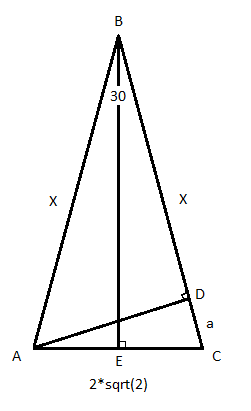
Isosceles Triangle.png [ 4.68 KiB | Viewed 47091 times ]
Now we can use some ratios to figure out x
Looking at triangle ABD, we know that \(\frac{BD}{AB} = \frac{x-a}{x} = \frac{\sqrt{3}}{2}\) (1)
And looking at triangles ADC and BEC (similar triangles) we can see that \(\frac{AC}{DC} = \frac{BC}{EC} = \frac{2\sqrt{2}}{a}=\frac{x}{\sqrt{2}}\) (2)
From (2) \(ax = 4\), or \(a=\frac{4}{x}\)
Cross multiply (1) and plug in \(a=\frac{4}{x}\)
\(2x-2a = \sqrt{3}x\)
\(2x-2(\frac{4}{x})=\sqrt{3}x\)
\(2x-\frac{8}{x}-\sqrt{3}=0\) --> multiply by \(x\)
\(2x^2-8-\sqrt{3}x^2=0\) --> gather terms
\((2-\sqrt{3})x^2=8\)
\(x=\sqrt{\frac{8}{2-\sqrt{3}}}\) --> Now this doesn't look like any of our answer choices, so we will have to manipulate it a bit
\(x=\frac{2\sqrt{2}}{\sqrt{2-\sqrt{3}}}\) --> multiply top and bottom by the conjugate of the denominator to rationalize the denominator
\(x=\frac{2\sqrt{2}*\sqrt{2+\sqrt{3}}}{(\sqrt{2-\sqrt{3}})*(\sqrt{2+\sqrt{3}})}\)
\(x=\frac{2\sqrt{2}*\sqrt{2+\sqrt{3}}}{1}\) --> bring the \(\sqrt{2}\) into the square root
\(x=2\sqrt{4+2\sqrt{3}}\) --> Now rearrange the expression to complete the square within the square root
\(x=2\sqrt{1+2\sqrt{3}+3} = 2\sqrt{(1+\sqrt{3})^2}\)
\(x=2(1+\sqrt{3})\)
Answer: E
WHEW! Ok, now the simpler approach that involves almost no calculation, just a few quick estimates and a good idea of what's going on in the triangle:
Because \(\angle{B}\) is \(30^{\circ}\), and the side opposite \(\angle{B}\) is \(2\sqrt{2}\), we know that the other two sides, x, will be longer than \(2\sqrt{2}\).
\(2\sqrt{2}\) is \(\approx 2.8\)
Now if we look at the answer choices:
(A) \(\sqrt{3}-1 \approx 0.73\)
(B) \(\sqrt{3}+2 \approx 3.73\)
(C) \(\frac{\sqrt{3}-1}{2} \approx 0.36\)
(D) \(\frac{\sqrt{3}+1}{2} \approx 1.36\)
(E) \(2(\sqrt{3}+1) \approx 5.46\)
Immediately we can eliminate A, C and D. To choose between B and E, we need to ask whether x should be almost twice as much as AC, or less than 1.5*AC. Go back to the diagram and look at triangle ABD. Since it is a 30-60-90 triangle, we know that AB (i.e. \(x\)) = 2*AD. Now, though the diagram is not to scale, it is accurate enough to surmise that AD is only slightly less than AC. Therefore, \(x\) should be only slightly less than 2*AC, which matches with answer E.
I recommend the second approach, but it only works well because the answer choices are spread out enough. That being said, I don't think the GMAT will expect you to do the algebraic approach, and will design the answer choices specifically to be able to use approximation.
Cheers
Algebraic approach:
Draw a perpendicular from point A to side BC, label it point D. Draw another perpendicular from point B to side AC, label it point E. Now we have a 30-60-90 triangle and a two similar 15-75-90 triangles. Let the length of CD = a
Attachment:
Isosceles Triangle.png [ 4.68 KiB | Viewed 47091 times ]
Now we can use some ratios to figure out x
Looking at triangle ABD, we know that \(\frac{BD}{AB} = \frac{x-a}{x} = \frac{\sqrt{3}}{2}\) (1)
And looking at triangles ADC and BEC (similar triangles) we can see that \(\frac{AC}{DC} = \frac{BC}{EC} = \frac{2\sqrt{2}}{a}=\frac{x}{\sqrt{2}}\) (2)
From (2) \(ax = 4\), or \(a=\frac{4}{x}\)
Cross multiply (1) and plug in \(a=\frac{4}{x}\)
\(2x-2a = \sqrt{3}x\)
\(2x-2(\frac{4}{x})=\sqrt{3}x\)
\(2x-\frac{8}{x}-\sqrt{3}=0\) --> multiply by \(x\)
\(2x^2-8-\sqrt{3}x^2=0\) --> gather terms
\((2-\sqrt{3})x^2=8\)
\(x=\sqrt{\frac{8}{2-\sqrt{3}}}\) --> Now this doesn't look like any of our answer choices, so we will have to manipulate it a bit
\(x=\frac{2\sqrt{2}}{\sqrt{2-\sqrt{3}}}\) --> multiply top and bottom by the conjugate of the denominator to rationalize the denominator
\(x=\frac{2\sqrt{2}*\sqrt{2+\sqrt{3}}}{(\sqrt{2-\sqrt{3}})*(\sqrt{2+\sqrt{3}})}\)
\(x=\frac{2\sqrt{2}*\sqrt{2+\sqrt{3}}}{1}\) --> bring the \(\sqrt{2}\) into the square root
\(x=2\sqrt{4+2\sqrt{3}}\) --> Now rearrange the expression to complete the square within the square root
\(x=2\sqrt{1+2\sqrt{3}+3} = 2\sqrt{(1+\sqrt{3})^2}\)
\(x=2(1+\sqrt{3})\)
Answer: E
WHEW! Ok, now the simpler approach that involves almost no calculation, just a few quick estimates and a good idea of what's going on in the triangle:
Because \(\angle{B}\) is \(30^{\circ}\), and the side opposite \(\angle{B}\) is \(2\sqrt{2}\), we know that the other two sides, x, will be longer than \(2\sqrt{2}\).
\(2\sqrt{2}\) is \(\approx 2.8\)
Now if we look at the answer choices:
(A) \(\sqrt{3}-1 \approx 0.73\)
(B) \(\sqrt{3}+2 \approx 3.73\)
(C) \(\frac{\sqrt{3}-1}{2} \approx 0.36\)
(D) \(\frac{\sqrt{3}+1}{2} \approx 1.36\)
(E) \(2(\sqrt{3}+1) \approx 5.46\)
Immediately we can eliminate A, C and D. To choose between B and E, we need to ask whether x should be almost twice as much as AC, or less than 1.5*AC. Go back to the diagram and look at triangle ABD. Since it is a 30-60-90 triangle, we know that AB (i.e. \(x\)) = 2*AD. Now, though the diagram is not to scale, it is accurate enough to surmise that AD is only slightly less than AC. Therefore, \(x\) should be only slightly less than 2*AC, which matches with answer E.
I recommend the second approach, but it only works well because the answer choices are spread out enough. That being said, I don't think the GMAT will expect you to do the algebraic approach, and will design the answer choices specifically to be able to use approximation.
Cheers






