Events & Promotions
|
|

GMAT Club Daily Prep
Thank you for using the timer - this advanced tool can estimate your performance and suggest more practice questions. We have subscribed you to Daily Prep Questions via email.
Customized
for You
Track
Your Progress
Practice
Pays
Not interested in getting valuable practice questions and articles delivered to your email? No problem, unsubscribe here.
 Sep 23
12:30 AM EDT
-01:30 AM EDT
Learn how Keshav, a Chartered Accountant, scored an impressive 705 on GMAT in just 30 days with GMATWhiz's expert guidance. In this video, he shares preparation tips and strategies that worked for him, including the mock, time management, and more Sep 24
01:30 AM EDT
-01:30 AM EDT
Tejas studied hard but kept repeating the same mistakes. After 3 attempts at 645, a focused 4-week strategy helped him identify and fix what was holding him back—leading to a 695 with just 12–15 hours of study per week. Sep 26
01:00 PM EDT
-04:00 PM EDT
Top scores are possible when you enroll in a powerful GMAT course, taught live online + 6 months access to TTP OnDemand video courses included. Class starts Saturdays Sept. 26, 2026 - Dec. 19, 2026, 1:00pm-4:00pm ES Sep 26
06:00 PM PDT
-07:00 PM PDT
Free- full-length test + 15 concept videos + 150+ short videos + study plan! Sep 29
11:00 AM EDT
-01:00 PM EDT
" Description: Top scores are possible when you enroll in a powerful GMAT course, taught live online + 6 months access to TTP OnDemand video courses included! Class starts Tues/Thur Sept. 29, 2026 - Dec. 3, 2026, 11:00am-1:00pm EST Oct 01
07:00 AM BST
-08:00 AM GMT
Welcome to the GMAT Club's Free Interview Prep Event for Top MBA Programs! Buy tickets - Virtual series that’s all set to equip you to -excel in your MBA interviews.

RaguramanS

Joined: 17 Feb 2016
Last visit: 09 Feb 2018
Posts: 71
Given Kudos: 59
Location: India
Concentration: General Management, Entrepreneurship
Schools: Rutgers '18 ISB '18 Great Lakes '18 Sloan '18
GMAT 1: 660 Q47 V36
GPA: 3.12
WE:Education (Internet and New Media)
Products:
 07 Jun 2017, 04:57
Kudos
Bookmarks


B
Be sure to select an answer first to save it in the Error Log before revealing the correct answer (OA)!
Difficulty:
 35%
(medium)
35%
(medium)
Question Stats:
71% (02:02) correct 29%
(02:09)
wrong
based on 886
sessions
29%
(02:09)
wrong
based on 886
sessions
History
Date
Time
Result
Not Attempted Yet
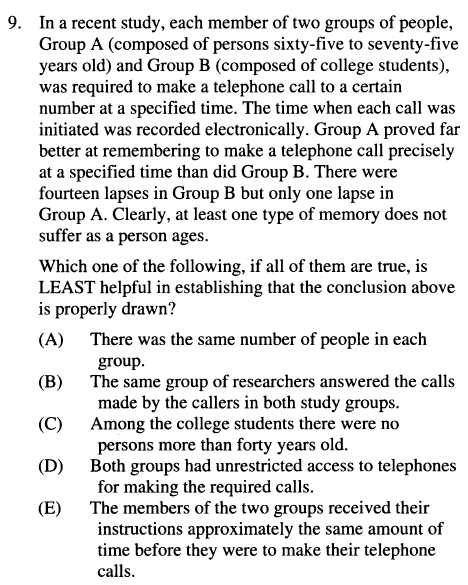
In a recent study, each member of two groups of people, Group A (composed of persons sixty-five to seventy-five years old) and Group B (composed of college students), was required to make a telephone call to a certain number at a specified time. The time when each call was initiated was recorded electronically. Group A proved far better at remembering to make a telephone call precisely at a specified time than did Group B. There were fourteen lapses in Group B but only one lapse in Group A. Clearly, at least one type of memory does not suffer as a person ages.
Which one of the following, if all of them are true, is LEAST helpful in establishing that the conclusion above is properly drawn?
(A) There was the same number of people in each group.
(B) The same group of researchers answered the calls made by the callers in both study groups.
(C) Among the college students there were no persons more than forty years old.
(D) Both groups had unrestricted access to telephones for making the required calls.
(E) The members of the two groups received their instructions approximately the same amount of time before they were to make their telephone calls.
LSAT CR 42 9.PNG [ 78.34 KiB | Viewed 10087 times ]
Which one of the following, if all of them are true, is LEAST helpful in establishing that the conclusion above is properly drawn?
(A) There was the same number of people in each group.
(B) The same group of researchers answered the calls made by the callers in both study groups.
(C) Among the college students there were no persons more than forty years old.
(D) Both groups had unrestricted access to telephones for making the required calls.
(E) The members of the two groups received their instructions approximately the same amount of time before they were to make their telephone calls.
Attachment:
LSAT CR 42 9.PNG [ 78.34 KiB | Viewed 10087 times ]


 21 Jul 2017, 18:57
Kudos
Bookmarks
The author's conclusion is that "at least one type of memory {i.e. the type required to remember to make a phone call at a certain time} does not suffer as a person ages. How does the author arrive at that conclusion?
Thus, it seems as though the members of Group A were better able to remember to make a phone call at a certain time. But what information would be useful in establishing whether that line of reasoning is accurate? Any statement that IS useful should be eliminated because we are looking for the statement that would be the LEAST useful:
Choice (B) is the best answer.
I hope that helps clear up some of the confusion!
- A recent study compared Group A (persons sixty-five to seventy-five years old) to Group B (college students).
- Each member of the two groups was asked to call a certain phone number at a certain time.
- "The time when each call was initiated was recorded electronically", allowing the scientists conducting the study to see whether the group members made the calls at the requested times.
- "Group A proved far better at remembering to make a telephone call precisely at a specified time than did Group B." In other words, members of Group A did a better job of making the phone calls at the specific times requested.
- How much better did Group A do compared to Group B? "There were 14 lapses in Group B but only one lapse in Group A."
Thus, it seems as though the members of Group A were better able to remember to make a phone call at a certain time. But what information would be useful in establishing whether that line of reasoning is accurate? Any statement that IS useful should be eliminated because we are looking for the statement that would be the LEAST useful:
Quote:
Yes, this would be useful to know. What if Group B had 1000 members but Group A only had 10? In that case, the difference in the number of lapses could be contributed to group size, not to a difference in memory between the two groups. Thus, (A) should be eliminated.
Quote:
All we need to know is whether the group members made their calls at the specific requested times. "The time when each call was initiated was recorded electronically," so it doesn't matter who answered the calls. (B) does NOT help us evaluate the argument or conclusion, so let's hang on to it.
Quote:
Remember, the conclusion is that "at least one type of memory does not suffer as a person ages." This conclusion is based on evidence comparing a group of college students to a group of persons sixty-five to seventy-five years old. This argument ASSUMES that the college students were much younger, but what if that was not the case? What if most of the college students participating in the study were actually older adults or even senior citizens over sixty-five years old? That would certainly harm the author's argument. Statement (C) WOULD be useful in evaluating the conclusion, so it should be eliminated.
Quote:
What if the college students (Group B) did not have unrestricted access to telephones while the members of Group A did have such access? In that case, the difference in the number of lapses could be contributed to telephone access, not to a difference in memory between the two groups. Thus, (D) would be helpful and should be eliminated.
Quote:
Again, this would provide an alternate reason to explain the difference in the number of lapses. If the college students in Group B were only give a very short amount of time and the members of Group A were given a lot of time, that might have given the members of Group A more time to prepare and make sure they would be ready to make the calls at the specified times. (E) would be helpful and should be eliminated.
Choice (B) is the best answer.
I hope that helps clear up some of the confusion!
General Discussion
RaguramanS
Joined: 17 Feb 2016
Last visit: 09 Feb 2018
Posts: 71
Given Kudos: 59
Location: India
Concentration: General Management, Entrepreneurship
Schools: Rutgers '18 ISB '18 Great Lakes '18 Sloan '18
GMAT 1: 660 Q47 V36
GPA: 3.12
WE:Education (Internet and New Media)
Products:
08 Jun 2017, 03:19
Kudos
Bookmarks
OE:
Premise:
As a person ages, his/her memory deteriorates. This is proved by evidencing the lapses in both groups. One memory doesn't have an effect on age.
Keyword:
The question stem is a little tricky. It is a strengthen question. So hunt for the additional information that can bolster the conclusion
POE
A.The correlation is between age and memory not numbers Wrong
B. This option intends to address the legitimacy of the research. This must be true. If different people answer the calls, then there might be other reason for the lapses. For example, the person attending the call might intentionally delay in answering the query. Correct
C. This is mere an inference. Wrong
D. This information does not address the correlation between the age and memory Wrong
E. This addresses that there is no delay in the starting time of the event. Irrelevant Wrong
Premise:
As a person ages, his/her memory deteriorates. This is proved by evidencing the lapses in both groups. One memory doesn't have an effect on age.
Keyword:
The question stem is a little tricky. It is a strengthen question. So hunt for the additional information that can bolster the conclusion
POE
A.The correlation is between age and memory not numbers Wrong
B. This option intends to address the legitimacy of the research. This must be true. If different people answer the calls, then there might be other reason for the lapses. For example, the person attending the call might intentionally delay in answering the query. Correct
C. This is mere an inference. Wrong
D. This information does not address the correlation between the age and memory Wrong
E. This addresses that there is no delay in the starting time of the event. Irrelevant Wrong






