Events & Promotions
| Last visit was: 20 Sep 2026, 18:10 |
It is currently 20 Sep 2026, 18:10 |
|
|

GMAT Club Daily Prep
Thank you for using the timer - this advanced tool can estimate your performance and suggest more practice questions. We have subscribed you to Daily Prep Questions via email.
Customized
for You
Track
Your Progress
Practice
Pays
Not interested in getting valuable practice questions and articles delivered to your email? No problem, unsubscribe here.
 Sep 18
10:00 AM IST
-11:00 PM IST
Start your journey with a fully customized action plan and work with a dedicated mentor to achieve a 735+ score. Sep 20
03:30 AM EDT
-04:30 AM EDT
Looking for your GMAT motivation to break through the score plateau? Pragati improved her score by massive 160 points with strategic guidance and hard-work! Find out how personalized mentorship and a strong mindset can turn GMAT struggles into success. Sep 21
07:00 PM EDT
-10:00 PM EDT
Boost your GMAT score in less than one month in a live online class + 6 months access to TTP OnDemand video courses included! Sep 23
12:30 AM EDT
-01:30 AM EDT
Learn how Keshav, a Chartered Accountant, scored an impressive 705 on GMAT in just 30 days with GMATWhiz's expert guidance. In this video, he shares preparation tips and strategies that worked for him, including the mock, time management, and more Sep 26
01:00 PM EDT
-04:00 PM EDT
Top scores are possible when you enroll in a powerful GMAT course, taught live online + 6 months access to TTP OnDemand video courses included. Class starts Saturdays Sept. 26, 2026 - Dec. 19, 2026, 1:00pm-4:00pm ES Sep 26
06:00 PM PDT
-07:00 PM PDT
Free- full-length test + 15 concept videos + 150+ short videos + study plan!

 Updated on: 28 Dec 2017, 10:20
Originally posted by AkshayKS21 on 16 Jun 2017, 05:31.
Last edited by broall on 28 Dec 2017, 10:20, edited 2 times in total.
Last edited by broall on 28 Dec 2017, 10:20, edited 2 times in total.
Reformatted question
Kudos
Bookmarks


C
Be sure to select an answer first to save it in the Error Log before revealing the correct answer (OA)!
Difficulty:
 45%
(medium)
45%
(medium)
Question Stats:
71% (01:59) correct 29%
(02:28)
wrong
based on 2912
sessions
29%
(02:28)
wrong
based on 2912
sessions
History
Date
Time
Result
Not Attempted Yet
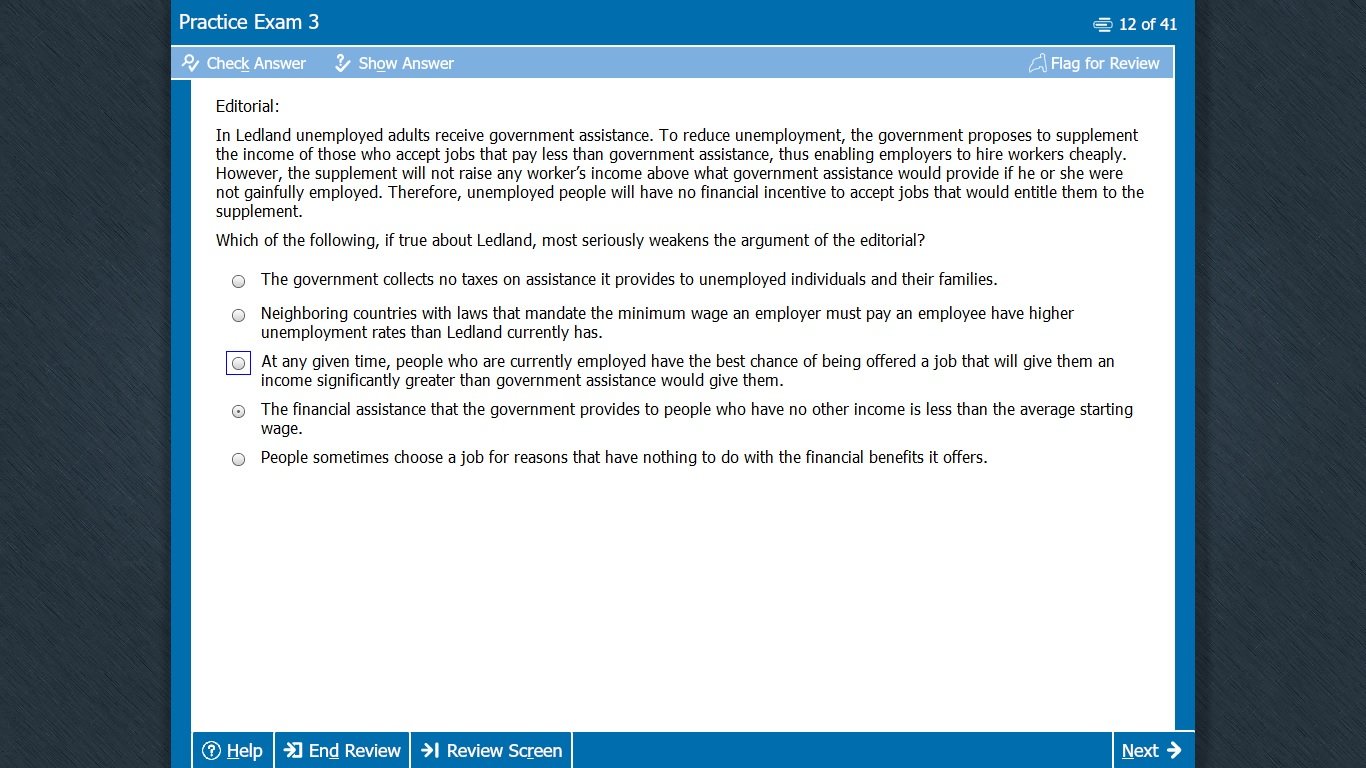
Editorial: In Ledland, unemployed adults receive government assistance. To reduce unemployment, the government proposes to supplement the income of those who accept jobs that pay less than government assistance, thus enabling employers to hire workers cheaply. However, the supplement will not raise any worker's income above what government assistance would provide if he or she were not gainfully employed. Therefore, unemployed people will have no financial incentive to accept jobs that would entitle them to the supplement.
Which of the following, if true about Ledland, most seriously weakens the argument of the editorial?
(A) The government collects no taxes on assistance it provides to unemployed individuals and their families.
(B) Neighboring countries with laws that mandate the minimum wage an employer must pay an employee have higher unemployment rates than Ledland currently has.
(C) At any given time, people who are currently employed have the best chance of being offered a job that will give them an income significantly greater than government assistance would give them.
(D) The financial assistance that the government provides to people who have no other income is less than the average starting wage.
(E) People sometimes choose a job for reasons that have nothing to do with the financial benefits it offers.
Same passage with different stem question: LINK
Which of the following, if true about Ledland, most seriously weakens the argument of the editorial?
(A) The government collects no taxes on assistance it provides to unemployed individuals and their families.
(B) Neighboring countries with laws that mandate the minimum wage an employer must pay an employee have higher unemployment rates than Ledland currently has.
(C) At any given time, people who are currently employed have the best chance of being offered a job that will give them an income significantly greater than government assistance would give them.
(D) The financial assistance that the government provides to people who have no other income is less than the average starting wage.
(E) People sometimes choose a job for reasons that have nothing to do with the financial benefits it offers.
Same passage with different stem question: LINK
I faced this question in GMATPrep Exam 3, but the answer choices were quite different from what stated here.
Attached is image for reference.
Needless to say, I got it wrong
LedlandUnemployed.jpg [ 293.07 KiB | Viewed 27075 times ]
Attached is image for reference.
Needless to say, I got it wrong
Attachment:
LedlandUnemployed.jpg [ 293.07 KiB | Viewed 27075 times ]
Solving this question helps.
Taking a timed set of similar questions in
GMAT Club Forum Quiz →
is even better.

 10 May 2019, 12:49
Kudos
Bookmarks
AkshayKS21
In this argument, we draw the conclusion that "unemployed people will have no financial incentive to accept jobs that would entitle them to the supplement" basically because according to the argument - the incentive would be a wash - as it would make up for any amount below unemployment - but nothing beyond that point. So, individuals wouldn't be financially incentivized to take on jobs that would (after the supplement) pay the same amount as unemployment.
Answer choice (C) gives us a reason the incentive may be helpful despite this - as it would allow individuals to take on lower-paying jobs in hopes of advancing to higher paying jobs, without risking taking on a job that pays below the unemployment level. So, despite not bringing the individuals to a higher pay level than unemployment - it puts them in a position to obtain a higher paying job without the disadvantage of a lower-than-unemployment job in the meantime. This provides a financial incentive to said individuals.
Answer choice (D) on the other hand, doesn't matter to us, since it is irrelevant to those who would earn above the unemployment assistance level, and for those who earn below that level - it is a wash (as mentioned above). So, it doesn't weaken the conclusion that "unemployed people will have no financial incentive to accept jobs that would entitle them to the supplement" - since to do so, we need a reason unemployed people might have some financial incentive to accept jobs that would entitle them to the supplement. (C) gives this to us, while (D) does not.
I hope this helps!
 22 Nov 2017, 05:04
Kudos
Bookmarks
GMATNinja
Please review my reasoning for eliminating option D:
Let's assign numbers to the scenario mentioned in the argument:
1. Current income of unemployed adults: $0
2. Government assistance provided to unemployed adults: $100
3. Salary of Jobs below the government supplement: $60
5. New Government assistance: $40
Option D : The financial assistance that the government provides ($40) to people who have no other income is less than the average starting wage ($60).
SO WHAT ? The sum total of what the unemployed people get under the new scheme is still $100. It strengthens the conclusion of the argument that THERE IS NO FINANCIAL INCENTIVE BECAUSE THE PEOPLE STILL GET $100 in total
Hence, we can eliminate option D
Please review my reasoning for eliminating option D:
Let's assign numbers to the scenario mentioned in the argument:
1. Current income of unemployed adults: $0
2. Government assistance provided to unemployed adults: $100
3. Salary of Jobs below the government supplement: $60
5. New Government assistance: $40
Option D : The financial assistance that the government provides ($40) to people who have no other income is less than the average starting wage ($60).
SO WHAT ? The sum total of what the unemployed people get under the new scheme is still $100. It strengthens the conclusion of the argument that THERE IS NO FINANCIAL INCENTIVE BECAUSE THE PEOPLE STILL GET $100 in total
Hence, we can eliminate option D
General Discussion

aceGMAT21

Joined: 19 Aug 2017
Last visit: 01 May 2020
Posts: 80
Given Kudos: 90
Status:Aiming MBA!!
Location: India
Schools: Rotman '20 Fisher '20 Kelley '20 NUS '20 ISB '19 Imperial '20
GMAT 1: 620 Q49 V25
GPA: 3.75
WE:Web Development (Consulting)
Products:
Schools: Rotman '20 Fisher '20 Kelley '20 NUS '20 ISB '19 Imperial '20
GMAT 1: 620 Q49 V25
Posts: 80
21 Nov 2017, 23:10
Kudos
Bookmarks
the conclusion -- unemployed people will have no financial incentive to accept jobs that would entitle them to the supplement.
(D) The financial assistance that the government provides to people who have no other income is less than the average starting wage.
As per my understanding, option D also weakens somewhat, but C is the better one. As we are looking for the best option out of the five. My reasoning for option D,
If the government provides financial assistance which is less than the average starting wage to people with no other source of income, then such people would be more interested in doing the job rather than relying on the financial assistance itself. Also, if you notice carefully, the conclusion is about the UNEMPLOYED PEOPLE but we do not know whether they have some other source of income or not. Unemployment does not mean that THEY WILL definitely does not have the other sources of INCOME AS WELL. So, if the unemployed people are not having the other sources of income as well, then the conclusion is strongly weakened. But if the unemployed people are having some other sources of income, then the starting wage may not seem lucrative to such people even if it is more than the financial assistance. So, option C is the clear winner.
GMATNinja, can you please review my reasoning for option D, the one mentioned in the GMATPrep snapshot just above my post and not the one in the existing post on the GMATClub.
Thanks.
-aceGMAT21.
(D) The financial assistance that the government provides to people who have no other income is less than the average starting wage.
As per my understanding, option D also weakens somewhat, but C is the better one. As we are looking for the best option out of the five. My reasoning for option D,
If the government provides financial assistance which is less than the average starting wage to people with no other source of income, then such people would be more interested in doing the job rather than relying on the financial assistance itself. Also, if you notice carefully, the conclusion is about the UNEMPLOYED PEOPLE but we do not know whether they have some other source of income or not. Unemployment does not mean that THEY WILL definitely does not have the other sources of INCOME AS WELL. So, if the unemployed people are not having the other sources of income as well, then the conclusion is strongly weakened. But if the unemployed people are having some other sources of income, then the starting wage may not seem lucrative to such people even if it is more than the financial assistance. So, option C is the clear winner.
GMATNinja, can you please review my reasoning for option D, the one mentioned in the GMATPrep snapshot just above my post and not the one in the existing post on the GMATClub.
Thanks.
-aceGMAT21.





