Events & Promotions
|
|

GMAT Club Daily Prep
Thank you for using the timer - this advanced tool can estimate your performance and suggest more practice questions. We have subscribed you to Daily Prep Questions via email.
Customized
for You
Track
Your Progress
Practice
Pays
Not interested in getting valuable practice questions and articles delivered to your email? No problem, unsubscribe here.
 Aug 26
10:00 AM EDT
-11:59 PM EDT
Save up to $1,000 on select GMAT prep now. This Fall, achieve your most ambitious goals with millions of student success stories behind you. Aug 27
10:00 AM EDT
-11:00 AM EDT
We’ve worked incredibly hard to build TTP into the best test prep experience possible, and it would mean a lot to us to win Newsweek’s 2026 Readers’ Choice Award for Best Test Prep. If TTP has helped you, we’d be incredibly grateful for your vote. Sep 06
09:30 AM EDT
-12:30 PM EST
Top scores are possible when you enroll in a powerful EA course, taught live online + 6 months access to TTP OnDemand video courses included! Perfect class schedule and easy course access for working professionals. Class starts Sept. 6, 9:30am-12:30pm EST Sep 09
07:00 AM PDT
-10:00 AM PDT
Meet AdComs and explore top Master’s programs - MiM, MiF, MSc, MSBA and more. - Application Fee Waivers - Free 1-Week of GMAT Club Tests: - Master's Application Toolkit - Grand Prize Giveaway Sep 15
07:00 PM EDT
-09:00 PM EST
Elite scores are possible when you enroll in a powerful GMAT course, taught live online + 6 months access to TTP OnDemand video courses included! Class starts Tues/Thurs Sept. 15, 2026 - Nov. 15, 2027, 7:00pm-9:00pm EST Sep 21
08:00 PM EDT
-10:00 PM EDT
Elite scores are possible when you enroll in a powerful GMAT course, taught live online + 6 months access to TTP OnDemand video courses included! Class starts Tues/Thurs Oct. 13, 2026 - Jan. 7, 2027, 8:00pm-10:00pm EST


 Updated on: 06 Jul 2023, 01:48
Originally posted by PeachSnapple1 on 09 Jun 2023, 06:58.
Last edited by bb on 06 Jul 2023, 01:48, edited 8 times in total.
Last edited by bb on 06 Jul 2023, 01:48, edited 8 times in total.
Kudos
Bookmarks
This is my second and final part of my journey.
First part:
https://gmatclub.com/forum/my-gmat-jour ... l#p3041886
Dear my GMAT fellows, I have finally made it to the 700+ club. This should be a much shorter version than my first debrief last year.
Recap:
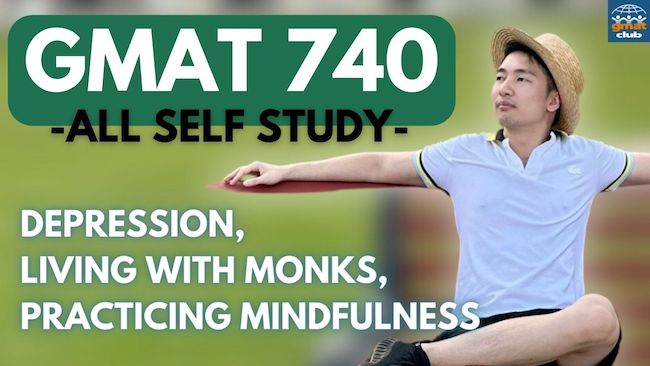
After failing miserably at my first two GMAT attempts last year (April and July of 2022) and having to deal with personal trauma (all details in part 1), I had decided to give up the GMAT altogether, as well as the business school dream, because I was unstable, physically and emotionally. I abandoned my city and have been living on the mountain side with the monks for almost a year now. During the seven months at the temple (July of 2022 to February of 2023), I was not in contact with the modern world, so that means no English. I learned how to grieve, but most importantly, how to be mindful. This factor, in my opinion, has played at least as an important part, if not more, as studying so as to help me achieving my 740. By March of 2023, I decided to give the GMAT my final shot (I will explain the reasons if some are interested). By March of 2023, I had forgot most of my GMAT knowledge. However, what I lack in the GMAT knowledge, I make up with my mindfulness mindset, which plays a crucial role later on.
Mindset:
I decided to not register until I knew I was ready. I think this is a very important decision. There is no point in signing up for the test unless you are ready. It's not like you have to wait for several months before you can register anyway; in my country, as I am sure in most others, there is availability within 2-3 days.
I know that there are a lot of advice on the technicality of studying itself, i.e., how to do SC, CR and RC, what materials to use, etc. But if I have to pick one factor that has the biggest influence on my time of studying, I will say having the right mindset. I know right, the 'right mindset'. But what does that actually mean? I mean being mindful - listen to your brain and your heart during your prep and during the real deal, do not rush the study, and most importantly, do not be scared of failure of self-judgement (questions such as what if I do not get my dream score, what if I cannot be in time to apply this year). It is important to note that you should not avoid those feelings, but rather face them head on and learn that they are an integrated into your life. Once you learn how to accept those feelings, you will be able to control your thoughts and emotions, and thus will, and can, conquer many things, not only the GMAT.
I know that my case is atypical, because I had all the time in the world to self-reflect and contemplate, and that not many people can relate, especially when they have work and family. But I promise you, if you can just spend some times to be with yourself and process those fear - because if you do not, those feelings of uncertainty may get to you during the real deal - you will know that I am right.
Materials:
I decided to self study, because I believe that self-studying is the best way to learn about myself, but don't do this if you don't have a lot of time.
Mentality:
Remember that, if you consider the GMAT something bigger than it is, the anxiety will crush you during exam. Remember when I mention letting go the fear of failure? Consider the GMAT a game, a puzzle to solve, a chance to show off your hard work. You have been prepared for this battle meticulously, you know what your potential is, you already know how the test gonna test you, so what is there to fear? You even practice harder than the real exam. Even in the worst case scenario, so what if you are a little short of your desired score? Then think of it as one more opportunity to prove yourself. Because let's face it, you not gonna study for the GMAT for your whole life, so enjoy it while it lasts.
My Records:
March 1st, 2023 - April 14: start binging videos. During the early of my journey, I could only watch 2-3 hours before my brain stopped registering information. But then I got used to it, to a point where I could spend 5-6 hours studying. Remember to unwind too, I did not study every day - sometimes I went sightseeing the mountainside, or just doing temple chores.
April 15: relax. You can spend more time if you need, but do not take too long that you lose the momentum.
April 16: OG 1: 780 (50Q/47V). The only problem I encountered is time on Verbal, but not too serious.
April 17 - June 2: Verbal Review and Advanced Question. Do every single one and review every single one.
June 3: break
June 4: OG 2: 760 (50Q/44V). Did it comfortably, with 15 minutes to spare on Quant and 2 minutes to spare on Verbal.
June 5: break
June 6: real exam - 740 (50Q/40V/6 AWA/8 IR). Did this very comfortably, with 15 mins to spare on Quant and 10 mins to spare on Verbal.
P/S:
I know that I can do better, probably can get to 760 comfortably, but I think I will stop here for now. Now, some of you might think that my debrief is just another one of those rare success stories in which people get such a high score in such a short amount of time and that I did not struggle. I did, and I could not remember how many times I felt demotivating. One of the things that kept me going is the certain knowing that the GMAT is not the hardest thing in the world; sure, it is challenging, but I am sure studying for the GMAT is much less terrifying than the process of applying, studying at business school, and looking for jobs. Bare in mind that while I was doing this in the time of three months, I was living with the monks and had way more time to study. One with a full-time job can follow these steps comfortably in a span of approximately 5 months, at most.
Giveaway:
I owe it to this amazing community, and I want to give some of this back. I will pick any of the first 8 fellows who are currently struggling to cross that 700 mark, or even want to get to 750 to give my tips to my best of my ability. If you are struggling and need help (trust me, I know how it felt to be stuck at one place for several months), comment below, or DM, what is your GMAT background - when did you start, what have you done, how have you studied, what is your goal, what area do you stuck, etc. I will try to reply to all of them, and if we have many dedicated people, we can schedule a video call so that we can help each other out. Pardon my grammar, there will be some typos here and there.
First part:
https://gmatclub.com/forum/my-gmat-jour ... l#p3041886
Dear my GMAT fellows, I have finally made it to the 700+ club. This should be a much shorter version than my first debrief last year.
Recap:
After failing miserably at my first two GMAT attempts last year (April and July of 2022) and having to deal with personal trauma (all details in part 1), I had decided to give up the GMAT altogether, as well as the business school dream, because I was unstable, physically and emotionally. I abandoned my city and have been living on the mountain side with the monks for almost a year now. During the seven months at the temple (July of 2022 to February of 2023), I was not in contact with the modern world, so that means no English. I learned how to grieve, but most importantly, how to be mindful. This factor, in my opinion, has played at least as an important part, if not more, as studying so as to help me achieving my 740. By March of 2023, I decided to give the GMAT my final shot (I will explain the reasons if some are interested). By March of 2023, I had forgot most of my GMAT knowledge. However, what I lack in the GMAT knowledge, I make up with my mindfulness mindset, which plays a crucial role later on.
Mindset:
I decided to not register until I knew I was ready. I think this is a very important decision. There is no point in signing up for the test unless you are ready. It's not like you have to wait for several months before you can register anyway; in my country, as I am sure in most others, there is availability within 2-3 days.
I know that there are a lot of advice on the technicality of studying itself, i.e., how to do SC, CR and RC, what materials to use, etc. But if I have to pick one factor that has the biggest influence on my time of studying, I will say having the right mindset. I know right, the 'right mindset'. But what does that actually mean? I mean being mindful - listen to your brain and your heart during your prep and during the real deal, do not rush the study, and most importantly, do not be scared of failure of self-judgement (questions such as what if I do not get my dream score, what if I cannot be in time to apply this year). It is important to note that you should not avoid those feelings, but rather face them head on and learn that they are an integrated into your life. Once you learn how to accept those feelings, you will be able to control your thoughts and emotions, and thus will, and can, conquer many things, not only the GMAT.
I know that my case is atypical, because I had all the time in the world to self-reflect and contemplate, and that not many people can relate, especially when they have work and family. But I promise you, if you can just spend some times to be with yourself and process those fear - because if you do not, those feelings of uncertainty may get to you during the real deal - you will know that I am right.
Materials:
I decided to self study, because I believe that self-studying is the best way to learn about myself, but don't do this if you don't have a lot of time.
- Foundation:
- All Thursday with Ron videos: I only watch Verbal. You can find his full series on YouTube. Very well-rounded quality. By learning this alone, I get from V27 to around V37-38. Watch at your own pace and do not rush. Ron said it himself, he has dyslexia and is a slow reader, so his method of reasoning is very easy to follow. You can even just need this series for all of your verbal if you do not have a lot of time to prep. Ron has a strong side in RC and SC, especially in RC.
- GMAT Ninja series on the GMAT Club. The Gmatclub YouTube channel has its own playlist of GMAT Ninja. No need to watch all of the other verbal videos on the Gmatclub because there a lot of them, unless you have the time. Charles has a different method of explaining and thinking than that of Ron, but both Charles and Ron compliment each other. Charles has a strong side in CR and SC; his SC approach is effective.
- All GMAT Ninja video on their own channel. Less in-depth than the above two series. You should use this only to review what you learn. OPTIONAL.
Honestly, if you want a V38-39, or even a V40, those three series are more than enough. Even if you want a V40 - V45, there is not much more you can do other than just thinking deeper and analyzing your past mistakes. If you can invest the time into those series, I guarantee that you have a very solid foundation. - Practice questions:
- - OG Test 1 to test your foundation. Should get around 700 after watching those series. You should only do the OG Test 1 after finishing the aforementioned series. Do not 'cold test' because that is a waste of time and of material.
- Verbal Review 2022. Very closely resembling the real exam.
- Advanced Questions. Very good to drill when you have a very solid foundation. Remember that do not get demoralizing when you get into some very difficult questions, which account for 75% of the questions, because they are mostly at the V43+ anyway. Rather, you should focus on getting easy and medium right and understand, not only why the correct answer is right, but also why the other four are wrong. Even if you can only nail 65% of these bad boys, you can get a 720+.
- OG Test 2: pretty much after you are done with this you can sign up for your real deal as soon as possible, preferable the day after you finish the OG test 2. If you have been honest with yourself the whole process and not ego-studying, your real score is pretty much within 20 scores. Why being nervous when you know what you can do, right? You have shown proof in your solid practice questions, and you have nothing to fear.
Remember that you have to study only the OG questions on verbal, and you only move on to the next one once you understand that why the four wrong answers are not even close to being correct. If it takes you an hour for even one question, do it. It is time well spent. In case some of the questions are too hard, skip them and come back later
Mentality:
Remember that, if you consider the GMAT something bigger than it is, the anxiety will crush you during exam. Remember when I mention letting go the fear of failure? Consider the GMAT a game, a puzzle to solve, a chance to show off your hard work. You have been prepared for this battle meticulously, you know what your potential is, you already know how the test gonna test you, so what is there to fear? You even practice harder than the real exam. Even in the worst case scenario, so what if you are a little short of your desired score? Then think of it as one more opportunity to prove yourself. Because let's face it, you not gonna study for the GMAT for your whole life, so enjoy it while it lasts.
My Records:
March 1st, 2023 - April 14: start binging videos. During the early of my journey, I could only watch 2-3 hours before my brain stopped registering information. But then I got used to it, to a point where I could spend 5-6 hours studying. Remember to unwind too, I did not study every day - sometimes I went sightseeing the mountainside, or just doing temple chores.
April 15: relax. You can spend more time if you need, but do not take too long that you lose the momentum.
April 16: OG 1: 780 (50Q/47V). The only problem I encountered is time on Verbal, but not too serious.
April 17 - June 2: Verbal Review and Advanced Question. Do every single one and review every single one.
June 3: break
June 4: OG 2: 760 (50Q/44V). Did it comfortably, with 15 minutes to spare on Quant and 2 minutes to spare on Verbal.
June 5: break
June 6: real exam - 740 (50Q/40V/6 AWA/8 IR). Did this very comfortably, with 15 mins to spare on Quant and 10 mins to spare on Verbal.
P/S:
I know that I can do better, probably can get to 760 comfortably, but I think I will stop here for now. Now, some of you might think that my debrief is just another one of those rare success stories in which people get such a high score in such a short amount of time and that I did not struggle. I did, and I could not remember how many times I felt demotivating. One of the things that kept me going is the certain knowing that the GMAT is not the hardest thing in the world; sure, it is challenging, but I am sure studying for the GMAT is much less terrifying than the process of applying, studying at business school, and looking for jobs. Bare in mind that while I was doing this in the time of three months, I was living with the monks and had way more time to study. One with a full-time job can follow these steps comfortably in a span of approximately 5 months, at most.
Giveaway:
I owe it to this amazing community, and I want to give some of this back. I will pick any of the first 8 fellows who are currently struggling to cross that 700 mark, or even want to get to 750 to give my tips to my best of my ability. If you are struggling and need help (trust me, I know how it felt to be stuck at one place for several months), comment below, or DM, what is your GMAT background - when did you start, what have you done, how have you studied, what is your goal, what area do you stuck, etc. I will try to reply to all of them, and if we have many dedicated people, we can schedule a video call so that we can help each other out. Pardon my grammar, there will be some typos here and there.
 Updated on: 09 Jun 2023, 08:11
Originally posted by GmatKnightTutor on 09 Jun 2023, 07:52.
Last edited by GmatKnightTutor on 09 Jun 2023, 08:11, edited 1 time in total.
Last edited by GmatKnightTutor on 09 Jun 2023, 08:11, edited 1 time in total.
Kudos
Bookmarks
Gratz on the 740. All the best going forward.
-contact: gmatknight site | instagram
-contact: gmatknight site | instagram
 09 Jun 2023, 08:04
Kudos
Bookmarks
Congratulations! Much needed motivation when i have been trying to touch that 700 mark for two years straight
Posted from my mobile device
Posted from my mobile device